Halloysite Market Size & Growth Forecast 2027–2036, By Segments (Application), Regional Demand Trends (North America, Asia Pacific, Europe), Key Country Insights (U.S., Japan, South Korea, Germany, France, Italy), and Competitive Landscape
Jump to content
Market Size and Growth Outlook
Halloysite Market size was valued at USD 51 million in 2026 and is anticipated to grow at a 5.23% CAGR from 2027 to 2036, crossing USD 84.91 million by 2036. The industry revenue for 2027 is assessed at USD 53.24 million.
Get more details on this report
Request Free Sample ReportHalloysite Market Intelligence Snapshot
Regional Market Dynamics
- Europe held a 37.74% market share in 2026, supported by mature supply chains, experienced manufacturers, and consistent industrial demand for dependable specialty mineral materials.
- North America is projected to grow at a 6.33% CAGR as manufacturers increase adoption of halloysite in higher-value industrial applications and expand commercialization of specialty material solutions.
Segment Momentum
- Medical accounted for 51.62% of the halloysite market in 2026 because demand is driven by applications requiring controlled material performance and specialized functional characteristics, supporting both market leadership and continued growth.
- The Medical segment is growing fastest as healthcare applications increasingly require materials that meet specialized formulation and performance needs, strengthening adoption of halloysite in advanced medical products.
Market Expansion Drivers
- Rising demand from ceramics and construction expanding halloysite consumption.
- Growing adoption in medical and cosmetic nanomaterial applications.
- Strategic mineral scarcity driving exploration and alternative clay sourcing initiatives.
Leading Market Participants
- Prominent players in the halloysite market include Imerys S.A. (France), Sibelco Group (Belgium), KaMin LLC (USA), Thiele Kaolin Company (USA), Applied Minerals Inc. (USA), I-Minerals Inc. (Canada), Northstar Clay Mines LLC (USA), Sedlecký Kaolin a.s. (Czech Republic), Eczacıbaşı Esan (Turkey), Active Minerals International LLC (USA).
Global Market Forecast Snapshot
Market Outlook
- 2026 Market Size: USD 51 million
- 2027 Estimated Market Size: USD 53.24 million.
- Projected Market Size: USD 84.91 million by 2036
- Growth Forecast: 5.23% CAGR (2027-2036)
Regional and Segment Outlook
- Leading Regional Market: Europe
- High-Growth Regional Hub: North America
- Core Revenue Segment: Medical (Application)
- Emerging Opportunity Segment: Medical (Application)
Market Growth Drivers and Industry Trends
Rising demand from ceramics and construction expanding halloysite consumption
Increasing activity in ceramics and construction is creating additional applications for specialized clay minerals, supporting the halloysite market through demand for materials with useful structural, thermal, and functional characteristics. Halloysite can contribute to ceramic formulations and other mineral-based products where properties such as morphology, stability, and compatibility with processing requirements are important. In construction-related applications, clay-based materials remain relevant across products and processes that require mineral inputs with controlled characteristics. Expanding construction activity, renovation projects, and ceramic manufacturing can therefore increase interest in dependable sources of halloysite, particularly where producers are seeking mineral materials that can support product performance and formulation requirements. Its distinctive tubular structure also differentiates it from conventional clay materials for selected industrial applications.
Growing adoption in medical and cosmetic nanomaterial applications
The distinctive nanotubular structure and surface characteristics of halloysite are expanding its relevance beyond traditional mineral applications, particularly in specialized medical and cosmetic nanomaterial development. The halloysite market is gaining attention from researchers and manufacturers exploring the material as a functional carrier and additive because its naturally occurring tubular morphology can provide opportunities for loading, controlled release, surface modification, and interaction with other substances. In medical applications, these characteristics can support investigation into delivery systems and advanced biomaterial formulations, while cosmetic developers can explore halloysite-based structures for specialized formulations and functional ingredients. Continued development of nanotechnology and increasing interest in naturally derived nanomaterials are broadening the range of potential applications, encouraging further processing and formulation research around halloysite.
Strategic mineral scarcity driving exploration and alternative clay sourcing initiatives
Concerns surrounding the availability and supply stability of specialized minerals are encouraging producers and downstream users to explore alternative clay resources, strengthening the halloysite market through greater attention to resource development. Halloysite deposits are not uniformly distributed, and differences in mineral quality, geological occurrence, and extraction conditions can influence the reliability of supply for industrial users. As manufacturers seek to reduce exposure to supply disruptions and secure consistent raw-material inputs, exploration activities can focus on identifying new deposits and evaluating previously underutilized clay resources. At the same time, advances in mineral characterization and processing can improve the ability to assess deposits for specialized applications, supporting efforts to diversify sourcing and establish more resilient supply channels for halloysite-based materials.
| Growth Driver | Impact on CAGR | Regulatory Influence | Geographic Relevance | Adoption Rate | Impact Timeline |
|---|---|---|---|---|---|
| Rising demand from ceramics and construction expanding halloysite consumption | 2.00% | Low | Asia Pacific, North America | High | Mid Term |
| Growing adoption in medical and cosmetic nanomaterial applications | 1.70% | Moderate | Europe, North America | Medium | Mid Term |
| Strategic mineral scarcity driving exploration and alternative clay sourcing initiatives | 1.40% | Moderate | North America, Asia Pacific | Emerging | Long Term |
Unlock insights tailored to your business with our bespoke market research solutions.
Click to get your customized report now.
Regional Demand Dynamics
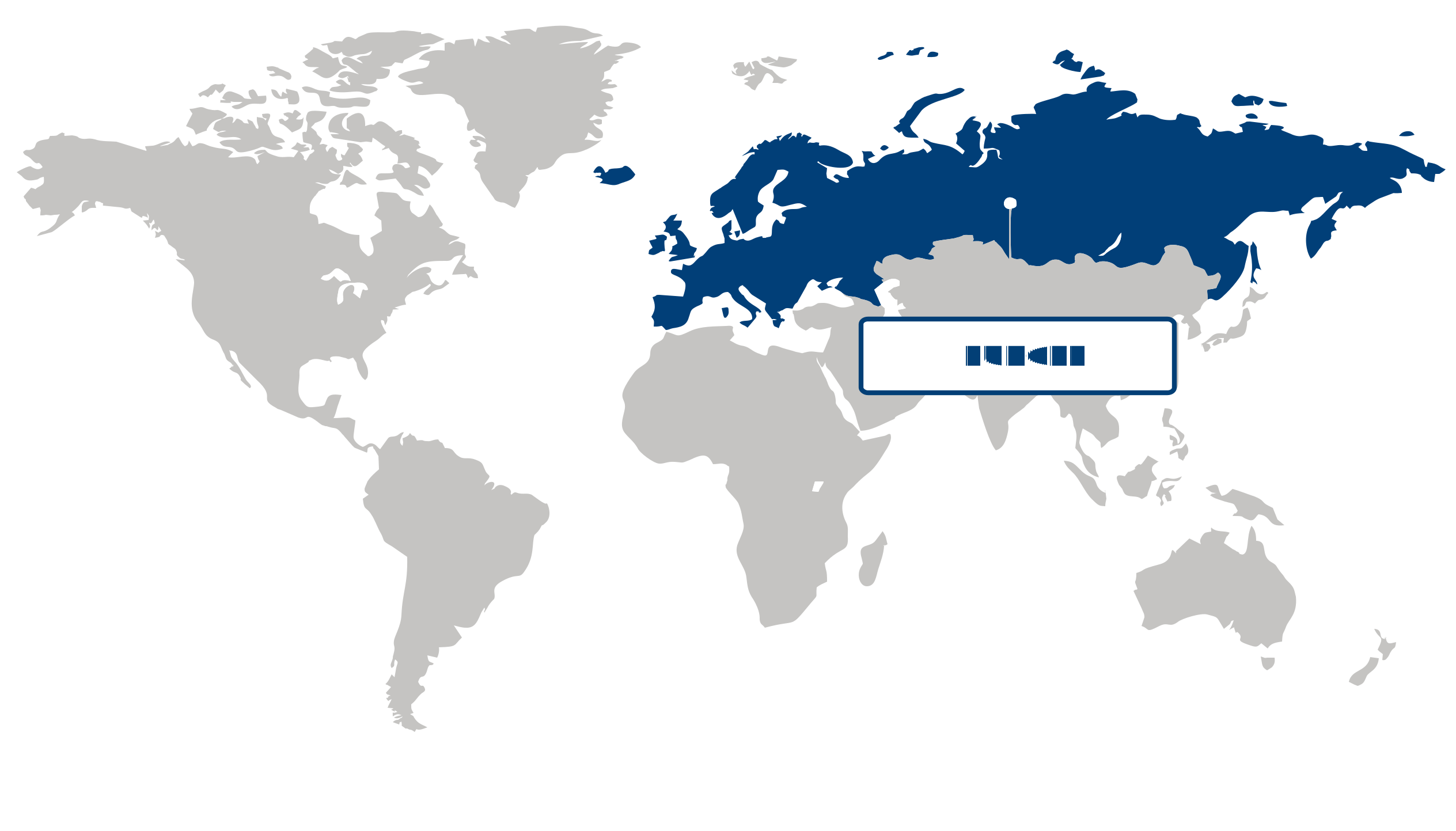
Europe (Largest Region)
Europe held the largest share of the halloysite market at 37.74% in 2026, supported by established mineral-processing capabilities and demand for specialized functional materials across industrial and advanced-material applications. Halloysite's distinctive tubular structure and surface properties make it relevant to areas such as nanocomposites, coatings, ceramics, adsorption, and controlled-release technologies. European research and manufacturing ecosystems are supporting efforts to develop higher-value applications for naturally occurring minerals, while growing interest in sustainable and multifunctional materials is creating additional opportunities. Demand is also reinforced by industries seeking materials that can improve product performance without requiring entirely synthetic alternatives, particularly in applications where surface modification and controlled material delivery are important.
North America (Fastest-Growing Region)
North America is the fastest-growing regional market as research activity and industrial interest in advanced mineral-based materials continue to expand. Halloysite's potential for use as a functional additive, carrier material, and reinforcement is attracting attention across specialized applications involving polymers, coatings, environmental technologies, and healthcare-related materials. The region's strong innovation ecosystem supports development of customized halloysite-based formulations and processing techniques, while demand for sustainable material solutions is encouraging exploration of naturally derived alternatives. Increasing collaboration between material researchers and industrial users is also helping move halloysite from conventional mineral applications toward higher-value technologies, creating favorable conditions for regional market expansion.
| Parameter | North America | Asia Pacific | Europe | Latin America | MEA |
|---|---|---|---|---|---|
| Innovation HubiScaleNascentDeveloping Advanced | |||||
| Cost-Sensitive RegioniScaleLowMedium High | |||||
| Regulatory EnvironmentiScaleRestrictiveNeutral Supportive | |||||
| Demand DriversiScaleWeakModerate Strong | |||||
| Development StageiScaleEmergingDeveloping Developed | |||||
| Adoption RateiScaleLowMedium High | |||||
| New Entrants / StartupsiScaleSparseModerate Dense | |||||
| Macro IndicatorsiScaleWeakStable Strong |
Key Country Insights
Germany 🇩🇪
Functional Additive InnovationGermany is utilizing halloysite as a performance-enhancing additive in advanced manufacturing and specialty materials. Industrial users focus on improving composite performance, material durability, and sustainable product development through engineered mineral applications.
France 🇫🇷
Sustainable Material SolutionsFrance is encouraging halloysite adoption in environmentally conscious material development and specialty manufacturing. Producers are assessing its potential to improve product performance while supporting lower environmental impact across multiple industrial sectors.
Italy 🇮🇹
Industrial Mineral ApplicationsItaly is expanding the use of halloysite in ceramics, construction materials, and industrial compounds requiring enhanced performance characteristics. Manufacturers are emphasizing reliable supply and application-specific processing to improve product differentiation.
Japan 🇯🇵
Specialty Formulation FocusJapan is integrating halloysite into high-value formulations for cosmetics, ceramics, and advanced material applications. Manufacturers prioritize consistent mineral quality and tailored processing characteristics to support precision manufacturing requirements.
South Korea 🇰🇷
Nanomaterial ApplicationsSouth Korea is exploring halloysite for nanotechnology, polymer modification, and functional coatings. Research-driven commercialization is encouraging manufacturers to evaluate halloysite for lightweight materials and high-performance industrial products.
United States 🇺🇸
Advanced Materials DevelopmentThe U.S. is expanding halloysite applications across polymers, coatings, healthcare, and environmental technologies. Companies are investing in value-added formulations that leverage halloysite's reinforcement and controlled-release properties for specialized industrial applications.
Halloysite Market Share (%), by Application, 2026
Go beyond the chart, access full insights & data tables
Request Free Sample ReportApplication Segment Analysis: Medical (Largest & Fastest-Growing Segment)
The medical segment led the halloysite market with the largest share of 51.62% in 2026 and is also the fastest-growing application segment, reflecting the material's expanding relevance in advanced healthcare applications. Halloysite's distinctive tubular structure, biocompatibility, and capacity to encapsulate and deliver active substances make it valuable for controlled drug delivery and other biomedical uses. Its ability to support sustained release while protecting incorporated compounds is increasing interest in pharmaceutical and medical formulations. Ongoing development of nanostructured delivery systems and growing demand for more targeted therapeutic approaches further strengthen the medical segment's position and growth potential.
| Segment | Sub-Segment | Largest Segment | Fastest Growing |
|---|---|---|---|
| Application | Medical, Cosmetics, Ceramics, Polymers, Cement, Paints, Others | Medical | Medical |
Competitive Landscape and Market Positioning
Leading companies in the halloysite market:
1. Imerys S.A. (France)
2. Sibelco Group (Belgium)
3. KaMin LLC (USA)
4. Thiele Kaolin Company (USA)
5. Applied Minerals Inc. (USA)
6. I-Minerals Inc. (Canada)
7. Northstar Clay Mines LLC (USA)
8. Sedlecký Kaolin a.s. (Czech Republic)
9. Eczacıbaşı Esan (Turkey)
10. Active Minerals International LLC (USA)
The halloysite market is gradually evolving as demand rises for high-performance mineral-based materials across advanced industrial applications. Ongoing experimentation with nanostructured forms is widening its usability in ceramics, coatings, and specialty composites. The halloysite market is also witnessing broader adoption driven by material optimization efforts that improve functional performance and unlock new application areas in emerging technologies.
| Company | Market Share | Company Revenue | Revenue CAGR (%) | Product Portfolio | Geographic Presence | Innovation / R&D Focus | Strategic Developments |
|---|---|---|---|---|---|---|---|
| Imerys S.A. (France) | |||||||
| Sibelco Group (Belgium) | |||||||
| KaMin LLC (USA) | |||||||
| Thiele Kaolin Company (USA) | |||||||
| Applied Minerals Inc. (USA) | |||||||
| I-Minerals Inc. (Canada) | |||||||
| Northstar Clay Mines LLC (USA) | |||||||
| Sedlecký Kaolin a.s. (Czech Republic) | |||||||
| Eczacıbaşı Esan (Turkey) | |||||||
| Active Minerals International LLC (USA). |
Industry Development / News
| Company Name | Date | Key Development |
|---|---|---|
| Ionic Mineral Technologies | Mar-25 | Ionic Mineral Technologies is advancing the Silicon Ridge project in Utah County, featuring an IAC-Plus halloysite-based deposit confirmed by ALS Chemex. The development establishes a domestic U.S. source of halloysite-associated critical minerals, including rare earth elements, strengthening supply security and positioning the asset as an alternative to concentrated global sourcing regions. |
| Applied Minerals | Feb-23 | Applied Minerals secured a purchase order for 40,000 lbs of its DRAGONITE halloysite clay, targeted for use in flame retardants and coatings applications. The order reflects continued commercial utilization of high-purity halloysite products in industrial materials markets, supporting ongoing demand in specialty additives and functional performance applications. |
| Ionic Mineral Technologies | Sep-22 | Ionic Mineral Technologies introduced Ionisil, a nano-silicon material derived from halloysite positioned as a substitute for graphite in lithium-based batteries. The development expands halloysite’s application into advanced battery materials, with potential implications for electric vehicle performance through improved energy density and charging efficiency in lithium-ion systems. |
Customize Your Report
Explore examples of how this report can be tailored to different research needs, including custom segments, additional topics or chapters, and related reports. Click a section of the wheel or its numbered marker to explore the available options.
Halloysite Market — Custom Segments
| Segment | Sub-Segment |
|---|---|
| Purity Level | Standard-Grade Halloysite, High-Purity Halloysite, Ultra-High-Purity Halloysite |
| Modification Type | Unmodified Halloysite, Surface-Modified Halloysite, Functionalized Halloysite, Intercalated Halloysite |
| Processing Method | Beneficiation & Purification, Surface Treatment, Functionalization, Encapsulation & Loading |
Halloysite Market — Custom TOC
| Custom Chapter | Chapter Details |
|---|---|
| High-Value Application Opportunity Assessment |
|
| Sustainable Nanomaterial Adoption Outlook |
|
| Advanced Material Commercialization Pathways |
|
Need a different cut of the data?
Request Custom ResearchFrequently Asked Questions
How big is the halloysite market?
How is the halloysite industry expected to grow over the next 10 years?
How is rising demand from ceramics and construction industries shaping consumption patterns in the halloysite market?
Why is halloysite gaining traction in medical and cosmetic nanomaterial applications?
Why is the Medical application the leading segment in the halloysite market?
What is driving the rapid growth of the Medical application in the halloysite market?
What makes Europe the leading region in the halloysite market?
Why is North America the fastest-growing halloysite market?
Who are the major participants shaping the halloysite landscape?
Our Clients
"The report helped us understand emerging consumer trends in our product category. It clarified where to focus innovation for the next product launch."
LyondellBasell
"The regional forecast section was incredibly useful. We were able to identify two new potential partners in Europe thanks to the vendor mapping you included."
SABIC
"We appreciated how actionable the recommendations were. It guided us to improve supply chain resilience."
Olin Corporation
Our Research Team & Methodology
Every Fundamental Business Insights report is built by a dedicated vertical research team, validated through a structured primary-and-secondary methodology, and reviewed for accuracy before it reaches you.
Delivery
Published
Available
Support
- Market Size & Forecast
- Market Segmentation
- Regional Analysis
- Growth Drivers & Challenges
- Market Dynamics
- Competitive Landscape
- Company Profiles
- Competitive Benchmarking
- Mergers & Acquisitions
- Market Share Analysis or Key Company Strategies
- Value Chain Analysis
- Porter's Five Forces
- PESTLE Analysis
- Pricing Trends
- Supply-Demand Analysis
- Technology Landscape
- Regulatory Landscape
- Investment & Funding Landscape
- Emerging Opportunities
- Future Market Outlook