Healthcare Smart Contracts Market Size & Growth Forecast 2027–2036, By Segments (Blockchain Type, End-use, Application), Regional Demand Trends (North America, Asia Pacific, Europe), Key Country Insights (U.S., Japan, South Korea, Germany, France, Italy), and Competitive Landscape
Jump to Content
Market Size and Growth Outlook
Healthcare Smart Contracts Market size was valued at USD 3.37 billion in 2026 and is projected to grow at a 19.48% CAGR from 2027 to 2036, surpassing USD 19.98 billion by 2036. The industry revenue for 2027 is estimated at USD 3.92 billion.
Get more details on this report
Request Free Sample ReportHealthcare Smart Contracts Market Intelligence Snapshot
Regional Market Dynamics
- Europe accounted for 37.10% of the market in 2026, supported by mature digital health infrastructure, interoperable healthcare systems, and wider adoption of blockchain-enabled administrative workflows.
- Asia Pacific is forecast to expand at a 22.29% CAGR as healthcare digitization accelerates and blockchain-based automation gains traction across payment, data-sharing, and administrative processes.
Segment Momentum
- Ethereum led with 32.4% share due to strong developer adoption, mature smart contract infrastructure, and proven interoperability for applications like claims automation and consent management.
- Hyperledger Fabric is growing fastest because healthcare organizations prefer permissioned networks with stronger data privacy, controlled access, and governance suited for sensitive clinical and payer workflows.
Market Expansion Drivers
- Rapid adoption of blockchain-based healthcare data exchange improving interoperability and transparency.
- Increasing need for secure medical record automation reducing administrative inefficiencies in healthcare systems.
- Growth in decentralized clinical trials and data verification enhancing blockchain healthcare applications.
Leading Market Participants
- Top players in the healthcare smart contracts market include IBM Corporation (USA), Microsoft Corporation (USA), Oracle Corporation (USA), SAP SE (Germany), Accenture plc (Ireland), ScienceSoft USA Corporation (USA), ConsenSys Software Inc. (USA), Guardtime AS (Estonia), Medicalchain SA (Switzerland).
Global Market Forecast Snapshot
Market Outlook
- 2026 Market Size: USD 3.37 billion
- 2027 Estimated Market Size: USD 3.92 billion.
- Projected Market Size: USD 19.98 billion by 2036
- Growth Forecast: 19.48% CAGR (2027-2036)
Regional and Segment Outlook
- Leading Regional Market: Europe
- High-Growth Regional Hub: Asia Pacific
- Core Revenue Segment: Ethereum (Blockchain Type) | Drug and Medical Device Companies (End-use) | Supply Chain Management (Application)
- Emerging Opportunity Segment: Hyperledger Fabric (Blockchain Type) | Healthcare Payer (End-use) | Data Exchange and Interoperability (Application)
Market Growth Drivers and Industry Trends
Rapid adoption of blockchain-based healthcare data exchange improving interoperability and transparency
The increasing deployment of blockchain for exchanging healthcare information will propel the healthcare smart contracts market growth by addressing persistent challenges associated with fragmented data environments and limited interoperability. Smart contracts can automate predefined transactions and permissions when specified conditions are met, helping healthcare organizations coordinate data-sharing activities across interconnected stakeholders. Blockchain-based records can also provide a more traceable framework for documenting transactions, supporting greater visibility into data access and exchange processes. As healthcare ecosystems increasingly connect providers, payers, laboratories, and digital health platforms, the ability to establish trusted rules for information sharing is becoming more important for improving coordination while maintaining appropriate controls around sensitive medical information.
Increasing need for secure medical record automation reducing administrative inefficiencies in healthcare systems
Healthcare organizations are seeking ways to reduce manual administrative processes surrounding patient records, claims, authorizations, and information exchange, creating a strong use case for smart contract technologies. The healthcare smart contracts market will benefit as automated contractual logic enables predefined workflows to be executed when verified conditions are satisfied, reducing dependence on repetitive manual intervention. Secure automation can support processes such as authorization management, record validation, and transaction coordination while maintaining an auditable history of relevant activities. By connecting data verification with automated workflow execution, healthcare institutions can address operational bottlenecks associated with fragmented systems and repetitive administrative tasks, particularly where multiple parties must validate or exchange information.
Growth in decentralized clinical trials and data verification enhancing blockchain healthcare applications
The expansion of decentralized clinical trial models is increasing the need for reliable data verification across geographically dispersed participants, researchers, healthcare providers, and trial sponsors, strengthening the healthcare smart contracts market. Blockchain-based applications can support transparent recording of trial-related activities and help establish verifiable data trails for information generated through remote patient interactions. Smart contracts can further automate predefined trial processes, such as eligibility checks, consent-related workflows, data submissions, and milestone-based transactions, when appropriate conditions are met. The combination of decentralized participation and blockchain-enabled verification can help research organizations manage distributed clinical information while improving traceability across increasingly digital trial environments.
| Growth Driver | Impact on CAGR | Regulatory Influence | Geographic Relevance | Adoption Rate | Impact Timeline |
|---|---|---|---|---|---|
| Rapid adoption of blockchain-based healthcare data exchange improving interoperability and transparency | 4.50% | High | North America, Europe | Medium | Near Term |
| Increasing need for secure medical record automation reducing administrative inefficiencies in healthcare systems | 3.80% | High | North America, Asia Pacific | High | Mid Term |
| Growth in decentralized clinical trials and data verification enhancing blockchain healthcare applications | 3.10% | High | Europe, North America | Emerging | Long Term |
Explore Growth Opportunities
Request Free Sample ReportRegional Demand Dynamics
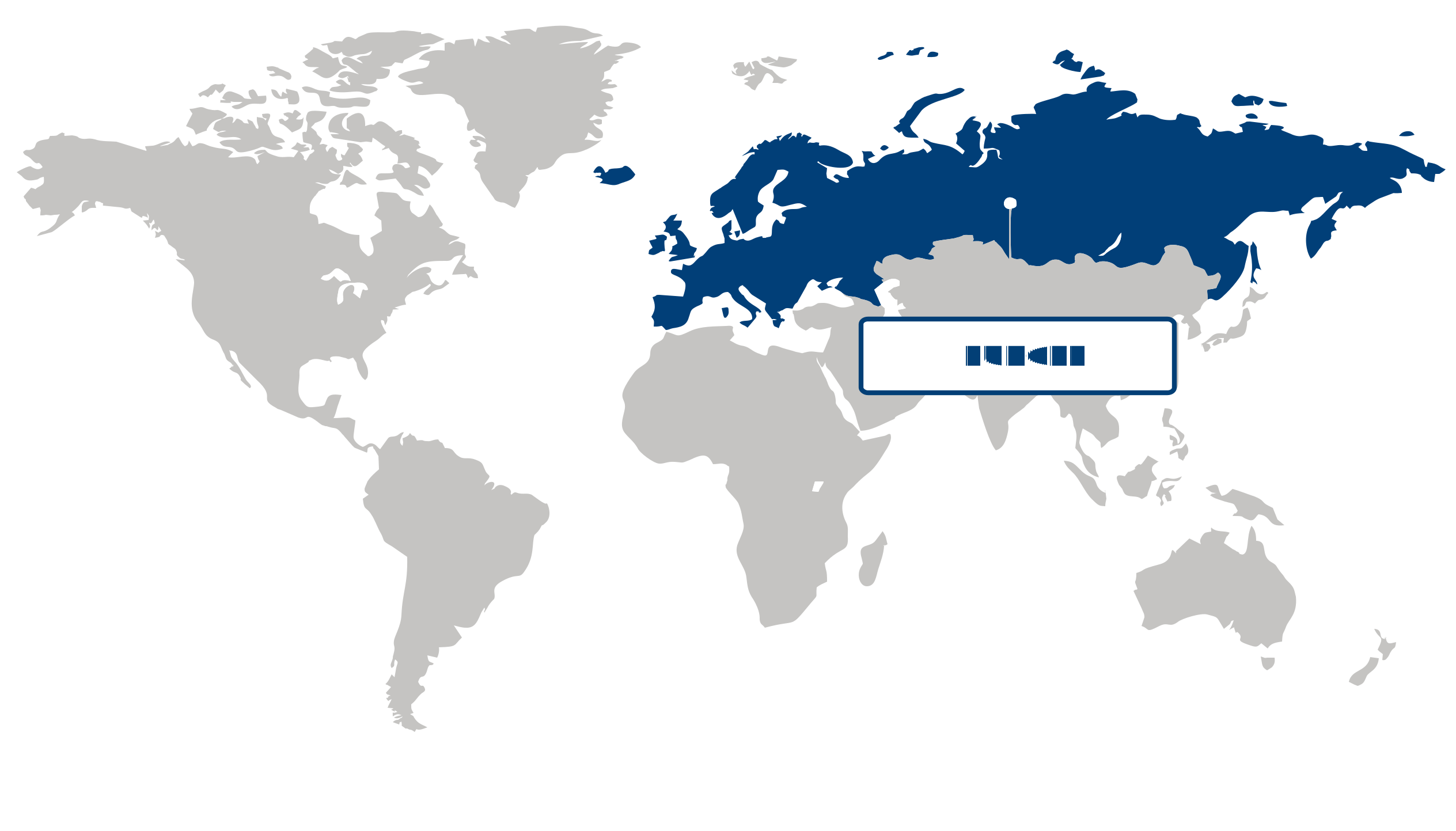
Europe (Largest Region)
The healthcare smart contracts market was led by Europe, which accounted for 37.10% share in 2026, reflecting the region's emphasis on secure healthcare data management, digital health transformation, and regulatory-driven improvements in information governance. Healthcare organizations are increasingly seeking technologies that can automate transactions, strengthen data integrity, and improve coordination among patients, providers, insurers, and other stakeholders. Smart contracts can support automated verification and execution of predefined healthcare processes while reducing administrative friction and enhancing transparency. Europe's established digital healthcare infrastructure, focus on interoperability, and strong attention to privacy and compliance create favorable conditions for adoption as healthcare systems continue modernizing their technology platforms.
Asia Pacific (Fastest-Growing Region)
Asia Pacific represents the fastest-growing region for the healthcare smart contracts market, supported by rapid digitization of healthcare services and increasing demand for efficient, transparent, and secure systems for managing medical information and transactions. Expanding digital health infrastructure is creating opportunities for blockchain-enabled solutions across areas such as claims processing, patient records, supply-chain management, and healthcare payments. The region's large and diverse patient base also encourages healthcare providers and public institutions to explore technologies that can improve operational efficiency and facilitate coordination across fragmented healthcare ecosystems. Growing investment in digital infrastructure, increasing acceptance of blockchain applications, and efforts to modernize healthcare delivery are strengthening the potential for smart contract adoption.
| Parameter | North America | Asia Pacific | Europe | Latin America | MEA |
|---|---|---|---|---|---|
| Innovation HubiScaleNascentDeveloping Advanced | |||||
| Cost-Sensitive RegioniScaleLowMedium High | |||||
| Regulatory EnvironmentiScaleRestrictiveNeutral Supportive | |||||
| Demand DriversiScaleWeakModerate Strong | |||||
| Development StageiScaleEmergingDeveloping Developed | |||||
| Adoption RateiScaleLowMedium High | |||||
| New Entrants / StartupsiScaleSparseModerate Dense | |||||
| Macro IndicatorsiScaleWeakStable Strong |
Key Country Insights
Germany 🇩🇪
Compliance-Driven AutomationGermany is integrating healthcare smart contracts into digital health initiatives where regulatory compliance and secure patient data management are central priorities. Healthcare organizations are evaluating blockchain-based workflows to improve administrative efficiency while maintaining strict privacy standards.
France 🇫🇷
Trusted Health TransactionsFrance is evaluating healthcare smart contracts to improve transaction transparency between healthcare stakeholders while supporting secure patient information management. The country's digital healthcare initiatives encourage solutions that reduce administrative complexity and strengthen operational accountability.
Italy 🇮🇹
Administrative Process ModernizationItaly is adopting healthcare smart contracts to simplify reimbursement workflows and improve coordination between healthcare providers and insurers. Interest is growing in blockchain applications that reduce manual processing while supporting secure healthcare data exchange.
Japan 🇯🇵
Digital Care IntegrationJapan is exploring healthcare smart contracts to support connected care delivery, automated reimbursement processes, and trusted medical record management. Healthcare providers are aligning blockchain adoption with broader digital transformation efforts across hospitals and insurance networks.
South Korea 🇰🇷
Blockchain Healthcare ExpansionSouth Korea is advancing healthcare smart contracts through blockchain-enabled healthcare platforms that emphasize secure data sharing and transparent service delivery. Investments in digital healthcare infrastructure continue to encourage practical implementation across clinical and administrative functions.
United States 🇺🇸
Interoperability CatalystThe U.S. is prioritizing healthcare smart contracts to streamline payer-provider transactions, automate claims processing, and strengthen data integrity across digital health ecosystems. Adoption is supported by expanding blockchain pilots and growing demand for secure healthcare information exchange.
Healthcare Smart Contracts Market Share (%), by Blockchain Type, 2026
Go beyond the chart, access full insights & data tables
Request Free Sample ReportBlockchain Type Segment Analysis: Ethereum (Largest Segment) vs Hyperledger Fabric (Fastest-Growing Segment)
Ethereum led the healthcare smart contracts market with a 32.4% share in 2026, supported by its established smart contract capabilities and broad developer ecosystem. Its programmable blockchain infrastructure enables healthcare organizations and technology providers to develop automated workflows for transactions, records, permissions, and data-sharing processes. The availability of established development tools and familiarity with ethereum-based smart contracts also facilitates experimentation and deployment across healthcare use cases. As healthcare organizations pursue greater transparency, automation, and interoperability, ethereum's established infrastructure continues to support its strong market position.
Hyperledger fabric is gaining adoption at a faster pace as healthcare institutions increasingly seek permissioned blockchain environments that provide greater control over network participation and data access. Its enterprise-oriented architecture is well suited to collaborative healthcare ecosystems where hospitals, payers, suppliers, and other participants need to exchange information while maintaining defined access permissions. The growing focus on privacy, governance, and controlled data sharing is strengthening demand for permissioned blockchain frameworks. These characteristics make hyperledger fabric particularly relevant to healthcare applications requiring secure collaboration among identifiable organizations.
End-use Segment Analysis: Drug and Medical Device Companies (Largest Segment) vs Healthcare Payer (Fastest-Growing Segment)
Drug and medical device companies accounted for the largest share of the healthcare smart contracts market at 34.98% in 2026, reflecting their complex interactions with suppliers, healthcare providers, regulators, distributors, and other stakeholders. Smart contracts can automate transaction conditions, improve traceability, and support more transparent workflows across areas such as supply chain management, procurement, product verification, and contractual processes. The need to coordinate large and highly regulated ecosystems creates strong incentives for these companies to adopt technologies that reduce administrative friction and improve the reliability of shared information.
Healthcare payers are emerging as a faster-growing end-use segment as insurers and other reimbursement organizations seek greater automation and transparency in claims, eligibility, payment, and provider-related processes. Smart contracts can help establish predefined conditions for transactions, potentially reducing manual intervention and improving coordination among payers and healthcare providers. Increasing pressure to streamline administrative operations, limit inefficiencies, and improve trust across healthcare transactions is encouraging greater interest in blockchain-enabled automation.
| Segment | Sub-Segment | Largest Segment | Fastest Growing |
|---|---|---|---|
| Blockchain Type | Hyperledger Fabric, MultiChain56, Ethereum, Others | Ethereum | Hyperledger Fabric |
| End-use | Healthcare Provider, Healthcare Payer, Drug and Medical Device Companies, Others | Drug and Medical Device Companies | Healthcare Payer |
| Application | Data Exchange and Interoperability, Clinical Trials, Supply Chain Management, Claims Adjudication and Billing Management, Others | Supply Chain Management | Data Exchange and Interoperability |
Unlock insights tailored to your business with our bespoke market research solutions.
Click to get your customized report now.
Competitive Landscape and Market Positioning
Major players in the healthcare smart contracts market:
1. IBM Corporation (USA)
2. Microsoft Corporation (USA)
3. Oracle Corporation (USA)
4. SAP SE (Germany)
5. Accenture plc (Ireland)
6. ScienceSoft USA Corporation (USA)
7. ConsenSys Software Inc. (USA)
8. Guardtime AS (Estonia)
9. Medicalchain SA (Switzerland)
The healthcare smart contracts market is evolving through increasing integration of blockchain-based automation in administrative and clinical workflows. Adoption of secure digital frameworks is improving transparency and reducing operational friction. Ecosystem connectivity is expanding across healthcare systems, while innovation is focused on streamlining data validation and transaction integrity.
| Company | Market Share | Company Revenue | Revenue CAGR (%) | Product Portfolio | Geographic Presence | Innovation / R&D Focus | Strategic Developments |
|---|---|---|---|---|---|---|---|
| IBM Corporation (USA) | |||||||
| Microsoft Corporation (USA) | |||||||
| Oracle Corporation (USA) | |||||||
| SAP SE (Germany) | |||||||
| Accenture plc (Ireland) | |||||||
| ScienceSoft USA Corporation (USA) | |||||||
| ConsenSys Software Inc. (USA) | |||||||
| Guardtime AS (Estonia) | |||||||
| Medicalchain SA (Switzerland). |
Customize Your Report
Explore examples of how this report can be tailored to different research needs, including custom segments, additional topics or chapters, and related reports. Click a section of the wheel or its numbered marker to explore the available options.
Healthcare Smart Contracts Market — Custom Segments
| Segment | Sub-Segment |
|---|---|
| Smart Contract Deployment Model | Public Blockchain, Private Blockchain, Consortium Blockchain, Hybrid Blockchain |
| Integration Model | Standalone Smart Contract Platforms, Electronic Health Record Integrated, Enterprise System Integrated, API-Based Integration |
| Organization Size | Large Healthcare Organizations, Mid-Sized Healthcare Organizations, Small Healthcare Organizations |
Healthcare Smart Contracts Market — Custom TOC
| Custom Chapter | Chapter Details |
|---|---|
| Smart Contract Use Case Prioritization |
|
| Healthcare Data Exchange Opportunity Analysis |
|
| Provider Adoption Barrier Assessment |
|
Need a different cut of the data?
Request Custom ResearchFrequently Asked Questions
How big is the healthcare smart contracts market?
How is the healthcare smart contracts industry expected to grow over the next 10 years?
Which operational priorities are accelerating healthcare smart contract adoption?
How are decentralized clinical trials expanding healthcare smart contract applications?
Why does Ethereum dominate the healthcare smart contracts market?
Why is Hyperledger Fabric growing faster in healthcare blockchain use?
Why is Europe the leading region in the healthcare smart contracts market?
How is Asia Pacific emerging as the fastest-growing healthcare smart contracts market?
Who are the major participants shaping the healthcare smart contracts landscape?
Our Clients
"The team took the time to understand our specific business needs and delivered a report that was well aligned with our objectives. Their expertise and understanding of the industry were clearly reflected in the quality and relevance of the insights provided."
Siemens Healthcare
"Our experience in acquiring the research report has been excellent. The depth of analysis, and actionable insights provided have been extremely valuable in supporting our ongoing R&D efforts."
GC Biopharma
"The report offered a comprehensive view of the market trends. The in-depth segmentation and analysis of emerging opportunities gave us a better understanding of the market."
Medtronic
Our Research Team & Methodology
Every Fundamental Business Insights report is built by a dedicated vertical research team, validated through a structured primary-and-secondary methodology, and reviewed for accuracy before it reaches you.
This report was prepared by the Healthcare & Medical Devices Research Team at Fundamental Business Insights, a dedicated research group specializing in the global healthcare and medical technology industry. Our analysts continuously monitor advancements in medical technologies, clinical adoption trends, regulatory developments, reimbursement policies, healthcare infrastructure investments, competitive strategies, and evolving patient care requirements to deliver timely and reliable market intelligence. The research is developed using a structured methodology that combines primary discussions with healthcare stakeholders, company financial disclosures, regulatory publications, clinical literature, government healthcare databases, medical associations, and other authoritative secondary sources. Market estimates are validated through multiple research techniques, including top-down and bottom-up analysis, before undergoing an internal quality review to ensure accuracy, consistency, and methodological integrity prior to publication.
Delivery
Published
Available
Support
- Market Size & Forecast
- Market Segmentation
- Regional Analysis
- Growth Drivers & Challenges
- Market Dynamics
- Competitive Landscape
- Company Profiles
- Competitive Benchmarking
- Mergers & Acquisitions
- Market Share Analysis or Key Company Strategies
- Value Chain Analysis
- Porter's Five Forces
- PESTLE Analysis
- Pricing Trends
- Supply-Demand Analysis
- Technology Landscape
- Regulatory Landscape
- Investment & Funding Landscape
- Emerging Opportunities
- Future Market Outlook