



High Purity Pig Iron Market Size & Growth Forecast 2027–2036, By Segments (Application), Regional Demand Trends (North America, Asia Pacific, Europe), Key Country Insights (U.S., Japan, South Korea, Germany, France, Italy), and Competitive Landscape
Market Size and Growth Outlook
High Purity Pig Iron Market size was worth USD 1.6 billion in 2026 and is poised to grow at a 10.55% CAGR between 2027 and 2036, attaining USD 4.36 billion by 2036. The industry revenue for 2027 is assessed at USD 1.74 billion.
Base Year Value (2026)
USD 1.6 billion
CAGR (2027-2036)
10.55%
Forecast Year Value (2036)
USD 4.36 billion

Historical Data Period
2022-2026

Largest Region
Europe

Forecast Period
2027-2036
High Purity Pig Iron Market Intelligence Snapshot:
-
Regional Market Dynamics:
- Europe held a 60.82% market share in 2026, supported by its established foundry industry, mature metallurgical infrastructure, and consistent demand for high-grade raw materials in specialized applications.
- Asia Pacific is projected to grow at a 9.61% CAGR as expanding manufacturing capacity, rising industrial output, and increasing demand for quality iron inputs strengthen regional sourcing and consumption.
-
Segment Momentum:
- Automotive & Transportation leads due to strong demand for high-quality iron inputs that ensure consistent metallurgical performance, improving casting stability, product reliability, and process efficiency in transport-related manufacturing applications.
- Asia Pacific is projected to grow at a 9.61% CAGR, supported by expanding industrial output and manufacturing capacity, increasing demand for high-quality inputs that enhance production consistency and material performance.
-
Market Expansion Drivers:
- Rising demand for precision castings in automotive, wind energy, and industrial machinery sectors.
- Expansion of renewable energy infrastructure increasing demand for defect-free turbine components.
- Adoption of low-carbon smelting and circular economy practices improving sustainable iron production.
-
Leading Market Participants:
Prominent companies in the high purity pig iron market include Kobe Steel, Ltd. (Japan), Ironveld Plc (United Kingdom), Mineral-Loy, Inc. (United States), Tronox Holdings plc (United States), Vedanta Limited (India), High Purity Iron Inc. (United States), Saraf Group (India), Rio Tinto Iron & Titanium Inc. (Canada).
Global Market Forecast Snapshot:
-
Market Outlook:
- 2026 Market Size: USD 1.6 billion
- 2027 Estimated Market Size: USD 1.74 billion.
- Projected Market Size: USD 4.36 billion by 2036
- Growth Forecasts: 10.55% CAGR (2027-2036)
-
Regional and Segment Outlook:
- Leading Regional Market: Europe
- High-Growth Regional Hub: Asia Pacific
- Core Revenue Segment: Automotive & Transportation (Application)
- Emerging Opportunity Segment: Automotive & Transportation (Application)
Market Growth Drivers and Industry Trends
Rising demand for precision castings in automotive, wind energy, and industrial machinery sectors
Rising demand for precision castings across automotive, wind energy, and industrial machinery applications will support the high purity pig iron market by increasing the need for consistent and reliable ferrous inputs. High-purity pig iron provides controlled material characteristics that are important when manufacturers require cast components with improved consistency, machinability, and surface quality. In automotive and industrial machinery production, precision casting is used for components that must meet demanding dimensional and performance requirements, while wind energy equipment requires durable cast parts capable of supporting large mechanical structures. Increasing emphasis on component quality and manufacturing consistency is encouraging foundries to use cleaner iron inputs in casting processes where impurities can adversely affect final product performance.
Expansion of renewable energy infrastructure increasing demand for defect-free turbine components
Expansion of renewable energy infrastructure will boost the high purity pig iron market as manufacturers increase production of turbine-related components requiring dependable metallurgical properties. Wind turbines incorporate substantial cast components that must withstand repeated mechanical loading, environmental exposure, and prolonged operating cycles. High-purity iron inputs can help foundries maintain tighter control over casting quality and reduce the influence of unwanted impurities on component characteristics. As renewable energy projects expand, the manufacturing ecosystem supporting turbines and related equipment is placing greater importance on reliable raw materials for producing structurally critical cast parts.
Adoption of low-carbon smelting and circular economy practices improving sustainable iron production
Adoption of low-carbon smelting and circular economy practices is creating new opportunities for the high purity pig iron market by encouraging producers to improve resource efficiency while maintaining material quality. Modern iron production is increasingly focused on reducing energy intensity, limiting emissions, and incorporating more efficient approaches to raw material utilization. Circular practices can support greater recovery and reuse of metallic resources, while lower-carbon smelting technologies seek to reduce the environmental impact associated with conventional production routes. These developments are also increasing attention toward production processes capable of delivering consistent iron quality while addressing sustainability requirements across downstream foundry and metal-processing operations.
| Growth Driver Assessment Framework | |||||
| Growth Driver | Impact On CAGR | Regulatory Influence | Geographic Relevance | Adoption Rate | Impact Timeline |
|---|---|---|---|---|---|
| Rising demand for precision castings in automotive, wind energy, and industrial machinery sectors | 2.30% | High | Asia Pacific, Europe, North America | High | Near Term |
| Expansion of renewable energy infrastructure increasing demand for defect-free turbine components | 2.10% | High | Europe, North America, Asia Pacific | High | Near Term |
| Adoption of low-carbon smelting and circular economy practices improving sustainable iron production | 1.90% | High | Europe, Asia Pacific | Medium | Mid Term |
Unlock insights tailored to your business with our bespoke market research solutions - Click to get your customized report now!
Regional Demand Dynamics
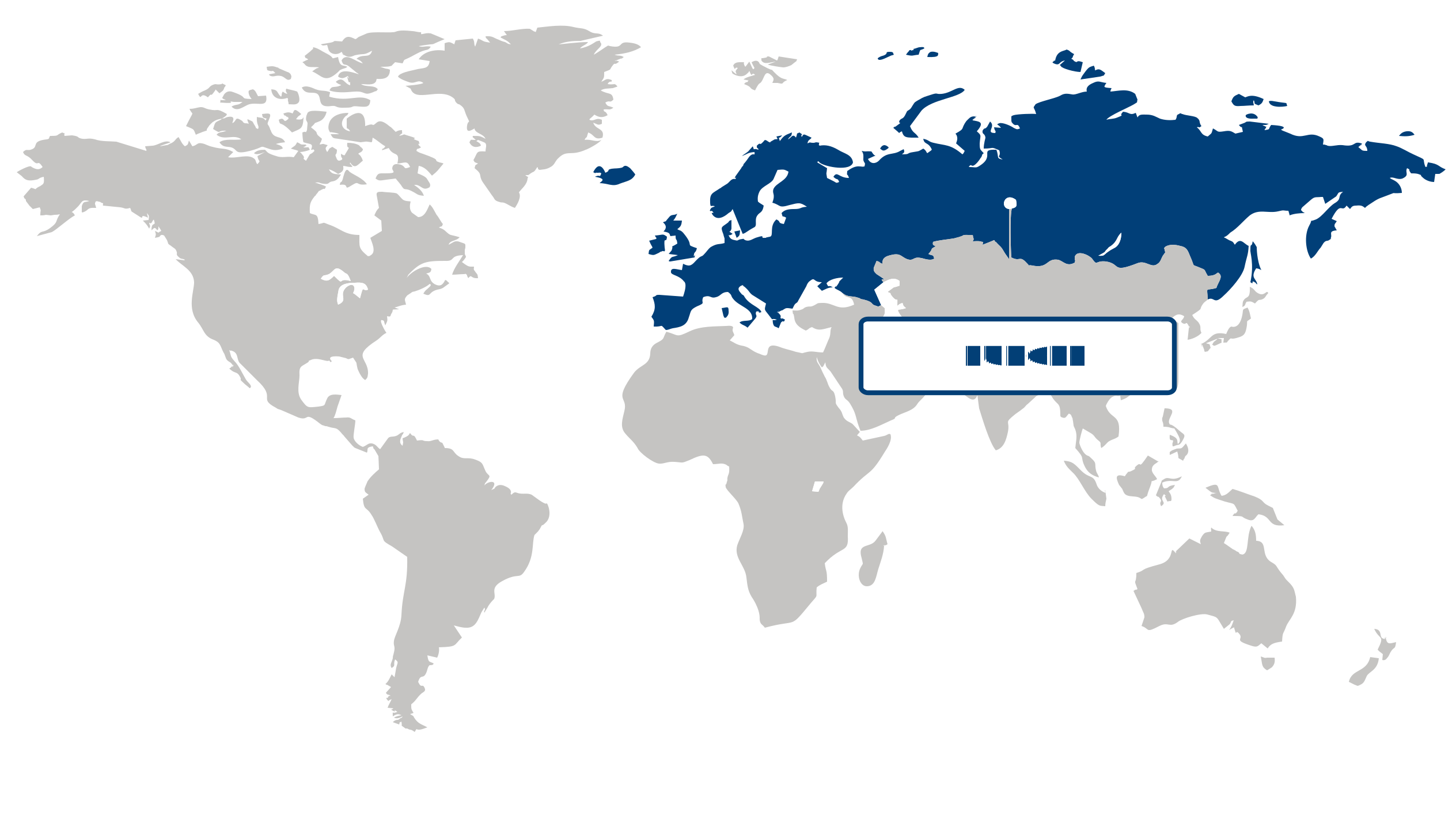
Largest Region
Europe
60.82% Market Share in 2026
Europe (Largest Region) vs Asia Pacific (Fastest-Growing Region)
Europe dominated the high purity pig iron market with a 60.82% share in 2026, supported by its established metallurgical industry, sophisticated steel manufacturing capabilities, and strong focus on material quality and production efficiency. High purity pig iron is valued in applications where consistent chemical composition and controlled impurity levels are important for achieving reliable performance in downstream metal processing. The region’s advanced manufacturing base and emphasis on high-quality industrial inputs support sustained demand, while environmental and efficiency considerations are encouraging producers to improve process control and optimize raw material utilization. Continued modernization of metal production facilities and demand for specialized iron inputs further reinforce Europe’s leading position in this market.
Asia Pacific is projected to be the fastest-growing region in the high purity pig iron market, supported by expanding steel production capabilities, industrialization, and increasing demand for high-quality metallic raw materials. The growth of automotive, construction, machinery, and other manufacturing industries is encouraging steel producers to improve material consistency and production performance. Investments in modern metallurgical facilities and process technologies are also supporting the adoption of higher-purity inputs, particularly as manufacturers seek greater control over product quality and production efficiency. Rising industrial activity, expanding downstream manufacturing capacity, and the gradual modernization of steelmaking operations are expected to create favorable conditions for greater consumption of high purity pig iron across the region.
Key Country Insights
The U.S. market emphasizes high purity pig iron for premium casting applications requiring consistent metallurgical performance. Manufacturers are securing dependable supply sources to support advanced foundries producing automotive, industrial, and precision-engineered components.
Japan values high purity pig iron for applications where metallurgical consistency and defect reduction are essential. Domestic manufacturers continue emphasizing premium raw materials that enhance precision casting and downstream product reliability.
South Korea utilizes high purity pig iron to strengthen productivity across advanced foundry operations serving industrial and automotive sectors. Producers are focusing on stable raw material quality that supports efficient melting and consistent casting performance.
Germany prioritizes high purity pig iron that supports demanding casting specifications in automotive and industrial manufacturing. Buyers favor materials with consistent chemical composition to improve casting quality and production efficiency.
France is expanding the use of high purity pig iron for specialized casting processes requiring improved material cleanliness. Industrial buyers increasingly prioritize dependable feedstock that aligns with quality-focused manufacturing practices.
Italy's foundry sector relies on high purity pig iron to manufacture premium cast components for industrial equipment and automotive applications. Purchasing decisions increasingly favor materials that improve process consistency and finished product quality.
Segment Leadership and Growth Trends
Application Segment Analysis: Automotive & Transportation (Largest & Fastest-Growing Segment)
The automotive & transportation segment led the high purity pig iron market in 2026 and is also positioned as the fastest-growing application segment, supported by the material's importance in producing high-quality iron and steel components. Demand from vehicle manufacturing is closely linked to the need for consistent metallurgical properties, controlled impurity levels, and reliable material performance in critical applications. As automotive producers pursue stronger, lighter, and more durable components while improving manufacturing efficiency, high purity pig iron is gaining relevance as a dependable input for advanced iron and steel production. Its application across transportation-related components further strengthens demand, particularly as vehicle production increasingly emphasizes material quality, performance, and process consistency.
| Report Segmentation | |||
| Segment | Sub-Segment | Largest Segment | Fastest Growing Segment |
|---|---|---|---|
| Application | Automotive & Transportation, Energy, Industrial | Automotive & Transportation | Automotive & Transportation |
 Read our Research Approach
Competitive Landscape and Market Positioning
Prominent players in the high purity pig iron market:
1. Kobe Steel Ltd. (Japan)
2. Ironveld Plc (United Kingdom)
3. Mineral-Loy Inc. (United States)
4. Tronox Holdings plc (United States)
5. Vedanta Limited (India)
6. High Purity Iron Inc. (United States)
7. Saraf Group (India)
8. Rio Tinto Iron & Titanium Inc. (Canada)
The high purity pig iron market is characterized by improvements in production efficiency and material quality optimization efforts. Strategic collaboration is supporting enhanced processing capabilities and broader application reach. Technological refinement is also contributing to improved output consistency. In the high purity pig iron market, operational excellence and material precision are key growth drivers.
Industry Development/News
| Company Name | Date | Key Development |
|---|---|---|
| Fortescue | Aug-24 | Fortescue commenced construction on a $50 million green iron pilot plant at Christmas Creek, Western Australia. This facility is designed to produce high-purity pig iron using green hydrogen, marking a strategic advancement in low-carbon metallurgical processing and demonstrating the technical feasibility of scaling sustainable, hydrogen-based iron production within the regional value chain. |
| Rio Tinto | Jun-25 | Rio Tinto officially opened its BioIron research and development facility in Western Australia, representing a $143 million investment. The plant utilizes microwave energy and biomass to pilot a low-carbon iron production process. This initiative is a critical component of the company's decarbonization strategy for high-purity pig iron supply chains, with production ramp-up activities ongoing through 2026. |
| Ironveld | May-26 | Ironveld is executing a reconfiguration of its Lapon plant in South Africa to stabilize high-purity iron production. Following technical upgrades, the company expects to reach sustained output in mid-2026, targeting a capacity of 7,500 tonnes per month by year-end. This operational scaling supports the company's long-term offtake agreements with European foundries in the specialty alloy and clean energy sectors. |
| VCI Global | May-24 | VCI Global provided early-stage capital to support the development of a green high-purity pig iron project in Saudi Arabia. This investment facilitates feasibility studies and initial execution phases, signaling a strategic commitment to developing low-carbon metallurgical infrastructure and building future production capacity in the region. |
| Magnum Mining and Exploration | Jan-24 | Magnum Mining and Exploration completed a comprehensive engineering study to assess the economic viability of a green high-purity pig iron project in Saudi Arabia. The study evaluates the integration of high-grade magnetite concentrate from its Nevada assets with low-carbon production technologies, establishing a strategic pathway for future international supply chain participation. |
| Kobe Steel | Dec-25 | Kobe Steel has expanded the deployment of its ITmk3® low-emission ironmaking technology, achieving significant reductions in blast furnace CO₂ emissions. By integrating advanced control systems and hot briquetted iron (HBI) processes, the company is enhancing production efficiency and aligning its operational footprint with global carbon-neutrality mandates, strengthening its competitive position in the high-purity pig iron segment. |
| Tronox Holdings | Dec-25 | Tronox Holdings has prioritized the optimization of its pig iron operations by leveraging its integrated titanium and iron assets to serve high-growth downstream sectors, including electric vehicles and aerospace. The company is actively focusing on operational efficiency and capacity utilization to improve cash generation while maintaining environmental compliance across its African mining and processing infrastructure. |
Why Choose Us
Specialized Expertise: Our team comprises industry experts with a deep understanding of your market segment. We bring specialized knowledge and experience that ensures our research and consulting services are tailored to your unique needs.
Customized Solutions: We understand that every client is different. That's why we offer customized research and consulting solutions designed specifically to address your challenges and capitalize on opportunities within your industry.
Proven Results: With a track record of successful projects and satisfied clients, we have demonstrated our ability to deliver tangible results. Our case studies and testimonials speak to our effectiveness in helping clients achieve their goals.
Cutting-Edge Methodologies: We leverage the latest methodologies and technologies to gather insights and drive informed decision-making. Our innovative approach ensures that you stay ahead of the curve and gain a competitive edge in your market.
Client-Centric Approach: Your satisfaction is our top priority. We prioritize open communication, responsiveness, and transparency to ensure that we not only meet but exceed your expectations at every stage of the engagement.
Continuous Innovation: We are committed to continuous improvement and staying at the forefront of our industry. Through ongoing learning, professional development, and investment in new technologies, we ensure that our services are always evolving to meet your evolving needs.
Value for Money: Our competitive pricing and flexible engagement models ensure that you get maximum value for your investment. We are committed to delivering high-quality results that help you achieve a strong return on your investment.
Select Licence Type

