High Voltage Direct Current Power Supply Market Size & Growth Forecast 2027–2036, By Segments (Voltage, Application), Regional Demand Trends (North America, Asia Pacific, Europe), Key Country Insights (U.S., Japan, South Korea, Germany, France, Italy), and Competitive Landscape
Market Size and Growth Outlook
High Voltage Direct Current Power Supply Market size was assessed at USD 4.3 billion in 2026 and is poised to grow at a 7.51% CAGR between 2027 and 2036, reaching USD 8.87 billion by 2036. The industry revenue for 2027 is estimated at USD 4.57 billion.
Get more details on this report
Request Free Sample ReportHigh Voltage Direct Current Power Supply Market Intelligence Snapshot
Regional Market Dynamics
- Europe held a 33.50% share in 2026, supported by its advanced industrial base, mature power infrastructure, and continued investment in high-performance electrical systems and power electronics.
- Asia Pacific is projected to grow at an 8.93% CAGR as industrialization, power infrastructure expansion, and wider deployment of advanced high-voltage systems increase demand for HVDC power supplies.
Segment Momentum
- The >4000V segment held a 60.8% share in 2026 because many industrial and technical applications require stable, high-voltage output for reliable performance and continuous operation.
- Industrial is the fastest-growing application because facilities require reliable high-voltage DC power to support continuous production, sustained loads, equipment performance, and operational uptime.
Market Expansion Drivers
- Renewable energy grid integration driving HVDC transmission project deployments globally.
- Long-distance power transmission efficiency upgrades accelerating AC to DC conversion projects.
- Advancements in power electronics and smart grid digitalization improving HVDC system efficiency.
Leading Market Participants
- Major companies in the high voltage direct current power supply market include ABB Ltd. (Switzerland), Siemens AG (Germany), General Electric Company (United States), Toshiba Corporation (Japan), Hitachi Energy Ltd. (Switzerland), XP Power Ltd. (Singapore), Advanced Energy Industries, Inc. (United States), Spellman High Voltage Electronics Corporation (United States), Excelitas Technologies Corp. (United States).
Global Market Forecast Snapshot
Market Outlook
- 2026 Market Size: USD 4.3 billion
- 2027 Estimated Market Size: USD 4.57 billion.
- Projected Market Size: USD 8.87 billion by 2036
- Growth Forecast: 7.51% CAGR (2027-2036)
Regional and Segment Outlook
- Leading Regional Market: Europe
- High-Growth Regional Hub: Asia Pacific
- Core Revenue Segment: >4000V (Voltage) | Industrial (Application)
- Emerging Opportunity Segment: >4000V (Voltage) | Industrial (Application)
Market Growth Drivers and Industry Trends
Renewable energy grid integration driving HVDC transmission project deployments globally
Integration of renewable energy into electricity networks is driving the high voltage direct current power supply market as power systems require transmission solutions capable of supporting expanding renewable generation. HVDC deployment helps connect generation resources with demand centers across transmission networks, supporting grid development where renewable power integration requires efficient long-distance electricity transfer.
Long-distance power transmission efficiency upgrades accelerating AC to DC conversion projects
Efficiency improvements for long-distance electricity transmission are creating greater demand in the high voltage direct current power supply market as grid operators pursue more effective methods of moving power across extensive networks. AC to DC conversion projects can support transmission efficiency requirements while enabling infrastructure upgrades aligned with changing power distribution patterns and long-distance electricity flows.
Advancements in power electronics and smart grid digitalization improving HVDC system efficiency
Advances in power electronics are improving the high voltage direct current power supply market by enabling more efficient control and operation of HVDC infrastructure. At the same time, smart grid digitalization supports enhanced system monitoring and management, helping transmission operators improve operational performance and integrate more intelligent capabilities into power networks.
| Growth Driver | Impact on CAGR | Regulatory Influence | Geographic Relevance | Adoption Rate | Impact Timeline |
|---|---|---|---|---|---|
| Expansion of High Voltage DC Power Systems | 3.00% | Short term (≤ 2 yrs) | North America, Europe (spillover: Asia Pacific) | Medium | Fast |
| Technological Advancements in HVDC Components | 2.50% | Medium term (2–5 yrs) | Europe, North America (spillover: Asia Pacific) | Low | Moderate |
| Regulatory Standards for High Voltage Transmission | 2.40% | Long term (5+ yrs) | North America, Europe (spillover: MEA) | High | Moderate |
| Renewable energy grid integration driving HVDC transmission project deployments globally | 1.90% | High | Asia Pacific, Europe | Medium | Mid Term |
| Long-distance power transmission efficiency upgrades accelerating AC to DC conversion projects | 1.70% | High | Europe, North America, Asia Pacific | Medium | Mid Term |
| Advancements in power electronics and smart grid digitalization improving HVDC system efficiency | 1.40% | High | Global | Medium | Long Term |
Unlock insights tailored to your business with our bespoke market research solutions.
Click to get your customized report now.
Regional Demand Dynamics
Europe (Largest Region)
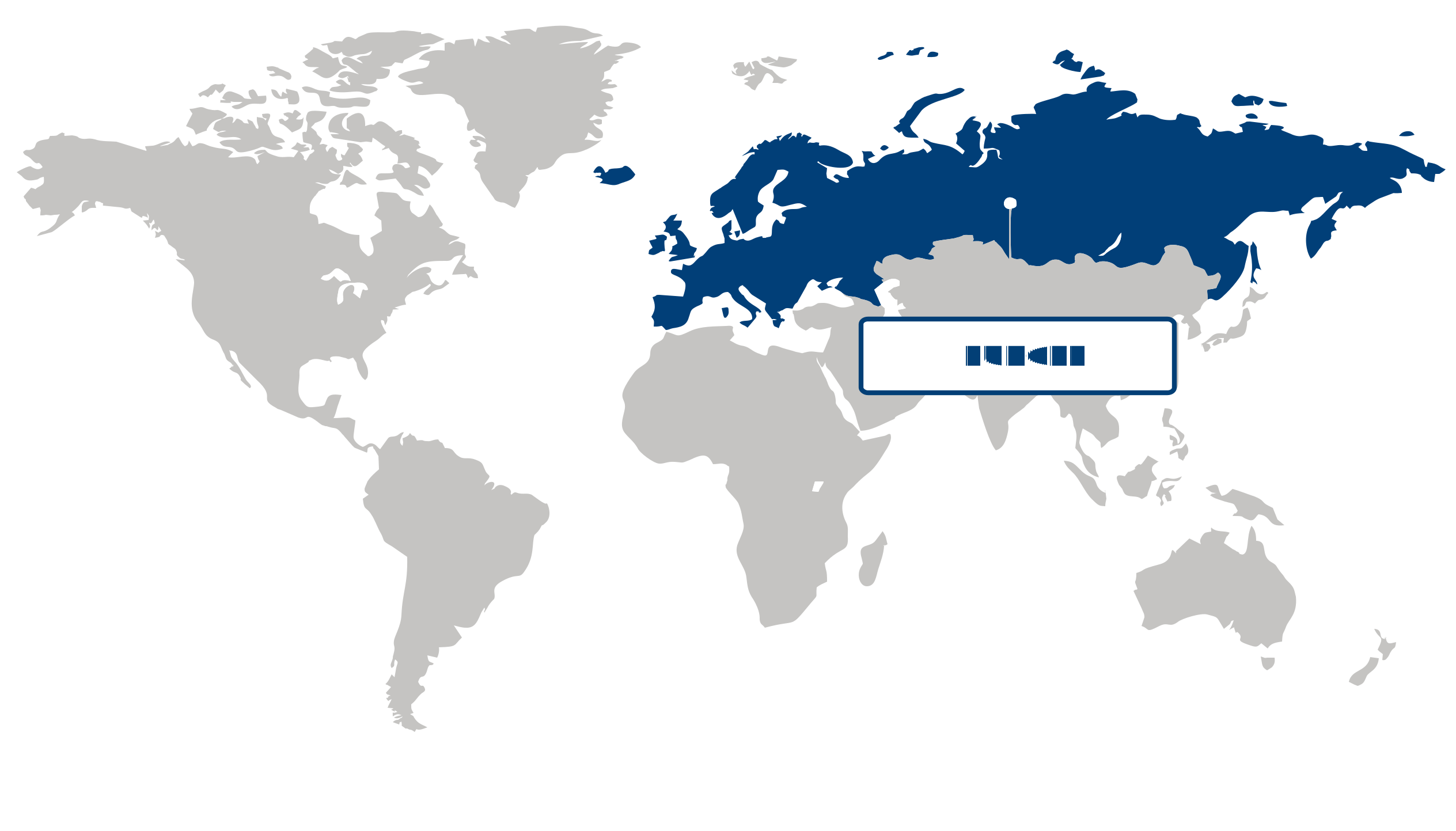
Europe accounted for the largest share of the high voltage direct current power supply market at 33.50% in 2026, reflecting the region’s emphasis on grid modernization, renewable energy integration, and efficient electricity transmission. The expansion of offshore and other renewable generation requires advanced power infrastructure capable of managing electricity flows across complex networks and long transmission distances. Investments in energy transition projects, grid resilience, and electrification are strengthening demand for high-voltage direct current technologies. The region’s focus on improving energy efficiency and integrating variable renewable power into transmission systems further supports its established market position.
Asia Pacific (Fastest-Growing Region)
Asia Pacific is experiencing the fastest growth as expanding electricity demand, industrialization, and large-scale renewable energy development create substantial requirements for advanced power transmission infrastructure. Rapid expansion of manufacturing and urban infrastructure is increasing pressure on power networks, encouraging investments in efficient and reliable transmission solutions. HVDC systems are particularly relevant for connecting remote generation resources with major consumption centers and supporting cross-regional power transfer. Government-led energy transition initiatives and ongoing modernization of transmission networks are further creating favorable conditions for market expansion.
| Parameter | North America | Asia Pacific | Europe | Latin America | MEA |
|---|---|---|---|---|---|
| Innovation Hub i Scale Nascent Developing Advanced | |||||
| Cost-Sensitive Region i Scale Low Medium High | |||||
| Regulatory Environment i Scale Restrictive Neutral Supportive | |||||
| Demand Drivers i Scale Weak Moderate Strong | |||||
| Development Stage i Scale Emerging Developing Developed | |||||
| Adoption Rate i Scale Low Medium High | |||||
| New Entrants / Startups i Scale Sparse Moderate Dense | |||||
| Macro Indicators i Scale Weak Stable Strong |
Key Country Insights
Germany 🇩🇪
Renewable Grid IntegrationGermany prioritizes HVDC power supply technologies that strengthen cross-border electricity exchange and offshore wind connectivity. Infrastructure developers in Germany are expanding high-efficiency transmission solutions to support grid stability during the energy transition.
France 🇫🇷
Cross-Border ConnectivityFrance continues expanding HVDC infrastructure to enhance interconnection with neighboring electricity markets and renewable generation assets. Energy companies in France are prioritizing efficient transmission technologies that improve grid reliability and operational flexibility.
Italy 🇮🇹
Energy Corridor DevelopmentItaly is deploying HVDC power supply systems to strengthen regional transmission capacity and renewable energy integration. Infrastructure operators in Italy are investing in modern converter technologies that improve long-distance electricity transfer while supporting grid modernization initiatives.
Japan 🇯🇵
Resilient Power NetworksJapan is advancing HVDC power supply deployment to improve interregional electricity transfer and reinforce energy security. Utilities in Japan are focusing on reliable transmission equipment that supports stable power delivery and disaster-resilient infrastructure.
South Korea 🇰🇷
Smart Transmission ExpansionSouth Korea is strengthening HVDC investments to accommodate growing electricity demand and renewable power integration. Domestic utilities and equipment manufacturers are emphasizing digitally managed transmission systems that improve operational efficiency and network flexibility.
United States 🇺🇸
Grid Modernization FocusThe U.S. high voltage direct current power supply market emphasizes long-distance transmission projects that support renewable energy integration and grid resilience. Utilities and technology providers in the U.S. are investing in advanced converter systems and digital grid control capabilities.
Segment Leadership and Growth Trends
High Voltage Direct Current Power Supply Market Share (%), by Voltage, 2026
Go beyond the chart, access full insights & data tables
Request Free Sample ReportVoltage Segment Analysis: >4000V (Largest & Fastest-Growing Segment)
The >4000V segment held the largest share of the high voltage direct current power supply market, accounting for 60.8% share in 2026, and is also expected to be the fastest-growing voltage segment. High-voltage direct current power supplies are essential for applications requiring stable delivery of substantial electrical power, particularly in demanding industrial and specialized environments. The >4000V range supports applications where higher voltage capability is necessary for efficient equipment operation, advanced testing, and high-power electrical systems. Increasing demand for reliable high-voltage power infrastructure and sophisticated electrical equipment is strengthening adoption within this segment.
Application Segment Analysis: Industrial (Largest & Fastest-Growing Segment)
The industrial segment dominated the high voltage direct current power supply market with a 57.49% share in 2026 and is also projected to be the fastest-growing application segment. Industrial operations rely on high-voltage DC power supplies for equipment, testing systems, manufacturing processes, and other applications requiring precise and dependable power delivery. Increasing industrial automation, electrification of manufacturing processes, and demand for reliable power systems are supporting broader deployment of high-voltage DC technologies. The growing need for efficient electrical infrastructure and advanced industrial equipment further reinforces the segment's expansion.
| Segment | Sub-Segment | Largest Segment | Fastest Growing |
|---|---|---|---|
| Voltage | <1000V, 1000-4000V, >4000V | >4000V | >4000V |
| Application | Telecommunication, Medical, Industrial, Oil & Gas, Others | Industrial | Industrial |
Competitive Landscape and Market Positioning
Top players in the high voltage direct current power supply market:
1. ABB Ltd. (Switzerland)
2. Siemens AG (Germany)
3. General Electric Company (United States)
4. Toshiba Corporation (Japan)
5. Hitachi Energy Ltd. (Switzerland)
6. XP Power Ltd. (Singapore)
7. Advanced Energy Industries Inc. (United States)
8. Spellman High Voltage Electronics Corporation (United States)
9. Excelitas Technologies Corp. (United States)
The high voltage direct current power supply market is advancing with growing demand for efficient long-distance power transmission. In the high voltage direct current power supply market, innovation is focused on enhancing grid stability and energy efficiency. Technological improvements are enabling more reliable and scalable power infrastructure. Collaborative development efforts are supporting next-generation transmission capabilities.
| Company | Market Share | Company Revenue | Revenue CAGR (%) | Product Portfolio | Geographic Presence | Innovation / R&D Focus | Strategic Developments |
|---|---|---|---|---|---|---|---|
| ABB Ltd. (Switzerland) | |||||||
| Siemens AG (Germany) | |||||||
| General Electric Company (United States) | |||||||
| Toshiba Corporation (Japan) | |||||||
| Hitachi Energy Ltd. (Switzerland) | |||||||
| XP Power Ltd. (Singapore) | |||||||
| Advanced Energy Industries Inc. (United States) | |||||||
| Spellman High Voltage Electronics Corporation (United States) | |||||||
| Excelitas Technologies Corp. (United States). |
Industry Development/News
| Company Name | Date | Key Development |
|---|---|---|
| DNV | Jan-24 | DNV launched a Joint Industry Project with offshore wind and transmission developers to assess required standardization changes for integrating HVDC systems into the U.S. grid. The initiative supports broader infrastructure alignment for long-distance electricity transmission, particularly for offshore wind integration and clean energy grid development. |
| Japan and United States | Oct-23 | Japan and the United States upgraded HVDC transmission infrastructure as part of efforts to accelerate renewable energy integration. The development is supported by U.S. Department of Energy funding aimed at reducing transmission costs and improving long-distance power transfer efficiency for clean energy deployment. |
| Ørsted and Eversource | Oct-21 | Ørsted and Eversource selected Siemens Energy to supply HVDC transmission systems for a 924 MW offshore wind project in New York. The project represents an early U.S. deployment of HVDC technology for offshore wind integration, supporting long-distance renewable power transmission to major demand centers. |
Customize Your Report
Explore examples of how this report can be tailored to different research needs, including custom segments, additional topics or chapters, and related reports. Click a section of the wheel or its numbered marker to explore the available options.
High Voltage Direct Current Power Supply Market — Custom Segments
| Segment | Sub-Segment |
|---|---|
| Output Power Rating | Low Power, Medium Power, High Power, Ultra-High Power |
| End-Use Equipment | Data Center Equipment, Telecom Equipment, Medical Equipment, Industrial Equipment, Test & Measurement Equipment |
| Power Supply Architecture | Single-Output, Multi-Output, Modular, Rack-Mounted |
High Voltage Direct Current Power Supply Market — Custom TOC
| Custom Chapter | Custom Details |
|---|---|
| Data Center Power Infrastructure Opportunity |
|
| Renewable Energy Transmission Strategies |
|
| Regional Grid Investment Opportunity Mapping |
|
Need a different cut of the data?
Request Custom ResearchHow big is the high voltage direct current power supply market?
What is the anticipated CAGR of the high voltage direct current power supply industry?
How is renewable energy integration driving demand for HVDC power supply systems?
Why are advancements in power electronics improving HVDC system adoption in modern grids?
Why does the >4000V segment dominate the high voltage direct current power supply market?
Why is the industrial application segment growing fastest in the high voltage direct current power supply market?
Why is Europe the leading regional market for high voltage direct current power supplies?
What is accelerating market growth in Asia Pacific?
Who are the major participants shaping the high voltage direct current power supply landscape?
Our Clients
"The information presented in the report was genuinely insightful. The data was clear and easy to understand, which made it much easier to interpret the findings."
Amara Raja Group
"The responsiveness and professionalism exhibited by the team were exemplary. They were readily available to address queries, provide clarifications, and offer additional insights."
ONGC
"The reports offered a comprehensive analysis of various segments within the market. The detailed insights into market trends, and regulatory landscapes were excellent."
TotalEnergies
Our Research Team & Methodology
Every Fundamental Business Insights report is built by a dedicated vertical research team, validated through a structured primary-and-secondary methodology, and reviewed for accuracy before it reaches you.
Research Team Overview
Prepared by the Energy & Power Research Team
Delivery
Published
Demand
Available
Support
Trust & Compliance
Research Domains
10 coverage areasResearch Intelligence
| Source | Reference |
|---|---|
| International Energy Agency (IEA) | www.iea.org |
| U.S. Energy Information Administration (EIA) | www.eia.gov |
| International Renewable Energy Agency (IRENA) | www.irena.org |
| International Electrotechnical Commission (IEC) | www.iec.ch |
| International Organization for Standardization (ISO) | www.iso.org |
| IEEE | www.ieee.org |
| CIGRE (International Council on Large Electric Systems) | www.cigre.org |
| World Energy Council (WEC) | www.worldenergy.org |
| U.S. Department of Energy (DOE) | www.energy.gov |
| International Atomic Energy Agency (IAEA) | www.iaea.org |
| American Petroleum Institute (API) | www.api.org |
| Society of Petroleum Engineers (SPE) | www.spe.org |
| Hydrogen Council | hydrogencouncil.com |
| Battery Council International (BCI) | batterycouncil.org |
| Global Wind Energy Council (GWEC) | gwec.net |
| SolarPower Europe | www.solarpowereurope.org |
| World Bioenergy Association (WBA) | worldbioenergy.org |
| International Hydropower Association (IHA) | www.hydropower.org |
| Edison Electric Institute (EEI) | www.eei.org |
| National Renewable Energy Laboratory (NREL) | www.nrel.gov |
Research Workflow & Quality Assurance
Data Collection
Verified information gathered through primary and secondary research.
Data Triangulation
Cross-validation using multiple independent data sources.
Forecast Modelling
Market estimates developed using historical trends and analytical models.
Analyst Validation
Findings reviewed by domain experts for accuracy and consistency.
Editorial & Quality Review
Final editorial, quality, and compliance checks before publication.
Final Publication
Released after successful completion of the internal review process.
Report Coverage
📊 Market Assessment
- Market Size & Forecast
- Market Segmentation
- Regional Analysis
- Growth Drivers & Challenges
- Market Dynamics
🏢 Competitive Intelligence
- Competitive Landscape
- Company Profiles
- Competitive Benchmarking
- Mergers & Acquisitions
- Market Share Analysis or Key Company Strategies
🔍 Strategic Analysis
- Value Chain Analysis
- Porter's Five Forces
- PESTLE Analysis
- Pricing Trends
- Supply-Demand Analysis
🚀 Future Outlook
- Technology Landscape
- Regulatory Landscape
- Investment & Funding Landscape
- Emerging Opportunities
- Future Market Outlook
Have a question about this report or need a custom scope?
Request Customization