Indoor Farming Market Size & Growth Forecast 2027–2036, By Segments (Growing Mechanism, Facility Type, Component, Crop Category), Regional Demand Trends (North America, Asia Pacific, Europe), Key Country Insights (U.S., Japan, South Korea, Germany, France, Italy), and Competitive Landscape
Jump to Content
Market Size and Growth Outlook
Indoor Farming Market size stood at USD 56.4 billion in 2026 and is predicted to grow at a 10.74% CAGR from 2027 to 2036, exceeding USD 156.43 billion by 2036. The industry revenue for 2027 is estimated at USD 61.5 billion.
Get more details on this report
Request Free Sample ReportIndoor Farming Market Intelligence Snapshot
Regional Market Dynamics
- Europe holds 32.86% share due to established controlled-environment agriculture, widespread hydroponic and vertical farming adoption, and strong demand for year-round urban food supply systems.
- Asia Pacific grows at 14.56% CAGR driven by vertical farming expansion, rising urban food demand, land constraints, and increasing investment in technology-enabled agriculture systems.
Segment Momentum
- Hydroponics held a 57.75% share in 2026 by providing growers with effective production control, water efficiency, and operational simplicity, making it well suited for consistent commercial-scale indoor cultivation.
- Vertical Farms are growing fastest because they maximize production in limited spaces through stacked cultivation while offering greater control over crop conditions and supporting localized, predictable output.
Market Expansion Drivers
- Rising global food demand driven by population growth and rapid urbanization trends.
- Climate change and soil degradation accelerating adoption of controlled environment agriculture systems.
- AI-powered hydroponics and automation improving yield efficiency in indoor farming operations.
Leading Market Participants
- Leading players in the indoor farming market include AeroFarms (United States), Signify N.V. (Netherlands), Netafim Ltd. (Israel), Gotham Greens (United States), Certhon Group (Netherlands), Plenty Unlimited Inc. (United States), Sky Greens (Singapore), Richel Group (France), General Hydroponics (United States).
Global Market Forecast Snapshot
Market Outlook
- 2026 Market Size: USD 56.4 billion
- 2027 Estimated Market Size: USD 61.5 billion.
- Projected Market Size: USD 156.43 billion by 2036
- Growth Forecast: 10.74% CAGR (2027-2036)
Regional and Segment Outlook
- Leading Regional Market: Europe
- High-Growth Regional Hub: Asia Pacific
- Core Revenue Segment: Hydroponics (Growing Mechanism) | Greenhouses (Facility Type) | Hardware (Component) | Fruits, Vegetables & Herbs (Crop Category)
- Emerging Opportunity Segment: Aquaponics (Growing Mechanism) | Vertical Farms (Facility Type) | Software (Component) | Fruits, Vegetables & Herbs (Crop Category)
Market Growth Drivers and Industry Trends
Rising global food demand driven by population growth and rapid urbanization trends
Population expansion and continued urbanization will drive the indoor farming market by increasing pressure on food production systems to supply fresh produce closer to densely populated consumption centers. Urban development reduces the availability of suitable agricultural land near cities while increasing demand for locally available vegetables, herbs, and other high-value crops. Indoor farming enables production within controlled facilities located near urban markets, reducing dependence on conventional agricultural land and allowing growers to manage production conditions throughout the year. Vertical farming, hydroponics, and other indoor cultivation approaches can also utilize limited space efficiently, making them relevant to food production strategies in areas where land availability is constrained by urban development.
Climate change and soil degradation accelerating adoption of controlled environment agriculture systems
Increasing climatic uncertainty and deterioration of agricultural soil quality will propel the indoor farming market as growers seek greater control over the conditions that influence crop production. Controlled environment agriculture systems can regulate parameters such as temperature, humidity, lighting, irrigation, and nutrient delivery, helping reduce dependence on favorable outdoor weather conditions. Indoor cultivation also provides an alternative for locations affected by soil degradation because hydroponic and other soilless systems can produce crops without conventional agricultural soil. By separating crop production from many environmental constraints associated with open-field farming, these systems allow growers to maintain more consistent cultivation conditions and manage water and nutrient inputs according to crop requirements.
AI-powered hydroponics and automation improving yield efficiency in indoor farming operations
Integration of artificial intelligence, sensors, robotics, and automated cultivation systems will boost the indoor farming market by enabling growers to monitor and adjust production conditions with greater precision. AI-based systems can analyze information relating to crop health, nutrient requirements, environmental conditions, irrigation, and lighting to support timely operational decisions. Automation further reduces the need for repetitive manual activities such as seeding, irrigation management, crop monitoring, and harvesting, while hydroponic systems deliver nutrients directly through controlled water-based growing environments. The combination of intelligent monitoring and automated resource management helps indoor farms optimize cultivation inputs and maintain consistent growing conditions across production cycles.
| Growth Driver | Impact on CAGR | Regulatory Influence | Geographic Relevance | Adoption Rate | Impact Timeline |
|---|---|---|---|---|---|
| Rising global food demand driven by population growth and rapid urbanization trends | 2.60% | Moderate | Asia Pacific, Africa | High | Mid Term |
| Climate change and soil degradation accelerating adoption of controlled environment agriculture systems | 2.40% | High | Europe, Asia Pacific, North America | High | Near Term |
| AI-powered hydroponics and automation improving yield efficiency in indoor farming operations | 2.00% | Moderate | North America, Europe | Emerging | Long Term |
Explore Growth Opportunities
Request Free Sample ReportRegional Demand Dynamics
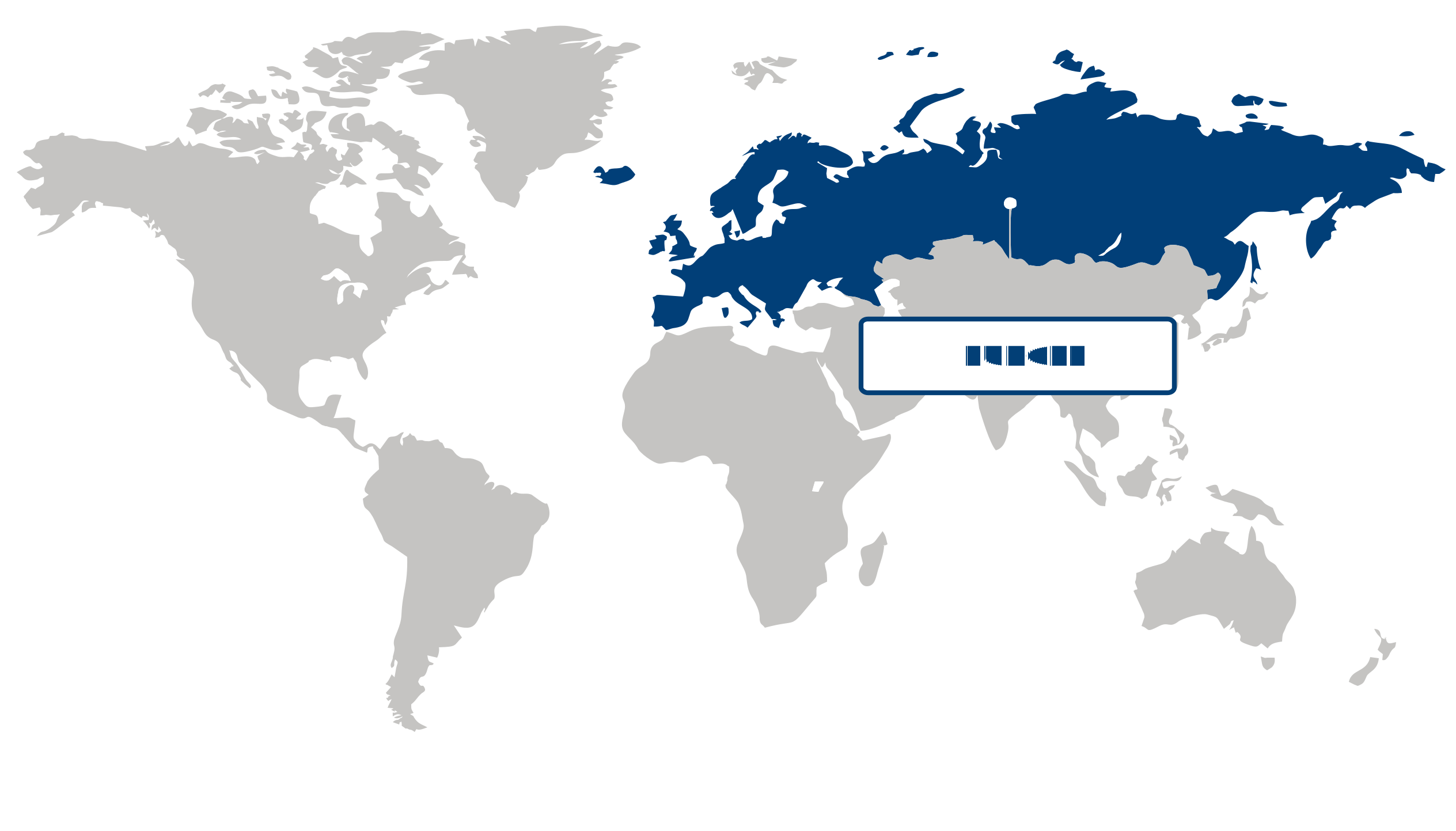
Europe (Largest Region)
Europe dominated the indoor farming market with a 32.86% share in 2026, benefiting from strong interest in sustainable food production, efficient resource utilization, and controlled agricultural environments. Limited availability of arable land in several markets is encouraging the adoption of technologies that enable food cultivation in controlled and space-efficient settings. Growing emphasis on reducing agricultural resource consumption, improving local food supply resilience, and producing crops closer to urban consumers is also supporting market development. In addition, technological progress in controlled-environment agriculture is strengthening the commercial viability of indoor farming solutions.
Asia Pacific (Fastest-Growing Region)
Asia Pacific represents the fastest-growing region, supported by rapid urbanization, increasing food demand, and growing pressure on conventional agricultural resources. Expanding urban populations are creating greater interest in localized food production systems that can operate near consumption centers while reducing exposure to land and climate constraints. Investments in controlled-environment agriculture are also being encouraged by the need to improve food supply resilience and agricultural productivity. Rising awareness of sustainable farming practices and increasing adoption of technology-enabled cultivation methods are further creating favorable conditions for indoor farming expansion.
| Parameter | North America | Asia Pacific | Europe | Latin America | MEA |
|---|---|---|---|---|---|
| Innovation HubiScaleNascentDeveloping Advanced | |||||
| Cost-Sensitive RegioniScaleLowMedium High | |||||
| Regulatory EnvironmentiScaleRestrictiveNeutral Supportive | |||||
| Demand DriversiScaleWeakModerate Strong | |||||
| Development StageiScaleEmergingDeveloping Developed | |||||
| Adoption RateiScaleLowMedium High | |||||
| New Entrants / StartupsiScaleSparseModerate Dense | |||||
| Macro IndicatorsiScaleWeakStable Strong |
Key Country Insights
Germany 🇩🇪
Energy-Efficient CultivationGermany emphasizes indoor farming solutions that improve resource efficiency while reducing energy consumption and operating costs. Indoor farming projects in Germany increasingly integrate smart climate technologies, renewable energy strategies, and precision monitoring to strengthen commercial viability.
France 🇫🇷
Premium Crop FocusFrance increasingly applies indoor farming to produce high-quality vegetables, herbs, and specialty crops with consistent supply characteristics. Indoor farming businesses in France focus on improving sustainability, reducing resource use, and meeting consumer demand for locally produced fresh food.
Italy 🇮🇹
High-Value Produce SystemsItaly adopts indoor farming to complement conventional agriculture with reliable production of premium crops and specialty vegetables. Indoor farming investments in Italy increasingly emphasize water efficiency, product quality, and cultivation technologies suited to controlled production environments.
Japan 🇯🇵
Urban Food ProductionJapan advances indoor farming to strengthen reliable fresh produce supply within densely populated urban areas. Indoor farming operators in Japan increasingly adopt automation, robotics, and efficient cultivation technologies that address labor limitations while maintaining consistent crop quality.
South Korea 🇰🇷
Smart Agriculture IntegrationSouth Korea actively integrates indoor farming with digital agriculture technologies including AI-based monitoring, environmental controls, and automated cultivation systems. Commercial growers in South Korea continue prioritizing scalable facilities that improve production consistency and operational efficiency.
United States 🇺🇸
Controlled Environment ExpansionThe U.S. continues expanding indoor farming through investments in automation, climate control, and data-driven crop management. Indoor farming operators across the U.S. increasingly prioritize production efficiency, consistent quality, and year-round supply for retail and foodservice customers.
Indoor Farming Market Share (%), by Growing Mechanism, 2026
Go beyond the chart, access full insights & data tables
Request Free Sample ReportGrowing Mechanism Segment Analysis: Hydroponics (Largest Segment) vs Aquaponics (Fastest-Growing Segment)
Hydroponics dominated the indoor farming market with a 57.75% share in 2026, reflecting its established role as an efficient cultivation method for controlled-environment agriculture. Hydroponic systems grow plants without conventional soil and allow growers to manage water, nutrients, and growing conditions with a high degree of precision. This supports efficient resource utilization and consistent crop production in environments where conventional agriculture may be constrained by land or climate conditions. The adaptability of hydroponics across different indoor farming configurations, combined with its suitability for commercial crop production, reinforces its leading position.
Aquaponics is the fastest-growing growing mechanism, supported by increasing interest in integrated systems that combine plant cultivation with aquatic production and resource recycling. Aquaponic systems can create a more circular production environment by using nutrients generated within the aquatic component to support plant growth, reducing dependence on conventional nutrient inputs. Growing attention to sustainable food production, efficient resource management, and closed-loop agricultural systems is encouraging interest in aquaponics. Its ability to integrate multiple forms of food production within controlled environments further strengthens its growth potential.
Facility Type Segment Analysis: Greenhouses (Largest Segment) vs Vertical Farms (Fastest-Growing Segment)
Greenhouses accounted for the largest share of the indoor farming market, reaching 68.16% in 2026. Their leading position is supported by the ability to create controlled growing conditions while retaining greater exposure to natural sunlight than fully enclosed systems. Greenhouses provide growers with improved control over temperature, humidity, irrigation, and crop protection, helping extend cultivation opportunities across different environmental conditions. Their established operating model and suitability for a broad range of crops also make greenhouse-based cultivation an important component of controlled-environment agriculture.
Vertical farms are the fastest-growing facility type as growers increasingly seek to maximize production within limited urban and indoor spaces. Vertical farming uses stacked cultivation structures to increase the productive use of available floor area while enabling close management of lighting, nutrients, water, and environmental conditions. Its suitability for urban food production and proximity to consumers can reduce dependence on conventional agricultural land and support localized supply chains. Increasing interest in resource-efficient cultivation and year-round production is further strengthening adoption of vertical farming systems.
| Segment | Sub-Segment | Largest Segment | Fastest Growing |
|---|---|---|---|
| Growing Mechanism | Aeroponics, Hydroponics, Aquaponics | Hydroponics | Aquaponics |
| Facility Type | Greenhouses, Vertical Farms, Others | Greenhouses | Vertical Farms |
| Component | Hardware, Software, Services | Hardware | Software |
| Crop Category | Fruits, Vegetables & Herbs, Flowers & Ornamentals, Others | Fruits, Vegetables & Herbs | Fruits, Vegetables & Herbs |
Unlock insights tailored to your business with our bespoke market research solutions.
Click to get your customized report now.
Competitive Landscape and Market Positioning
Key companies in the indoor farming market:
1. AeroFarms (United States)
2. Signify N.V. (Netherlands)
3. Netafim Ltd. (Israel)
4. Gotham Greens (United States)
5. Certhon Group (Netherlands)
6. Plenty Unlimited Inc. (United States)
7. Sky Greens (Singapore)
8. Richel Group (France)
9. General Hydroponics (United States)
The indoor farming market is growing due to increasing demand for sustainable and controlled agriculture systems. The indoor farming market is witnessing innovation in hydroponics and automated cultivation technologies. Continuous development is improving yield efficiency and resource optimization.
| Company | Market Share | Company Revenue | Revenue CAGR (%) | Product Portfolio | Geographic Presence | Innovation / R&D Focus | Strategic Developments |
|---|---|---|---|---|---|---|---|
| AeroFarms (United States) | |||||||
| Signify N.V. (Netherlands) | |||||||
| Netafim Ltd. (Israel) | |||||||
| Gotham Greens (United States) | |||||||
| Certhon Group (Netherlands) | |||||||
| Plenty Unlimited Inc. (United States) | |||||||
| Sky Greens (Singapore) | |||||||
| Richel Group (France) | |||||||
| General Hydroponics (United States). |
Industry Development/News
| Company Name | Date | Key Development |
|---|---|---|
| 80 Acres Farms & Soli Organic | Aug-25 | 80 Acres Farms merged with Soli Organic to form one of the largest indoor farming networks in the United States, servicing over 17,000 retail stores. The consolidated entity integrates advanced farming technologies, scaled agricultural expertise, and established distribution networks, projecting approximately $200 million in first-year revenue to alter the competitive landscape. |
| Oishii | Jul-25 | Oishii secured the first closing of a $150 million Series C financing round to scale its automated controlled-environment agriculture infrastructure. Capital allocation will directly fund the geographic expansion of its high-tech Smart Farm model, significantly driving production capacity increases and proprietary technology deployment across target consumer markets. |
| Sensei Farms | Jun-25 | Sensei Farms executed an asset acquisition of a 283,000-square-foot greenhouse and specialized research facility in Texas. The transaction expands the firm's domestic production footprint, augmenting supply chain infrastructure and scaling regional cultivation capacity within the North American controlled-environment agriculture segment. |
| Mowreq | Jun-25 | Mowreq finalized the construction and commissioning of its largest indoor vertical farming facility in Riyadh. The infrastructure project scales the enterprise's regional operational capacity, driving capital-intensive facility expansion and localized production capabilities within the Middle Eastern controlled-environment agriculture sector. |
| Square Roots | Jun-25 | Square Roots established a new corporate operating unit in Tokyo to initiate international expansion of its proprietary modular indoor farming platform. The geographic initiative combines localized specialty crop production with automated indoor agriculture technologies, positioning the company to tap into alternative Asian market networks. |
| Area 2 Farms | Jun-25 | Area 2 Farms launched a nationwide franchise expansion program to scale its hyper-local urban agriculture infrastructure across the United States. The commercial initiative establishes a decentralized distribution architecture, accelerating market penetration and scaling production access via a standardized, franchise-driven business framework. |
| Cox Farms | May-25 | Cox Farms accelerated its agricultural market consolidation through the operational integration of BrightFarms and Mucci Farms, establishing the entity as North America’s largest greenhouse operator. The transaction increases total indoor farming acreage to secure dominant market positioning and expanded commercial distribution reach. |
| Plenty Unlimited | May-25 | Plenty Unlimited entered a high-volume commercial supply agreement with 7-Eleven to provide vertically farmed lettuce to roughly 1,300 retail storefronts in California year-round. The strategic partnership broadens commercial distribution channels and solidifies retail-facing supply chain integration for advanced indoor-grown consumer produce. |
| Soli Organic | May-25 | Soli Organic expanded its manufacturing footprint through the construction and development of a new indoor cultivation facility in Texas. The facility expansion drives a material increase in overall enterprise production capacity, strengthening regional supply chains and supporting long-term commercialization goals in target markets. |
| Saffron Tech | May-25 | Saffron Tech commissioned a new pilot facility integrating autonomous cultivation systems with controlled-environment agriculture technology. The infrastructure deployment serves as a commercialization testbed designed to optimize automated indoor saffron production mechanics ahead of planned future global commercial-scale facility rollouts. |
Customize Your Report
Explore examples of how this report can be tailored to different research needs, including custom segments, additional topics or chapters, and related reports. Click a section of the wheel or its numbered marker to explore the available options.
Indoor Farming Market — Custom Segments
| Segment | Sub-Segment |
|---|---|
| Farm Scale | Small-Scale Farms, Medium-Scale Farms, Large-Scale Farms |
| Ownership Model | Independent Growers, Corporate-Owned Farms, Contract Farming & Grower Partnerships |
| Cultivation Purpose | Commercial Food Production, Research & Educational Cultivation, Specialty & Ornamental Production |
Indoor Farming Market — Custom TOC
| Custom Chapter | Chapter Details |
|---|---|
| Indoor Farming Business Model Analysis |
|
| Crop Portfolio Profitability Assessment |
|
| Controlled Environment Agriculture Adoption Roadmap |
|
Need a different cut of the data?
Request Custom ResearchFrequently Asked Questions
What is the current revenue of the indoor farming market?
How much is the indoor farming industry expected to grow by 2036?
How is rising urbanization and population growth shaping demand for indoor farming solutions?
How is climate variability influencing adoption of controlled environment agriculture systems?
Why does Hydroponics lead the indoor farming market?
Why are Vertical Farms the fastest-growing facility type in the indoor farming market?
Why is Europe the largest region in the indoor farming market?
What is fueling Asia Pacific’s fastest growth in indoor farming?
Which companies are driving growth in the indoor farming landscape?
Our Clients
"The report provided a thorough look at market trends, technological advancements, and the competitive landscape. The depth of insights was really valuable."
ITC Limited
"We would highly recommend Fundamental Business Insights & Consulting to anyone looking for reliable, detailed, and comprehensive market research in the Food industry."
Tyson Foods
"The clarity and presentation of the information were commendable. The report was delivered timely, which made the overall experience smooth and convenient."
Mondelēz International
Our Research Team & Methodology
Every Fundamental Business Insights report is built by a dedicated vertical research team, validated through a structured primary-and-secondary methodology, and reviewed for accuracy before it reaches you.
This report was prepared by the Food & Beverage Research Team at Fundamental Business Insights, a dedicated research group specializing in the global food, beverage, ingredients, and food processing industries. Our analysts continuously monitor evolving consumer preferences, product innovation, ingredient developments, food safety regulations, manufacturing technologies, supply chain dynamics, pricing trends, sustainability initiatives, and changing retail and foodservice landscapes to deliver timely and reliable market intelligence. The research is developed using a structured methodology that combines primary discussions with food manufacturers, ingredient suppliers, distributors, retailers, industry experts, and other key stakeholders, along with company annual reports, regulatory publications, government trade statistics, food safety authorities, industry associations, technical publications, and other authoritative secondary sources. Market estimates are validated through multiple research techniques, including top-down and bottom-up analysis, before undergoing an internal quality review to ensure accuracy, consistency, and methodological integrity prior to publication.
Delivery
Published
Available
Support
- Market Size & Forecast
- Market Segmentation
- Regional Analysis
- Growth Drivers & Challenges
- Market Dynamics
- Competitive Landscape
- Company Profiles
- Competitive Benchmarking
- Mergers & Acquisitions
- Market Share Analysis or Key Company Strategies
- Value Chain Analysis
- Porter's Five Forces
- PESTLE Analysis
- Pricing Trends
- Supply-Demand Analysis
- Technology Landscape
- Regulatory Landscape
- Investment & Funding Landscape
- Emerging Opportunities
- Future Market Outlook