



Induction Cookware Market Size & Growth Forecast 2027–2036, By Segments (Application, Product, Material, Distribution Channel), Regional Demand Trends (North America, Asia Pacific, Europe), Key Country Insights (U.S., Japan, South Korea, Germany, France, Italy), and Competitive Landscape
Market Size and Growth Outlook
Induction Cookware Market size was valued at USD 3.1 billion in 2026 and is anticipated to grow at a 6.94% CAGR from 2027 to 2036, reaching USD 6.06 billion by 2036. The industry revenue for 2027 is assessed at USD 3.28 billion.
Base Year Value (2026)
USD 3.1 billion
CAGR (2027-2036)
6.94%
Forecast Year Value (2036)
USD 6.06 billion

Historical Data Period
2022-2026

Largest Region
Europe

Forecast Period
2027-2036
Induction Cookware Market Intelligence Snapshot:
-
Regional Market Dynamics:
- Europe accounted for 38.16% of the market in 2026, supported by widespread induction cooktop adoption, strong retail availability, and steady replacement demand for durable, induction-compatible cookware.
- Asia Pacific is expected to expand at an 8.36% CAGR as induction cooking gains popularity, household formation rises, and consumers increasingly purchase cookware alongside new induction stoves.
-
Segment Momentum:
- Residential accounted for 69.12% of the market in 2026, supported by everyday home cooking, replacement purchases, cookware set upgrades, and demand for induction-compatible kitchen products.
- Pots are the fastest-growing product segment as consumers and foodservice operators increasingly prefer versatile cookware for boiling, simmering, batch cooking, and multi-purpose meal preparation on induction cooktops.
-
Market Expansion Drivers:
- Growing adoption of induction cooking technology improving energy efficiency and safety in kitchens.
- Rising residential renovation and kitchen modernization driving premium cookware demand.
- Increasing sustainability focus accelerating shift toward energy-efficient cookware solutions.
-
Leading Market Participants:
Key players in the induction cookware market include Werhahn Group (Germany), Groupe SEB (France), Meyer Corporation (United States), Fissler GmbH (Germany), Tramontina S.A. (Brazil), Newell Brands Inc. (United States), Scanpan A/S (Denmark), Le Creuset (France), Chantal Corporation (United States), Mauviel 1830 (France).
Global Market Forecast Snapshot:
-
Market Outlook:
- 2026 Market Size: USD 3.1 billion
- 2027 Estimated Market Size: USD 3.28 billion.
- Projected Market Size: USD 6.06 billion by 2036
- Growth Forecasts: 6.94% CAGR (2027-2036)
-
Regional and Segment Outlook:
- Leading Regional Market: Europe
- High-Growth Regional Hub: Asia Pacific
- Core Revenue Segment: Residential (Application) | Pans (Product) | Stainless Steel (Material) | Supermarket/ Hypermarket (Distribution Channel)
- Emerging Opportunity Segment: Commercial (Application) | Pots (Product) | Carbon Steel (Material) | Online (Distribution Channel)
Market Growth Drivers and Industry Trends
Growing adoption of induction cooking technology improving energy efficiency and safety in kitchens
Increasing consumer familiarity with induction cooking is encouraging households and commercial kitchens to transition toward cooking systems that offer precise temperature control, efficient heat transfer, and enhanced operational safety. The induction cookware market growth is closely linked to this adoption because induction systems require cookware with suitable magnetic properties to generate heat effectively. Induction-compatible cookware provides users with faster and more controlled cooking while reducing reliance on conventional heating methods that transfer greater amounts of heat into the surrounding environment. Safety benefits, including reduced open-flame exposure and cooking surfaces that can offer greater control over heat generation, further support demand among consumers seeking modern kitchen equipment.
Rising residential renovation and kitchen modernization driving premium cookware demand
Residential renovation activity is prompting consumers to upgrade kitchen appliances, surfaces, and cooking equipment as part of broader modernization projects. This trend will propel the induction cookware market as households installing induction cooktops increasingly require compatible cookware and often seek products that complement upgraded kitchen environments. Premium cookware can provide improved heat distribution, durability, ergonomic design, and compatibility with contemporary cooking appliances, making it relevant to consumers investing in higher-quality kitchen setups. The growing preference for coordinated, modern kitchens also encourages replacement of older cookware that may not perform effectively on induction surfaces, creating additional demand during appliance upgrades and renovation projects.
Increasing sustainability focus accelerating shift toward energy-efficient cookware solutions
Greater consumer and industry attention to energy conservation is encouraging the adoption of cooking solutions designed to use energy more efficiently. The induction cookware market is benefiting from this shift because cookware specifically designed for induction systems supports efficient heat transfer between the cooking surface and the vessel, helping reduce unnecessary energy losses during food preparation. Consumers increasingly consider energy consumption alongside durability, functionality, and product lifespan when selecting kitchen equipment, while induction-compatible cookware can complement broader efforts to reduce resource use in modern kitchens. Manufacturers are also responding to sustainability-oriented preferences by emphasizing durable construction and designs intended for repeated, long-term use.
| Growth Driver Assessment Framework | |||||
| Growth Driver | Impact On CAGR | Regulatory Influence | Geographic Relevance | Adoption Rate | Impact Timeline |
|---|---|---|---|---|---|
| Growing adoption of induction cooking technology improving energy efficiency and safety in kitchens | 2.00% | Low | North America, Europe | High | Near Term |
| Rising residential renovation and kitchen modernization driving premium cookware demand | 1.60% | Low | North America, Asia Pacific | High | Mid Term |
| Increasing sustainability focus accelerating shift toward energy-efficient cookware solutions | 1.30% | Low | Europe, North America | Medium | Long Term |
Unlock insights tailored to your business with our bespoke market research solutions - Click to get your customized report now!
Regional Demand Dynamics
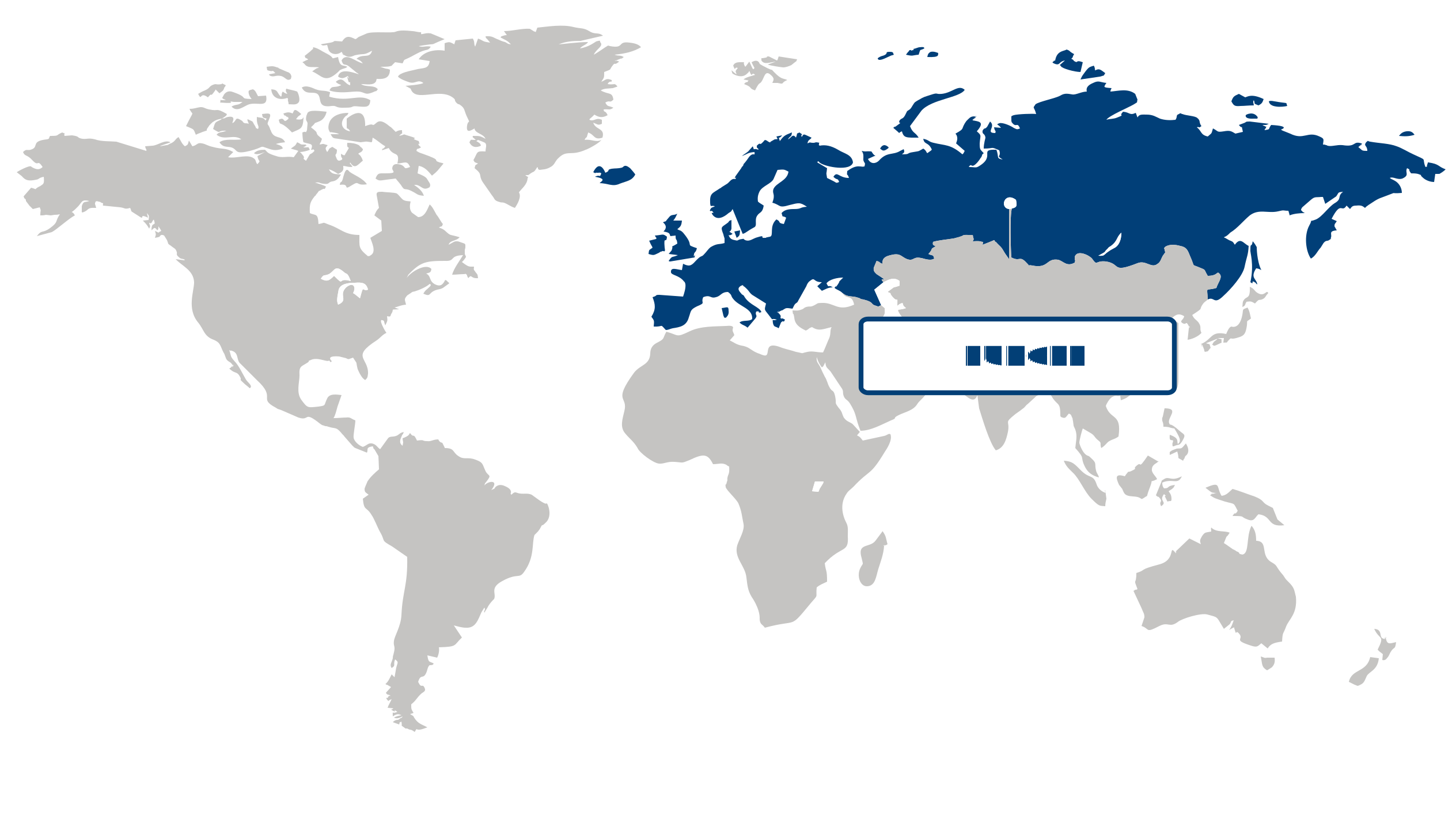
Largest Region
Europe
38.16% Market Share in 2026
Europe (Largest Region) vs Asia Pacific (Fastest-Growing Region)
Europe held the largest share of the induction cookware market at 38.16% in 2026, supported by strong consumer awareness of energy-efficient cooking technologies and established demand for modern kitchen appliances. Induction cooking is increasingly associated with precise temperature control, convenience, safety, and efficient energy use, aligning with European preferences for practical and environmentally conscious household products. Well-developed retail networks, premium kitchenware adoption, and continued interest in upgrading residential kitchens are further supporting demand for induction-compatible cookware.
Asia Pacific is projected to be the fastest-growing region as urbanization, changing lifestyles, and expanding middle-class households increase demand for modern cooking solutions. Consumers are increasingly seeking cookware compatible with contemporary induction appliances, particularly as compact urban kitchens and energy-conscious household practices become more common. Expanding appliance penetration, growth in organized retail and e-commerce, and increasing awareness of convenient cooking technologies are also creating favorable conditions for induction cookware adoption across the region.
Key Country Insights
The U.S. induction cookware market benefits from increasing adoption of induction cooktops in residential kitchens. Manufacturers emphasize durable materials, compatibility across induction appliances, and premium product designs that enhance cooking performance.
Japan favors induction cookware designed for space-efficient kitchens and precise temperature control. Manufacturers develop lightweight, high-quality products that meet consumer demand for convenience and compatibility with modern cooking appliances.
South Korea integrates induction cookware into smart kitchen ecosystems supported by advanced household appliances. Brands focus on stylish designs, durable coatings, and cookware optimized for efficient everyday cooking.
Germany prioritizes induction cookware that complements energy-efficient kitchen appliances and sustainable household practices. Consumers increasingly seek durable cookware with superior heat distribution and long-term performance.
France values induction cookware that delivers precise heat control for both professional and home cooking applications. Manufacturers highlight premium materials, ergonomic designs, and compatibility with evolving induction cooking technologies.
Italy combines functional performance with aesthetic appeal in the induction cookware market. Consumers increasingly prefer cookware that supports modern induction cooking while maintaining durability and suitability for traditional culinary techniques.
Segment Leadership and Growth Trends
Application Segment Analysis: Residential (Largest Segment) vs Commercial (Fastest-Growing Segment)
The residential segment dominated the induction cookware market with a 69.12% share in 2026, supported by growing household preference for energy-efficient, convenient, and precise cooking solutions. Induction cookware offers rapid heating, improved temperature control, and compatibility with modern induction cooktops, making it increasingly attractive for home kitchens. Rising adoption of electric cooking appliances, space-efficient kitchen designs, and consumer interest in safer and more efficient cooking technologies further reinforce the residential segment's leading position.
The commercial segment is gaining momentum as restaurants, hotels, catering operations, and institutional kitchens increasingly prioritize efficient cooking equipment and consistent thermal performance. Induction-based cookware supports faster preparation, precise heat regulation, and improved kitchen safety while reducing heat generation in working environments. The broader shift toward energy-efficient commercial kitchens and modern foodservice infrastructure is strengthening demand for induction cookware across professional applications.
Product Segment Analysis: Pans (Largest Segment) vs Pots (Fastest-Growing Segment)
Holding the largest share of the induction cookware market, the pans segment accounted for 52.83% in 2026, reflecting their broad utility across everyday cooking activities. Pans are widely used for frying, sautéing, searing, and shallow cooking, making them a practical choice for households seeking versatile induction-compatible cookware. Their frequent use, compatibility with varied recipes, and availability across multiple designs and materials support sustained demand within the product category.
The pots segment is emerging as the faster-growing product category as consumers and professional users increasingly seek cookware suited to boiling, simmering, stewing, and batch preparation. Growing interest in multifunctional cooking equipment and induction-compatible solutions is expanding the role of pots in modern kitchens. Their suitability for preparing larger-volume meals and diverse food types is also supporting broader adoption across residential and foodservice settings.
| Report Segmentation | |||
| Segment | Sub-Segment | Largest Segment | Fastest Growing Segment |
|---|---|---|---|
| Application | Residential, Commercial | Residential | Commercial |
| Product | Pans, Pots, Others | Pans | Pots |
| Material | Stainless Steel, Cast Iron, Carbon Steel, Others | Stainless Steel | Carbon Steel |
| Distribution Channel | Supermarket/ Hypermarket, Specialty Stores, Online, Others | Supermarket/ Hypermarket | Online |
 Read our Research Approach
Competitive Landscape and Market Positioning
Top players in the induction cookware market:
1. Werhahn Group (Germany)
2. Groupe SEB (France)
3. Meyer Corporation (United States)
4. Fissler GmbH (Germany)
5. Tramontina S.A. (Brazil)
6. Newell Brands Inc. (United States)
7. Scanpan A/S (Denmark)
8. Le Creuset (France)
9. Chantal Corporation (United States)
10. Mauviel 1830 (France)
In the induction cookware market, innovation is centered on improving thermal efficiency and user experience through advanced material engineering. New cookware designs are being introduced to enhance heat distribution and cooking precision. Product differentiation is increasingly driven by ergonomic and performance-oriented features. Ongoing development efforts are also improving durability and energy efficiency across product lines.
Industry Development/News
| Company Name | Date | Key Development |
|---|---|---|
| BURN | Jul-25 | BURN secured a USD 15 million investment from the European Investment Bank (EIB) to expand distribution of its ECOA Electric Induction Cooker across East Africa through its Pay-As-You-Cook financing model. The funding supports wider adoption of induction cooking technology while strengthening the company's regional commercialization and distribution network. |
| Groupe SEB | Jan-23 | Groupe SEB extended its partnership with GXO to secure additional warehouse capacity supporting its UK and Ireland omnichannel operations. The expanded logistics collaboration strengthens supply chain efficiency and distribution capabilities, enabling the company to support sustainable growth and improve product availability across its cookware portfolio. |
| All-Clad | Jul-23 | All-Clad introduced a new enameled cast iron cookware collection comprising a braiser, Dutch oven, grill pan, and griddle. Manufactured using 97% recycled materials, the launch expands the company's premium cookware portfolio while reinforcing its focus on sustainable product development compatible with modern cooking applications, including induction cooktops. |
| Tefal | Jun-23 | Tefal launched the RENEW cookware range featuring pots and pans manufactured with 100% recycled aluminum and the company's Inoceramic non-stick ceramic coating. The product introduction strengthens its sustainable cookware portfolio while addressing growing consumer demand for environmentally responsible cookware compatible with induction cooking systems. |
Why Choose Us
Specialized Expertise: Our team comprises industry experts with a deep understanding of your market segment. We bring specialized knowledge and experience that ensures our research and consulting services are tailored to your unique needs.
Customized Solutions: We understand that every client is different. That's why we offer customized research and consulting solutions designed specifically to address your challenges and capitalize on opportunities within your industry.
Proven Results: With a track record of successful projects and satisfied clients, we have demonstrated our ability to deliver tangible results. Our case studies and testimonials speak to our effectiveness in helping clients achieve their goals.
Cutting-Edge Methodologies: We leverage the latest methodologies and technologies to gather insights and drive informed decision-making. Our innovative approach ensures that you stay ahead of the curve and gain a competitive edge in your market.
Client-Centric Approach: Your satisfaction is our top priority. We prioritize open communication, responsiveness, and transparency to ensure that we not only meet but exceed your expectations at every stage of the engagement.
Continuous Innovation: We are committed to continuous improvement and staying at the forefront of our industry. Through ongoing learning, professional development, and investment in new technologies, we ensure that our services are always evolving to meet your evolving needs.
Value for Money: Our competitive pricing and flexible engagement models ensure that you get maximum value for your investment. We are committed to delivering high-quality results that help you achieve a strong return on your investment.
Select Licence Type

