Industrial Heat Exchanger Market Size & Growth Forecast 2027–2036, By Segments (Material, Type, Distribution Channel, End Use Industry), Regional Demand Trends (North America, Asia Pacific, Europe), Key Country Insights (U.S., Japan, South Korea, Germany, France, Italy), and Competitive Landscape
Jump to content
Market Size and Growth Outlook
Industrial Heat Exchanger Market size was estimated at USD 21.39 Billion in 2026 and is projected to grow at 6.89% CAGR from 2027 to 2036, surpassing USD 41.65 Billion by 2036. The industry revenue for 2027 is calculated at USD 22.64 Billion.
Get more details on this report
Request Free Sample ReportIndustrial Heat Exchanger Market Intelligence Snapshot
Regional Market Dynamics
- Europe leads through its established industrial base, strong energy-efficiency focus, industrial decarbonization efforts, and investment in efficient thermal systems across energy-intensive industries.
- Asia Pacific is expanding rapidly through industrial growth, rising energy demand, new manufacturing facilities, and increasing adoption of energy conservation and process heat recovery.
Segment Momentum
- Steel accounted for 43.46% of the market in 2026 because it offers high mechanical strength, durability, temperature resistance, and reliable performance across demanding industrial applications.
- Plate heat exchangers are the fastest-growing type as industries increasingly prioritize energy efficiency, compact equipment, improved heat transfer performance, and lower operating costs in modern facilities.
Market Expansion Drivers
- Expanding HVAC and industrial cooling demand driving heat exchanger system installations
- Growth in oil, gas, and power generation sectors increasing heat transfer equipment deployment
- Energy efficiency regulations accelerating adoption of advanced thermal management technologies
Leading Market Participants
- Prominent companies in the industrial heat exchanger market include Alfa Laval AB (Sweden), Kelvion Holding GmbH (Germany), SPX FLOW, Inc. (United States), Danfoss A/S (Denmark), GEA Group AG (Germany), API Heat Transfer Inc. (United States), Tranter Inc. (United States), SWEP International AB (Sweden), Hisaka Works Ltd. (Japan), Chart Industries Inc. (United States)
Global Market Forecast Snapshot
Market Outlook
- 2026 Market Size: USD 21.39 Billion
- 2027 Estimated Market Size: USD 22.64 Billion
- Projected Market Size: USD 41.65 Billion by 2036
- Growth Forecast: 6.89% CAGR (2027-2036)
Regional and Segment Outlook
- Leading Regional Market: Europe
- High-Growth Regional Hub: Asia Pacific
- Core Revenue Segment: Steel (Material) | Shell and Tube Heat Exchangers (Type) | Direct (Distribution Channel) | Oil & Gas (End Use Industry)
- Emerging Opportunity Segment: Plastic (Material) | Plate Heat Exchangers (Type) | Indirect (Distribution Channel) | HVAC (End Use Industry)
Market Growth Drivers and Industry Trends
Expanding HVAC and industrial cooling demand driving heat exchanger system installations
Rising investments in commercial buildings, manufacturing facilities, and large-scale industrial operations are increasing the need for efficient heating and cooling infrastructure. The industrial heat exchanger market growth is driven by expanding HVAC deployments and industrial cooling requirements, where heat exchangers play a critical role in maintaining process temperatures, improving equipment reliability, and supporting continuous operations. Industries also prioritize thermal systems that optimize energy utilization while handling diverse operating conditions across production plants, warehouses, and processing facilities.
Growth in oil, gas, and power generation sectors increasing heat transfer equipment deployment
The continued expansion of oil and gas processing, refining activities, and power generation facilities is creating sustained demand for reliable heat transfer equipment capable of operating under demanding process conditions. This trend will propel the industrial heat exchanger market growth as these industries depend on efficient thermal exchange systems for applications such as cooling, condensation, evaporation, and energy recovery. Process operators increasingly require durable equipment that supports high-pressure environments while maintaining operational efficiency and minimizing unplanned maintenance interruptions.
Energy efficiency regulations accelerating adoption of advanced thermal management technologies
Strengthening energy conservation standards across industrial sectors are encouraging companies to modernize thermal systems with equipment that delivers greater operational efficiency and lower energy consumption. Within this transition, the industrial heat exchanger market benefits from growing adoption of advanced thermal management technologies designed to maximize heat recovery and reduce process energy losses. Manufacturers are integrating improved materials, optimized flow designs, and enhanced thermal performance into heat exchanger systems to comply with evolving efficiency requirements while supporting sustainable industrial operations.
| Growth Driver | Impact on CAGR | Regulatory Influence | Geographic Relevance | Adoption Rate | Impact Timeline |
|---|---|---|---|---|---|
| Expanding HVAC and industrial cooling demand driving heat exchanger system installations | 2.2% | Moderate | North America, Asia Pacific | High | Near Term |
| Growth in oil, gas, and power generation sectors increasing heat transfer equipment deployment | 2% | High | Middle East & Africa, Asia Pacific | High | Near Term |
| Energy efficiency regulations accelerating adoption of advanced thermal management technologies | 1.7% | High | Europe, North America | High | Mid Term |
Unlock insights tailored to your business with our bespoke market research solutions.
Click to get your customized report now.
Regional Demand Dynamics
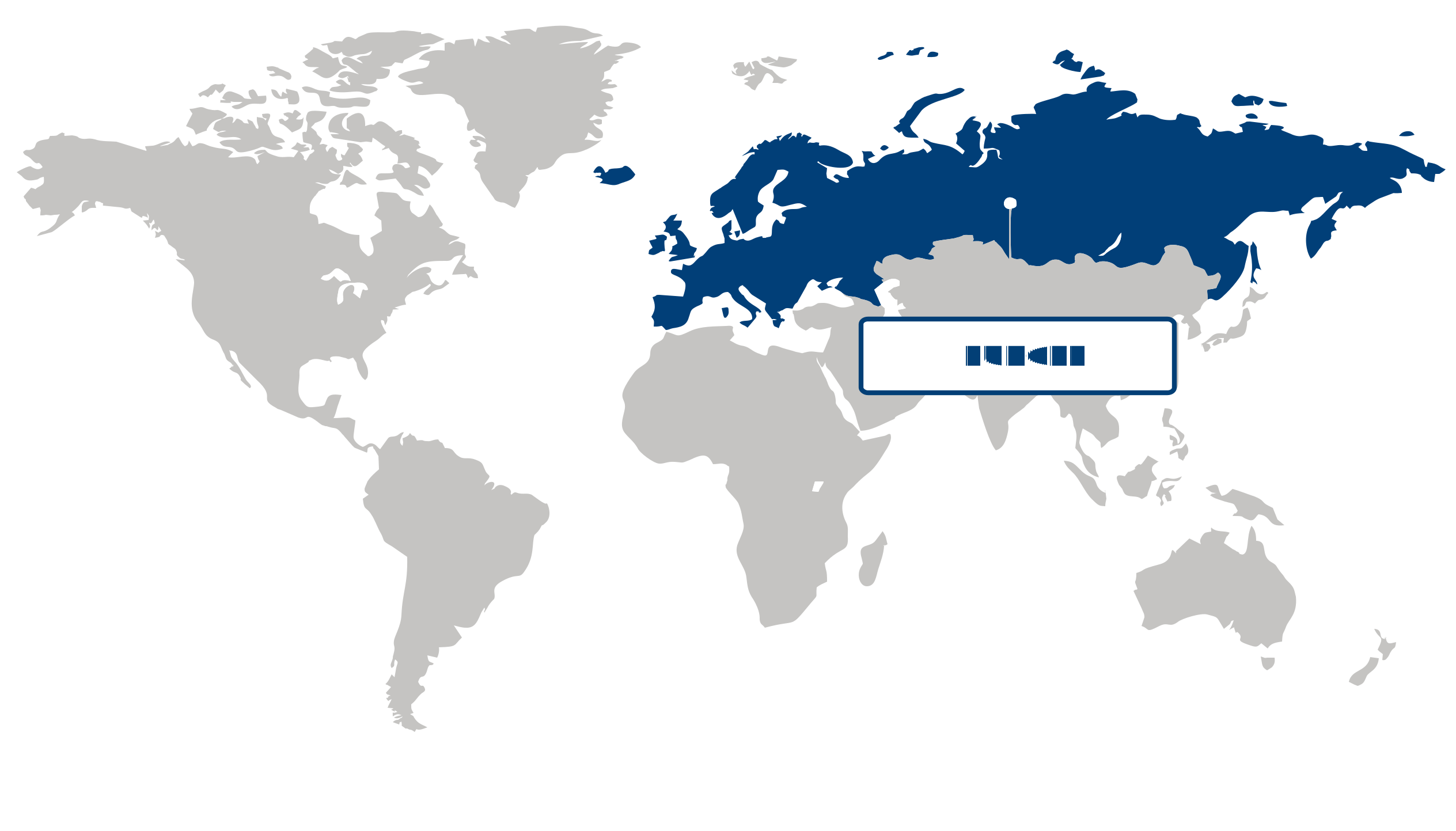
Europe (Largest Region)
Europe held the largest share of the industrial heat exchanger market in 2026, supported by its established industrial base, strong focus on energy efficiency, and increasing efforts to reduce energy consumption and emissions across manufacturing operations. Heat exchangers are widely used across chemical processing, power generation, food processing, refining, and other energy-intensive industries, where efficient heat recovery can improve operational performance. Europe's emphasis on industrial decarbonization and process optimization is encouraging companies to modernize thermal systems and adopt more efficient heat-transfer technologies. Growing investment in sustainable industrial infrastructure is further supporting demand for advanced heat exchanger solutions.
Asia Pacific (Fastest-Growing Region)
Asia Pacific is anticipated to be the fastest-growing regional market, fueled by rapid industrial expansion, increasing energy demand, and the development of manufacturing and processing facilities. Expanding chemical, petrochemical, food processing, power generation, and other industrial sectors are creating a broad application base for heat exchange equipment. Rising emphasis on energy conservation and operational efficiency is also encouraging industrial operators to improve thermal management and recover process heat. Furthermore, continued infrastructure development and investments in modern production facilities are strengthening demand for reliable and efficient heat exchanger systems across emerging economies in the region.
| Parameter | North America | Asia Pacific | Europe | Latin America | MEA |
|---|---|---|---|---|---|
| Innovation HubiScaleNascentDeveloping Advanced | |||||
| Cost-Sensitive RegioniScaleLowMedium High | |||||
| Regulatory EnvironmentiScaleRestrictiveNeutral Supportive | |||||
| Demand DriversiScaleWeakModerate Strong | |||||
| Development StageiScaleEmergingDeveloping Developed | |||||
| Adoption RateiScaleLowMedium High | |||||
| New Entrants / StartupsiScaleSparseModerate Dense | |||||
| Macro IndicatorsiScaleWeakStable Strong |
Key Country Insights
United States 🇺🇸
Process Efficiency FocusThe U.S. industrial heat exchanger market is driven by modernization across chemical, energy, and manufacturing facilities. U.S. buyers prioritize high-efficiency systems that reduce operating costs while supporting process optimization and increasingly stringent environmental compliance requirements.
Germany 🇩🇪
Advanced Manufacturing IntegrationGermany emphasizes industrial heat exchangers engineered for precision manufacturing and energy-efficient production lines. German industries invest in corrosion-resistant and high-performance thermal systems that improve operational reliability across industrial processing applications.
Japan 🇯🇵
Compact Thermal EngineeringJapan favors industrial heat exchangers with compact designs and high thermal efficiency for space-constrained industrial facilities. Japanese manufacturers continue refining advanced materials and precision engineering to enhance long-term equipment performance and maintenance efficiency.
South Korea 🇰🇷
Industrial Infrastructure UpgradesSouth Korea continues upgrading industrial heat exchanger installations across petrochemical, shipbuilding, and manufacturing sectors. Local demand centers on durable, energy-efficient systems capable of supporting continuous industrial operations and optimized thermal management.
France 🇫🇷
Sustainable Process SolutionsFrance promotes industrial heat exchangers that improve energy recovery and reduce industrial emissions. French manufacturers increasingly integrate advanced thermal technologies into processing facilities to support operational efficiency and sustainability objectives.
Italy 🇮🇹
Industrial Equipment ModernizationItaly's industrial heat exchanger market benefits from modernization across food processing, chemical production, and industrial manufacturing. Italian companies prioritize reliable thermal equipment that supports production efficiency while minimizing maintenance interruptions and energy consumption.
Industrial Heat Exchanger Market Share (%), by Material, 2026
Go beyond the chart, access full insights & data tables
Request Free Sample ReportMaterial Segment Analysis: Steel (Largest Segment) vs Plastic (Fastest-Growing Segment)
The steel segment dominated the industrial heat exchanger market, accounting for 43.46% in 2026. Steel remains the preferred material because of its excellent mechanical strength, high-temperature resistance, durability, and ability to withstand demanding industrial operating environments. Its broad compatibility with applications across oil and gas, chemical processing, power generation, and manufacturing industries has reinforced its leadership. Long service life and reliable performance under varying pressure and temperature conditions continue to support widespread adoption of steel-based heat exchangers.
The plastic segment is projected to witness the fastest growth during the forecast period. Advances in high-performance engineering plastics are expanding their use in applications involving corrosive fluids and aggressive chemical environments where lightweight construction and corrosion resistance provide significant operational advantages. Growing demand for energy-efficient systems with reduced maintenance requirements is also encouraging manufacturers to increase the adoption of plastic heat exchanger components across specialized industrial processes.
Type Segment Analysis: Shell and Tube Heat Exchangers (Largest Segment) vs Plate Heat Exchangers (Fastest-Growing Segment)
Shell and tube heat exchangers accounted for 43.14% of the industrial heat exchanger market in 2026, making them the largest segment. Their ability to accommodate high pressures, elevated temperatures, and demanding industrial fluids makes them indispensable across process industries. Their proven operational reliability, ease of customization, and suitability for continuous large-scale operations have maintained their strong position in sectors such as petrochemicals, power generation, and heavy manufacturing.
The plate heat exchanger segment is expected to register the fastest growth during the forecast period. Increasing emphasis on energy efficiency, compact equipment design, and enhanced heat transfer performance is accelerating adoption across a wider range of industrial applications. Plate heat exchangers offer efficient thermal performance while reducing installation space and operating costs, making them well suited to modern industrial facilities focused on optimizing energy utilization and process efficiency.
Distribution Channel Segment Analysis: Direct (Largest Segment) vs Indirect (Fastest-Growing Segment)
In the industrial heat exchanger market, the direct distribution channel held the largest share in 2026. Industrial buyers often procure heat exchangers directly from manufacturers to obtain customized solutions, technical support, installation guidance, and long-term maintenance services. Direct engagement also enables manufacturers to address complex application requirements while building stronger customer relationships and ensuring product performance throughout the equipment lifecycle.
The indirect distribution channel is expected to grow at the fastest pace during the forecast period. Expanding regional distribution networks, increasing participation of specialized industrial equipment suppliers, and growing demand from small and medium-sized industrial customers are strengthening indirect sales channels. These intermediaries enhance market accessibility, improve product availability, and provide localized support, enabling broader adoption of industrial heat exchangers across diverse end-use industries.
| Segment | Sub-Segment | Largest Segment | Fastest Growing |
|---|---|---|---|
| Material | Steel, Copper and Copper Alloys, Plastic, Others | Steel | Plastic |
| Type | Shell and Tube Heat Exchangers, Plate Heat Exchangers, Air-Cooled Heat Exchangers, Others | Shell and Tube Heat Exchangers | Plate Heat Exchangers |
| Distribution Channel | Direct, Indirect | Direct | Indirect |
| End Use Industry | Oil & Gas, Power Generation, Automotive, HVAC, Others | Oil & Gas | HVAC |
Competitive Landscape and Market Positioning
Leading companies in the industrial heat exchanger market:
- Alfa Laval AB (Sweden)
- Kelvion Holding GmbH (Germany)
- SPX FLOW, Inc. (United States)
- Danfoss A/S (Denmark)
- GEA Group AG (Germany)
- API Heat Transfer, Inc. (United States)
- Tranter, Inc. (United States)
- SWEP International AB (Sweden)
- Hisaka Works Ltd. (Japan)
- Chart Industries, Inc. (United States)
Efficiency improvements and application-specific design are becoming the primary battlegrounds within the industrial heat exchanger market as manufacturers seek to address rising expectations for energy optimization and process reliability across diverse industrial sectors. Competitive differentiation increasingly depends on engineering expertise that enables higher thermal performance, reduced maintenance requirements, and compatibility with demanding operating environments. At the same time, customers are placing greater value on customized system configurations, responsive technical support, and long-term operational performance, encouraging suppliers to strengthen both product development capabilities and aftermarket service networks.
| Company | Market Share | Company Revenue | Revenue CAGR (%) | Product Portfolio | Geographic Presence | Innovation / R&D Focus | Strategic Developments |
|---|---|---|---|---|---|---|---|
| Alfa Laval AB (Sweden) | |||||||
| Kelvion Holding GmbH (Germany) | |||||||
| SPX FLOW Inc. (United States) | |||||||
| Danfoss A/S (Denmark) | |||||||
| GEA Group AG (Germany) | |||||||
| API Heat Transfer Inc. (United States) | |||||||
| Tranter Inc. (United States) | |||||||
| SWEP International AB (Sweden) | |||||||
| Hisaka Works Ltd. (Japan) | |||||||
| Chart Industries Inc. (United States) |
Customize Your Report
Explore examples of how this report can be tailored to different research needs, including custom segments, additional topics or chapters, and related reports. Click a section of the wheel or its numbered marker to explore the available options.
Industrial Heat Exchanger Market — Custom Segments
| Segment | Sub-Segment |
|---|---|
| Heat Transfer Medium | Liquid-to-Liquid, Liquid-to-Gas, Gas-to-Gas, Condensing & Evaporating Media |
| Installation Configuration | Skid-Mounted Systems, Packaged Systems, Integrated Plant Systems, Custom Engineered Installations |
| Demand Type | New Plant Installations, Capacity Expansion & Upgrades, Replacement & Retrofit |
Industrial Heat Exchanger Market — Custom TOC
| Custom Chapter | Chapter Details |
|---|---|
| Decarbonization & Electrification Transformation |
|
| Industrial Retrofit Opportunity Mapping |
|
| Heat Recovery Business Case Development |
|
Need a different cut of the data?
Request Custom ResearchFrequently Asked Questions
How large is the industrial heat exchanger market?
What is the expected industry size of industrial heat exchanger by 2036?
Which industrial trends are driving demand for advanced heat exchanger systems?
How are energy efficiency initiatives shaping the industrial heat exchanger market?
Why is steel the leading material in the industrial heat exchanger market?
Which type of heat exchanger is growing the fastest in the industrial heat exchanger market?
Why does Europe hold the largest share of the industrial heat exchanger market?
What is driving faster growth of industrial heat exchangers in Asia Pacific?
Who holds a significant market share in the industrial heat exchanger landscape?
Our Clients
"The team at Fundamental Business Insights & Consulting demonstrated a commitment to excellence, not only in the quality of the report but also in their client-centric approach."
FANUC
"The level of detail in the market segmentation provided were particularly noteworthy. The detailed country-level insights were also very helpful."
B&R Industrial Automation GmbH
"The consultant took the time to understand our specific business objectives, ensuring that the reports were tailored to address our unique challenges and opportunities."
KUKA SE & Co. KGaA
Our Research Team & Methodology
Every Fundamental Business Insights report is built by a dedicated vertical research team, validated through a structured primary-and-secondary methodology, and reviewed for accuracy before it reaches you.
Delivery
Published
Available
Support
- Market Size & Forecast
- Market Segmentation
- Regional Analysis
- Growth Drivers & Challenges
- Market Dynamics
- Competitive Landscape
- Company Profiles
- Competitive Benchmarking
- Mergers & Acquisitions
- Market Share Analysis or Key Company Strategies
- Value Chain Analysis
- Porter's Five Forces
- PESTLE Analysis
- Pricing Trends
- Supply-Demand Analysis
- Technology Landscape
- Regulatory Landscape
- Investment & Funding Landscape
- Emerging Opportunities
- Future Market Outlook