



Industry 4.0 Market Size & Growth Forecast 2027–2036, By Segments (Component, Industry Vertical, Technology), Regional Demand Trends (North America, Asia Pacific, Europe), Key Country Insights (U.S., Japan, South Korea, Germany, France, Italy), and Competitive Landscape
Market Size and Growth Outlook
Industry 4.0 Market size was over USD 303.6 billion in 2026 and is likely to grow at a 17.1% CAGR between 2027 and 2036, attaining USD 1.47 trillion by 2036. The industry revenue for 2027 is calculated at USD 347.32 billion.
Base Year Value (2026)
USD 303.6 billion
CAGR (2027-2036)
17.10%
Forecast Year Value (2036)
USD 1.47 trillion

Historical Data Period
2022-2026

Largest Region
Europe

Forecast Period
2027-2036
Industry 4.0 Market Intelligence Snapshot:
-
Regional Market Dynamics:
- Europe leads due to deep industrial base, early automation integration, and widespread connected production systems improving efficiency, uptime, and precision manufacturing operations.
- Asia Pacific is expanding at a 22.29% CAGR, driven by rapid industrial modernization and adoption of smart manufacturing systems improving throughput, productivity, and real-time production monitoring.
-
Segment Momentum:
- Hardware accounted for 53% of the market in 2026 because sensors, controllers, robotics, and industrial networking equipment provide the essential infrastructure required for connected industrial operations and digital transformation.
- Automotive is the fastest-growing vertical as manufacturers increasingly adopt advanced automation and digitally integrated workflows to support precision production, complex assembly operations, and greater manufacturing flexibility.
-
Market Expansion Drivers:
- Rapid adoption of AI, IoT, and automation across manufacturing accelerating smart factory transformation.
- Increasing deployment of IIoT-enabled predictive maintenance improving industrial efficiency and uptime.
- Rising cybersecurity and regulatory compliance needs driving secure industrial digital infrastructure investments.
-
Leading Market Participants:
Prominent companies in the industry 4.0 market include Siemens AG (Germany), ABB Ltd. (Switzerland), Schneider Electric SE (France), Robert Bosch GmbH (Germany), Rockwell Automation, Inc. (United States), Honeywell International Inc. (United States), Emerson Electric Co. (United States), Cisco Systems, Inc. (United States), FANUC Corporation (Japan), KUKA AG (Germany).
Global Market Forecast Snapshot:
-
Market Outlook:
- 2026 Market Size: USD 303.6 billion
- 2027 Estimated Market Size: USD 347.32 billion.
- Projected Market Size: USD 1.47 trillion by 2036
- Growth Forecasts: 17.1% CAGR (2027-2036)
-
Regional and Segment Outlook:
- Leading Regional Market: Europe
- High-Growth Regional Hub: Asia Pacific
- Core Revenue Segment: Hardware (Component) | Manufacturing (Industry Vertical) | Industrial Internet of Things (IIoT) (Technology)
- Emerging Opportunity Segment: Software (Component) | Automotive (Industry Vertical) | Blockchain & Secure Data Exchange (Technology)
Market Growth Drivers and Industry Trends
Rapid adoption of AI, IoT, and automation across manufacturing accelerating smart factory transformation
The rapid integration of AI, IoT, and automation technologies will propel the industry 4.0 market by enabling manufacturers to transform conventional production facilities into connected and intelligent smart factories. AI-based systems can analyze operational data, optimize production parameters, and support faster decision-making, while IoT devices provide continuous visibility into machines, processes, and material flows. Automation further improves consistency and reduces dependence on manual intervention across repetitive manufacturing activities. The combination of these technologies allows factories to coordinate production assets more effectively, improve resource utilization, and support flexible manufacturing models suited to changing customer requirements.
Increasing deployment of IIoT-enabled predictive maintenance improving industrial efficiency and uptime
The industry 4.0 market growth is increasingly supported by IIoT-enabled predictive maintenance, as connected sensors can continuously monitor equipment conditions and identify abnormal operating patterns before failures occur. Manufacturers can use real-time information on vibration, temperature, pressure, and other machine parameters to schedule maintenance based on actual equipment requirements rather than fixed intervals. This approach helps reduce unexpected production interruptions, optimize maintenance resources, and extend the useful life of industrial assets. Integration with analytics platforms also enables maintenance teams to prioritize critical equipment and coordinate service activities with production schedules.
Rising cybersecurity and regulatory compliance needs driving secure industrial digital infrastructure investments
Rising cybersecurity risks across connected factories will boost the industry 4.0 market as manufacturers increasingly recognize the need to protect operational technology, industrial networks, and production data from unauthorized access and disruption. Greater connectivity between machines, enterprise systems, cloud platforms, and remote users expands the number of potential entry points, creating demand for secure network architectures, identity controls, monitoring tools, and industrial cybersecurity solutions. Regulatory compliance requirements further encourage manufacturers to establish structured data governance, access management, and security monitoring practices, particularly where production systems handle sensitive operational information.
| Growth Driver Assessment Framework | |||||
| Growth Driver | Impact On CAGR | Regulatory Influence | Geographic Relevance | Adoption Rate | Impact Timeline |
|---|---|---|---|---|---|
| Rapid adoption of AI, IoT, and automation across manufacturing accelerating smart factory transformation | 2.40% | High | Asia Pacific, Europe, North America | High | Near Term |
| Increasing deployment of IIoT-enabled predictive maintenance improving industrial efficiency and uptime | 2.00% | High | North America, Europe, Asia Pacific | High | Mid Term |
| Rising cybersecurity and regulatory compliance needs driving secure industrial digital infrastructure investments | 1.60% | High | North America, Europe | Medium | Long Term |
Unlock insights tailored to your business with our bespoke market research solutions - Click to get your customized report now!
Regional Demand Dynamics
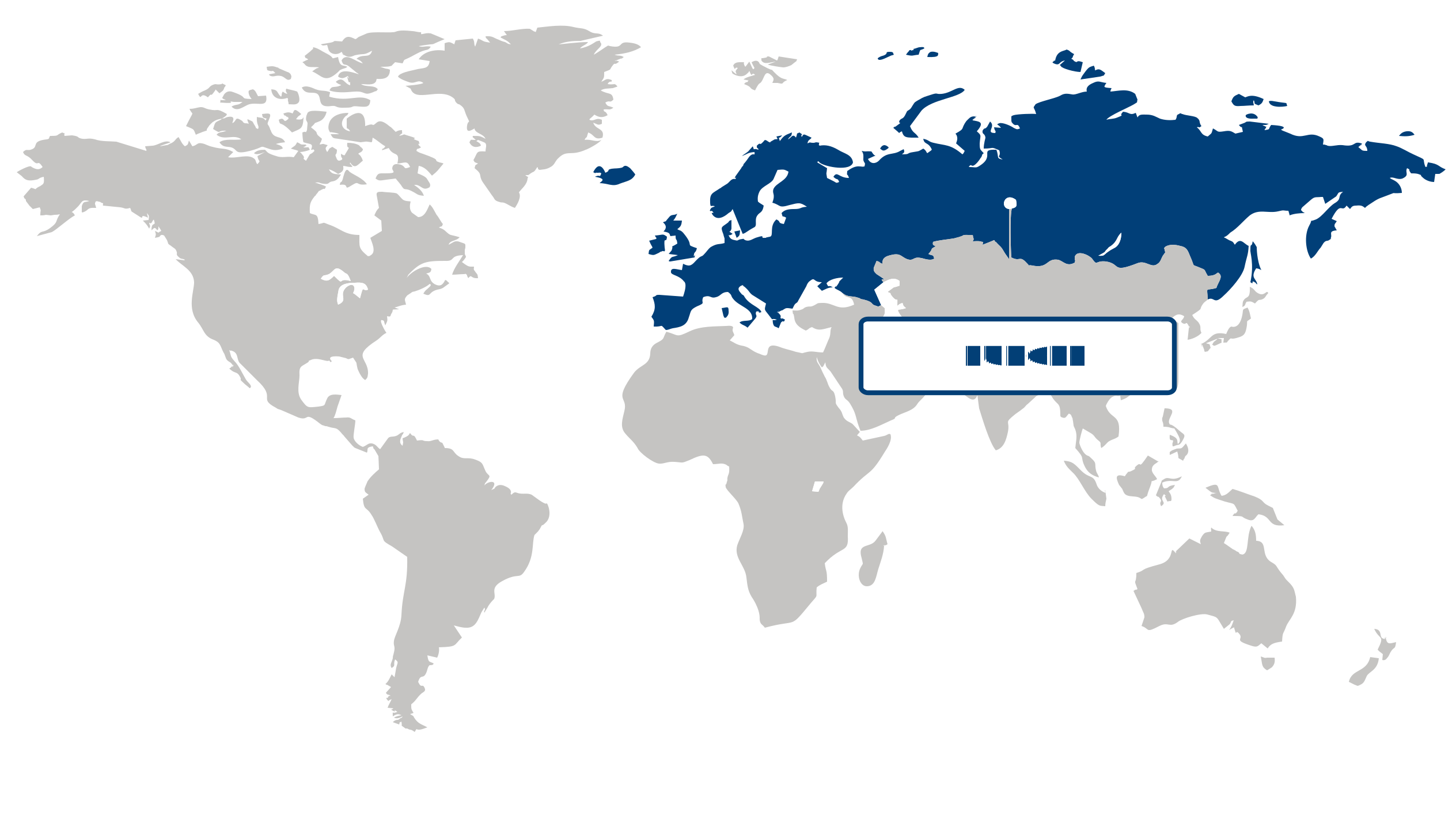
Largest Region
Europe
Largest Market Share in 2026
Europe (Largest Region) vs Asia Pacific (Fastest-Growing Region)
Europe maintained the largest position in the industry 4.0 market in 2026, supported by its mature industrial ecosystem, strong focus on manufacturing modernization, and widespread adoption of connected production technologies. The region benefits from a well-developed base of advanced manufacturing facilities and a high level of industrial automation, enabling manufacturers to integrate smart sensors, industrial internet technologies, robotics, artificial intelligence, and data-driven process optimization into production environments. Strong emphasis on operational efficiency, energy management, and digital transformation is further encouraging enterprises to upgrade legacy systems and adopt interconnected manufacturing architectures. In addition, regulatory attention toward industrial sustainability and resource efficiency is reinforcing investment in technologies that improve production visibility, reduce waste, and support more flexible manufacturing operations.
Asia Pacific is emerging as the fastest-growing regional market, driven by rapid industrialization, expanding manufacturing capacity, and accelerating digital transformation across major production economies. Increasing adoption of automation and connected technologies is being supported by the expansion of electronics, automotive, machinery, and other technology-intensive industries, while manufacturers are increasingly seeking greater productivity, quality control, and supply-chain visibility. The growing availability of digital infrastructure and increasing investments in smart factories are also creating favorable conditions for broader deployment of industry 4.0 solutions. Government-led initiatives supporting advanced manufacturing, industrial digitization, and technological upgrading are further strengthening the region's growth trajectory as businesses transition toward more intelligent and data-driven production models.
Key Country Insights
The U.S. Industry 4.0 market emphasizes connected manufacturing through industrial IoT, AI, and advanced analytics. Enterprises prioritize operational visibility, predictive maintenance, and scalable automation to improve production efficiency across diverse industrial sectors.
Japan advances Industry 4.0 by combining robotics, sensor technologies, and connected manufacturing platforms to optimize factory performance. Companies emphasize operational reliability, quality improvement, and efficient production management through digital transformation initiatives.
South Korea accelerates Industry 4.0 adoption through AI-enabled automation, smart factories, and high-speed industrial connectivity. Manufacturers prioritize integrated production environments that improve process monitoring, equipment utilization, and manufacturing responsiveness.
Germany focuses on Industry 4.0 solutions that integrate automation, digital twins, and intelligent production systems into advanced manufacturing environments. Industrial organizations continue modernizing operations with interoperable technologies that strengthen manufacturing precision and flexibility.
France promotes Industry 4.0 through modernization programs that encourage digital manufacturing and connected industrial operations. Companies increasingly deploy data-driven production technologies to improve operational efficiency and enhance manufacturing competitiveness.
Italy emphasizes Industry 4.0 investments that modernize production while supporting flexible manufacturing across diverse industrial segments. Manufacturers focus on automation, machine connectivity, and digital process optimization to improve operational performance.
Segment Leadership and Growth Trends
Component Segment Analysis: Hardware (Largest Segment) vs Software (Fastest-Growing Segment)
Hardware represented the largest component segment in the industry 4.0 market, accounting for a 53% share in 2026. The segment's strong position reflects the foundational role of connected physical technologies in modern industrial transformation. Sensors, industrial control equipment, robotics, connectivity infrastructure, and other smart devices provide the physical layer required to collect operational data and connect industrial assets with digital systems. Manufacturers increasingly rely on these technologies to improve production visibility, automate repetitive processes, monitor equipment performance, and support real-time decision-making. The continued modernization of production facilities therefore sustains demand for hardware capable of enabling connected and intelligent industrial environments.
Software is expected to be the fastest-growing component segment as manufacturers increasingly move beyond basic connectivity toward data-driven optimization and intelligent automation. Industrial software enables organizations to interpret information generated by connected equipment, coordinate production processes, identify operational inefficiencies, and support predictive decision-making. The growing integration of artificial intelligence, analytics, digital twins, and cloud-based industrial platforms is expanding the strategic importance of software within industry 4.0 deployments. As enterprises seek to extract greater business value from connected infrastructure, software is becoming increasingly central to transforming industrial data into actionable operational insights.
Industry Vertical Segment Analysis: Manufacturing (Largest Segment) vs Automotive (Fastest-Growing Segment)
The manufacturing segment accounted for the largest share of the industry 4.0 market at 32.86% in 2026, reflecting the sector's direct need for automation, connected production systems, real-time monitoring, and process optimization. Manufacturers are increasingly adopting smart technologies to improve production efficiency, enhance quality control, reduce operational disruptions, and increase visibility across complex production environments. Industry 4.0 solutions also support greater flexibility in manufacturing by enabling connected machinery and data-driven production management. As industrial organizations continue modernizing facilities and integrating digital technologies into core operations, manufacturing remains a central application area for industry 4.0 solutions.
Automotive is positioned as the fastest-growing industry vertical as vehicle production becomes increasingly dependent on automation, connected manufacturing, advanced robotics, and digitally integrated production systems. Automotive manufacturers face growing requirements for flexible production, precision, quality assurance, and efficient management of complex supply and manufacturing processes. Industry 4.0 technologies can support these objectives by connecting production assets, enabling real-time monitoring, and improving coordination across manufacturing operations. The industry's ongoing transition toward technologically advanced vehicle platforms is also encouraging manufacturers to modernize production environments, creating additional opportunities for smart factory technologies and digital industrial solutions.
| Report Segmentation | |||
| Segment | Sub-Segment | Largest Segment | Fastest Growing Segment |
|---|---|---|---|
| Component | Hardware, Software, Services | Hardware | Software |
| Industry Vertical | Manufacturing, Petrochemicals, Automotive, Energy & Utilities, Oil & Gas, Food & Beverage, Aerospace & Defense, Others | Manufacturing | Automotive |
| Technology | Industrial Internet of Things (IIoT), Robotics & Automation, Artificial Intelligence & Machine Learning (AI & ML), Big Data & Advanced Analytics, Additive Manufacturing, Augmented Reality & Virtual Reality (AR & VR), Digital Twin & Simulation, Blockchain & Secure Data Exchange, Others | Industrial Internet of Things (IIoT) | Blockchain & Secure Data Exchange |
 Read our Research Approach
Competitive Landscape and Market Positioning
Prominent players in the industry 4.0 market:
1. Siemens AG (Germany)
2. ABB Ltd. (Switzerland)
3. Schneider Electric SE (France)
4. Robert Bosch GmbH (Germany)
5. Rockwell Automation Inc. (United States)
6. Honeywell International Inc. (United States)
7. Emerson Electric Co. (United States)
8. Cisco Systems Inc. (United States)
9. FANUC Corporation (Japan)
10. KUKA AG (Germany)
The industry 4.0 market is transforming manufacturing ecosystems through integration of smart automation, IoT-enabled systems, and AI-driven analytics. Continuous advancement in connected industrial technologies is improving productivity and operational intelligence. The industry 4.0 market is increasingly defined by digital manufacturing transformation and intelligent production systems.
Industry Development/News
| Company Name | Date | Key Development |
|---|---|---|
| RTX | Feb-26 | Pratt & Whitney, a subsidiary of RTX, is investing $200 million in a new isothermal forging press at its Georgia facility. This capital expenditure significantly expands production capacity and integrates advanced manufacturing technology for critical commercial and military aerospace programs. |
| NXP Semiconductors | Aug-25 | NXP Semiconductors acquired Port GmbH to bolster its industrial edge computing portfolio. By integrating specialized protocol software into its processor architecture, the company strengthens its technological position in enabling Industry 4.0-compliant industrial systems and real-time connectivity. |
| Accenture | Feb-25 | Accenture acquired Staufen to scale its specialized Industry 4.0 consulting and integration capabilities. The acquisition enhances the firm's capacity to deliver complex manufacturing optimization and digital transformation projects, directly supporting operational efficiency initiatives for industrial clients. |
| Interspectral | Aug-24 | Interspectral secured an investment round led by Navigare Ventures to accelerate the development of its AI-driven quality assurance solutions. The focus is on enhancing inspection accuracy and production reliability within additive manufacturing, a critical component of high-precision Industry 4.0 production environments. |
| ADF Engineering | May-26 | ADF Engineering partnered with Heartland Growth Partners to scale its operations and accelerate the deployment of AI-driven automation. This strategic move aims to improve operational efficiency and advance digital transformation across its engineering and manufacturing processes. |
| InfraX | Oct-25 | InfraX and MEA-Comm formed a strategic partnership in the UAE to accelerate Industry 4.0 implementation. The collaboration focuses on deploying digital twin technology, edge computing architectures, and private industrial IoT networks to enable real-time operational monitoring and management. |
| Dixon Technologies | Aug-25 | Dixon Technologies entered a master services agreement with Tech Mahindra to implement Industry 4.0 solutions across its manufacturing and R&D facilities. The initiative prioritizes AI-led automation and smart factory transformation to modernize production workflows in India. |
| MGA MedTech | Sep-24 | MGA MedTech launched a sustainable Industry 4.0 medical technology facility in France. The site integrates smart production systems specifically designed for the advanced digital manufacturing of medical devices and diagnostic equipment, establishing a new operational benchmark for the sector. |
| Ford | Apr-24 | Ford is executing an Industry 4.0-enabled manufacturing transformation at its Oakville operations. The project focuses on deploying highly digitalized and flexible production systems, specifically engineered to support the scaling of electric vehicle production and improve manufacturing responsiveness. |
| Denso Corporation | Aug-23 | Denso Corporation acquired a full stake in horticultural facility operator Certhon Group. The strategic acquisition aims to leverage the combined expertise of both entities to develop advanced automated systems and smart facility technologies to address global food production challenges through Industry 4.0 solutions. |
Why Choose Us
Specialized Expertise: Our team comprises industry experts with a deep understanding of your market segment. We bring specialized knowledge and experience that ensures our research and consulting services are tailored to your unique needs.
Customized Solutions: We understand that every client is different. That's why we offer customized research and consulting solutions designed specifically to address your challenges and capitalize on opportunities within your industry.
Proven Results: With a track record of successful projects and satisfied clients, we have demonstrated our ability to deliver tangible results. Our case studies and testimonials speak to our effectiveness in helping clients achieve their goals.
Cutting-Edge Methodologies: We leverage the latest methodologies and technologies to gather insights and drive informed decision-making. Our innovative approach ensures that you stay ahead of the curve and gain a competitive edge in your market.
Client-Centric Approach: Your satisfaction is our top priority. We prioritize open communication, responsiveness, and transparency to ensure that we not only meet but exceed your expectations at every stage of the engagement.
Continuous Innovation: We are committed to continuous improvement and staying at the forefront of our industry. Through ongoing learning, professional development, and investment in new technologies, we ensure that our services are always evolving to meet your evolving needs.
Value for Money: Our competitive pricing and flexible engagement models ensure that you get maximum value for your investment. We are committed to delivering high-quality results that help you achieve a strong return on your investment.
Select Licence Type

