Intermediate Bulk Container Liner Market Size & Growth Forecast 2027–2036, By Segments (Capacity, Application), Regional Demand Trends (North America, Asia Pacific, Europe), Key Country Insights (U.S., Japan, South Korea, Germany, France, Italy), and Competitive Landscape
Market Size and Growth Outlook
Intermediate Bulk Container Liner Market size was over USD 1.16 billion in 2026 and is likely to grow at a 5.13% CAGR between 2027 and 2036, crossing USD 1.91 billion by 2036. The industry revenue for 2027 is calculated at USD 1.21 billion.
Get more details on this report
Request Free Sample ReportIntermediate Bulk Container Liner Market Intelligence Snapshot
Regional Market Dynamics
- Europe leads due to established industrial packaging ecosystem, strong chemical and food logistics, and mature cross-border supply chains requiring standardized bulk handling solutions.
- Asia Pacific grows at 6.22% CAGR driven by rising manufacturing output, export-oriented supply chains, and increasing adoption of efficient bulk packaging for commodities.
Segment Momentum
- The above 1000 liters segment held a 69.12% share in 2026 because it supports efficient bulk transport and storage by reducing container changeovers and lowering handling effort for high-volume liquid movements.
- Industrial liquids are the fastest-growing application segment as companies increasingly adopt liner solutions to improve bulk liquid handling efficiency, cleanliness, and flexibility across diverse processing and logistics operations.
Market Expansion Drivers
- Expanding global food and beverage trade increasing demand for bulk liquid transportation packaging.
- Rising international dairy exports driving adoption of hygienic flexible bulk container liners.
- Increasing preference for cost-efficient and contamination-resistant bulk packaging solutions supporting liner demand.
Leading Market Participants
- Top companies in the intermediate bulk container liner market include Amcor plc (Switzerland), Sealed Air Corporation (United States), Greif, Inc. (United States), Scholle IPN Corporation (United States), Liquibox Corporation (United States), CDF Corporation (United States), ILC Dover LP (United States), Smurfit Kappa Group plc (Ireland), Arena Products, Inc. (United States), Qbig Packaging B.V. (Netherlands).
Global Market Forecast Snapshot
Market Outlook
- 2026 Market Size: USD 1.16 billion
- 2027 Estimated Market Size: USD 1.21 billion.
- Projected Market Size: USD 1.91 billion by 2036
- Growth Forecast: 5.13% CAGR (2027-2036)
Regional and Segment Outlook
- Leading Regional Market: Europe
- High-Growth Regional Hub: Asia Pacific
- Core Revenue Segment: Above 1000 Liters (Capacity) | Food & Beverage (Application)
- Emerging Opportunity Segment: Upto 1000 Liters (Capacity) | Industrial Liquids (Application)
Market Growth Drivers and Industry Trends
Expanding global food and beverage trade increasing demand for bulk liquid transportation packaging
Growth in international food and beverage trade is increasing the movement of liquid and semi-liquid products across longer and more complex supply chains. The intermediate bulk container liner market is supported by the need for packaging systems that can facilitate efficient transportation of products such as food ingredients, beverages, syrups, oils, and other bulk liquids within intermediate containers. Flexible liners can provide an internal barrier between the transported product and the outer container, supporting handling efficiency while helping manufacturers and logistics operators manage bulk shipments across different transportation modes.
Rising international dairy exports driving adoption of hygienic flexible bulk container liners
Increasing cross-border movement of dairy products and ingredients is creating stronger requirements for packaging that maintains product hygiene throughout storage and transportation. The intermediate bulk container liner market benefits from the use of flexible liners that can provide a clean internal surface and help protect dairy products from direct contact with the reusable outer container. This packaging approach is particularly relevant for liquid dairy ingredients and other sensitive food products where contamination control, handling convenience, and preservation of product integrity are important considerations during international distribution.
Increasing preference for cost-efficient and contamination-resistant bulk packaging solutions supporting liner demand
Manufacturers and logistics operators are increasingly seeking packaging formats that balance transportation efficiency, product protection, and operating costs. Within the intermediate bulk container liner market, liners provide a practical barrier that can help minimize contamination risks while supporting the use of bulk containers for repeated logistics operations. Their flexible construction can also simplify filling, unloading, handling, and container preparation across supply chains, making liner-based systems attractive for industries transporting food, beverages, chemicals, and other bulk materials where product cleanliness and efficient packaging management are essential.
| Growth Driver | Impact on CAGR | Regulatory Influence | Geographic Relevance | Adoption Rate | Impact Timeline |
|---|---|---|---|---|---|
| Expanding global food and beverage trade increasing demand for bulk liquid transportation packaging | 1.80% | Moderate | Asia Pacific, North America | High | Near Term |
| Rising international dairy exports driving adoption of hygienic flexible bulk container liners | 1.50% | Moderate | North America, Latin America | High | Mid Term |
| Increasing preference for cost-efficient and contamination-resistant bulk packaging solutions supporting liner demand | 1.30% | Low | Europe, Asia Pacific | Emerging | Mid Term |
Explore Growth Opportunities
Request Free Sample ReportRegional Demand Dynamics
Europe (Largest Region)
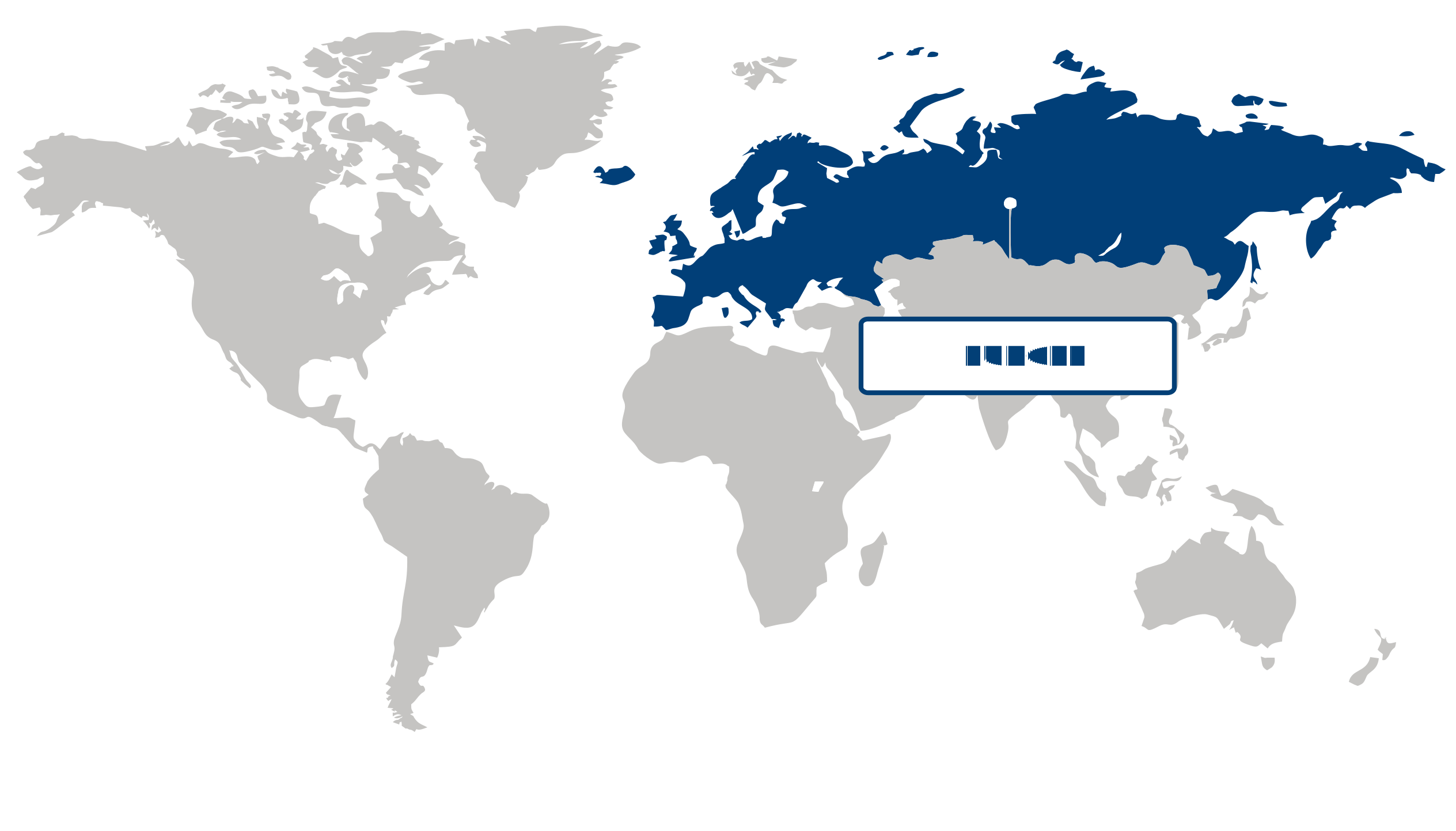
Europe dominated the intermediate bulk container liner market and held the largest share in 2026, supported by its extensive manufacturing base, mature logistics infrastructure, and strong demand for efficient bulk transportation solutions. The region's established chemical, food and beverage, pharmaceutical, and agricultural industries generate substantial requirements for hygienic and cost-efficient handling of bulk materials. Intermediate bulk container liners help improve product protection, simplify handling, and reduce cleaning requirements, making them valuable across industries where contamination control and operational efficiency are important. Increasing attention to sustainable packaging practices and resource-efficient logistics is also encouraging businesses to evaluate liner solutions that can optimize transportation and handling processes.
Asia Pacific (Fastest-Growing Region)
Asia Pacific represents the fastest-growing region, driven by expanding manufacturing activity, rising international trade, and the development of logistics and warehousing infrastructure. Growth across food processing, chemicals, pharmaceuticals, agriculture, and other bulk-handling industries is creating broader applications for intermediate bulk container liners. Manufacturers and logistics operators are increasingly seeking packaging solutions that improve loading efficiency, product protection, and handling convenience as supply chains become more sophisticated. The expansion of industrial production and export-oriented trade, together with greater adoption of modern bulk packaging practices, is creating favorable conditions for continued demand across the region.
| Parameter | North America | Asia Pacific | Europe | Latin America | MEA |
|---|---|---|---|---|---|
| Innovation Hub i Scale Nascent Developing Advanced | |||||
| Cost-Sensitive Region i Scale Low Medium High | |||||
| Regulatory Environment i Scale Restrictive Neutral Supportive | |||||
| Demand Drivers i Scale Weak Moderate Strong | |||||
| Development Stage i Scale Emerging Developing Developed | |||||
| Adoption Rate i Scale Low Medium High | |||||
| New Entrants / Startups i Scale Sparse Moderate Dense | |||||
| Macro Indicators i Scale Weak Stable Strong |
Key Country Insights
Germany 🇩🇪
Industrial Packaging ReliabilityGermany emphasizes durable intermediate bulk container liners that meet stringent industrial quality and product protection requirements. German manufacturers focus on packaging solutions that improve operational efficiency while supporting safe bulk material transportation.
France 🇫🇷
Sustainable Packaging PracticesFrance encourages intermediate bulk container liner adoption alongside sustainable industrial packaging initiatives and efficient bulk transportation. French businesses increasingly evaluate recyclable and resource-efficient liner materials without compromising product safety or operational performance.
Italy 🇮🇹
Flexible Industrial SupplyItaly supports intermediate bulk container liner usage across chemical, food, and specialty manufacturing applications requiring adaptable packaging solutions. Italian producers prioritize liners that improve operational flexibility while maintaining reliable protection during bulk product distribution.
Japan 🇯🇵
Clean Handling SolutionsJapan prioritizes intermediate bulk container liners designed for contamination control and efficient handling across sensitive manufacturing sectors. Japanese companies increasingly adopt high-quality liner systems that support product integrity throughout storage and distribution.
South Korea 🇰🇷
Export Packaging PerformanceSouth Korea strengthens demand for intermediate bulk container liners that support export-oriented supply chains and efficient bulk logistics. South Korean manufacturers value liner solutions that enhance product protection while improving loading and unloading processes.
United States 🇺🇸
Bulk Logistics EfficiencyThe U.S. market prioritizes intermediate bulk container liners that improve transport efficiency for food, chemical, and industrial products. Manufacturers and logistics providers increasingly favor high-performance liners that reduce contamination risks and simplify bulk handling operations.
Segment Leadership and Growth Trends
Intermediate Bulk Container Liner Market Share (%), by Capacity, 2026
Go beyond the chart, access full insights & data tables
Request Free Sample ReportCapacity Segment Analysis: Above 1000 Liters (Largest Segment) vs Upto 1000 Liters (Fastest-Growing Segment)
The above 1000 liters capacity segment dominated the intermediate bulk container liner market with a 69.12% share in 2026, reflecting strong demand for high-volume handling of bulk materials across industries that require efficient transportation and storage. Larger liners can help businesses maximize container utilization while reducing the need for repeated handling and transfers, supporting operational efficiency for bulk shipments. Their suitability for food ingredients, chemicals, powders, and other materials requiring controlled containment also contributes to broad adoption. Improvements in liner design, filling and discharge systems, material compatibility, and contamination control are further strengthening the attractiveness of high-capacity solutions for businesses managing large-volume supply chains.
Upto 1000 liters is the fastest-growing capacity segment, supported by increasing demand for more flexible bulk-handling solutions among users with smaller shipment volumes or more varied operational requirements. These liners can offer greater adaptability where businesses need to manage different material quantities without committing to very large container capacities. Growth in diversified manufacturing operations, specialty products, and distribution models requiring more manageable shipment sizes is creating additional opportunities for smaller-capacity liners. Their practical handling characteristics and suitability for applications where storage flexibility and material segregation are important are also encouraging broader adoption across emerging bulk logistics requirements.
Application Segment Analysis: Food & Beverage (Largest Segment) vs Industrial Liquids (Fastest-Growing Segment)
Food & beverage applications held the largest share of 67.9% in 2026, underpinned by the extensive movement of bulk ingredients and processed materials that require hygienic, secure, and efficient packaging solutions. Intermediate bulk container liners provide a protective barrier that can help reduce contamination risks while simplifying the handling of liquid and semi-liquid food materials during transportation. Demand is also supported by the industry's focus on operational efficiency, product integrity, and packaging systems that can accommodate large-volume distribution. Increasing attention to food safety, controlled handling, and efficient supply-chain management further strengthens the role of liners in bulk food and beverage logistics.
Industrial liquids are experiencing the fastest growth as manufacturers increasingly seek efficient containment solutions for transporting and handling liquid materials across complex industrial supply chains. Liners can improve the usability of intermediate bulk containers by providing a contained internal layer that simplifies loading, unloading, and cleaning requirements. Their application across chemical processing, manufacturing inputs, and other liquid-intensive operations is expanding as companies prioritize safer handling and reduced operational complexity. Advances in liner materials designed for different liquid characteristics, together with growing demand for flexible bulk packaging, are supporting the increasing adoption of these solutions in industrial environments.
| Segment | Sub-Segment | Largest Segment | Fastest Growing |
|---|---|---|---|
| Capacity | Upto 1000 Liters, Above 1000 Liters | Above 1000 Liters | Upto 1000 Liters |
| Application | Food & Beverage, Industrial Liquids, Household Products | Food & Beverage | Industrial Liquids |
Unlock insights tailored to your business with our bespoke market research solutions.
Click to get your customized report now.
Competitive Landscape and Market Positioning
Leading companies in the intermediate bulk container liner market:
1. Amcor plc (Switzerland)
2. Sealed Air Corporation (United States)
3. Greif Inc. (United States)
4. Scholle IPN Corporation (United States)
5. Liquibox Corporation (United States)
6. CDF Corporation (United States)
7. ILC Dover LP (United States)
8. Smurfit Kappa Group plc (Ireland)
9. Arena Products Inc. (United States)
10. Qbig Packaging B.V. (Netherlands)
The intermediate bulk container liner market is experiencing strategic development centered on enhanced packaging performance and supply chain optimization. Manufacturers are introducing high-strength liner materials and contamination-resistant designs to improve product protection during bulk transportation. Growing demand from chemical, food, and industrial sectors is also encouraging innovation in lightweight, reusable, and cost-efficient liner solutions that support operational flexibility.
| Company | Market Share | Company Revenue | Revenue CAGR (%) | Product Portfolio | Geographic Presence | Innovation / R&D Focus | Strategic Developments |
|---|---|---|---|---|---|---|---|
| Amcor plc (Switzerland) | |||||||
| Sealed Air Corporation (United States) | |||||||
| Greif Inc. (United States) | |||||||
| Scholle IPN Corporation (United States) | |||||||
| Liquibox Corporation (United States) | |||||||
| CDF Corporation (United States) | |||||||
| ILC Dover LP (United States) | |||||||
| Smurfit Kappa Group plc (Ireland) | |||||||
| Arena Products Inc. (United States) | |||||||
| Qbig Packaging B.V. (Netherlands). |
Industry Development/News
| Company Name | Date | Key Development |
|---|---|---|
| Greif, Inc. | Oct-24 | Greif, Inc. finalized its USD 576 million acquisition of Ipackchem Group, a manufacturer of high-barrier rigid packaging assets. The cross-border transaction significantly scales Greif's specialized flexible intermediate bulk container production capacities and distribution networks across three continents. |
| Greif, Inc. | Apr-23 | Greif, Inc. completed an all-cash transaction valued at USD 145 million to increase its equity ownership stake in Centurion Container LLC from 9% to 80%. The acquisition establishes absolute control over Centurion's North American industrial container reconditioning network, driving downstream supply chain circularity. |
| Sealed Air | Feb-23 | Sealed Air finalized the acquisition of bulk liquid packaging solutions provider Liquibox for a transaction value of USD 1.15 billion. The strategic integration expands Sealed Air’s high-barrier flexible packaging capabilities and expands its liquid intermediate bulk container liner portfolio under the CRYOVAC brand. |
| New Water Capital | Dec-22 | New Water Capital completed the joint acquisition of Bulk Lift International LLC and Bagwell Supply Ltd., executing a strategic consolidation within the flexible intermediate bulk container sector. The transaction scales the firm's manufacturing and distribution footprint across specialized food, beverage, and pharmaceutical container markets. |
Customize Your Report
Explore examples of how this report can be tailored to different research needs, including custom segments, additional topics or chapters, and related reports. Click a section of the wheel or its numbered marker to explore the available options.
Intermediate Bulk Container Liner Market — Custom Segments
| Segment | Sub-Segment |
|---|---|
| Material Type | Polyethylene, Polypropylene, Ethylene Vinyl Alcohol, Other Materials |
| Filling Method | Top-Fill Liners, Bottom-Fill Liners, Top-and-Bottom Fill Liners |
| Liner Construction | Form-Fit Liners, Pillow Liners, Baffle Liners, Multi-Layer Liners |
Intermediate Bulk Container Liner Market — Custom TOC
| Custom Chapter | Chapter Details |
|---|---|
| End-Use Packaging Conversion Opportunity Assessment |
|
| Sustainable Packaging Transition Readiness |
|
| Strategic Customer Procurement and Buying Criteria Analysis |
|
Need a different cut of the data?
Request Custom ResearchWhat is the market size of intermediate bulk container liner?
What is the anticipated CAGR of the intermediate bulk container liner industry?
Why are hygienic bulk packaging solutions becoming a strategic priority in the intermediate bulk container liner market?
How are cost and operational efficiency influencing liner adoption across bulk liquid logistics?
Why is the above 1000 liters segment the largest in the intermediate bulk container liner market?
What is fueling growth in industrial liquid applications for intermediate bulk container liners?
Why does Europe lead the intermediate bulk container liner market?
What is driving growth in Asia Pacific for this market?
Which organizations are considered leaders in the intermediate bulk container liner landscape?
Our Clients
"The report helped us understand emerging consumer trends in our product category. It clarified where to focus innovation for the next product launch."
LyondellBasell
"The regional forecast section was incredibly useful. We were able to identify two new potential partners in Europe thanks to the vendor mapping you included."
SABIC
"We appreciated how actionable the recommendations were. It guided us to improve supply chain resilience."
Olin Corporation
Our Research Team & Methodology
Every Fundamental Business Insights report is built by a dedicated vertical research team, validated through a structured primary-and-secondary methodology, and reviewed for accuracy before it reaches you.
Research Team Overview
Prepared by the Chemicals & Materials Research Team
Delivery
Published
Demand
Available
Support
Trust & Compliance
Research Intelligence
| Source | Reference |
|---|---|
| American Chemistry Council (ACC) | www.americanchemistry.com |
| European Chemical Industry Council (Cefic) | cefic.org |
| International Council of Chemical Associations (ICCA) | icca-chem.org |
| European Chemicals Agency (ECHA) | echa.europa.eu |
| U.S. Environmental Protection Agency (EPA) | www.epa.gov |
| ASTM International | www.astm.org |
| International Organization for Standardization (ISO) | www.iso.org |
| National Institute of Standards and Technology (NIST) | www.nist.gov |
| Plastics Industry Association (PLASTICS) | www.plasticsindustry.org |
| European Biplastics | www.european-bioplastics.org |
| The Adhesive and Sealant Council (ASC) | www.ascouncil.org |
| National Association of Corrosion Engineers (AMPP) | www.ampp.org |
| Society of Plastics Engineers (SPE) | www.4spe.org |
| International Fertilizer Association (IFA) | www.fertilizer.org |
| CropLife International | croplife.org |
| Packaging Europe | packagingeurope.com |
| Flexible Packaging Association (FPA) | www.flexpack.org |
| Battery Council International (BCI) | batterycouncil.org |
| International Copper Association (ICA) | internationalcopper.org |
| World Steel Association | worldsteel.org |
Research Workflow & Quality Assurance
Data Collection
Verified information gathered through primary and secondary research.
Data Triangulation
Cross-validation using multiple independent data sources.
Forecast Modelling
Market estimates developed using historical trends and analytical models.
Analyst Validation
Findings reviewed by domain experts for accuracy and consistency.
Editorial & Quality Review
Final editorial, quality, and compliance checks before publication.
Final Publication
Released after successful completion of the internal review process.
Report Coverage
📊 Market Assessment
- Market Size & Forecast
- Market Segmentation
- Regional Analysis
- Growth Drivers & Challenges
- Market Dynamics
🏢 Competitive Intelligence
- Competitive Landscape
- Company Profiles
- Competitive Benchmarking
- Mergers & Acquisitions
- Market Share Analysis or Key Company Strategies
🔍 Strategic Analysis
- Value Chain Analysis
- Porter's Five Forces
- PESTLE Analysis
- Pricing Trends
- Supply-Demand Analysis
🚀 Future Outlook
- Technology Landscape
- Regulatory Landscape
- Investment & Funding Landscape
- Emerging Opportunities
- Future Market Outlook
Have a question about this report or need a custom scope?
Request Customization