Kefir Market Size & Growth Forecast 2027–2036, By Segments (Nature, Flavor, Distribution Channel, Type), Regional Demand Trends (North America, Asia Pacific, Europe), Key Country Insights (U.S., Japan, South Korea, Germany, France, Italy), and Competitive Landscape
Market Size and Growth Outlook
Kefir Market size was over USD 3.33 Billion in 2026 and is likely to grow at 6.68% CAGR between 2027 and 2036, crossing USD 6.36 Billion by 2036. The industry revenue for 2027 is calculated at USD 3.52 Billion.
Get more details on this report
Request Free Sample ReportKefir Market Intelligence Snapshot
Regional Market Dynamics
- Europe led in 2026, supported by established consumer familiarity with fermented dairy, growing gut health interest, and broad supermarket, specialty retail, and online availability.
- Asia Pacific is growing fastest as health consciousness, urbanization, modern retail expansion, product innovation, and interest in functional foods increase kefir adoption.
Segment Momentum
- Conventional kefir held a 58.3% share in 2026, supported by consumer familiarity, efficient production, competitive pricing, broad retail availability, and consistent supply for everyday consumption.
- Online retail is growing fastest as doorstep delivery, subscription purchasing, wider availability, improving cold-chain logistics, and greater digital grocery adoption increase consumer purchasing convenience.
Market Expansion Drivers
- Rising consumer demand for probiotic and functional foods driving kefir consumption
- Increasing lactose intolerance prevalence expanding dairy alternative beverage adoption
- Product innovation in functional beverages enhancing fermented dairy market penetration
Leading Market Participants
- Top players in the kefir market include Danone S.A. (France), Nestlé S.A. (Switzerland), Lifeway Foods, Inc. (USA), The Hain Celestial Group, Inc. (USA), Müller Group (Germany), Biotiful Dairy Ltd. (UK), Redwood Hill Farm & Creamery (USA), OSM Krasnystaw S.A. (Poland), Green Valley Creamery (USA), Valio Ltd. (Finland)
Global Market Forecast Snapshot
Market Outlook
- 2026 Market Size: USD 3.33 Billion
- 2027 Estimated Market Size: USD 3.52 Billion
- Projected Market Size: USD 6.36 Billion by 2036
- Growth Forecast: 6.68% CAGR (2027-2036)
Regional and Segment Outlook
- Leading Regional Market: Europe
- High-Growth Regional Hub: Asia Pacific
- Core Revenue Segment: Conventional (Nature) | Flavoured (Flavor) | Offline (Distribution Channel) | Milk Kefir (Type)
- Emerging Opportunity Segment: Organic (Nature) | Non-Flavoured (Flavor) | Online (Distribution Channel) | Water Kefir (Type)
Market Growth Drivers and Industry Trends
Rising consumer demand for probiotic and functional foods driving kefir consumption
Consumers are increasingly seeking foods and beverages that provide nutritional benefits beyond basic dietary requirements, with digestive wellness becoming a major purchasing consideration. This evolving preference will drive the kefir market growth as kefir is widely recognized for its probiotic content and its role in supporting gut health and overall wellness. Greater awareness of functional nutrition, preventive healthcare, and balanced dietary habits is encouraging consumers to incorporate fermented beverages into their daily routines across a broad range of age groups.
Increasing lactose intolerance prevalence expanding dairy alternative beverage adoption
A growing number of consumers are exploring products that are easier to digest while still offering the nutritional value associated with dairy-based beverages. The kefir market benefits from this trend because fermented dairy products are often perceived as a suitable option for individuals seeking alternatives that better align with their digestive needs. Expanding consumer interest in specialized nutritional products has also encouraged retailers to broaden product availability across supermarkets, health food stores, and online distribution channels.
Product innovation in functional beverages enhancing fermented dairy market penetration
Continuous innovation in flavor profiles, nutritional formulations, and product formats is strengthening the appeal of fermented beverages among both existing and new consumer segments. This trend will boost the kefir market demand as manufacturers introduce products enriched with functional ingredients, improved taste profiles, and convenient packaging designed to suit modern consumption habits. Product differentiation through clean-label formulations, premium ingredients, and wellness-focused positioning further expands consumer interest across mainstream and health-conscious markets.
| Growth Driver | Impact on CAGR | Regulatory Influence | Geographic Relevance | Adoption Rate | Impact Timeline |
|---|---|---|---|---|---|
| Rising consumer demand for probiotic and functional foods driving kefir consumption | 2% | Low | Europe, North America | High | Near Term |
| Increasing lactose intolerance prevalence expanding dairy alternative beverage adoption | 1.8% | Moderate | Asia Pacific, North America | High | Mid Term |
| Product innovation in functional beverages enhancing fermented dairy market penetration | 1.6% | Low | Europe, Asia Pacific | High | Mid Term |
Explore Growth Opportunities
Request Free Sample ReportRegional Demand Dynamics
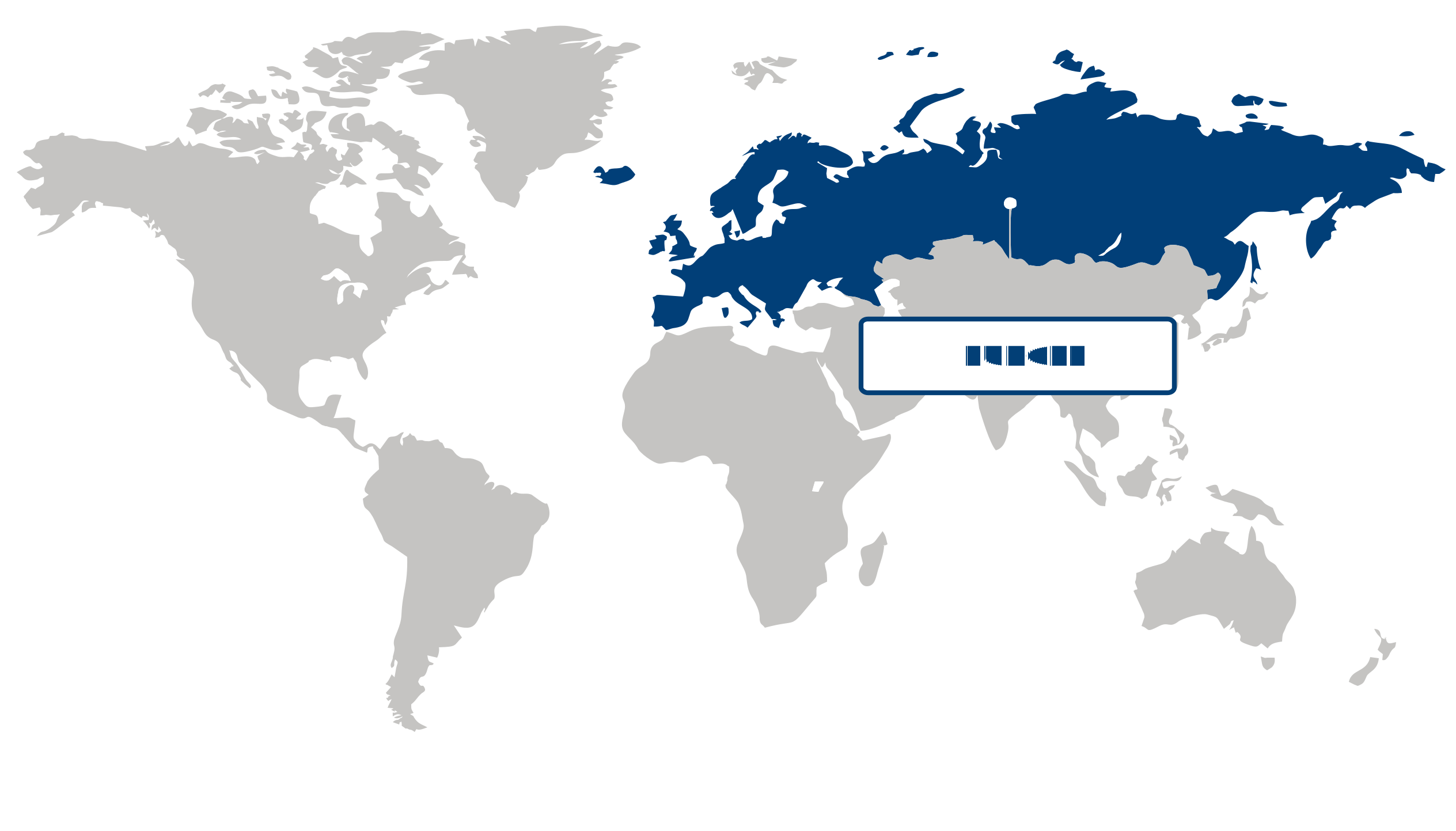
Europe (Largest Region)
Europe maintained the leading position in the kefir market in 2026, supported by established consumer familiarity with fermented dairy products and growing interest in foods associated with digestive and nutritional benefits. Kefir's positioning as a fermented product containing beneficial cultures aligns with increasing consumer attention to gut health, functional nutrition, and naturally produced foods. Demand is also being supported by expanding availability through supermarkets, specialty food retailers, and online distribution channels. Rising preference for clean-label and minimally processed food products is encouraging manufacturers to broaden kefir offerings and develop products suited to evolving dietary preferences.
Asia Pacific (Fastest-Growing Region)
Asia Pacific is experiencing the fastest growth as awareness of fermented foods and their potential functional benefits continues to increase. Rising health consciousness, urbanization, and changing dietary habits are encouraging consumers to explore probiotic and cultured food products. Expansion of modern retail and foodservice channels is improving access to kefir, while growing interest in functional beverages and convenient nutrition is creating additional demand opportunities. Increasing product innovation, broader consumer education around fermented foods, and the development of dairy and alternative-food processing capabilities are expected to support continued expansion of the kefir market across Asia Pacific.
| Parameter | North America | Asia Pacific | Europe | Latin America | MEA |
|---|---|---|---|---|---|
| Innovation Hub i Scale Nascent Developing Advanced | |||||
| Cost-Sensitive Region i Scale Low Medium High | |||||
| Regulatory Environment i Scale Restrictive Neutral Supportive | |||||
| Demand Drivers i Scale Weak Moderate Strong | |||||
| Development Stage i Scale Emerging Developing Developed | |||||
| Adoption Rate i Scale Low Medium High | |||||
| New Entrants / Startups i Scale Sparse Moderate Dense | |||||
| Macro Indicators i Scale Weak Stable Strong |
Key Country Insights
United States 🇺🇸
Functional Wellness DemandThe U.S. kefir market is expanding through consumer interest in probiotic beverages and functional nutrition. Product innovation emphasizes clean-label ingredients, reduced sugar formulations, and convenient ready-to-drink formats that broaden kefir's appeal beyond traditional health-focused consumers.
Germany 🇩🇪
Traditional Dairy InnovationGermany combines established fermented dairy consumption with innovation in probiotic and organic kefir products. Manufacturers continue expanding premium offerings while responding to consumer preferences for natural ingredients and digestive wellness benefits.
Japan 🇯🇵
Convenient Functional NutritionJapan positions kefir within the functional foods segment, where consumers value digestive health and convenient daily nutrition. Product development increasingly focuses on portion-controlled formats, mild flavor profiles, and premium quality standards suited to local preferences.
South Korea 🇰🇷
Health-Oriented Beverage ChoiceSouth Korea's kefir market benefits from rising interest in gut health and fermented functional beverages. Producers are introducing differentiated flavors and convenient packaging while expanding availability through modern retail and digital grocery channels.
France 🇫🇷
Premium Fermented DairyFrance supports kefir demand through consumer appreciation for premium fermented dairy products with natural ingredients. The market increasingly favors products that balance traditional fermentation with contemporary preferences for wellness-focused and minimally processed foods.
Italy 🇮🇹
Artisan Dairy AppealItaly's kefir market reflects growing consumer interest in fermented dairy products that complement healthy dietary habits. Producers emphasize authentic production methods, clean ingredient profiles, and premium positioning to attract consumers seeking nutritious everyday beverage options.
Segment Leadership and Growth Trends
Kefir Market Share (%), by Nature, 2026
Go beyond the chart, access full insights & data tables
Request Free Sample ReportNature Segment Analysis: Conventional (Largest Segment) vs Organic (Fastest-Growing Segment)
The conventional nature segment held the largest share of the kefir market, accounting for 58.3% in 2026. Its leading position is supported by widespread consumer familiarity, established production practices, and broad availability across retail channels. Conventional kefir benefits from efficient manufacturing processes that help maintain competitive pricing and consistent product supply, making it accessible to a larger consumer base. Strong distribution networks and the ability to cater to everyday consumption further reinforce the segment's dominant position across both developed and emerging markets.
The organic nature segment is anticipated to witness the fastest growth as consumers increasingly prioritize clean-label foods, natural ingredients, and sustainable production methods. Rising awareness regarding food quality, environmental responsibility, and the preference for products produced without synthetic chemicals is encouraging greater adoption of organic kefir. Expanding organic product portfolios and improving availability through mainstream retail outlets are also supporting the rapid development of this segment.
Flavor Segment Analysis: Flavoured (Largest Segment) vs Non-Flavoured (Fastest-Growing Segment)
Flavoured products accounted for the largest share of 58.3% in 2026 within the flavor segment. Their strong market position is driven by the ability to attract a broad consumer audience through diverse taste options that improve product appeal while masking the naturally tangy flavor of kefir. Manufacturers continue introducing fruit, vanilla, and other innovative flavor combinations to encourage repeat purchases, expand consumption occasions, and appeal to younger demographics seeking functional beverages with enjoyable taste profiles.
In the kefir market, the non-flavoured flavor segment is expected to record the fastest growth as health-conscious consumers increasingly seek minimally processed products with no added sugars or artificial flavoring. Demand is being supported by individuals incorporating kefir into smoothies, recipes, and personalized nutrition plans where a neutral taste is preferred. Growing interest in authentic fermented dairy products and clean-label offerings is further accelerating adoption of non-flavoured variants.
Distribution Channel Segment Analysis: Offline (Largest Segment) vs Online (Fastest-Growing Segment)
Holding the largest share of the kefir market, the offline distribution channel represented 79.09% in 2026. Supermarkets, hypermarkets, specialty food stores, and convenience outlets remain the primary purchasing destinations because they allow consumers to compare products, verify freshness, and make immediate purchases. The extensive retail infrastructure, refrigerated storage capabilities, and strong brand visibility offered by physical stores continue to support the segment's leadership, particularly for perishable dairy products.
The online distribution channel is projected to expand at the fastest pace as digital grocery shopping becomes increasingly integrated into consumers' purchasing habits. Greater convenience, doorstep delivery, subscription-based purchasing options, and wider product availability are encouraging more consumers to buy kefir through e-commerce platforms. Improvements in cold-chain logistics and expanding online retail ecosystems are further strengthening the growth prospects of this channel.
| Segment | Sub-Segment | Largest Segment | Fastest Growing |
|---|---|---|---|
| Nature | Organic, Conventional | Conventional | Organic |
| Flavor | Flavoured, Non-Flavoured | Flavoured | Non-Flavoured |
| Distribution Channel | Offline, Online | Offline | Online |
| Type | Milk Kefir, Water Kefir | Milk Kefir | Water Kefir |
Unlock insights tailored to your business with our bespoke market research solutions.
Click to get your customized report now.
Competitive Landscape and Market Positioning
Leading companies in the kefir market:
- Danone S.A. (France)
- Nestlé S.A. (Switzerland)
- Lifeway Foods, Inc. (USA)
- The Hain Celestial Group, Inc. (USA)
- Müller Group (Germany)
- Biotiful Dairy Ltd. (UK)
- Redwood Hill Farm & Creamery (USA)
- OSM Krasnystaw S.A. (Poland)
- Green Valley Creamery (USA)
- Valio Ltd. (Finland)
Consumer interest in functional nutrition is shifting competition in the kefir market toward product differentiation based on formulation quality, ingredient transparency, and sensory appeal instead of traditional dairy positioning alone. Producers are expanding their focus to include diverse flavor profiles, alternative ingredient bases, and processing methods that preserve desirable nutritional characteristics while meeting evolving dietary preferences. This is encouraging greater emphasis on brand credibility, consistent fermentation performance, and product innovation that supports broader adoption across both established and emerging consumer segments.
| Company | Market Share | Company Revenue | Revenue CAGR (%) | Product Portfolio | Geographic Presence | Innovation / R&D Focus | Strategic Developments |
|---|---|---|---|---|---|---|---|
| Danone S.A. (France) | |||||||
| Nestlé S.A. (Switzerland) | |||||||
| Lifeway Foods Inc. (USA) | |||||||
| The Hain Celestial Group Inc. (USA) | |||||||
| Müller Group (Germany) | |||||||
| Biotiful Dairy Ltd. (UK) | |||||||
| Redwood Hill Farm & Creamery (USA) | |||||||
| OSM Krasnystaw S.A. (Poland) | |||||||
| Green Valley Creamery (USA) | |||||||
| Valio Ltd. (Finland) |
Industry Development/News
| Company Name | Date | Key Development |
|---|---|---|
| MYKA | Jul-26 | MYKA commenced its international retail expansion by opening its inaugural UK storefront in London. The new location features on-site production capabilities for the brand's Greek frozen yoghurt utilizing artisanal Greek yoghurt and premium goat's milk kefir, directly supporting the brand's global retail infrastructure and footprint. |
| Danone | May-26 | Danone successfully completed its strategic exit from the U.S. kefir market by divesting its US$67.4 million stake in Lifeway Foods. This transaction follows the conclusion of Danone's recent takeover efforts, allowing the conglomerate to refocus its capital allocation and broader portfolio strategy away from the U.S. producer. |
| The Coconut Collab | Apr-26 | The Coconut Collab expanded its plant-based dairy-free portfolio through the commercial launch of Natural Kefir. The product introduction targets growing consumer demand for plant-based, gut health-focused functional beverages, intensifying competition within the alternative dairy and non-dairy fermented beverage market segments. |
| IFF | Mar-26 | IFF introduced critical advancements in fermentation technology, culture development, and AI-driven process optimization tailored for kefir production. These technical developments are positioned to enhance manufacturing efficiencies and process controls, providing commercial dairy processors with the toolsets required for broader product innovation. |
| Lifeway Foods | Nov-25 | Lifeway Foods advanced the second phase of its US$45 million expansion project at its Wisconsin facility. The capital investment is specifically designed to double overall manufacturing capacity, optimize operational efficiencies, and strengthen the company's large-scale production capabilities to meet growing market demand for kefir products. |
| Müller | Apr-25 | Müller acquired Biotiful Gut Health to establish a strong footprint in the rapidly expanding functional dairy and kefir market. The acquisition allows Müller to scale its product portfolio by integrating a well-established gut health brand, directly enhancing its competitive positioning in functional fermented dairy categories. |
| Lifeway Foods | Oct-24 | Lifeway Foods initiated its first geographic expansion into the South African market by launching distribution for its Lifeway Kefir and ProBugs lines. The strategic move extends the manufacturer's international retail footprint and introduces its probiotic dairy portfolio into an entirely new regional consumer segment. |
| Danone | Sep-24 | Danone introduced its first Activia-branded kefir product range into the United Kingdom market. Formulated with authentic kefir grains and multiple live cultures, the launch strategically extends Danone's regional functional dairy portfolio to capitalize on increasing British consumer interest in digestive and gut health solutions. |
| M&S Food | Jan-24 | M&S Food entered a strategic collaboration with health science company Zoe to introduce the M&S x Zoe Gut Shot. Formulated with milk kefir and multiple live culture strains, the joint product commercialization represents a targeted effort to capture expanding consumer market demand for functional gut health beverages. |
| Danone | Sep-23 | Danone signed a joint business development plan with bioscience leader Chr. Hansen to accelerate innovation across its dairy and plant-based categories. By leveraging Chr. Hansen’s advanced bio-solutions capabilities and combining both companies' extensive culture collections, the partnership aims to drive industrial culture development and product innovation. |
Customize Your Report
Explore examples of how this report can be tailored to different research needs, including custom segments, additional topics or chapters, and related reports. Click a section of the wheel or its numbered marker to explore the available options.
Kefir Market — Custom Segments
| Segment | Sub-Segment |
|---|---|
| Packaging Type | Bottles, Cartons, Pouches, Cups |
| Target Consumer | Adults, Children, Athletes & Fitness Consumers, Health-Conscious Consumers |
| Price Point | Economy, Mid-Range, Premium |
Kefir Market — Custom TOC
| Custom Chapter | Chapter Details |
|---|---|
| Consumer Occasion & Usage Analysis |
|
| Retail Channel Expansion Strategy |
|
| Product Positioning & Premiumization Strategy |
|
Need a different cut of the data?
Request Custom ResearchHow big is the kefir market?
How will the kefir industry grow in terms of size and CAGR by 2036?
What consumer trends are driving growth in the kefir market?
How is product innovation expanding opportunities in the kefir market?
Why does conventional kefir hold the largest share of the market?
How is online retail driving growth in the kefir market?
Why does Europe lead the kefir market?
What is driving the fastest growth of kefir in Asia Pacific?
Who are the major participants shaping the kefir landscape?
Our Clients
"The report provided a thorough look at market trends, technological advancements, and the competitive landscape. The depth of insights was really valuable."
ITC Limited
"We would highly recommend Fundamental Business Insights & Consulting to anyone looking for reliable, detailed, and comprehensive market research in the Food industry."
Tyson Foods
"The clarity and presentation of the information were commendable. The report was delivered timely, which made the overall experience smooth and convenient."
Mondelēz International
Our Research Team & Methodology
Every Fundamental Business Insights report is built by a dedicated vertical research team, validated through a structured primary-and-secondary methodology, and reviewed for accuracy before it reaches you.
Research Team Overview
Prepared by the Food & Beverage Research Team
Delivery
Published
Demand
Available
Support
Trust & Compliance
Research Intelligence
| Source | Reference |
|---|---|
| Food and Agriculture Organization (FAO) | www.fao.org |
| World Health Organization (WHO) | www.who.int |
| U.S. Food & Drug Administration (FDA) | www.fda.gov |
| European Food Safety Authority (EFSA) | www.efsa.europa.eu |
| U.S. Department of Agriculture (USDA) | www.usda.gov |
| Codex Alimentarius Commission | www.fao.org/fao-who-codexalimentarius |
| International Organization for Standardization (ISO) | www.iso.org |
| AOAC INTERNATIONAL | www.aoac.org |
| Institute of Food Technologists (IFT) | www.ift.org |
| International Dairy Foods Association (IDFA) | www.idfa.org |
| International Sweeteners Association (ISA) | www.sweeteners.org |
| International Probiotics Association (IPA) | internationalprobiotics.org |
| Good Food Institute (GFI) | gfi.org |
| American Feed Industry Association (AFIA) | www.afia.org |
| International Feed Industry Federation (IFIF) | ifif.org |
| Specialty Food Association (SFA) | www.specialtyfood.com |
| Brewers Association | www.brewersassociation.org |
| International Bottled Water Association (IBWA) | bottledwater.org |
| International Alliance for Dietary/Food Supplement Associations (IADSA) | www.iadsa.org |
| OECD Agriculture & Food | www.oecd.org/agriculture |
Research Workflow & Quality Assurance
Data Collection
Verified information gathered through primary and secondary research.
Data Triangulation
Cross-validation using multiple independent data sources.
Forecast Modelling
Market estimates developed using historical trends and analytical models.
Analyst Validation
Findings reviewed by domain experts for accuracy and consistency.
Editorial & Quality Review
Final editorial, quality, and compliance checks before publication.
Final Publication
Released after successful completion of the internal review process.
Report Coverage
📊 Market Assessment
- Market Size & Forecast
- Market Segmentation
- Regional Analysis
- Growth Drivers & Challenges
- Market Dynamics
🏢 Competitive Intelligence
- Competitive Landscape
- Company Profiles
- Competitive Benchmarking
- Mergers & Acquisitions
- Market Share Analysis or Key Company Strategies
🔍 Strategic Analysis
- Value Chain Analysis
- Porter's Five Forces
- PESTLE Analysis
- Pricing Trends
- Supply-Demand Analysis
🚀 Future Outlook
- Technology Landscape
- Regulatory Landscape
- Investment & Funding Landscape
- Emerging Opportunities
- Future Market Outlook
Have a question about this report or need a custom scope?
Request Customization