Liquid Pouch Packaging Market Size & Growth Forecast 2027–2036, By Segments (Packaging, Material, Technology, Application, Product), Regional Demand Trends (North America, Asia Pacific, Europe), Key Country Insights (U.S., Japan, South Korea, Germany, France, Italy), and Competitive Landscape
Market Size and Growth Outlook
Liquid Pouch Packaging Market size was valued at USD 11.53 Billion in 2026 and is projected to grow at 5.41% CAGR from 2027 to 2036, surpassing USD 19.53 Billion by 2036. The industry revenue for 2027 is estimated at USD 12.06 Billion.
Get more details on this report
Request Free Sample ReportLiquid Pouch Packaging Market Intelligence Snapshot
Regional Market Dynamics
- Europe led in 2026, supported by established flexible packaging capabilities, strong adoption across consumer applications, and emphasis on material efficiency and lightweight formats.
- Asia Pacific is the fastest-growing region, driven by urbanization, rising packaged food consumption, modern retail expansion, and investments in flexible packaging production.
Segment Momentum
- Flexible packaging held an 88.79% market share in 2026 and was also the fastest-growing segment, driven by lightweight design, lower transportation costs, product protection, and growing demand for convenient packaging.
- Aseptic technology is expanding fastest as demand rises for shelf-stable liquid products with extended shelf life, improved product safety, and preservation of quality without refrigeration or added preservatives.
Market Expansion Drivers
- Growing demand for convenient and lightweight packaging formats driving pouch adoption
- Cost-efficient packaging shift among manufacturers accelerating flexible pouch penetration
- Rising brand differentiation needs driving innovative pouch design and printing solutions
Leading Market Participants
- Prominent companies in the liquid pouch packaging market include Amcor plc (Switzerland), Mondi plc (United Kingdom), Smurfit Kappa Group plc (Ireland), Tetra Pak International S.A. (Switzerland), Sealed Air Corporation (USA), Berry Global Group Inc. (USA), BillerudKorsnäs AB (Sweden), IMPAK Corporation (USA), Huhtamaki Oyj (Finland)
Global Market Forecast Snapshot
Market Outlook
- 2026 Market Size: USD 11.53 Billion
- 2027 Estimated Market Size: USD 12.06 Billion
- Projected Market Size: USD 19.53 Billion by 2036
- Growth Forecast: 5.41% CAGR (2027-2036)
Regional and Segment Outlook
- Leading Regional Market: Europe
- High-Growth Regional Hub: Asia Pacific
- Core Revenue Segment: Flexible (Packaging) | Polyethylene (Material) | Form Fill (Technology) | Food & Beverages (Application) | Spout Pouches (Product)
- Emerging Opportunity Segment: Flexible (Packaging) | Polyethylene (Material) | Aseptic (Technology) | Food & Beverages (Application) | Pillow Pouches (Product)
Market Growth Drivers and Industry Trends
Growing demand for convenient and lightweight packaging formats driving pouch adoption
Consumers and manufacturers are increasingly shifting toward packaging formats that offer portability, ease of storage, and reduced material usage. The liquid pouch packaging market growth is driven by growing preference for flexible solutions that provide convenience while maintaining product protection during handling and transportation. Liquid pouches are gaining adoption across various applications due to their lightweight structure, efficient space utilization, and suitability for modern consumption patterns that prioritize practicality.
Cost-efficient packaging shift among manufacturers accelerating flexible pouch penetration
Manufacturers are increasingly evaluating packaging alternatives that help optimize material consumption, storage efficiency, and transportation costs. The liquid pouch packaging market is benefiting from this shift as flexible pouches provide a cost-effective option compared with traditional rigid packaging formats. Companies are adopting pouch solutions to improve operational efficiency while maintaining product integrity, enabling broader use across liquid product categories where packaging economics remain a key consideration.
Rising brand differentiation needs driving innovative pouch design and printing solutions
Increasing competition among consumer product brands is encouraging manufacturers to invest in packaging designs that improve shelf visibility and consumer engagement. The liquid pouch packaging market growth is supported by demand for advanced printing capabilities, customized designs, and distinctive pouch structures that help products stand out in retail environments. Brands are leveraging flexible packaging innovations to create visually appealing formats while incorporating functional features that enhance user experience.
| Growth Driver | Impact on CAGR | Regulatory Influence | Geographic Relevance | Adoption Rate | Impact Timeline |
|---|---|---|---|---|---|
| Growing demand for convenient and lightweight packaging formats driving pouch adoption | 1.9% | Low | Asia Pacific, North America | High | Near Term |
| Cost-efficient packaging shift among manufacturers accelerating flexible pouch penetration | 1.7% | Low | Asia Pacific, Latin America | High | Mid Term |
| Rising brand differentiation needs driving innovative pouch design and printing solutions | 1.4% | Low | Europe, Asia Pacific | Medium | Mid Term |
Explore Growth Opportunities
Request Free Sample ReportRegional Demand Dynamics
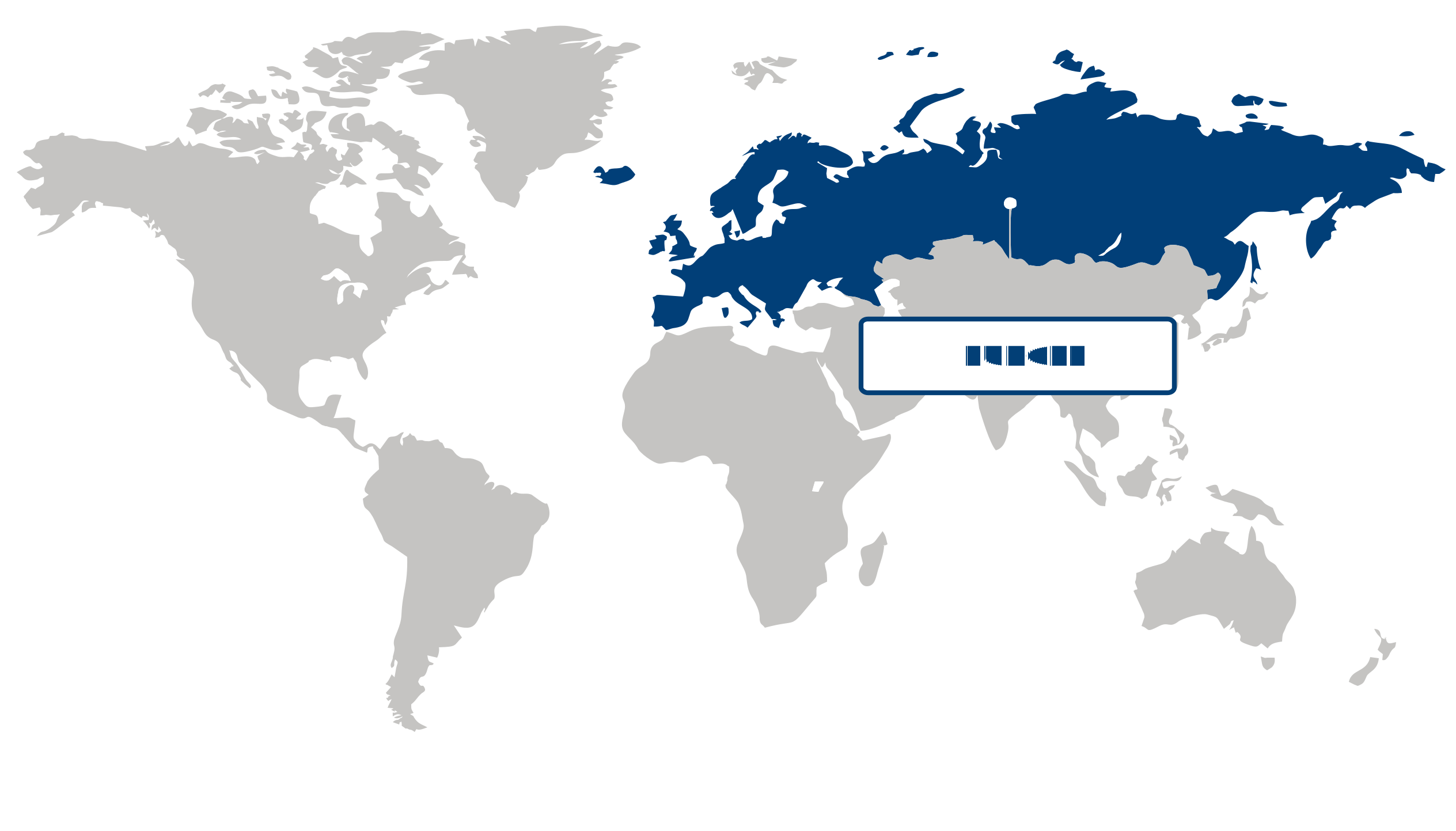
Europe (Largest Region)
In the liquid pouch packaging market, Europe held the largest regional position in 2026, supported by strong adoption of flexible packaging across food, beverages, household products, and personal care applications. The region's established packaging industry, emphasis on material efficiency, and growing preference for convenient formats are supporting the use of liquid pouches as an alternative to rigid containers. Increasing attention to packaging waste reduction and resource-efficient solutions is also encouraging manufacturers to develop lightweight pouch formats that provide product protection while improving handling and distribution efficiency.
Asia Pacific (Fastest-Growing Region)
Asia Pacific is emerging as the fastest-growing region, driven by expanding food and beverage consumption, rapid urbanization, and rising demand for convenient packaged products. Growing household consumption and the expansion of modern retail and e-commerce are creating favorable conditions for liquid pouch adoption, particularly where portability, storage efficiency, and ease of use are important purchasing considerations. Increasing investments in flexible packaging production and the modernization of food processing infrastructure are further broadening the application potential of liquid pouches across the region.
| Parameter | North America | Asia Pacific | Europe | Latin America | MEA |
|---|---|---|---|---|---|
| Innovation Hub i Scale Nascent Developing Advanced | |||||
| Cost-Sensitive Region i Scale Low Medium High | |||||
| Regulatory Environment i Scale Restrictive Neutral Supportive | |||||
| Demand Drivers i Scale Weak Moderate Strong | |||||
| Development Stage i Scale Emerging Developing Developed | |||||
| Adoption Rate i Scale Low Medium High | |||||
| New Entrants / Startups i Scale Sparse Moderate Dense | |||||
| Macro Indicators i Scale Weak Stable Strong |
Key Country Insights
United States 🇺🇸
Convenience Packaging ExpansionThe U.S. liquid pouch packaging market is driven by demand for portable, lightweight packaging across beverages, household products, and personal care applications. Companies increasingly adopt high-performance pouch materials that improve storage efficiency while supporting consumer convenience and sustainability initiatives.
Germany 🇩🇪
Material Efficiency StrategyGermany emphasizes liquid pouch packaging solutions that reduce material consumption while maintaining product integrity and filling efficiency. Manufacturers continue developing recyclable pouch structures and advanced barrier technologies for food, industrial, and consumer liquid applications.
Japan 🇯🇵
Compact Consumption FormatsJapan favors liquid pouch packaging designed for portion control, convenience, and efficient retail distribution. Producers focus on high-quality sealing performance, compact packaging formats, and user-friendly dispensing features to meet consumer expectations across multiple end-use categories.
South Korea 🇰🇷
Innovative Flexible PackagingSouth Korea is strengthening liquid pouch packaging adoption through product differentiation and advanced flexible packaging technologies. Companies prioritize attractive packaging designs, improved barrier performance, and manufacturing efficiency to support competitive consumer and industrial packaging applications.
France 🇫🇷
Eco-Conscious Packaging DesignFrance promotes liquid pouch packaging that supports packaging waste reduction while maintaining product quality and functionality. Packaging suppliers are introducing recyclable material options and optimized pouch structures that align with sustainability priorities across retail and food industries.
Italy 🇮🇹
Food Packaging AdaptationItaly applies liquid pouch packaging across food, beverage, and specialty product segments requiring flexible and efficient packaging solutions. Manufacturers emphasize reliable sealing performance, production versatility, and packaging formats that improve logistics while preserving product quality.
Segment Leadership and Growth Trends
Liquid Pouch Packaging Market Share (%), by Packaging, 2026
Go beyond the chart, access full insights & data tables
Request Free Sample ReportPackaging Segment Analysis: Flexible (Largest & Fastest-Growing Segment)
The flexible packaging segment accounted for the largest market share of 88.79% in 2026 in the liquid pouch packaging market and is also anticipated to remain the fastest-growing segment. Its leadership is driven by the increasing preference for lightweight, durable, and space-efficient packaging that lowers transportation and storage costs while providing excellent product protection. Flexible pouches are widely adopted across food, beverages, personal care, and household products because they offer convenience, easy handling, and reduced material usage. Continuous innovation in sustainable packaging designs and growing consumer demand for portable packaging formats are expected to reinforce the segment’s long-term growth.
Material Segment Analysis: Polyethylene (Largest & Fastest-Growing Segment)
The polyethylene material segment led the liquid pouch packaging market with the largest market share of 38.88% in 2026 and is also expected to remain the fastest-growing material segment. Polyethylene is extensively used because of its excellent flexibility, moisture resistance, sealing performance, and compatibility with a wide variety of liquid products. Its ability to provide reliable packaging integrity while supporting efficient manufacturing processes makes it a preferred material for liquid pouch applications. Increasing demand for durable, lightweight, and recyclable packaging solutions continues to strengthen the segment’s market position.
Technology Segment Analysis: Form Fill (Largest Segment) vs Aseptic (Fastest-Growing Segment)
The form fill technology segment held the largest share in 2026, supported by its ability to streamline packaging operations through efficient pouch formation, filling, and sealing within a single integrated process. Manufacturers favor this technology because it improves production efficiency, reduces packaging waste, and supports high-volume operations across food, beverage, pharmaceutical, and personal care industries. Its versatility across different pouch formats further contributes to its widespread adoption.
The aseptic technology segment is projected to experience the fastest growth as demand increases for packaging solutions capable of extending product shelf life without the need for refrigeration or added preservatives. Growing consumption of shelf-stable beverages, dairy products, and pharmaceutical liquids is encouraging investment in aseptic packaging systems. Enhanced product safety, preservation of product quality, and expanding distribution requirements are expected to accelerate the adoption of aseptic technology.
| Segment | Sub-Segment | Largest Segment | Fastest Growing |
|---|---|---|---|
| Packaging | Rigid, Flexible | Flexible | Flexible |
| Material | Polyester, Polyethylene, Polystyrene, Polypropylene, Aluminum, Fitments, Tubes & Spouts | Polyethylene | Polyethylene |
| Technology | Blow Molding, Form Fill, Aseptic | Form Fill | Aseptic |
| Application | Food & Beverages, Industrial, Personal Care, Pharmaceutical, Home Care | Food & Beverages | Food & Beverages |
| Product | Pillow Pouches, Stand-up Pouches, Four Side Seal Pouches, Spout Pouches, Others | Spout Pouches | Pillow Pouches |
Unlock insights tailored to your business with our bespoke market research solutions.
Click to get your customized report now.
Competitive Landscape and Market Positioning
Major players in the liquid pouch packaging market:
- Amcor plc (Switzerland)
- Mondi plc (United Kingdom)
- Smurfit Kappa Group plc (Ireland)
- Tetra Pak International S.A. (Switzerland)
- Sealed Air Corporation (USA)
- Berry Global Group, Inc. (USA)
- BillerudKorsnäs AB (Sweden)
- IMPAK Corporation (USA)
- Huhtamaki Oyj (Finland)
Changing preferences for convenient and flexible packaging are encouraging suppliers in the liquid pouch packaging market to differentiate through advanced sealing technologies, enhanced barrier properties, and application-specific pouch designs. Manufacturers are refining packaging structures to improve product protection while accommodating a broader range of liquid formulations across food, beverage, household, and personal care applications. Competition is increasingly influenced by the ability to provide customized packaging solutions, rapid design adaptation, and efficient production capabilities that help customers respond to evolving consumer expectations and regulatory demands.
| Company | Market Share | Company Revenue | Revenue CAGR (%) | Product Portfolio | Geographic Presence | Innovation / R&D Focus | Strategic Developments |
|---|---|---|---|---|---|---|---|
| Amcor plc (Switzerland) | |||||||
| Mondi plc (United Kingdom) | |||||||
| Smurfit Kappa Group plc (Ireland) | |||||||
| Tetra Pak International S.A. (Switzerland) | |||||||
| Sealed Air Corporation (USA) | |||||||
| Berry Global Group Inc. (USA) | |||||||
| BillerudKorsnäs AB (Sweden) | |||||||
| IMPAK Corporation (USA) | |||||||
| Huhtamaki Oyj (Finland) |
Customize Your Report
Explore examples of how this report can be tailored to different research needs, including custom segments, additional topics or chapters, and related reports. Click a section of the wheel or its numbered marker to explore the available options.
Liquid Pouch Packaging Market — Custom Segments
| Segment | Sub-Segment |
|---|---|
| Distribution Channel | Supermarkets & Hypermarkets, Convenience & Grocery Stores, Foodservice, E-commerce, Direct-to-Consumer |
| Customer Type | Brand Owners, Contract Packagers, Retailers, Foodservice Operators, Industrial Users |
| Sustainability Profile | Conventional Plastic, Lightweighted Packaging, Recyclable Mono-Material, Bio-Based & Compostable Materials |
Liquid Pouch Packaging Market — Custom TOC
| Custom Chapter | Chapter Details |
|---|---|
| Flexible Packaging Conversion Strategies |
|
| Aseptic & Shelf-Stable Pouch Opportunities |
|
| Filling & Packaging Infrastructure Readiness |
|
Need a different cut of the data?
Request Custom ResearchWhat is the current size of the liquid pouch packaging market?
How much is the liquid pouch packaging industry expected to grow by 2036?
How are cost and operational priorities influencing adoption of liquid pouch packaging?
How is brand differentiation driving innovation in the liquid pouch packaging market?
Which packaging segment leads the liquid pouch packaging market?
Why is aseptic technology the fastest-growing segment in the liquid pouch packaging market?
Why does Europe lead the liquid pouch packaging market?
How is Asia Pacific driving growth in liquid pouch packaging?
Who are the leading players in the liquid pouch packaging landscape?
Our Clients
"The report helped us understand emerging consumer trends in our product category. It clarified where to focus innovation for the next product launch."
LyondellBasell
"The regional forecast section was incredibly useful. We were able to identify two new potential partners in Europe thanks to the vendor mapping you included."
SABIC
"We appreciated how actionable the recommendations were. It guided us to improve supply chain resilience."
Olin Corporation
Our Research Team & Methodology
Every Fundamental Business Insights report is built by a dedicated vertical research team, validated through a structured primary-and-secondary methodology, and reviewed for accuracy before it reaches you.
Research Team Overview
Prepared by the Chemicals & Materials Research Team
Delivery
Published
Demand
Available
Support
Trust & Compliance
Research Intelligence
| Source | Reference |
|---|---|
| American Chemistry Council (ACC) | www.americanchemistry.com |
| European Chemical Industry Council (Cefic) | cefic.org |
| International Council of Chemical Associations (ICCA) | icca-chem.org |
| European Chemicals Agency (ECHA) | echa.europa.eu |
| U.S. Environmental Protection Agency (EPA) | www.epa.gov |
| ASTM International | www.astm.org |
| International Organization for Standardization (ISO) | www.iso.org |
| National Institute of Standards and Technology (NIST) | www.nist.gov |
| Plastics Industry Association (PLASTICS) | www.plasticsindustry.org |
| European Biplastics | www.european-bioplastics.org |
| The Adhesive and Sealant Council (ASC) | www.ascouncil.org |
| National Association of Corrosion Engineers (AMPP) | www.ampp.org |
| Society of Plastics Engineers (SPE) | www.4spe.org |
| International Fertilizer Association (IFA) | www.fertilizer.org |
| CropLife International | croplife.org |
| Packaging Europe | packagingeurope.com |
| Flexible Packaging Association (FPA) | www.flexpack.org |
| Battery Council International (BCI) | batterycouncil.org |
| International Copper Association (ICA) | internationalcopper.org |
| World Steel Association | worldsteel.org |
Research Workflow & Quality Assurance
Data Collection
Verified information gathered through primary and secondary research.
Data Triangulation
Cross-validation using multiple independent data sources.
Forecast Modelling
Market estimates developed using historical trends and analytical models.
Analyst Validation
Findings reviewed by domain experts for accuracy and consistency.
Editorial & Quality Review
Final editorial, quality, and compliance checks before publication.
Final Publication
Released after successful completion of the internal review process.
Report Coverage
📊 Market Assessment
- Market Size & Forecast
- Market Segmentation
- Regional Analysis
- Growth Drivers & Challenges
- Market Dynamics
🏢 Competitive Intelligence
- Competitive Landscape
- Company Profiles
- Competitive Benchmarking
- Mergers & Acquisitions
- Market Share Analysis or Key Company Strategies
🔍 Strategic Analysis
- Value Chain Analysis
- Porter's Five Forces
- PESTLE Analysis
- Pricing Trends
- Supply-Demand Analysis
🚀 Future Outlook
- Technology Landscape
- Regulatory Landscape
- Investment & Funding Landscape
- Emerging Opportunities
- Future Market Outlook
Have a question about this report or need a custom scope?
Request Customization