



Machine Safety Market Size & Growth Forecast 2027–2036, By Segments (Application, Component, Implementation Type, End Use Industry), Regional Demand Trends (North America, Asia Pacific, Europe), Key Country Insights (U.S., Japan, South Korea, Germany, France, Italy), and Competitive Landscape
Market Size and Growth Outlook
Machine Safety Market size was more than USD 6.5 Billion in 2026 and is set to grow at 7% CAGR between 2027 and 2036, reaching USD 12.79 Billion by 2036. The industry revenue for 2027 is calculated at USD 6.89 Billion.
Base Year Value (2026)
USD 6.5 Billion
CAGR (2027-2036)
7%
Forecast Year Value (2036)
USD 12.79 Billion

Historical Data Period
2022-2026

Largest Region
Europe

Forecast Period
2027-2036
Machine Safety Market Intelligence Snapshot:
-
Regional Market Dynamics:
- Europe held 33.16% of the market in 2025, supported by its established industrial base, strong workplace protection practices, machinery compliance, and manufacturing modernization.
- Asia Pacific is the fastest-growing region as manufacturing activity, industrial infrastructure investment, automation, and awareness of worker protection continue to expand.
-
Segment Momentum:
- The assembly segment accounted for 32.08% of the market in 2025, driven by increasing automation, close worker-machine interaction, stricter safety regulations, and the need to reduce operational downtime while maintaining productivity.
- Safety controllers, modules, and relays are projected to grow the fastest as manufacturers adopt centralized safety management and integrated safety architectures for increasingly complex automated production systems.
-
Market Expansion Drivers:
- Industrial automation expansion increasing demand for advanced machine safety systems
- Rising workplace safety awareness driving deployment of integrated safety monitoring solutions
- Mining and heavy industry sustainability initiatives boosting safety compliance technologies adoption
-
Leading Market Participants:
Prominent companies in the machine safety market include ABB Ltd. (Switzerland), Siemens AG (Germany), Schneider Electric SE (France), Rockwell Automation, Inc. (United States), Honeywell International Inc. (United States), OMRON Corporation (Japan), Mitsubishi Electric Corporation (Japan), SICK AG (Germany), KEYENCE Corporation (Japan), Pilz GmbH & Co. KG (Germany)
Global Market Forecast Snapshot:
-
Market Outlook:
- 2026 Market Size: USD 6.5 Billion
- 2027 Estimated Market Size: USD 6.89 Billion
- Projected Market Size: USD 12.79 Billion by 2036
- Growth Forecasts: 7% CAGR (2027-2036)
-
Regional and Segment Outlook:
- Leading Regional Market: Europe
- High-Growth Regional Hub: Asia Pacific
- Core Revenue Segment: Assembly (Application) | Presence Sensing Safety Sensors (Component) | Individual Components (Implementation Type) | Automotive (End Use Industry)
- Emerging Opportunity Segment: Robotics (Application) | Safety Controllers/Modules/Relays (Component) | Embedded Components (Implementation Type) | Healthcare (End Use Industry)
Market Growth Drivers and Industry Trends
Industrial automation expansion increasing demand for advanced machine safety systems
The expansion of automated manufacturing environments is driving the machine safety market growth as industries integrate robotics, automated production lines, and intelligent machinery that require reliable protection mechanisms. As factories move toward higher levels of operational autonomy, safety systems such as emergency controls, protective sensors, and automated monitoring solutions are becoming essential components for preventing equipment-related incidents and maintaining uninterrupted workflows. Manufacturers are increasingly prioritizing safety integration during machine design and modernization projects to support efficient production while meeting operational risk management requirements.
Rising workplace safety awareness driving deployment of integrated safety monitoring solutions
Growing emphasis on employee protection and safer industrial workplaces will propel the machine safety market growth by encouraging organizations to adopt advanced monitoring and control technologies. Companies across manufacturing and processing sectors are moving beyond traditional safety practices by implementing interconnected solutions that provide real-time hazard detection, machine status visibility, and automated intervention capabilities. Increased awareness of occupational risks is also influencing investment decisions as businesses seek systems that improve compliance readiness while reducing the likelihood of workplace disruptions.
Mining and heavy industry sustainability initiatives boosting safety compliance technologies adoption
Sustainability-driven modernization programs in mining and heavy industrial operations are supporting machine safety market demand as companies upgrade aging equipment with safer and more efficient technologies. These industries are increasingly adopting digital safety platforms, automated monitoring tools, and compliance-focused systems to improve operational control in complex environments where equipment reliability and worker protection are critical. The integration of safety technologies into broader industrial transformation initiatives allows operators to enhance resource efficiency while maintaining stricter safety standards.
| Growth Driver Assessment Framework | |||||
| Growth Driver | Impact On CAGR | Regulatory Influence | Geographic Relevance | Adoption Rate | Impact Timeline |
|---|---|---|---|---|---|
| Industrial automation expansion increasing demand for advanced machine safety systems | 2% | High | Europe, North America | High | Near Term |
| Rising workplace safety awareness driving deployment of integrated safety monitoring solutions | 1.7% | High | Asia Pacific, Europe | High | Mid Term |
| Mining and heavy industry sustainability initiatives boosting safety compliance technologies adoption | 1.5% | Moderate | Latin America, Middle East & Africa | Medium | Mid Term |
Unlock insights tailored to your business with our bespoke market research solutions - Click to get your customized report now!
Regional Demand Dynamics
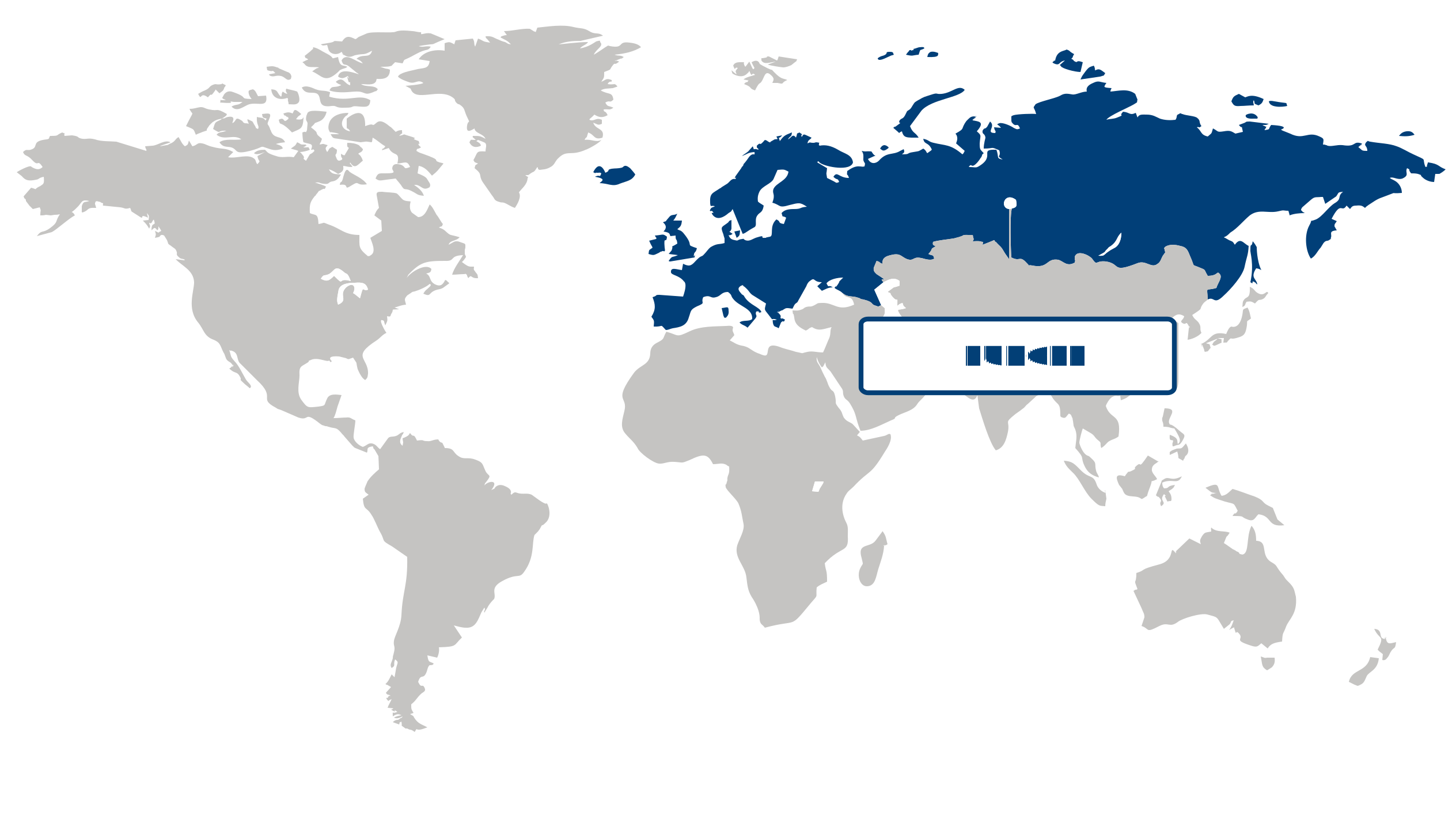
Largest Region
Europe
33.16% Market Share in 2026
Europe (Largest Region) vs Asia Pacific (Fastest-Growing Region)
Europe accounted for 33.16% of the machine safety market in 2026, reflecting the region's well-established industrial base and strong emphasis on workplace protection and machinery compliance. Extensive use of automated production equipment, established safety practices, and continued modernization of manufacturing operations are supporting demand for machine safety technologies across industrial environments.
In the machine safety market, Asia Pacific is positioned as the fastest-growing region, supported by expanding manufacturing activity and increasing deployment of automated machinery. Rising investments in industrial infrastructure, greater awareness of worker protection, and the integration of safety systems into modern production lines are encouraging manufacturers to strengthen machine safety measures as automation expands.
No card data available for this language/report.
Segment Leadership and Growth Trends
Application Segment Analysis: Assembly (Largest Segment) vs Robotics (Fastest-Growing Segment)
The assembly segment accounted for 32.08% of the machine safety market in 2026, making it the leading application segment. Assembly operations involve continuous interaction between workers and automated equipment, creating a strong need for safety systems that minimize workplace risks while maintaining production efficiency. The increasing adoption of automated assembly lines, coupled with stricter workplace safety regulations and the need to reduce operational downtime, continues to drive demand for advanced machine safety solutions within this segment.
The robotics segment is projected to register the fastest growth as manufacturers increasingly deploy industrial robots to improve productivity and operational precision. As robotic systems become more sophisticated and operate alongside human workers, demand for advanced safety technologies capable of ensuring safe collaboration continues to rise. Growing investments in smart factories and flexible manufacturing environments are further supporting rapid expansion of the robotics application segment.
Component Segment Analysis: Presence Sensing Safety Sensors (Largest Segment) vs Safety Controllers/Modules/Relays (Fastest-Growing Segment)
In the machine safety market, the presence sensing safety sensors segment held a 38.77% share in 2026, establishing it as the largest component category. These sensors play a critical role in detecting personnel within hazardous operating zones and automatically initiating protective actions before accidents occur. Their widespread use across automated manufacturing environments, combined with continuous improvements in sensing accuracy and response speed, has strengthened their adoption across multiple industries.
The safety controllers/modules/relays segment is anticipated to expand at the fastest rate due to increasing demand for centralized safety management and more complex automated production systems. These components enable efficient coordination of multiple safety devices while supporting compliance with evolving industrial safety standards. Rising implementation of integrated safety architectures within advanced manufacturing facilities is expected to further accelerate segment growth.
Implementation Type Segment Analysis: Individual Components (Largest Segment) vs Embedded Components (Fastest-Growing Segment)
The individual components segment led the market with the largest share in 2026. Its dominance is supported by the flexibility it offers manufacturers to configure safety systems according to specific operational requirements and equipment layouts. Individual safety devices can be integrated into both new and existing machinery, making them a practical and cost-effective solution across a broad range of industrial applications.
The embedded components segment is expected to witness the fastest growth as equipment manufacturers increasingly integrate safety functions directly into machine designs. Embedded safety solutions simplify installation, reduce system complexity, and enhance overall operational efficiency while supporting the development of highly automated production environments. Growing demand for compact, intelligent, and seamlessly integrated machinery continues to drive adoption of embedded machine safety technologies.
| Report Segmentation | |||
| Segment | Sub-Segment | Largest Segment | Fastest Growing Segment |
|---|---|---|---|
| Application | Assembly, Robotics, Packaging, Material Handling, Metal Working | Assembly | Robotics |
| Component | Presence Sensing Safety Sensors, Safety Interlock Switches, Safety Controllers/Modules/Relays, Programmable Safety Applications, Emergency Stop Controls, Two-hand Safety Controls | Presence Sensing Safety Sensors | Safety Controllers/Modules/Relays |
| Implementation Type | Individual Components, Embedded Components | Individual Components | Embedded Components |
| End Use Industry | Oil & Gas, Aerospace, Semiconductor & Electronics, Food & Beverages, Automotive, Healthcare, Others | Automotive | Healthcare |
 Read our Research Approach
Competitive Landscape and Market Positioning
Key companies in the machine safety market:
- ABB Ltd. (Switzerland)
- Siemens AG (Germany)
- Schneider Electric SE (France)
- Rockwell Automation, Inc. (United States)
- Honeywell International, Inc. (United States)
- OMRON Corporation (Japan)
- Mitsubishi Electric Corporation (Japan)
- SICK AG (Germany)
- KEYENCE Corporation (Japan)
- Pilz GmbH & Co. KG (Germany)
Industrial automation is redefining competitive positioning in the Machine Safety market, where suppliers are increasingly expected to deliver integrated safety architectures rather than standalone protective components. Differentiation is shifting toward solutions that combine functional safety, real-time diagnostics, and seamless interoperability with connected manufacturing environments, enabling manufacturers to enhance productivity without compromising regulatory compliance. As production systems become more complex and digitally connected, vendors are strengthening engineering expertise, lifecycle support, and application-specific customization to address diverse industrial requirements while helping end users balance operational efficiency with evolving workplace safety expectations.
Industry Development/News
| Company Name | Date | Key Development |
|---|---|---|
| iconsys | Jul-26 | iconsys formed a strategic partnership with Tebulo to expand its robotics capabilities. The collaboration enhances the company's ability to deliver advanced robotics solutions, supporting broader machine automation and safety applications across industrial environments. |
| McHale Komatsu | Jun-26 | McHale Komatsu became an approved supplier for Xwatch Safety Solutions, expanding its portfolio of machine safety technologies. The partnership strengthens the company's offering of safety systems specifically for construction equipment and related hazardous applications. |
| FORT Robotics | May-26 | FORT Robotics acquired Mapless AI to strengthen its supervised autonomy and physical AI safety platform. The transaction expands capabilities in vehicle teleoperation, remote operations, safety systems, and autonomous fleet deployment, enhancing the company's overall industrial robotics and machine safety portfolio. |
| ifm | Mar-26 | ifm launched the O2M500 2D camera featuring AI-powered human detection to improve mobile machine safety. The product enhances operator awareness and helps reduce collision risks in industrial and mobile equipment applications. |
| Pilz | Nov-25 | Pilz launched its MYZEL lifecycle platform, a digital safety management environment enabling complete documentation, monitoring, and validation of machine-level safety requirements. The platform supports compliance with global functional safety standards throughout the equipment lifecycle. |
| SICK | Oct-25 | SICK introduced the Visionary AI.Assist safety sensor, a rugged AI-enhanced 3D monitoring system. The technology features reliable people detection, collision avoidance, and real-time risk assessment in demanding industrial and mobile machine environments subject to extreme temperatures. |
| Siemens | Oct-25 | Siemens launched the SIMATIC S7-1200 G2 controller series, integrating motion control with space-saving machine safety functions. The development enhances machine automation by combining control performance with built-in safety capabilities to optimize shop floor footprints. |
| OMRON | Apr-25 | OMRON released the OL 450S autonomous mobile robot, engineered with full 360-degree safety coverage, intelligent obstacle avoidance, and ISO-aligned safety controls to ensure safe navigation and material handling performance in dynamic industrial environments. |
| JCB | Oct-24 | JCB launched an AI-based machine safety system designed to reduce the risk of injuries on construction sites. The technology improves hazard detection and enhances operator and worker safety during heavy equipment operation. |
| MacLean | Jun-24 | MacLean collaborated with Sandvik to improve automation zone interoperability for mining equipment. The partnership advances safer and more efficient autonomous mining operations through enhanced equipment compatibility and coordinated safety automation capabilities. |
Why Choose Us
Specialized Expertise: Our team comprises industry experts with a deep understanding of your market segment. We bring specialized knowledge and experience that ensures our research and consulting services are tailored to your unique needs.
Customized Solutions: We understand that every client is different. That's why we offer customized research and consulting solutions designed specifically to address your challenges and capitalize on opportunities within your industry.
Proven Results: With a track record of successful projects and satisfied clients, we have demonstrated our ability to deliver tangible results. Our case studies and testimonials speak to our effectiveness in helping clients achieve their goals.
Cutting-Edge Methodologies: We leverage the latest methodologies and technologies to gather insights and drive informed decision-making. Our innovative approach ensures that you stay ahead of the curve and gain a competitive edge in your market.
Client-Centric Approach: Your satisfaction is our top priority. We prioritize open communication, responsiveness, and transparency to ensure that we not only meet but exceed your expectations at every stage of the engagement.
Continuous Innovation: We are committed to continuous improvement and staying at the forefront of our industry. Through ongoing learning, professional development, and investment in new technologies, we ensure that our services are always evolving to meet your evolving needs.
Value for Money: Our competitive pricing and flexible engagement models ensure that you get maximum value for your investment. We are committed to delivering high-quality results that help you achieve a strong return on your investment.
Select Licence Type

