



Marine Battery Market Size & Growth Forecast 2027–2036, By Segments (Ships, Battery Design, Battery, Propulsion Type, Energy Density, Ship Power, Battery Type, Sales Channel, Nominal Capacity), Regional Demand Trends (North America, Asia Pacific, Europe), Key Country Insights (U.S., Japan, South Korea, Germany, France, Italy), and Competitive Landscape
Market Size and Growth Outlook
Marine Battery Market size was worth USD 893.1 million in 2026 and is expected to grow at a 17.01% CAGR between 2027 and 2036, exceeding USD 4.3 billion by 2036. The industry revenue for 2027 is estimated at USD 1.02 billion.
Base Year Value (2026)
USD 893.1 million
CAGR (2027-2036)
17.01%
Forecast Year Value (2036)
USD 4.3 billion

Historical Data Period
2022-2026

Largest Region
Europe

Forecast Period
2027-2036
Marine Battery Market Intelligence Snapshot:
-
Regional Market Dynamics:
- Europe captured 47.49% of the market in 2026, supported by an established maritime industry, vessel electrification, hybrid propulsion investments, and widespread adoption of low-emission marine technologies.
- Asia Pacific is expected to expand at a 17.92% CAGR, driven by rising shipbuilding activity, greater marine electrification, and increasing integration of battery systems into newly built vessels.
-
Segment Momentum:
- Commercial ships accounted for 77.14% of the market in 2026 and remain the fastest-growing segment due to high fleet utilization, fuel efficiency goals, emissions compliance, and strong operational returns from battery investments.
- Solid-state batteries are gaining momentum as operators seek advanced energy storage with improved space efficiency, operating resilience, and long-term performance for new vessel deployments and future fleet planning.
-
Market Expansion Drivers:
- Accelerating electrification of ferries and vessels driven by global maritime decarbonization mandates.
- Expansion of shore power infrastructure and port-side fast charging enabling hybrid vessel operations.
- Naval fleet modernization and hybrid propulsion retrofitting increasing defense sector battery adoption.
-
Leading Market Participants:
Key companies in the marine battery market include Corvus Energy AS (Norway), Leclanché S.A. (Switzerland), Saft S.A. (France), Siemens AG (Germany), Echandia Marine AB (Sweden), Shift Clean Energy Inc. (Canada), EST-Floattech B.V. (Netherlands), Sensata Technologies Holding plc (United States), PowerTech Systems SAS (France), Lifeline Batteries, Inc. (United States).
Global Market Forecast Snapshot:
-
Market Outlook:
- 2026 Market Size: USD 893.1 million
- 2027 Estimated Market Size: USD 1.02 billion.
- Projected Market Size: USD 4.3 billion by 2036
- Growth Forecasts: 17.01% CAGR (2027-2036)
-
Regional and Segment Outlook:
- Leading Regional Market: Europe
- High-Growth Regional Hub: Asia Pacific
- Core Revenue Segment: Commercial (Ships) | Liquid/Gel Based (Battery Design) | Deep-Cycle Batteries (Battery) | Hybrid (Propulsion Type) | 100 - 500 WH/Kg (Energy Density) | 150 - 745 KW (Ship Power) | Lithium (Battery Type) | OEM (Sales Channel) | < 100 AH (Nominal Capacity)
- Emerging Opportunity Segment: Commercial (Ships) | Solid State (Battery Design) | Deep-Cycle Batteries (Battery) | Conventional (Propulsion Type) | 100 - 500 WH/Kg (Energy Density) | 150 - 745 KW (Ship Power) | Lithium (Battery Type) | OEM (Sales Channel) | > 250 AH (Nominal Capacity)
Market Growth Drivers and Industry Trends
Accelerating electrification of ferries and vessels driven by global maritime decarbonization mandates
Maritime decarbonization efforts are accelerating the transition toward lower-emission propulsion systems, and this trend will propel the marine battery market as vessel operators evaluate electric and hybrid alternatives to conventional propulsion. Ferries and short-distance vessels are particularly suited to battery-based operations because their predictable routes and recurring port calls allow charging requirements to be incorporated into operating schedules. Regulatory pressure to reduce emissions is also encouraging fleet owners to consider propulsion technologies that can lower fuel consumption and local air pollution. Battery systems can support fully electric propulsion in suitable applications while also serving as an energy source within hybrid configurations, increasing their relevance across different vessel categories.
Expansion of shore power infrastructure and port-side fast charging enabling hybrid vessel operations
Investment in shore power and port charging infrastructure is improving the practicality of battery-powered marine operations, strengthening demand in the marine battery market. Reliable access to electricity while vessels are berthed allows operators to recharge onboard battery systems between journeys and reduces reliance on prolonged onboard charging periods. Fast-charging capabilities are particularly valuable for ferries and other vessels operating frequent routes, where limited turnaround times require efficient energy replenishment. The development of compatible charging infrastructure also enables hybrid vessels to use stored electrical energy during appropriate portions of their journeys while maintaining conventional propulsion capabilities when longer-range operation requires it.
Naval fleet modernization and hybrid propulsion retrofitting increasing defense sector battery adoption
Modernization programs across naval fleets are creating opportunities for battery systems as defense operators seek more efficient and flexible propulsion configurations. The marine battery market benefits from the integration of batteries into hybrid propulsion architectures, where stored electrical power can complement conventional engines during selected operating conditions. Retrofitting existing vessels can provide an alternative to complete fleet replacement by allowing propulsion and energy systems to be upgraded within established platforms. Battery-assisted operations can also support lower-noise and more efficient vessel performance during missions where reduced acoustic or thermal signatures are operationally valuable.
| Growth Driver Assessment Framework | |||||
| Growth Driver | Impact On CAGR | Regulatory Influence | Geographic Relevance | Adoption Rate | Impact Timeline |
|---|---|---|---|---|---|
| Accelerating electrification of ferries and vessels driven by global maritime decarbonization mandates | 2.20% | High | Europe, North America | High | Near Term |
| Expansion of shore power infrastructure and port-side fast charging enabling hybrid vessel operations | 1.80% | Moderate | Asia Pacific, Europe | High | Mid Term |
| Naval fleet modernization and hybrid propulsion retrofitting increasing defense sector battery adoption | 1.60% | High | North America, Asia Pacific | Medium | Mid Term |
Unlock insights tailored to your business with our bespoke market research solutions - Click to get your customized report now!
Regional Demand Dynamics
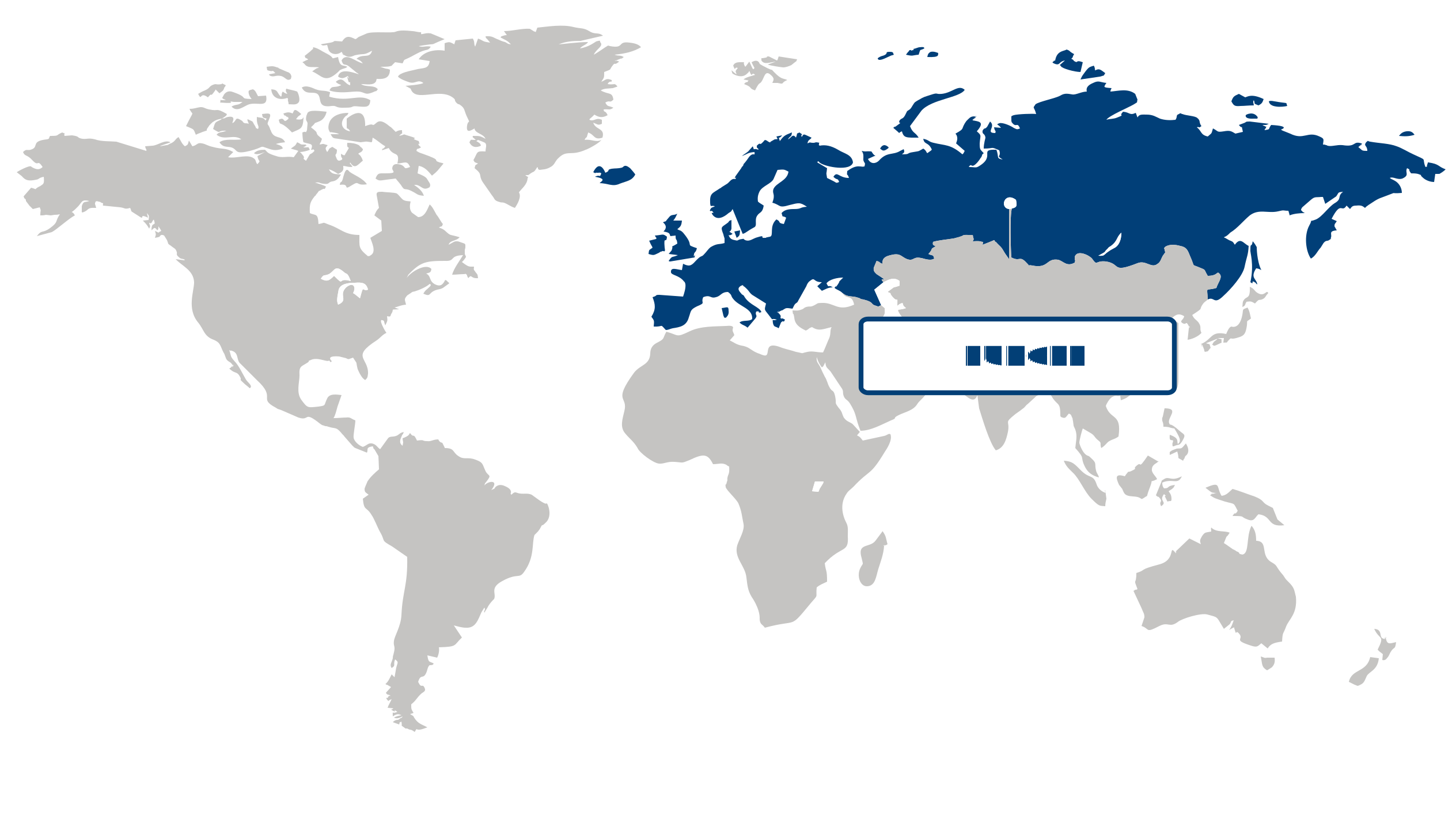
Largest Region
Europe
47.49% Market Share in 2026
Europe (Largest Region) vs Asia Pacific (Fastest-Growing Region)
Europe accounted for the largest share of the marine battery market at 47.49% in 2026, reflecting the region's strong maritime industry, established environmental policies, and growing emphasis on lower-emission propulsion technologies. The transition toward electrification in recreational vessels, ferries, workboats, and other marine applications is encouraging demand for efficient battery systems capable of supporting cleaner and quieter operations. Europe's focus on reducing emissions from transportation and strengthening sustainable maritime infrastructure is also stimulating investment in electric and hybrid vessel technologies. In addition, established shipbuilding capabilities and access to advanced charging and energy-management infrastructure provide a supportive environment for marine battery adoption. Increasing attention to vessel efficiency and lifecycle operating costs further strengthens the case for battery-based propulsion and onboard energy storage.
Asia Pacific is the fastest-growing regional market, driven by extensive shipbuilding activity, expanding commercial marine transportation, and increasing investment in maritime electrification. The region's large coastal economies are developing cleaner vessel technologies as environmental requirements and fuel-efficiency considerations become more important. Growth in port infrastructure, inland waterways, passenger transportation, and marine tourism is creating additional opportunities for battery-powered and hybrid vessels. Advances in battery technology, energy-management systems, and charging infrastructure are also improving the feasibility of electrified marine applications. As regional manufacturers and vessel operators increasingly pursue efficient propulsion solutions, demand for marine batteries is gaining momentum across both established and emerging maritime markets.
Key Country Insights
The U.S. marine battery market is supported by investments in electric ferries, naval modernization, and hybrid commercial vessels. U.S. buyers prioritize high-energy-density systems, safety certifications, and battery management technologies suited for demanding marine environments.
Japan advances marine battery deployment through coastal shipping modernization and next-generation vessel development. Japanese manufacturers focus on compact, durable battery technologies that improve operational efficiency while supporting maritime decarbonization initiatives.
South Korea integrates marine batteries into advanced shipbuilding programs for commercial and specialized vessels. South Korean shipyards emphasize scalable energy storage solutions that align with hybrid propulsion systems and evolving international environmental standards.
Germany emphasizes marine battery adoption for inland waterways, passenger ferries, and environmentally compliant ship operations. German shipbuilders increasingly seek modular battery systems that integrate efficiently with hybrid propulsion and advanced energy management platforms.
France encourages marine battery adoption across ferries, leisure vessels, and port operations to reduce emissions. French operators increasingly evaluate battery systems offering long service life, reliable charging performance, and compatibility with electric propulsion platforms.
Italy is expanding marine battery use in passenger ferries, tourism vessels, and port service fleets. Italian shipowners prioritize compact battery solutions that improve fuel efficiency while supporting cleaner coastal transportation operations.
Segment Leadership and Growth Trends
Ships Segment Analysis: Commercial (Largest & Fastest-Growing Segment)
Commercial ships represented both the largest and fastest-growing segment of the marine battery market, accounting for a 77.14% share in 2026. The segment is benefiting from the maritime industry's increasing focus on energy efficiency, emissions reduction, and fleet modernization. Marine batteries are being incorporated into commercial vessels for applications such as auxiliary power, hybrid propulsion, peak-load management, and onboard energy storage, helping operators optimize power consumption and reduce reliance on conventional engine operation. Growing environmental pressure on shipping and the transition toward cleaner maritime technologies are further strengthening the role of battery-based systems in commercial vessel operations.
Battery Design Segment Analysis: Liquid/Gel Based (Largest Segment) vs Solid State (Fastest-Growing Segment)
Liquid/Gel based battery designs held the largest position in the marine battery market in 2026, supported by their established use in marine environments and compatibility with existing vessel power systems. Their familiarity among marine operators, proven operating characteristics, and suitability for varied onboard energy requirements continue to support adoption. Demand remains linked to the need for dependable power storage across commercial and recreational vessels, particularly where reliability, maintenance considerations, and established infrastructure influence battery selection.
Solid state is the fastest-growing battery design as marine electrification increases interest in advanced energy-storage technologies offering improved safety, compactness, and energy-storage potential. The technology is gaining attention for applications where vessel operators need to manage increasing electrical loads while addressing space and weight constraints. Continued development of hybrid propulsion and electrically powered marine systems, combined with the industry's broader pursuit of lower-emission operations, is creating a favorable environment for the adoption of solid-state battery technologies.
| Report Segmentation | |||
| Segment | Sub-Segment | Largest Segment | Fastest Growing Segment |
|---|---|---|---|
| Ships | Commercial, Defense, Unmanned | Commercial | Commercial |
| Battery Design | Solid State, Liquid/Gel Based | Liquid/Gel Based | Solid State |
| Battery | Starting Batteries, Deep-Cycle Batteries, Dual Purpose Batteries | Deep-Cycle Batteries | Deep-Cycle Batteries |
| Propulsion Type | Conventional, Hybrid, Fully Electric | Hybrid | Conventional |
| Energy Density | <100 WH/Kg, 100 - 500 WH/Kg, >500 WH/Kg | 100 - 500 WH/Kg | 100 - 500 WH/Kg |
| Ship Power | < 75 KW, 75 - 150 KW, 150 - 745 KW, 745 KW & Above | 150 - 745 KW | 150 - 745 KW |
| Battery Type | Lithium, Lead Acid, Nickel Cadmium, Sodium-Ion, Fuel Cells | Lithium | Lithium |
| Sales Channel | OEM, After Market | OEM | OEM |
| Nominal Capacity | < 100 AH, 100 - 250 AH, > 250 AH | < 100 AH | > 250 AH |
 Read our Research Approach
Competitive Landscape and Market Positioning
Key companies in the marine battery market:
1. Corvus Energy AS (Norway)
2. Leclanché S.A. (Switzerland)
3. Saft S.A. (France)
4. Siemens AG (Germany)
5. Echandia Marine AB (Sweden)
6. Shift Clean Energy Inc. (Canada)
7. EST-Floattech B.V. (Netherlands)
8. Sensata Technologies Holding plc (United States)
9. PowerTech Systems SAS (France)
10. Lifeline Batteries Inc. (United States)
The marine battery market is advancing with improved energy storage systems for maritime applications. Enhanced battery efficiency is supporting cleaner propulsion systems. Innovation is focused on durability in harsh marine environments. The marine battery market is strengthening through sustainable energy transition efforts.
Industry Development/News
| Company Name | Date | Key Development |
|---|---|---|
| Echandia | Jun-25 | Echandia expanded its manufacturing capacity by opening a dedicated marine battery production facility in Washington State. This expansion is designed to scale the production of zero-emission energy storage systems to meet rising demand for electrified propulsion solutions within the commercial shipping and ferry sectors. |
| Echandia | Aug-25 | Echandia launched the “Core” LTO marine battery system, a major product release aimed at reducing system footprint and upfront costs by approximately 30 percent. This development enhances the company’s competitive positioning in marine electrification by providing a more scalable and cost-efficient energy storage solution for commercial maritime vessel applications. |
| Corvus Energy | Dec-25 | Corvus Energy entered a strategic partnership with BYD Energy Storage to co-develop high-rate lithium iron phosphate (LFP) marine battery systems. The collaboration leverages BYD’s automotive-scale battery manufacturing expertise and Corvus Energy’s maritime integration experience to accelerate the delivery of standardized, high-performance battery solutions for commercial vessel decarbonization. |
| Corvus Energy | Jun-25 | Corvus Energy achieved classification approvals from Lloyd’s Register and RINA for its Dolphin NxtGen Energy marine battery system. These certifications validate the system’s compliance with safety and operational standards for large-scale maritime deployment, strengthening the company’s ability to supply standardized energy storage solutions to global commercial shipping operators. |
| EVE Energy | Jul-25 | EVE Energy partnered with Green Whale Technology to develop certified marine battery energy storage systems engineered for a 15-year lifecycle. The initiative focuses on enhancing durability and regulatory compliance for long-term deployment in commercial vessels, supporting the market shift toward sustainable and low-maintenance maritime electrification. |
| Lehmann Marine | Jul-25 | Lehmann Marine launched a water-cooled modular LFP marine battery system featuring a 2C discharge rate. The system is designed for high energy delivery and adaptability, specifically targeting space-constrained vessel environments where high power density and modular integration are required for effective hybrid or full-electric propulsion. |
| Volvo Penta | Jun-25 | Volvo Penta introduced a hybrid-electric propulsion package designed for both commercial and recreational vessels. By enabling integration with existing combustion engines, the system provides a scalable pathway for operators to improve fuel efficiency and reduce emissions, expanding the company’s electrification footprint in the industrial and pleasure-craft marine segments. |
| Vision Marine | Aug-25 | Vision Marine enhanced its electric boating strategy by integrating high-density battery systems supplied by Octillion. This upgrade improves the energy storage efficiency and performance of the company’s electric marine propulsion platforms, strengthening its competitive positioning in the recreational and commercial electric boating market. |
| Fortescue | Jun-25 | Fortescue launched U.S.-based manufacturing operations for modular, high-voltage battery packs. The facility represents a strategic entry into the industrial battery production space, providing scalable energy storage technology designed to support decarbonization efforts across heavy-duty transport and industrial maritime applications. |
| AYK Energy | Aug-25 | AYK Energy supported the operational deployment of a high-capacity electric tugboat, validating the performance of its marine battery systems in heavy-duty port environments. This deployment serves as a key reference for the reliability and scalability of battery electrification in demanding workboat applications. |
Why Choose Us
Specialized Expertise: Our team comprises industry experts with a deep understanding of your market segment. We bring specialized knowledge and experience that ensures our research and consulting services are tailored to your unique needs.
Customized Solutions: We understand that every client is different. That's why we offer customized research and consulting solutions designed specifically to address your challenges and capitalize on opportunities within your industry.
Proven Results: With a track record of successful projects and satisfied clients, we have demonstrated our ability to deliver tangible results. Our case studies and testimonials speak to our effectiveness in helping clients achieve their goals.
Cutting-Edge Methodologies: We leverage the latest methodologies and technologies to gather insights and drive informed decision-making. Our innovative approach ensures that you stay ahead of the curve and gain a competitive edge in your market.
Client-Centric Approach: Your satisfaction is our top priority. We prioritize open communication, responsiveness, and transparency to ensure that we not only meet but exceed your expectations at every stage of the engagement.
Continuous Innovation: We are committed to continuous improvement and staying at the forefront of our industry. Through ongoing learning, professional development, and investment in new technologies, we ensure that our services are always evolving to meet your evolving needs.
Value for Money: Our competitive pricing and flexible engagement models ensure that you get maximum value for your investment. We are committed to delivering high-quality results that help you achieve a strong return on your investment.
Select Licence Type

