



Microporous Insulation Market Size & Forecasts 2026-2035, By Segments (Product, Application), Growth Opportunities, Innovation Landscape, Regulatory Shifts, Strategic Regional Insights (U.S., Japan, China, South Korea, UK, Germany, France), and Competitive Dynamics (Unifrax, Promat, Thermal Ceramics, 3M, ZIRCAR Ceramics)
Market Size and Growth Outlook
Microporous Insulation Market size is likely to expand from USD 183.6 million in 2025 to USD 307.72 million by 2035, posting a CAGR above 5.3% across 2026-2035. The industry’s revenue potential for 2026 is USD 192.03 million.
Base Year Value (2025)
USD 183.6 Million
CAGR (2026-2035)
5.3%
Forecast Year Value (2035)
USD 307.72 Million

Historical Data Period
2022-2025

Largest Region
Europe

Forecast Period
2026-2035
Key Takeaways
- Europe region gained more than 38% revenue share in 2025, propelled by stringent energy efficiency regulations and sustainability initiatives in Europe that have boosted demand for high-performance microporous insulation in construction and industrial applications.
- Asia Pacific region will grow at more than 7.1% CAGR during the forecast period, accelerated by expanding petrochemical and aerospace sectors.
- In microporous insulation market, the rigid boards & panels segment accounted for the largest revenue share in 2025, driven by demand for high-temperature insulation in industrial applications.
- In 2025, the industrial segment accounted for majority share, owing to increasing adoption in furnaces and process equipment.
- Top companies in the microporous insulation market comprise Unifrax (USA), Promat (Belgium), Thermal Ceramics (USA), 3M (USA), ZIRCAR Ceramics (USA), Morgan Advanced Materials (UK), Isolite Insulating Products (USA), Armacell (Germany), Kerneos (France), GHT Group (USA).
Market Growth Drivers and Industry Trends
Growth in industrial thermal insulation demand: Growth in industrial thermal insulation demand has been driven by tighter plant-level energy management and decarbonization programs in heavy industry, raising demand for low-thickness, high-performance solutions that reduce heat loss and downtime. The International Energy Agency has flagged industrial efficiency as a core emissions lever, and the U.S. Department of Energy’s Advanced Manufacturing Office promotes retrofit insulation in process plants, creating procurement windows for advanced materials. For the microporous insulation market, established suppliers can expand turnkey retrofit services and long-term maintenance contracts, while new entrants can win pilot projects by partnering on site trials. Observable developments—broader industrial retrofit funding and supplier-led demonstration projects—signal sustained commercial uptake in asset-intensive sectors.Energy efficiency regulations driving high-performance insulation: Energy codes and building performance mandates are elevating specification standards for insulation, pushing architects, contractors, and owners toward higher R-value-per-thickness solutions and verified test data. The European Commission’s Energy Performance of Buildings Directive and the U.S. Department of Energy’s building efficiency programs have prompted manufacturers such as Saint-Gobain and Kingspan to publicize certified, thin-profile systems, increasing buyer awareness and procurement requirements. In the microporous insulation market, incumbents can leverage existing certification footprints and distribution channels, while challengers can differentiate through third-party testing and code compliance services. The observable trend of stricter codes and supplier certification campaigns points to growing specification-driven demand.
Adoption in aerospace and high-temperature applications: Uptake in aerospace and other high-temperature sectors reflects a need for minimal weight, tight thickness envelopes, and reliable thermal performance under extreme conditions; NASA and aerospace OEMs such as Boeing and Airbus continue to validate novel materials for thermal protection and insulation. Engine manufacturers like Rolls-Royce and GE Aviation report material qualification paths for turbine and exhaust systems, and specialty producers such as Morgan Advanced Materials and Unifrax have publicly communicated developments in high-temp insulation. For the microporous insulation market, opportunities include long-term OEM supply agreements and certified material qualifications for critical systems, while new entrants can target sub-assemblies and non-critical demonstrations to build qualification pedigrees. Ongoing OEM qualification programs and collaborative material testing indicate an expanding addressable base in high-temperature applications.
Industry Restraints:
Regulatory Restrictions on Hazardous Constituents
Tighter controls on PFAS, respirable crystalline silica and certain flame-retardant chemistries raise compliance costs and slow product introductions by forcing reformulation, extended testing and certification delays. Recent regulatory activity from the U.S. Environmental Protection Agency (U.S. EPA) on PFAS, the European Chemicals Agency (ECHA) PFAS restriction processes, and the U.S. Occupational Safety and Health Administration (OSHA) silica standards create concrete pathways for higher compliance and monitoring costs. Incumbents with regulatory affairs teams can absorb testing and qualification cycles; smaller specialists and startups face higher technical and capital hurdles. Expect continued headwinds in the near–medium term as ECHA and U.S. EPA actions progress, favoring firms that preemptively reformulate or secure compliant supply chains.
Raw Material Scarcity and Manufacturing Capacity Bottlenecks
Dependence on specialty feedstocks (aerogel precursors, high-purity silica, opacifiers) and capital‑intensive, low-throughput production creates supply tightness, long lead times and price volatility. Public disclosures by Aspen Aerogels (see Aspen Aerogels Form 10-K and investor presentations) highlight capacity expansion needs and supply-chain sensitivity; upstream suppliers such as Cabot Corporation have likewise signaled tightness in specialty silica markets in their investor communications. For established players, resolving bottlenecks requires large capex and long payback periods; for new entrants, supplier contracts and plant scale are material barriers. Unless multiple producers complete planned expansions, these constraints will continue to privilege vertically integrated or well-capitalized players in the near to medium term.
| Growth Driver Assessment Framework | |||||
| Growth Driver | Impact On CAGR | Regulatory Influence | Geographic Relevance | Adoption Rate | Impact Timeline |
|---|---|---|---|---|---|
| Growth in industrial thermal insulation demand | 1.00% | Short term (≤ 2 yrs) | Europe, Asia Pacific | Medium | Fast |
| Energy efficiency regulations driving high-performance insulation | 0.90% | Medium term (2–5 yrs) | North America, Europe | High | Moderate |
| Adoption in aerospace and high-temperature applications | 0.80% | Long term (5+ yrs) | North America | Medium | Slow |
Unlock insights tailored to your business with our bespoke market research solutions - Click to get your customized report now!
Regional Demand Dynamics
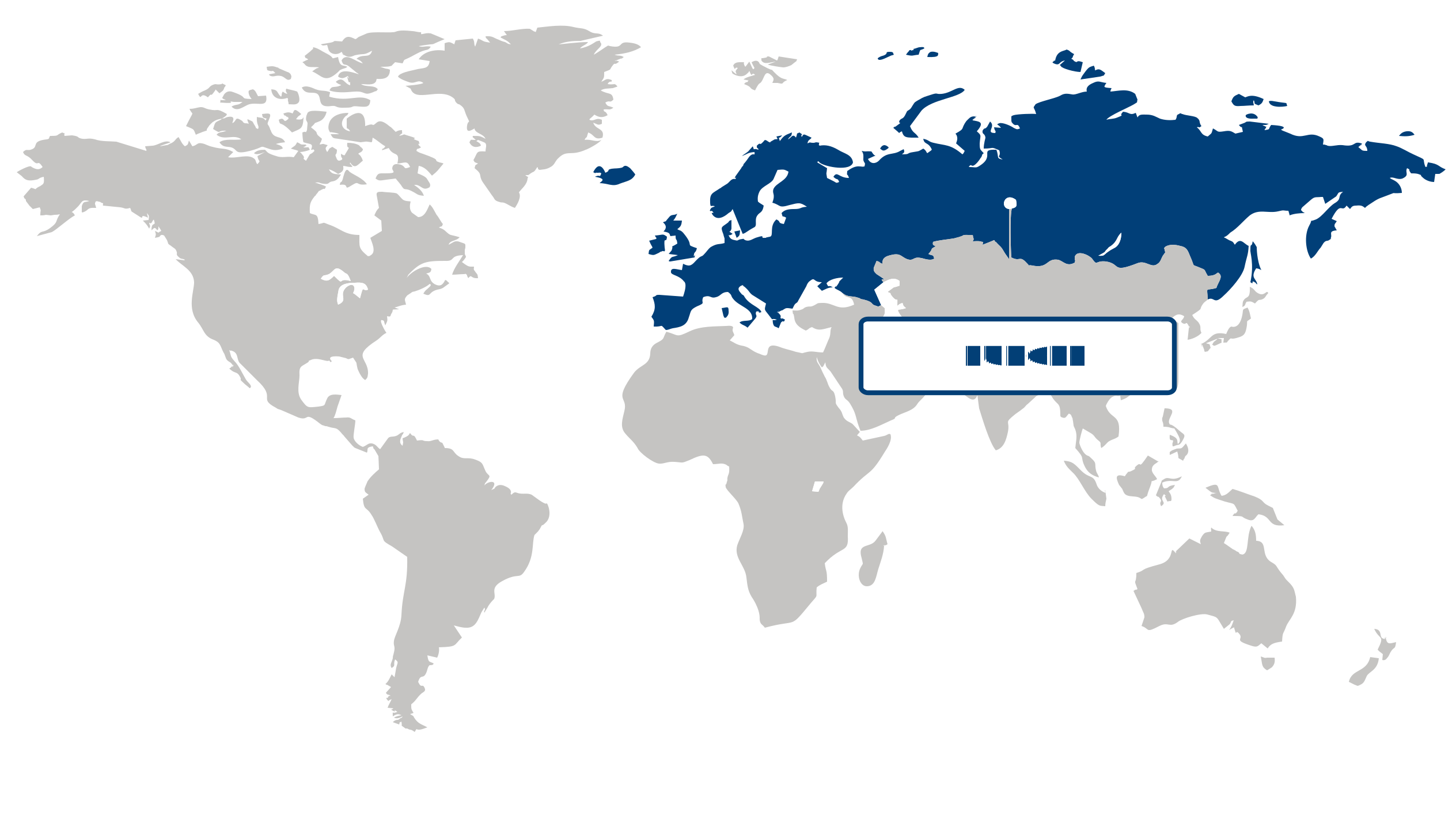
Largest Region
Europe
38% Market Share in 2025
Europe captured over 38% of the global microporous insulation market in 2025, making it the largest regional share as stringent energy-efficiency regulations and sustainability initiatives reshape demand. Policy drivers such as the European Commission’s Energy Performance of Buildings Directive (EPBD) and the Renovation Wave under the European Green Deal have accelerated demand for high-performance thermal solutions, while the International Energy Agency (IEA) highlights insulation as a priority for emissions reduction. Financial instruments from the European Investment Bank (EIB) and national retrofit funds are de-risking large projects, and corporate procurement statements from major manufacturers point to rising specification of low-thickness, high-performance materials in industrial and building applications. These converging policy, finance, and specification trends create material commercial opportunities for suppliers that can scale production, deliver compliance documentation, and partner with installers and EPCs across Europe.
Germany anchors the European market for microporous insulation market uptake, driven by its large manufacturing base, stringent national efficiency targets, and targeted retrofit incentives. Programs and guidance from the Federal Ministry for Economic Affairs and Climate Action (BMWK), promotional work by the German Energy Agency (dena), and financing through KfW’s energy-efficiency lending programs have boosted demand for compact, high-performance insulation in petrochemical plants, power generation, and historic-building retrofits. Industrial customers in Germany favor certified performance, lifecycle cost analyses, and local technical support, so suppliers that invest in Germanized testing, service networks, and partnerships with engineering firms will be best positioned to capture project-level demand and reinforce Europe-wide leadership.
France is positioned as a pivotal hub in Europe for adoption of microporous insulation market solutions, propelled by ambitious renovation subsidies and national decarbonization commitments. Programs such as MaPrimeRénov and implementation support from ADEME alongside guidance from the Ministère de la Transition écologique have stimulated residential and public-sector retrofit pipelines that specify high-efficiency, space-saving insulation products. French public procurement and utility-driven retrofit initiatives reward demonstrable energy savings and installer training, so market entrants that combine compliant product portfolios with installer partnerships and turnkey retrofit services can scale rapidly and help consolidate regional market share.
Asia Pacific Market Analysis:
Asia Pacific emerged as the fastest-growing region in the microporous insulation market, registering a robust CAGR of 7.1% as expanding petrochemical and aerospace sectors accelerate demand. Rising petrochemical feedstock use and refinery-petrochemical integration in Asia support demand for high-temperature, low-volume insulation, while rapid fleet and engine replacements in the region’s airlines and OEMs increase demand for lightweight, thermally stable materials; the International Energy Agency documents growing petrochemical feedstock demand in Asia, and Boeing’s Commercial Market Outlook identifies Asia-Pacific as the largest source of new aircraft demand. Supportive industrial policy from agencies such as Japan’s Ministry of Economy, Trade and Industry (METI) and China’s 14th Five-Year Plan, plus localized fabrication hubs, position the region for continued adoption and upgrading of microporous solutions, creating sizeable commercial opportunities for premium and scale suppliers.
Japan is the high-performance and niche-application leader in the microporous insulation market, supplying precision components for aerospace and specialty petrochemical installations. Japan’s manufacturers, working with OEMs such as Mitsubishi Heavy Industries, prioritize low mass, high-temperature stability and stringent quality controls demanded by aero-engine and specialty petrochemical projects; METI programs that fund material R&D and energy-efficiency standards reinforce procurement of advanced insulation. Strong supply-chain precision and a skilled engineering workforce make Japan the preferred source for qualifying microporous products for critical aerospace and high-end petrochemical use, enabling regional manufacturers and integrators to rely on Japanese-certified components for export and domestic projects.
China is the volume engine in the microporous insulation market, where large-scale petrochemical expansions and rapid commercial aircraft fleet growth drive durable demand. State-affiliated refiners and petrochemical groups such as Sinopec continue capacity additions and complex integration, while China’s 14th Five-Year Plan and Boeing’s forecasts for China’s fleet expansion underpin bulk demand for thermal-management solutions. Cost-competitive production, expanding domestic OEMs, and fast-moving project pipelines allow Chinese fabricators to scale microporous insulation supply for both domestic installations and export, creating opportunities for suppliers who can combine quality certification with high-volume manufacturing to serve project-led growth across the region.
North America Market Trends:
Held a substantial share, North America’s microporous insulation market is anchored by large-scale industrial demand, accelerated retrofit spending in energy‑intensive sectors, and a concentrated supplier network that supports rapid specification and deployment. Evidence includes U.S. Department of Energy initiatives promoting industrial efficiency and the allocation of funds from the Infrastructure Investment and Jobs Act to energy projects, while corporate communications from Aspen Aerogels and Morgan Advanced Materials point to rising commercial and industrial order activity. Logistics advantages around Gulf Coast manufacturing and Port of Houston connectivity, alongside a skilled fabrication workforce noted by the Bureau of Labor Statistics, further underpin capacity. These dynamics position the region for continued uptake as decarbonization and efficiency programs expand demand.
The U.S. maintained a dominant role in the microporous insulation market, where federal programs, large petrochemical and LNG maintenance cycles, and corporate sustainability commitments drive specification of higher‑performance products. U.S. Department of Energy programs and funding streams under the Bipartisan Infrastructure Law have incentivized energy‑efficiency upgrades in manufacturing, and press releases from Aspen Aerogels and Unifrax reflect growing commercial interest in advanced thermal solutions for industrial and transportation applications. This concentrated demand and policy support in the U.S. create a strategic beachhead for suppliers to scale regional production, standardize product qualification, and capture retrofit and new‑build projects across North America.
No card data available for this language/report.
Segment Leadership and Growth Trends
Rigid boards & panels dominated the microporous insulation market as the largest share in 2025, driven by their unmatched performance for high-temperature industrial insulation. Leadership reflects direct demand for thin, high-R-value segments able to withstand furnace and process heat, aligning with U.S. Department of Energy guidance on industrial heat-loss reduction and NASA use-cases for ultralight high-temperature insulation that emphasize weight- and space-sensitive applications. Customer preference for compact, long-life solutions, tightening energy-efficiency rules from the European Commission, and supply-chain moves toward pre-fabricated thermal modules have reinforced adoption. This creates strategic openings for incumbent manufacturers to offer integrated system warranties and for nimble entrants to specialize in custom board fabrication and low-carbon feedstocks. Given ongoing industrial heat demands and regulatory focus on efficiency, these segments should retain near-term relevance.
Analysis by Application
Industrial represented largest share in the microporous insulation market in 2025, reflecting rapid uptake in furnaces and process equipment across heavy industry. The segment leads because operators prioritize higher-temperature containment to reduce energy loss and improve throughput, consistent with International Energy Agency analysis on industrial heat and U.S. Department of Energy programs targeting process efficiency; equipment suppliers such as Siemens Energy and Babcock & Wilcox emphasize thermal management in product roadmaps. Shifts in procurement toward lifecycle cost, aftermarket service models, digital monitoring of insulation performance, and manufacturing decarbonization are influencing demand patterns. Opportunities exist for established players to bundle insulation with thermal services and for startups to deploy sensor-enabled retrofit solutions. With sustained industrial heating needs and stricter efficiency standards, this segment will remain strategically important in the near to medium term.
| Report Segmentation | |||
| Segment | Sub-Segment | Largest Segment | Fastest Growing Segment |
|---|---|---|---|
| Product | Rigid boards & panels, Flexible panels, Others | ||
| Application | Industrial, Energy & Power, Oil & Gas, Aerospace & Defense, Others | ||
 Read our Research Approach
Competitive Landscape and Market Positioning
Key players in the microporous insulation market include Unifrax (USA), Promat (Belgium), Thermal Ceramics (USA), 3M (USA), ZIRCAR Ceramics (USA), Morgan Advanced Materials (UK), Isolite Insulating Products (USA), Armacell (Germany), Kerneos (France), and GHT Group (USA). These firms combine deep materials science capabilities with application-focused portfolios: Unifrax and ZIRCAR are recognized for advanced fiber and high‑temperature ceramic technologies, Promat and Kerneos bring refractory and fire‑safety expertise, while Thermal Ceramics, Morgan Advanced Materials and Armacell link broad industrial systems experience to engineered microporous offerings. 3M leverages global specialty‑materials channels and R&D intensity, Isolite occupies niche panel and module segments, and GHT Group operates as an agile provider of tailored microporous solutions across industrial end markets.The competitive landscape is shaped by moves that extend technical depth, route products to demanding applications, and tighten supplier‑end user integration. Leading firms have expanded technical platforms through selective portfolio consolidation and partnerships that accelerate entry into adjacent thermal‑management systems, and they have reinforced laboratory and pilot capabilities to shorten development cycles. Several players are aligning closer with OEMs and project integrators to offer systemized, thinner‑profile solutions for energy, petrochemical and aerospace end uses, while others are adapting manufacturing footprints and channel access to improve responsiveness and customization for regional projects.
Strategic / Actionable Recommendations for Regional Players
North America: Leverage existing engineering relationships with aerospace, petrochemical and power OEMs to co‑develop application‑specific microporous modules and services. Strengthen local pilot and testing capabilities to reduce qualification time, and pursue alliances that broaden channel access into turn‑key thermal systems for retrofit and new builds.
Asia Pacific: Establish closer collaborations with regional construction and industrial contractors to adapt product designs for cost‑sensitive, high‑volume projects and to local standards. Invest in flexible manufacturing cells and digital simulation tools to accelerate customization and scale production near emerging demand hubs while enabling rapid response to competitive entrants.
Europe: Focus on premium, high‑performance niches linked to energy transition and specialty process industries by deepening technical partnerships with research centers and OEMs. Enhance sustainability credentials and material circularity in product development, and seek cooperative arrangements that provide fast access to regulated markets and hydrogen/renewables applications.
Why Choose Us
Specialized Expertise: Our team comprises industry experts with a deep understanding of your market segment. We bring specialized knowledge and experience that ensures our research and consulting services are tailored to your unique needs.
Customized Solutions: We understand that every client is different. That's why we offer customized research and consulting solutions designed specifically to address your challenges and capitalize on opportunities within your industry.
Proven Results: With a track record of successful projects and satisfied clients, we have demonstrated our ability to deliver tangible results. Our case studies and testimonials speak to our effectiveness in helping clients achieve their goals.
Cutting-Edge Methodologies: We leverage the latest methodologies and technologies to gather insights and drive informed decision-making. Our innovative approach ensures that you stay ahead of the curve and gain a competitive edge in your market.
Client-Centric Approach: Your satisfaction is our top priority. We prioritize open communication, responsiveness, and transparency to ensure that we not only meet but exceed your expectations at every stage of the engagement.
Continuous Innovation: We are committed to continuous improvement and staying at the forefront of our industry. Through ongoing learning, professional development, and investment in new technologies, we ensure that our services are always evolving to meet your evolving needs.
Value for Money: Our competitive pricing and flexible engagement models ensure that you get maximum value for your investment. We are committed to delivering high-quality results that help you achieve a strong return on your investment.
Select Licence Type

