



Modular Kitchen Market Size & Growth Forecast 2026–2035, By Segments (Application, Distribution, Product, Layout), Regional Demand Trends (North America, Asia Pacific, Europe), Key Country Insights (U.S., Japan, South Korea, Germany, France, Italy), and Competitive Landscape
Market Size and Growth Outlook
Modular Kitchen Market size was estimated at USD 27.33 Billion in 2025 and is projected to grow at a 5% CAGR from 2026 to 2035, crossing USD 44.52 Billion by 2035. The industry revenue for 2026 is assessed at USD 28.51 billion.
Base Year Value (2025)
USD 27.33 Billion
CAGR (2026-2035)
5%
Forecast Year Value (2035)
USD 44.52 Billion

Historical Data Period
2022-2025

Largest Region
Europe

Forecast Period
2026-2035
Modular Kitchen Market Intelligence Snapshot:
-
Regional Market Dynamics:
- Europe captured a 35.33% market share in 2025, supported by a mature renovation market, strong demand for customized kitchens, established installation networks, and premium interior preferences.
- Asia Pacific is projected to grow at a 5.7% CAGR, driven by urban housing expansion, rising middle-class spending, developer-led residential projects, and increasing adoption of branded modular kitchen solutions.
-
Segment Momentum:
- Residential held a 76.1% share in 2025 because demand is closely tied to home renovations, apartment fit-outs, and new housing projects that prioritize space efficiency and design flexibility.
- Online is the fastest-growing distribution channel as buyers increasingly use digital platforms to compare designs, explore configurations, and access remote consultations before making purchase decisions.
-
Market Expansion Drivers:
- Rising residential construction and income growth boosting modular kitchen installations.
- Increasing smart kitchen adoption with IoT-enabled automation and open-plan designs.
- Urban compact living trends driving demand for space-optimized kitchen configurations.
-
Leading Market Participants:
Prominent players in the modular kitchen market include IKEA Group (Netherlands), nobilia-Werke J. Stickling GmbH & Co. KG (Germany), Häcker Küchen GmbH & Co. KG (Germany), Poggenpohl Möbelwerke GmbH (Germany), SieMatic Möbelwerke GmbH & Co. KG (Germany), Bulthaup GmbH & Co KG (Germany), Snaidero Rino S.p.A. (Italy), Hettich Holding GmbH & Co. oHG (Germany), Pedini S.p.A. (Italy), Lineadecor Mobilya Sanayi ve Ticaret A.Ş. (Turkey).
Global Market Forecast Snapshot:
-
Market Outlook:
- 2025 Market Size: USD 27.33 Billion
- Projected Market Size: USD 44.52 Billion by 2035
- Growth Forecasts: 5% CAGR (2026-2035)
-
Regional and Segment Outlook:
- Leading Regional Market: Europe
- High-Growth Regional Hub: Asia Pacific
- Core Revenue Segment: Residential (Application) | Offline (Distribution) | Floor Cabinet (Product) | L-Shape (Layout)
- Emerging Opportunity Segment: Commercial (Application) | Online (Distribution) | Tall Storage Cabinets (Product) | Parallel (Layout)
Market Growth Drivers and Industry Trends
Rising residential construction and income growth boosting modular kitchen installationsA larger pipeline of new apartments, villas, and redevelopment projects creates a direct installation opportunity for the modular kitchen market because kitchens are increasingly specified as integrated interior packages rather than post-handover carpentry work. As household incomes rise, buyers tend to shift from basic built-in formats to branded modular systems that offer standardized finishes, better hardware, and faster installation, prompting developers and homeowners to allocate more spending to fitted kitchens at the purchase stage. This combination strengthens market development by expanding both first-time installations in new homes and upgrade demand from consumers seeking improved aesthetics, storage efficiency, and long-term durability.
Increasing smart kitchen adoption with IoT-enabled automation and open-plan designs
The spread of connected appliances, sensor-based fittings, and app-enabled kitchen controls is influencing market adoption by pushing the modular kitchen market toward integrated layouts that can accommodate power management, embedded devices, and coordinated appliance placement. Open-plan home design reinforces this shift because the kitchen now functions as a visible part of the living space, raising the importance of seamless cabinetry, concealed storage, and design consistency with adjacent interiors. That practical convergence of technology integration and lifestyle-led layout planning is driving demand for higher-value modular configurations designed around both usability and presentation.
Urban compact living trends driving demand for space-optimized kitchen configurations
Smaller urban homes are increasing market penetration for the modular kitchen market because limited floor area makes efficient storage, precise layout planning, and multifunctional fittings more valuable than conventional carpenter-built kitchens. In compact apartments, consumers prioritize pull-out units, corner solutions, tall storage modules, and customized workstation arrangements that maximize utility without overcrowding the room, which favors factory-designed modular systems with standardized yet adaptable components. This shift supports market expansion by making space optimization a core purchase criterion rather than a premium add-on, especially in densely populated cities where every square foot influences furniture and renovation decisions.
| Growth Driver Assessment Framework | |||||
| Growth Driver | Impact On CAGR | Regulatory Influence | Geographic Relevance | Adoption Rate | Impact Timeline |
|---|---|---|---|---|---|
| Rising residential construction and income growth boosting modular kitchen installations | 2.00% | Low | Asia Pacific, Europe | High | Near Term |
| Increasing smart kitchen adoption with IoT-enabled automation and open-plan designs | 1.80% | Low | Europe, North America | Emerging | Mid Term |
| Urban compact living trends driving demand for space-optimized kitchen configurations | 1.50% | Low | Asia Pacific | Medium | Mid Term |
Unlock insights tailored to your business with our bespoke market research solutions - Click to get your customized report now!
Regional Demand Dynamics
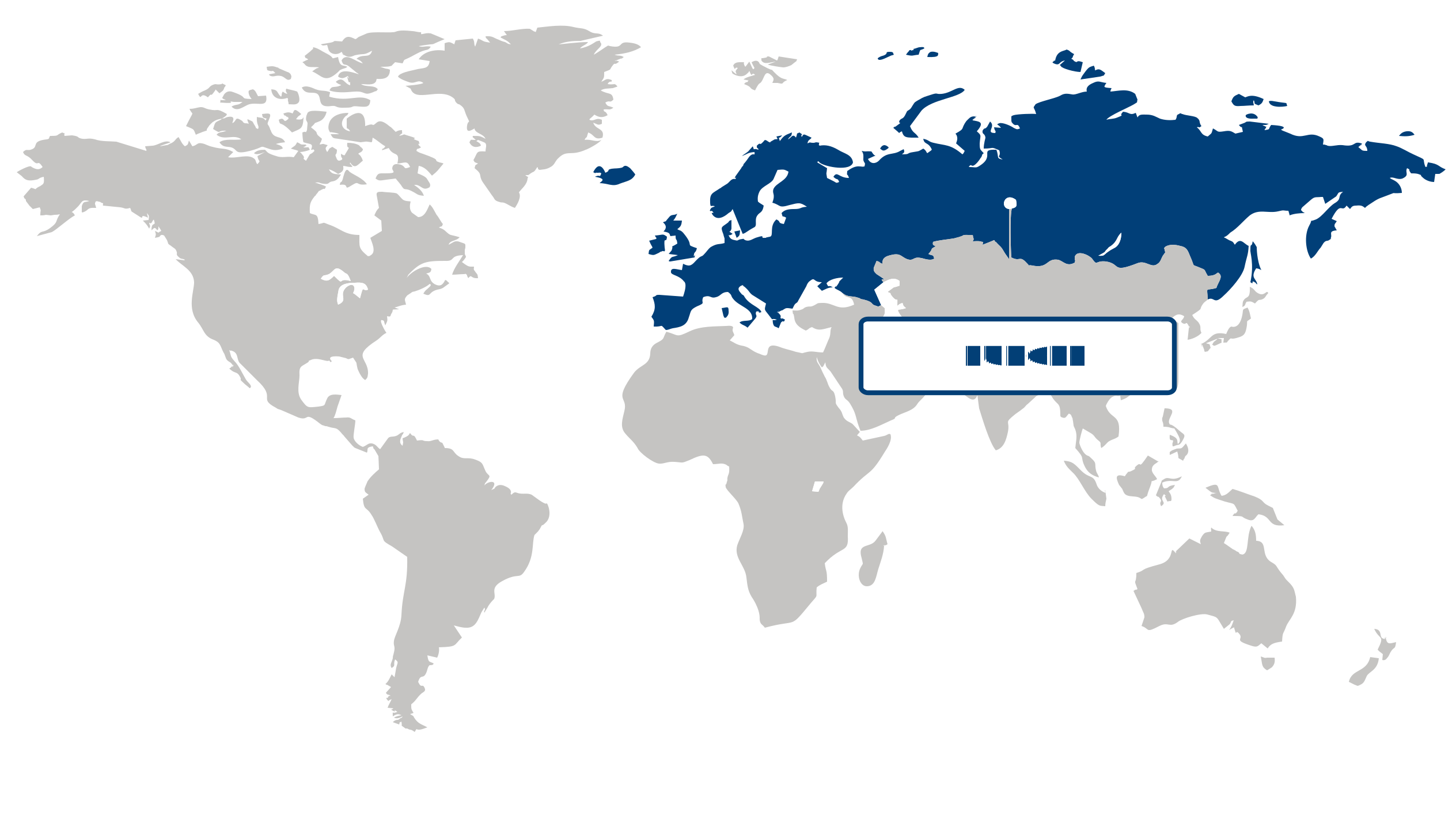
Largest Region
Europe
35.33% Market Share in 2025
Europe held a 35.33% share of the modular kitchen market in 2025, supported by a mature home improvement ecosystem, strong consumer preference for customized interior solutions, and widespread adoption of space-efficient kitchen layouts. The region’s leadership is reinforced by established distribution networks, experienced installation providers, and steady renovation activity across urban housing stock, which keeps demand tied not only to new residential projects but also to replacement and upgrade cycles. Practical buying behavior in Europe also favors premium finishes, integrated storage, and design-led functionality, helping sustain higher value realization across the market.
Asia Pacific is projected to expand at a 5.7% CAGR over the forecast period, with the modular kitchen market gaining momentum from rapid urban housing development, rising middle-class spending on organized home interiors, and increasing demand for efficient kitchen formats in compact apartments. Growth is being accelerated by changing consumer expectations around convenience, aesthetics, and better space utilization, especially in densely populated cities where modular designs fit modern residential construction patterns. The region is also seeing stronger adoption through expanding developer-led housing projects and broader access to branded kitchen solutions across both emerging metropolitan and tier-two urban markets.
Key Country Insights
The U.S. modular kitchen market is shaped by demand for customized layouts, premium finishes, and integrated smart appliances. Manufacturers in the U.S. continue expanding flexible design solutions that address renovation activity and evolving residential lifestyles.
Japan emphasizes modular kitchens designed for compact homes where efficient space utilization is essential. Manufacturers in Japan develop multifunctional cabinetry and streamlined layouts that maximize usability while maintaining premium aesthetics.
South Korea's modular kitchen market benefits from strong demand for modern interiors and premium residential developments. Kitchen manufacturers in South Korea focus on minimalist designs, integrated appliances, and customized configurations that enhance everyday functionality.
Germany prioritizes modular kitchen solutions that combine ergonomic layouts, precision engineering, and long-lasting materials. German consumers increasingly value efficient storage systems and sustainable product designs suited to modern residential spaces.
France favors modular kitchens that blend sophisticated design with durable materials and tailored storage solutions. Suppliers in France increasingly introduce customizable collections that reflect changing consumer preferences for aesthetics and efficient home organization.
Italy's modular kitchen market combines contemporary styling with established furniture manufacturing expertise. Italian producers invest in premium finishes, innovative layouts, and high-quality materials that support both domestic demand and international design appeal.
Segment Leadership and Growth Trends
Residential held the strongest position in the modular kitchen market in 2025, accounting for a 76.1% share. This dominance is sustained by the direct link between modular kitchen adoption and household renovation, apartment fit-outs, and new home furnishing demand, where buyers prioritize space efficiency, standardized layouts, and design flexibility. The residential application continues to command share because modular kitchen solutions align well with everyday storage optimization and customization needs across urban housing formats.
Commercial is emerging as the fastest-growing application in the modular kitchen market as hospitality, food service, and institutional projects increasingly require durable, standardized, and quickly installable kitchen systems. Growth is being encouraged by the practical need for operational efficiency and consistent layout execution across restaurants, hotels, cloud kitchens, and similar facilities, where modular formats offer faster deployment and easier maintenance than conventional built-in alternatives. This makes commercial adoption rise faster relative to residential replacement cycles.
Distribution Segment Analysis: Offline (Largest Segment) vs Online (Fastest-Growing Segment)
In 2025, offline remained the dominant distribution channel in the modular kitchen market with an 80.56% share. Its leadership is aided by the high-involvement nature of the purchase, where customers often prefer in-store consultation, material inspection, layout discussion, and personalized design support before committing. Offline channels retain share because modular kitchen buying typically depends on tactile evaluation and project-specific planning, which physical showrooms and dealer networks are better positioned to provide.
Online is the fastest-growing distribution channel in the modular kitchen market as buyers increasingly begin their purchasing journey through digital platforms that simplify product discovery, design comparison, and lead generation. Its momentum comes from growing comfort with remote consultation and the convenience of browsing configurations, finishes, and pricing options without visiting multiple stores. Compared with offline routes, online channels are gaining faster because they reduce search friction and better match digitally influenced home improvement purchasing behavior.
| Report Segmentation | |||
| Segment | Sub-Segment | Largest Segment | Fastest Growing Segment |
|---|---|---|---|
| Application | Residential, Commercial | Residential | Commercial |
| Distribution | Offline, Online | Offline | Online |
| Product | Floor Cabinet, Water Cabinet, Tall Storage Cabinets | Floor Cabinet | Tall Storage Cabinets |
| Layout | L-Shape, U-Shape, Parallel, Straight, Island, Others | L-Shape | Parallel |
 Read our Research Approach
Competitive Landscape and Market Positioning
Leading companies in the modular kitchen market:1. IKEA Group (Netherlands)
2. nobilia-Werke J. Stickling GmbH & Co. KG (Germany)
3. Häcker Küchen GmbH & Co. KG (Germany)
4. Poggenpohl Möbelwerke GmbH (Germany)
5. SieMatic Möbelwerke GmbH & Co. KG (Germany)
6. Bulthaup GmbH & Co KG (Germany)
7. Snaidero Rino S.p.A. (Italy)
8. Hettich Holding GmbH & Co. oHG (Germany)
9. Pedini S.p.A. (Italy)
10. Lineadecor Mobilya Sanayi ve Ticaret A.Ş. (Turkey)
In the modular kitchen market, design preferences are increasingly shaped by evolving urban living patterns and demand for space optimization. The rise of smart manufacturing tools and digital design integration is influencing customization levels, while new modular kitchen market offerings continue to emphasize functionality and aesthetics. Collaborative design ecosystems between manufacturers and design specialists are also supporting faster innovation cycles and more personalized layouts.
Industry Development/News
| Company Name | Date | Key Development |
|---|---|---|
| Blum | Mar-26 | Blum inaugurated an exclusive Solution Centre in Gorakhpur, India, in partnership with Kitchen Pro. This facility serves as a dedicated hub for demonstrating high-end furniture fittings and modular kitchen hardware, significantly expanding the company's regional retail and partner network while improving consumer access to integrated, design-led kitchen interior systems. |
| Interio by Godrej | Jan-26 | Interio by Godrej announced a strategic growth initiative targeting a 10% CAGR in the modular kitchen segment through fiscal year 2030. The company is prioritizing expansion into tier 2 and tier 3 cities, backed by increased investment in technology-enabled customization to capture rising demand for modular interiors in India’s residential market. |
| Liebherr | Jul-25 | Liebherr commenced local manufacturing of fully integrated refrigerators in India, engineered to meet specific regional climatic requirements. This move enhances the company’s kitchen appliance portfolio by delivering increased durability and energy efficiency, supporting its ability to provide integrated kitchen solutions and strengthening its competitive standing through localized production capabilities. |
| Nolte Küchen | Mar-25 | Nolte Küchen committed $2 million to accelerate its market penetration in India. The investment focuses on the development of flagship showrooms, expansion of its distribution network, and local workforce training. This structured approach aims to establish the firm as a leading European modular kitchen brand within the Indian premium residential interior ecosystem. |
| BSH Home Appliances | Dec-24 | BSH Home Appliances opened a new Siemens Experience Centre in Bengaluru to showcase its premium integrated kitchen and home appliances. This interactive retail space is designed to facilitate deeper consumer engagement with built-in appliance ecosystems, reinforcing the Siemens brand’s positioning within the high-end modular kitchen and smart home segment in India. |
Why Choose Us
Specialized Expertise: Our team comprises industry experts with a deep understanding of your market segment. We bring specialized knowledge and experience that ensures our research and consulting services are tailored to your unique needs.
Customized Solutions: We understand that every client is different. That's why we offer customized research and consulting solutions designed specifically to address your challenges and capitalize on opportunities within your industry.
Proven Results: With a track record of successful projects and satisfied clients, we have demonstrated our ability to deliver tangible results. Our case studies and testimonials speak to our effectiveness in helping clients achieve their goals.
Cutting-Edge Methodologies: We leverage the latest methodologies and technologies to gather insights and drive informed decision-making. Our innovative approach ensures that you stay ahead of the curve and gain a competitive edge in your market.
Client-Centric Approach: Your satisfaction is our top priority. We prioritize open communication, responsiveness, and transparency to ensure that we not only meet but exceed your expectations at every stage of the engagement.
Continuous Innovation: We are committed to continuous improvement and staying at the forefront of our industry. Through ongoing learning, professional development, and investment in new technologies, we ensure that our services are always evolving to meet your evolving needs.
Value for Money: Our competitive pricing and flexible engagement models ensure that you get maximum value for your investment. We are committed to delivering high-quality results that help you achieve a strong return on your investment.
Select Licence Type

