



Montan Wax Market Size & Forecasts 2026-2035, By Segments (Function, End-Use Industry), Growth Opportunities, Innovation Landscape, Regulatory Shifts, Strategic Regional Insights (U.S., Japan, China, South Korea, UK, Germany, France), and Competitive Dynamics (Clariant, Honeywell International, Arr Mazola, BASF, Sinopec)
Market Size and Growth Outlook
Base Year Value (2025)
USD 153.81 Million
CAGR (2026-2035)
4.8%
Forecast Year Value (2035)
USD 245.81 Million

Historical Data Period
2022-2025

Largest Region
Europe

Forecast Period
2026-2035
Key Takeaways
- Europe region gained over 42% revenue share in 2025, driven by steady demand from European cosmetics, coatings, and polishing industries that extensively use montan wax for performance enhancement.
- Asia Pacific region will register over 6.1% CAGR during the forecast period, propelled by rising personal care and industrial applications.
- The lubricants segment held largest share of the market in 2025, driven by increasing use of montan wax as processing aids in plastics and rubber industries.
- The wax polishes segment maintained its lead in the montan wax market, supported by rising demand for high-gloss automotive and furniture polish products.
- Key companies dominating the montan wax market are Clariant (Switzerland), Honeywell International (USA), Arr Mazola (Austria), BASF (Germany), Sinopec (China), Shell Chemicals (Netherlands), Sasol (South Africa), AkzoNobel (Netherlands), Nitol Group (Russia), Evonik Industries (Germany).
Market Growth Drivers and Industry Trends
Growth in Packaging & Coating ApplicationsRising regulatory pressure on recyclable and mono-material packaging and corporate sustainability commitments are elevating performance demands for barrier and release coatings, positioning the montan wax market as a technical enabler for recyclable coatings and paperboard finishes. The European Commission’s Packaging and Packaging Waste Directive revisions and Unilever’s public packaging targets illustrate procurement and design shifts toward easily separable coatings and low-impact additives. Established wax producers can partner with packaging converters and coating formulators to supply tailored grades; new entrants can capture niche niches by certifying recyclability and food-contact compliance. Observable policy updates and brand deadlines suggest steady demand for coating-specific montan wax formulations in packaging supply chains.
Use in Polymer Modification & Composites
Performance needs in polymer processing—improved dispersion, lubricity, release and anti-block properties—are increasing interest in specialty wax additives, making the montan wax market relevant to compounders and composite manufacturers. BASF and Dow product literature on polymer additives and mold-release solutions demonstrates industry reliance on wax chemistries to meet processing and surface specifications. Strategic opportunities include co-development agreements with compounders such as Borealis or SABIC, bespoke functionalization for high-performance composites, and supplying masterbatch-ready concentrates. As major polymer suppliers publish additive compatibility guidance, montan wax suppliers able to align with technical specifications will gain access to broader polymer formulations.
Long-term Demand in Niche Industrial Applications
Durable end-use sectors—metalworking, polishing, leather finishing and specialty lubricants—continue to require high-performance solid waxes, sustaining the montan wax market beyond commodity cycles. Product portfolios from Henkel and 3M show persistent use of wax-based additives in adhesives, surface treatments and polishes, underlining long-lived aftermarket and maintenance demand. This creates opportunities for legacy manufacturers to expand custom formulations and for agile entrants to target specialty channels (industrial maintenance, heritage conservation, tool shops). Given steady industrial maintenance practices and manufacturer specifications that favor proven wax chemistries, these niche applications will remain a reliable demand base for differentiated montan wax grades.
Industry Restraints:
Regulatory and PAH Compliance Burdens — Heightened restrictions on polycyclic aromatic hydrocarbons (PAHs) under REACH and related EU guidance increase testing, certification, and reformulation costs for montan wax suppliers. The European Chemicals Agency (ECHA) has advanced restriction dossiers addressing PAHs and the European Commission’s regulatory scrutiny of hazardous substances has intensified compliance timelines and documentation requirements. This raises operating expenses for incumbent producers and erects entry barriers for smaller firms lacking capital for analytical testing and registration. Strategic responses include investment in purification technology and certified supply chains. Given continued ECHA activity and the European Commission’s Green Deal focus on chemical safety, regulatory pressure will remain a persistent constraint in the near to medium term, favoring well-capitalized participants.
Feedstock Availability and Lignite Phase‑down — Montan wax feedstock is concentrated in lignite-derived fractions, with producers such as Montanwerke Brixlegg AG emblematic of a narrow supply base; the International Energy Agency (IEA) and Germany’s Federal Institute for Geosciences and Natural Resources (BGR) document declining lignite extraction and policy-driven reductions in coal. Geographic concentration and shrinking lignite output create sourcing risk, longer lead times, and volatility for manufacturers. Incumbents can mitigate exposure via vertical integration and long-term offtake contracts, while new entrants face higher procurement costs and scarcity. As energy-transition policies reduce lignite availability, feedstock constraints will continue to force strategic shifts toward secured supply chains or alternative wax chemistries.
| Growth Driver Assessment Framework | |||||
| Growth Driver | Impact On CAGR | Regulatory Influence | Geographic Relevance | Adoption Rate | Impact Timeline |
|---|---|---|---|---|---|
| Growth in packaging & coating applications | 1.30% | Short term (≤ 2 yrs) | North America, Europe | Medium | Fast |
| Use in polymer modification & composites | 1.50% | Medium term (2–5 yrs) | Asia Pacific, Europe | Low | Moderate |
| Long-term demand in niche industrial applications | 1.00% | Long term (5+ yrs) | North America, Asia Pacific | Medium | Slow |
Unlock insights tailored to your business with our bespoke market research solutions - Click to get your customized report now!
Regional Demand Dynamics
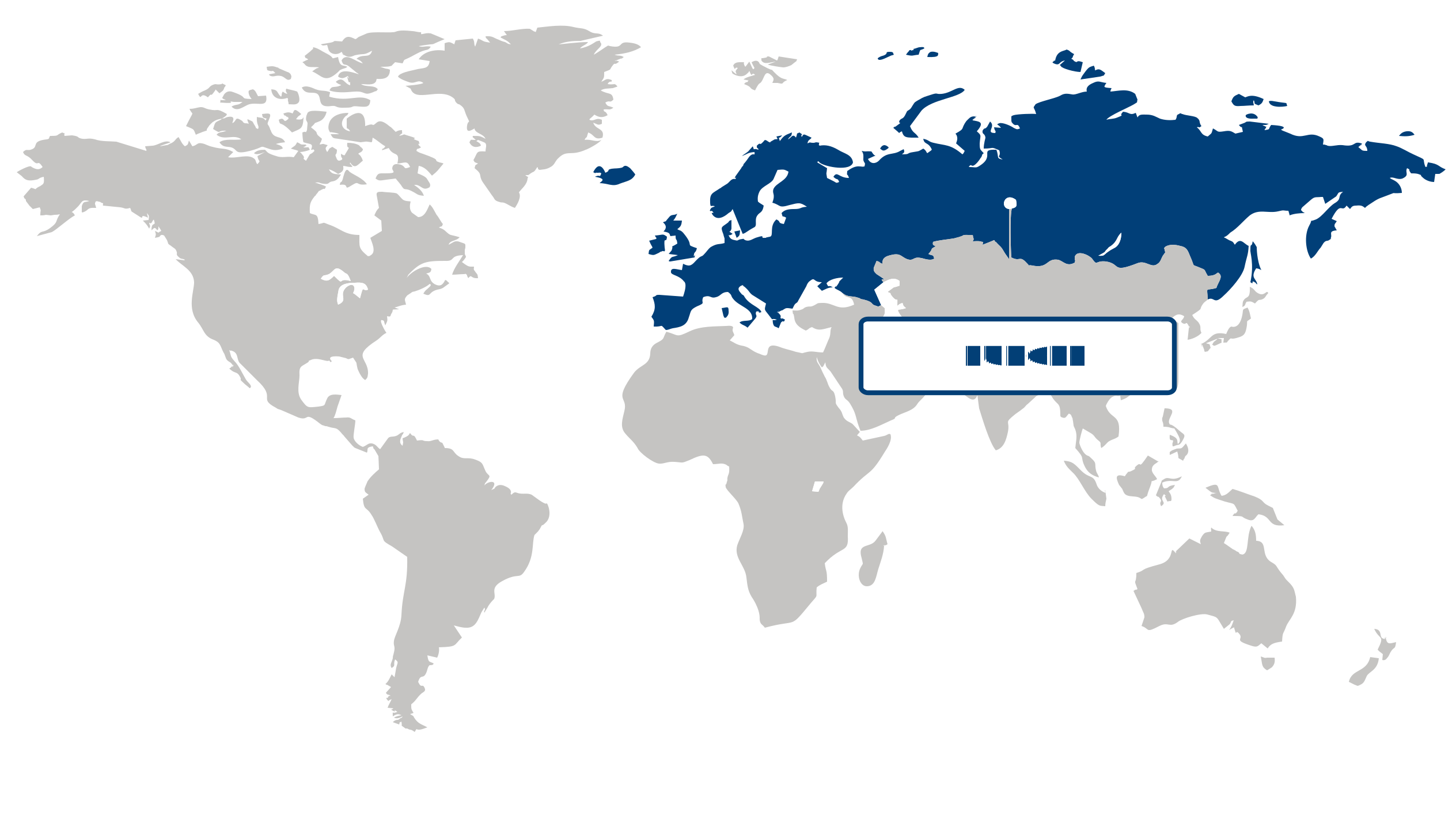
Largest Region
Europe
42% Market Share in 2025
Europe captured over 42% of the global montan wax market in 2025, making it the largest regional market by share; this leadership is anchored in steady demand from cosmetics, coatings, and polishing industries that rely on montan wax for performance enhancement. The region’s market is reinforced by regulatory and sustainability pressures—illustrated by the European Commission Green Deal and activity at the European Chemicals Agency (ECHA)—which are encouraging manufacturers to adopt higher‑performance, traceable wax inputs. Commercial signals such as L’Oréal’s sustainability commitments and BASF’s investments in advanced coating chemistries further validate industrial uptake. Together, these dynamics position Europe as a high‑value, innovation‑oriented market where premium applications and localized supply chains offer significant commercial opportunities.
Germany anchors the European market for montan wax market demand through a dense industrial ecosystem that blends automotive coatings, technical polishing, and personal‑care formulation needs. Large industrial buyers such as Volkswagen Group and chemical and consumer‑care firms like Beiersdorf create steady, specification‑driven demand for functional waxes, while German innovation clusters and the Federal Ministry for Economic Affairs and Climate Action’s industrial policies support scale‑up of local processing and formulation R&D. For investors and suppliers, Germany’s concentration of OEMs and formulators favors partnerships for co‑development, qualification runs, and near‑market logistics that amplify regional growth.
France serves as a pivotal hub in the European montan wax market, where a globally leading cosmetics sector and active sustainability agencies shape product requirements and adoption. Major cosmetics companies such as L’Oréal, combined with policy and support from ADEME (French Agency for Ecological Transition), are driving demand for high‑performing, more sustainable wax ingredients in premium formulations. This creates a testing ground for differentiated montan wax grades and certified sourcing models; consequently, France’s market dynamics encourage suppliers to introduce eco‑labelled and high‑purity grades that can scale across Europe, reinforcing regional opportunity.
Asia Pacific Market Analysis:
The Asia Pacific montan wax market emerged as the fastest-growing region, registering a CAGR of 6.1%, driven by rising personal care and expanding industrial applications. Rapid growth in regional cosmetics demand—supported by product innovation from firms such as Shiseido Co., Ltd. and Kao Corporation—is increasing demand for wax-based emollients and coating agents, while broader industrial uses in metal polishes, coatings and rubber processing are buoyed by durable-goods production in China and Japan; the National Bureau of Statistics of China and Japan’s Ministry of Economy, Trade and Industry (METI) both report resilient manufacturing activity. Sustainability preferences and stricter formulation standards are encouraging higher-purity, specialty wax sourcing, creating premium-margin opportunities for suppliers and converters across the region.
Japan plays a technology- and quality-led role in the montan wax market, supplying high-value formulations and precision industrial applications. Japanese personal-care leaders such as Shiseido Co., Ltd. and Kao Corporation have publicly highlighted R&D in texture and stability that favors specialty wax inputs, while METI’s focus on advanced materials supports adoption in electronics and automotive components where consistent wax performance is critical. Regulatory rigor and an experienced specialty-chemicals workforce make Japan a testbed for premium montan wax grades, signaling opportunities for suppliers to validate product performance before wider regional rollouts.
China functions as the volume-growth engine for the montan wax market, where scale in both personal care and industrial sectors is accelerating uptake. The National Bureau of Statistics of China documents continued expansion in manufacturing output that drives demand for waxes in coatings, polishes and rubber additives, while e-commerce platforms led by Alibaba Group have amplified beauty-category penetration, increasing demand for cosmetic wax ingredients. Recent regulatory modernization by the National Medical Products Administration (NMPA) has reduced barriers for innovative cosmetic formulations, making China a critical market for scaling montan wax applications and linking regional supply strategies to high-volume growth.
North America Market Trends:
The montan wax market held a substantial share in North America, driven by concentrated industrial demand from automotive refinishing, floor polishes and speciality coatings and supported by resilient downstream manufacturing clusters. Regional significance is evident as the U.S. and neighboring markets balance steady domestic consumption with targeted imports; the U.S. Environmental Protection Agency’s recent VOC guidance for coatings has nudged formulators toward higher-performance, low-emission additives, while the U.S. International Trade Commission’s trade data point to ongoing flows of specialty waxes into North America. The American Coatings Association has documented growth in performance-additive procurement, and supplier activity by Montanwerke Brixlegg underscores established import channels. These dynamics, alongside investment incentives from the U.S. Department of Commerce for advanced materials, position North America to expand value-added montan wax applications across sustainable and high-performance segments.
The montan wax market in the U.S. serves as the region’s commercial hub, where concentrated R&D, manufacturing scale and logistics capacity amplify demand for tailored wax grades. U.S. manufacturers benefit from manufacturing resilience highlighted in U.S. Bureau of Labor Statistics data and from technology-transfer programs at the National Institute of Standards and Technology that speed formulation innovation for coatings, inks and adhesives. Import dependence creates supplier negotiation opportunities—evidenced by ongoing commercial outreach from Montanwerke Brixlegg—while digitization of formulation and supply-chain planning reduces time-to-market for specialty grades. For investors and strategists, the U.S. role implies that partnerships with formulators, logistics optimization and targeted application development will capture disproportionate regional upside for montan wax products.
No card data available for this language/report.
Segment Leadership and Growth Trends
Lubricants held largest share of the montan wax market's Function segment in 2025, driven by the material’s extensive use as processing aids in plastics and rubber industries. Lubricants lead because montan wax reduces melt fracture, improves demolding and enhances flow during extrusion and molding—directly aligning with the stated growth driver and supported by production trends reported by PlasticsEurope and processing guidance from the European Tyre & Rubber Manufacturers' Association (ETRMA). Producers such as Montanwerke Brixlegg AG and major formulators have highlighted these performance benefits in technical literature, and buyers increasingly favor suppliers that offer traceability and lower environmental footprints. This creates strategic openings for established chemical suppliers to deepen OEM partnerships and for agile specialty players to supply tailored, sustainable grades; ongoing polymer processing optimization and regulatory focus by the European Chemicals Agency (ECHA) on additive characterization underpin the segment’s near- to medium-term relevance.
Analysis by End-Use Industry
Wax Polishes represented largest share of the montan wax market's End-Use Industry segment in 2025, supported by rising demand for high-gloss automotive and furniture polish products. Market leadership stems from montan wax’s strong film-forming and burnish properties that meet OEM and consumer expectations for durable gloss, a dynamic reflected in product announcements from 3M and SC Johnson emphasizing wax-based high-performance finishes. Demand patterns cited by the European Automobile Manufacturers' Association (ACEA) for vehicle care and standards noted by the Furniture Industry Research Association (FIRA) for furniture finishes reinforce sustained uptake. Suppliers that can combine premium performance, REACH-compliant formulations, and sustainable sourcing will secure advantaged positions, while niche entrants can capitalize on eco-friendly, differentiated blends. Continued consumer preference for superior surface aesthetics and clearer regulatory guidance around additives suggest this segment will remain strategically important in the near to medium term.
| Report Segmentation | |||
| Segment | Sub-Segment | Largest Segment | Fastest Growing Segment |
|---|---|---|---|
| Function | Lubricants, Cosmetics, Dispersants, Release Agents, Thickening Agents, Others | ||
| End-Use Industry | Pharmaceuticals, Cosmetics, Leather & Textiles, Plastics, Rubbers, Wax Polishes, Electricals, Agriculture & Forestry, Machinery, Others | ||
 Read our Research Approach
Competitive Landscape and Market Positioning
Key players in the montan wax market include Clariant (Switzerland), Honeywell International (USA), Arr Mazola (Austria), BASF (Germany), Sinopec (China), Shell Chemicals (Netherlands), Sasol (South Africa), AkzoNobel (Netherlands), Nitol Group (Russia), and Evonik Industries (Germany). These companies collectively span integrated commodity supply, specialty-chemicals know-how, and regional distribution depth: global producers such as BASF, Sinopec, Shell, and Sasol anchor feedstock integration and logistics, while Clariant, Evonik, and AkzoNobel supply formulation expertise and application development for coatings, polishes, and polymer additives. Honeywell and Nitol serve as commercialization and channel specialists, and Arr Mazola represents focused regional production with niche customer relationships. Together they shape quality differentiation, technical service expectations, and supply-security norms across end-use segments without relying solely on price competition.The competitive environment is characterized by portfolio deepening, stronger application orientation, and selective repositioning of manufacturing footprints. Leading firms have expanded capabilities through targeted corporate moves and cooperative supply arrangements while stepping up pilot-scale work and analytical services to validate high-purity and specialty grades. Several players are emphasizing lower-impurity and bio-derivative variants alongside enhanced formulation support to capture premium downstream niches; others are streamlining asset networks and reinforcing logistics to better serve multinational formulators. These combined efforts push competition toward technical differentiation and customer-centric solutions, raising barriers for pure commodity entrants and accelerating incremental innovation across lubricants, coatings, and specialty additive uses.
Strategic / Actionable Recommendations for Regional Players
North America: Prioritize closer engagement with automotive, industrial coatings, and floor-care formulators to co-develop high-performance montan grades and platform technologies. Strengthen access to advanced analytical labs and pilot lines to shorten application validation cycles, and align supply arrangements with regional distribution partners to ensure rapid responsiveness to OEM and formulator specifications.
Asia Pacific: Expand downstream presence by deepening ties with large converters and regional distributors, and focus on cost-efficient feedstock integration while piloting bio-based or lower-impurity product variants that meet evolving regulatory and customer demands. Invest selectively in application centers to demonstrate value in high-volume consumer and industrial segments.
Europe: Emphasize sustainability credentials and circular feedstock pathways in product positioning, collaborating with specialty formulators and research consortia to validate eco-preferred montan solutions for conservation, premium coatings, and regulated industries. Leverage proximity to innovation clusters and certification bodies to differentiate on performance and compliance.
Why Choose Us
Specialized Expertise: Our team comprises industry experts with a deep understanding of your market segment. We bring specialized knowledge and experience that ensures our research and consulting services are tailored to your unique needs.
Customized Solutions: We understand that every client is different. That's why we offer customized research and consulting solutions designed specifically to address your challenges and capitalize on opportunities within your industry.
Proven Results: With a track record of successful projects and satisfied clients, we have demonstrated our ability to deliver tangible results. Our case studies and testimonials speak to our effectiveness in helping clients achieve their goals.
Cutting-Edge Methodologies: We leverage the latest methodologies and technologies to gather insights and drive informed decision-making. Our innovative approach ensures that you stay ahead of the curve and gain a competitive edge in your market.
Client-Centric Approach: Your satisfaction is our top priority. We prioritize open communication, responsiveness, and transparency to ensure that we not only meet but exceed your expectations at every stage of the engagement.
Continuous Innovation: We are committed to continuous improvement and staying at the forefront of our industry. Through ongoing learning, professional development, and investment in new technologies, we ensure that our services are always evolving to meet your evolving needs.
Value for Money: Our competitive pricing and flexible engagement models ensure that you get maximum value for your investment. We are committed to delivering high-quality results that help you achieve a strong return on your investment.
Select Licence Type

