Motorsport Transmission Market Size & Growth Forecast 2027–2036, By Segments (Gearbox, Racing, Transmission), Regional Demand Trends (North America, Asia Pacific, Europe), Key Country Insights (U.S., Japan, South Korea, Germany, France, Italy), and Competitive Landscape
Jump to content
Market Size and Growth Outlook
Motorsport Transmission Market size was worth USD 304.79 Million in 2026 and is poised to grow at 4.32% CAGR between 2027 and 2036, crossing USD 465.24 Million by 2036. The industry revenue for 2027 is assessed at USD 315.76 Million.
Get more details on this report
Request Free Sample ReportMotorsport Transmission Market Intelligence Snapshot
Regional Market Dynamics
- Europe held 43.2% in 2026, supported by its established motorsport ecosystem, automotive engineering capabilities, racing activities, and investment in high-performance vehicle development.
- Asia Pacific is growing rapidly as motorsport participation, racing infrastructure investment, local programs, and advanced automotive engineering capabilities expand.
Segment Momentum
- The sequential gearbox segment accounted for 62.4% of the market in 2026, as it enables faster gear changes, improved drivetrain efficiency, and enhanced vehicle control during demanding racing conditions.
- Continuously variable transmissions (CVTs) are expected to witness the fastest growth as ongoing engineering developments improve power delivery efficiency, responsiveness, and performance in specialized racing applications.
Market Expansion Drivers
- Rising demand for high-performance vehicles driving advanced transmission system innovation
- Global expansion of motorsport events increasing demand for specialized racing transmissions
- Advancements in lightweight transmission materials improving speed and fuel efficiency performance
Leading Market Participants
- Top players in the motorsport transmission market include Xtrac Ltd (United Kingdom), Hewland Engineering Ltd. (United Kingdom), Ricardo plc (United Kingdom), ZF Friedrichshafen AG (Germany), Sadev S.A. (France), Holinger Engineering Pty Ltd (Australia), Drenth Motorsport Gearboxes B.V. (Netherlands), Quaife Engineering Ltd. (United Kingdom), Samsonas Motorsport Transmissions UAB (Lithuania), Tractive AB (Sweden)
Global Market Forecast Snapshot
Market Outlook
- 2026 Market Size: USD 304.79 Million
- 2027 Estimated Market Size: USD 315.76 Million
- Projected Market Size: USD 465.24 Million by 2036
- Growth Forecast: 4.32% CAGR (2027-2036)
Regional and Segment Outlook
- Leading Regional Market: Europe
- High-Growth Regional Hub: Asia Pacific
- Core Revenue Segment: Sequential Gearbox (Gearbox) | F1 (Racing) | Manual (Transmission)
- Emerging Opportunity Segment: H-Gearbox (Gearbox) | F1 (Racing) | Continuously Variable Transmissions (CVTs) (Transmission)
Market Growth Drivers and Industry Trends
Rising demand for high-performance vehicles driving advanced transmission system innovation
The growing pursuit of enhanced vehicle performance is encouraging manufacturers to develop transmission systems that deliver faster response, improved power transfer, and greater reliability under demanding conditions. The motorsport transmission market growth is driven by rising demand for high-performance vehicles, as racing applications require advanced engineering solutions that can maximize acceleration and handling capabilities. Transmission developers are focusing on precision components, optimized shifting mechanisms, and durable designs capable of operating under extreme driving conditions, with innovations often influencing broader performance vehicle technologies.
Global expansion of motorsport events increasing demand for specialized racing transmissions
The increasing popularity of competitive racing across regional and international platforms is creating sustained demand for purpose-built transmission technologies. Motorsport transmission market growth will be supported by the expansion of motorsport events, as teams and vehicle manufacturers seek specialized systems designed for different racing formats and performance requirements. Racing environments require transmissions that provide consistent performance, rapid gear changes, and adaptability across challenging track conditions. The growing participation of professional and amateur racing communities is further contributing to demand for specialized drivetrain solutions.
Advancements in lightweight transmission materials improving speed and fuel efficiency performance
Material innovation is transforming transmission design by enabling manufacturers to reduce weight while maintaining structural strength and operational reliability. The motorsport transmission market demand will increase as lightweight materials help racing vehicles achieve improved speed, handling, and efficiency characteristics. Engineers are exploring advanced material combinations and manufacturing techniques to develop components that withstand high mechanical stress without adding unnecessary mass. These developments support the continuous refinement of racing transmission systems where performance optimization remains a key design priority.
| Growth Driver | Impact on CAGR | Regulatory Influence | Geographic Relevance | Adoption Rate | Impact Timeline |
|---|---|---|---|---|---|
| Rising demand for high-performance vehicles driving advanced transmission system innovation | 2% | Low | Europe, North America | Medium | Mid Term |
| Global expansion of motorsport events increasing demand for specialized racing transmissions | 1.7% | Low | Europe, Middle East & Africa | Medium | Mid Term |
| Advancements in lightweight transmission materials improving speed and fuel efficiency performance | 1.5% | Low | North America, Europe | Emerging | Long Term |
Unlock insights tailored to your business with our bespoke market research solutions.
Click to get your customized report now.
Regional Demand Dynamics
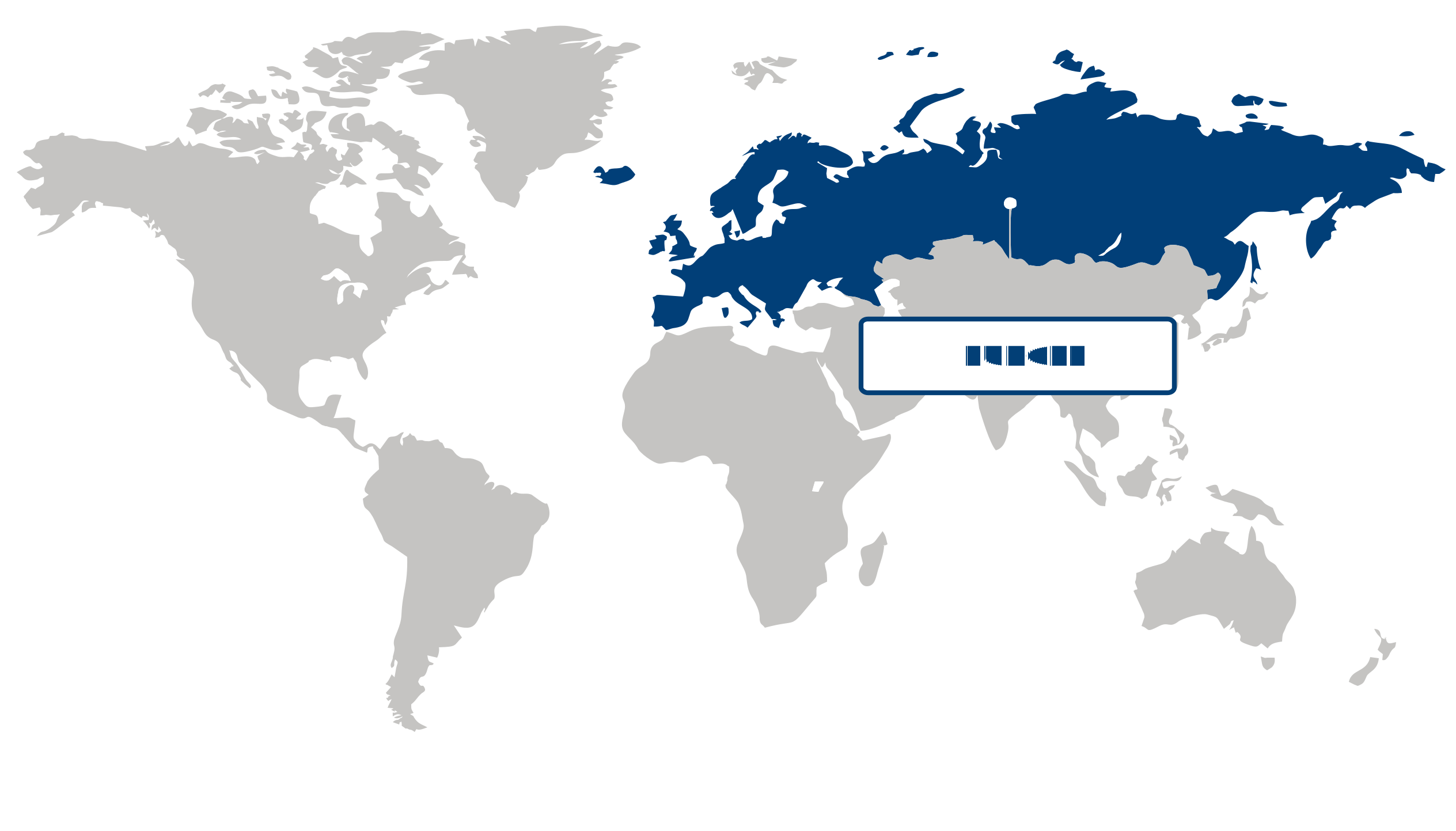
Europe (Largest Region)
Europe held the largest share of 43.2% in the motorsport transmission market in 2026, reflecting its strong motorsport ecosystem, established automotive engineering capabilities, and extensive concentration of racing activities. The region benefits from sustained investment in high-performance vehicle development and demand for specialized transmission systems capable of delivering rapid gear changes, durability, and precise power management. Continued technological development in motorsport engineering and the presence of sophisticated automotive manufacturing infrastructure further support the region’s leading position.
Asia Pacific (Fastest-Growing Region)
Asia Pacific is anticipated to experience the fastest growth, supported by increasing participation in motorsport activities, expanding automotive manufacturing capabilities, and rising interest in high-performance vehicles. Growing investment in racing infrastructure and the development of local motorsport programs are creating new opportunities for specialized transmission technologies. The region’s expanding automotive engineering base and increasing adoption of advanced vehicle technologies are also contributing to greater demand for performance-oriented transmission systems.
| Parameter | North America | Asia Pacific | Europe | Latin America | MEA |
|---|---|---|---|---|---|
| Innovation HubiScaleNascentDeveloping Advanced | |||||
| Cost-Sensitive RegioniScaleLowMedium High | |||||
| Regulatory EnvironmentiScaleRestrictiveNeutral Supportive | |||||
| Demand DriversiScaleWeakModerate Strong | |||||
| Development StageiScaleEmergingDeveloping Developed | |||||
| Adoption RateiScaleLowMedium High | |||||
| New Entrants / StartupsiScaleSparseModerate Dense | |||||
| Macro IndicatorsiScaleWeakStable Strong |
Key Country Insights
United States 🇺🇸
Performance Engineering DemandThe U.S. motorsport transmission market benefits from strong demand across professional racing and high-performance vehicle programs. Manufacturers prioritize lightweight transmission systems, rapid gear changes, and durability to meet diverse motorsport competition requirements.
Germany 🇩🇪
Precision Racing SystemsGermany emphasizes precision-engineered motorsport transmissions that support competitive racing and performance vehicle development. Engineering expertise and close collaboration with automotive manufacturers encourage continuous refinement of transmission efficiency and reliability.
Japan 🇯🇵
Compact Performance SolutionsJapan focuses on compact, high-efficiency motorsport transmission technologies designed for responsive vehicle dynamics. Domestic manufacturers continue refining advanced materials and precision manufacturing techniques to satisfy demanding racing applications.
South Korea 🇰🇷
Motorsport Technology DevelopmentSouth Korea is expanding its presence in motorsport transmission development by leveraging advanced automotive manufacturing capabilities. Companies are investing in lightweight components and precision drivetrain technologies to support competitive racing performance.
France 🇫🇷
Competitive Racing InnovationFrance maintains steady demand for specialized motorsport transmissions through its established racing ecosystem and engineering expertise. Manufacturers emphasize rapid customization and technical collaboration to address evolving competition requirements.
Italy 🇮🇹
Premium Drivetrain ExpertiseItaly supports the motorsport transmission market through its strong heritage in performance vehicle engineering and racing technologies. Companies prioritize precision manufacturing and bespoke transmission solutions for premium motorsport applications.
Motorsport Transmission Market Share (%), by Gearbox, 2026
Go beyond the chart, access full insights & data tables
Request Free Sample ReportGearbox Segment Analysis: Sequential Gearbox (Largest Segment) vs H-Gearbox (Fastest-Growing Segment)
Holding the largest share of the motorsport transmission market, the sequential gearbox segment accounted for 62.4% in 2026. Its dominance is driven by the ability to deliver faster gear changes, improved drivetrain efficiency, and enhanced vehicle control under demanding racing conditions. Sequential gearboxes minimize shift times while allowing drivers to maintain optimal performance throughout competitive events, making them the preferred choice across many professional racing categories. Ongoing advancements in transmission engineering and lightweight materials continue to reinforce the segment’s leading position.
The H-gearbox segment is expected to register the fastest growth during the forecast period. Growing interest in historic motorsport competitions, amateur racing events, and driver-focused racing experiences is increasing demand for traditional H-pattern gearboxes. Their mechanical simplicity, lower maintenance complexity, and authentic driving characteristics continue to attract enthusiasts and racing teams seeking a more engaging driving experience.
Racing Segment Analysis: F1 (Largest & Fastest-Growing Segment)
The motorsport transmission market was led by the F1 racing segment, which captured 22.68% in 2026, while also emerging as the fastest-growing racing category. Formula one continues to represent the highest level of technological innovation in motorsport, driving continuous advancements in transmission performance, lightweight engineering, and precision gear-shifting systems. The sport's emphasis on maximizing speed, efficiency, and reliability under extreme competitive conditions encourages ongoing investment in advanced transmission technologies. Continuous technical development and global audience growth further reinforce both the segment's leadership and its strong expansion potential.
Transmission Segment Analysis: Manual (Largest Segment) vs Continuously Variable Transmissions (CVTs) (Fastest-Growing Segment)
The manual transmission segment held the largest position in 2026. Manual systems continue to maintain a strong presence in motorsport because they provide direct mechanical engagement, precise driver control, and proven durability across a variety of racing disciplines. Their established use in numerous competition formats and compatibility with performance-oriented vehicle platforms continue to support sustained market demand.
In the motorsport transmission market, the continuously variable transmissions (CVTs) segment is anticipated to experience the fastest growth during the forecast period. Increasing research into alternative transmission technologies and efforts to improve power delivery efficiency are encouraging greater exploration of CVT systems in specialized racing applications. Continuous engineering developments aimed at enhancing responsiveness, reliability, and performance are expected to support the expansion of this segment.
| Segment | Sub-Segment | Largest Segment | Fastest Growing |
|---|---|---|---|
| Gearbox | H-Gearbox, Sequential Gearbox | Sequential Gearbox | H-Gearbox |
| Racing | F1, NASCAR, GT Racing, 24 Hours of Le Mans, FIA World Endurance Championship (WEC), World Rally Championship (WRC), Others | F1 | F1 |
| Transmission | Manual, Automatic/Semi-Automatic, Continuously Variable Transmissions (CVTs) | Manual | Continuously Variable Transmissions (CVTs) |
Competitive Landscape and Market Positioning
Leading companies in the motorsport transmission market:
- Xtrac Ltd (United Kingdom)
- Hewland Engineering Ltd. (United Kingdom)
- Ricardo plc (United Kingdom)
- ZF Friedrichshafen AG (Germany)
- Sadev S.A. (France)
- Holinger Engineering Pty Ltd (Australia)
- Drenth Motorsport Gearboxes B.V. (Netherlands)
- Quaife Engineering Ltd. (United Kingdom)
- Samsonas Motorsport Transmissions UAB (Lithuania)
- Tractive AB (Sweden)
Engineering precision has become the defining competitive battleground in the motorsport transmission market, where success increasingly depends on delivering drivetrain systems tailored to demanding race conditions and evolving vehicle architectures. Manufacturers are investing in lightweight materials, advanced gear design, and rapid customization capabilities that enable teams to fine-tune performance without compromising durability under extreme operating stresses. Development cycles are becoming more collaborative as transmission suppliers work closely with racing programs to accelerate testing, calibration, and component refinement, rewarding firms that can translate technical responsiveness into sustained competitive advantage.
| Company | Market Share | Company Revenue | Revenue CAGR (%) | Product Portfolio | Geographic Presence | Innovation / R&D Focus | Strategic Developments |
|---|---|---|---|---|---|---|---|
| Xtrac Ltd (United Kingdom) | |||||||
| Hewland Engineering Ltd. (United Kingdom) | |||||||
| Ricardo plc (United Kingdom) | |||||||
| ZF Friedrichshafen AG (Germany) | |||||||
| Sadev S.A. (France) | |||||||
| Holinger Engineering Pty Ltd (Australia) | |||||||
| Drenth Motorsport Gearboxes B.V. (Netherlands) | |||||||
| Quaife Engineering Ltd. (United Kingdom) | |||||||
| Samsonas Motorsport Transmissions UAB (Lithuania) | |||||||
| Tractive AB (Sweden) |
Industry Development / News
| Company Name | Date | Key Development |
|---|---|---|
| SADEV Industries | Nov-24 | SADEV Industries initiated a new strategic growth phase centered on elevated investment and innovation within its drivetrain technologies. The program directly targets the expansion of global manufacturing capabilities to improve competitive positioning and scaling capacity within the high-performance motorsport transmission segment. |
| TGR | Jan-24 | TGR expanded the appeal of high-performance driving by launching an 8-speed GAZOO Racing Direct Automatic Transmission for the GR Yaris series. Featuring enhanced shifting software and heat-resistant friction material to handle racing demands, the close-ratio automatic gearbox optimizes engine power utilization over previous 6-speed manual configurations. |
Customize Your Report
Explore examples of how this report can be tailored to different research needs, including custom segments, additional topics or chapters, and related reports. Click a section of the wheel or its numbered marker to explore the available options.
Motorsport Transmission Market — Custom Segments
| Segment | Sub-Segment |
|---|---|
| Vehicle Class | Open-Wheel, Sports Cars, Touring Cars, Stock Cars, Rally Cars, Prototype/Endurance Cars |
| Powertrain Type | Internal Combustion Engine, Hybrid, Electric |
| Supplier Type | Original Equipment Manufacturers, Specialist Motorsport Transmission Suppliers, Performance & Aftermarket Suppliers |
Motorsport Transmission Market — Custom TOC
| Custom Chapter | Chapter Details |
|---|---|
| Motorsport Transmission Technology Roadmap |
|
| Racing Team Powertrain Sourcing Strategies |
|
| Transmission Lifecycle and Service Economics |
|
Need a different cut of the data?
Request Custom ResearchFrequently Asked Questions
How much is the motorsport transmission market worth?
How will the motorsport transmission industry grow in terms of size and CAGR by 2036?
How are performance vehicle trends driving innovation in motorsport transmission systems?
Why are lightweight materials becoming a strategic focus in the motorsport transmission market?
Why does the sequential gearbox segment dominate the motorsport transmission market?
Which transmission segment is expected to grow the fastest in the motorsport transmission market?
What makes Europe the leading motorsport transmission market?
Why is Asia Pacific expected to see the fastest growth in motorsport transmissions?
What are the key competitors in the motorsport transmission landscape?
Our Clients
"The team surpassed our expectations with the report depth. The actionable insights provided proved crucial in navigating market challenges."
Tata Motors
"We found the report to be very informative. The expertise and attention to market nuances significantly influenced our business direction."
DENSO Corporation
"The consumer survey findings were quite good. We now have a clearer picture of the customer churning and retention strategy."
HL Mando
Our Research Team & Methodology
Every Fundamental Business Insights report is built by a dedicated vertical research team, validated through a structured primary-and-secondary methodology, and reviewed for accuracy before it reaches you.
Delivery
Published
Available
Support
- Market Size & Forecast
- Market Segmentation
- Regional Analysis
- Growth Drivers & Challenges
- Market Dynamics
- Competitive Landscape
- Company Profiles
- Competitive Benchmarking
- Mergers & Acquisitions
- Market Share Analysis or Key Company Strategies
- Value Chain Analysis
- Porter's Five Forces
- PESTLE Analysis
- Pricing Trends
- Supply-Demand Analysis
- Technology Landscape
- Regulatory Landscape
- Investment & Funding Landscape
- Emerging Opportunities
- Future Market Outlook