



Neobanking Market Size & Growth Forecast 2027–2036, By Segments (Account Type, Application), Regional Demand Trends (North America, Asia Pacific, Europe), Key Country Insights (U.S., Japan, South Korea, Germany, France, Italy), and Competitive Landscape
Market Size and Growth Outlook
Neobanking Market size was worth USD 322.3 billion in 2026 and is poised to grow at a 58.81% CAGR between 2027 and 2036, attaining USD 32.89 trillion by 2036. The industry revenue for 2027 is assessed at USD 481.9 billion.
Base Year Value (2026)
USD 322.3 billion
CAGR (2027-2036)
58.81%
Forecast Year Value (2036)
USD 32.89 trillion

Historical Data Period
2022-2026

Largest Region
Europe

Forecast Period
2027-2036
Neobanking Market Intelligence Snapshot:
-
Regional Market Dynamics:
- Europe leads with 31.32% share due to a mature digital banking ecosystem, high consumer adoption of app-based services, and strong presence of established neobanks.
- Asia Pacific is expanding at 51.56% CAGR, driven by rapid mobile-first banking adoption, direct transition to app-based services, and strong demand for low-friction digital financial solutions.
-
Segment Momentum:
- Business Accounts accounted for 63.05% of the market in 2026, driven by demand for digital tools that support payments, payroll, expense management, and cash-flow administration for businesses.
- Personal is the fastest-growing application segment as consumers increasingly adopt mobile-first banking for everyday transactions, account management, and simplified digital financial experiences.
-
Market Expansion Drivers:
- Rising smartphone and internet penetration accelerating adoption of branchless digital banking platforms.
- Increasing partnerships between fintech firms and traditional banks expanding digital financial service ecosystems.
- Growing SME demand for low-cost digital banking tools driving business account adoption.
-
Leading Market Participants:
Prominent companies in the neobanking market include Revolut Ltd. (United Kingdom), N26 GmbH (Germany), Monzo Bank Ltd. (United Kingdom), WeBank Co., Ltd. (China), Atom Bank plc (United Kingdom), Chime Financial, Inc. (United States), Nubank (Brazil), Ubank Limited (Australia), Fidor Bank AG (Germany), Varo Bank, N.A. (United States).
Global Market Forecast Snapshot:
-
Market Outlook:
- 2026 Market Size: USD 322.3 billion
- 2027 Estimated Market Size: USD 481.9 billion.
- Projected Market Size: USD 32.89 trillion by 2036
- Growth Forecasts: 58.81% CAGR (2027-2036)
-
Regional and Segment Outlook:
- Leading Regional Market: Europe
- High-Growth Regional Hub: Asia Pacific
- Core Revenue Segment: Business Account (Account Type) | Enterprises (Application)
- Emerging Opportunity Segment: Savings Account (Account Type) | Personal (Application)
Market Growth Drivers and Industry Trends
Rising smartphone and internet penetration accelerating adoption of branchless digital banking platforms
The neobanking market is expanding as wider smartphone and internet access makes financial services increasingly accessible through digital channels. Consumers can open accounts, transfer funds, monitor balances, make payments, and access other banking functions through mobile applications without depending on physical branches. Improvements in mobile connectivity and smartphone capabilities are making app-based financial management more practical across consumer segments, while digitally oriented users increasingly expect banking services to be available on demand. The branchless structure of neobanks also enables financial providers to deliver services through streamlined digital interfaces rather than traditional branch networks.
Increasing partnerships between fintech firms and traditional banks expanding digital financial service ecosystems
Increasing collaboration between fintech companies and established banks is creating broader opportunities for the neobanking market by combining digital innovation with established financial infrastructure. Fintech firms can contribute specialized technologies, intuitive interfaces, payment capabilities, and data-driven services, while traditional banking institutions can provide regulated infrastructure, financial products, and established operational capabilities. Such partnerships can accelerate the development of integrated digital financial ecosystems and expand the range of services available through digital banking platforms. Collaboration also enables providers to address customer needs across payments, savings, lending, account management, and other financial activities through interconnected digital services.
Growing SME demand for low-cost digital banking tools driving business account adoption
Growing demand from small and medium-sized enterprises for affordable and convenient financial management solutions is supporting the neobanking market as businesses increasingly seek alternatives to complex traditional banking processes. Digital banking platforms can provide SMEs with streamlined account opening, payments, transaction monitoring, expense management, and other functions through online interfaces, helping businesses manage financial activities with fewer administrative requirements. Cost-sensitive enterprises can particularly benefit from digitally delivered services that reduce reliance on branch-based interactions and simplify routine banking operations. The increasing need for flexible financial tools among smaller businesses is encouraging wider adoption of digital business accounts.
| Growth Driver Assessment Framework | |||||
| Growth Driver | Impact On CAGR | Regulatory Influence | Geographic Relevance | Adoption Rate | Impact Timeline |
|---|---|---|---|---|---|
| Rising smartphone and internet penetration accelerating adoption of branchless digital banking platforms | 2.00% | Moderate | Asia Pacific, Europe | High | Near Term |
| Increasing partnerships between fintech firms and traditional banks expanding digital financial service ecosystems | 1.80% | High | Europe, North America | High | Mid Term |
| Growing SME demand for low-cost digital banking tools driving business account adoption | 1.50% | Moderate | Asia Pacific, Latin America | High | Mid Term |
Unlock insights tailored to your business with our bespoke market research solutions - Click to get your customized report now!
Regional Demand Dynamics
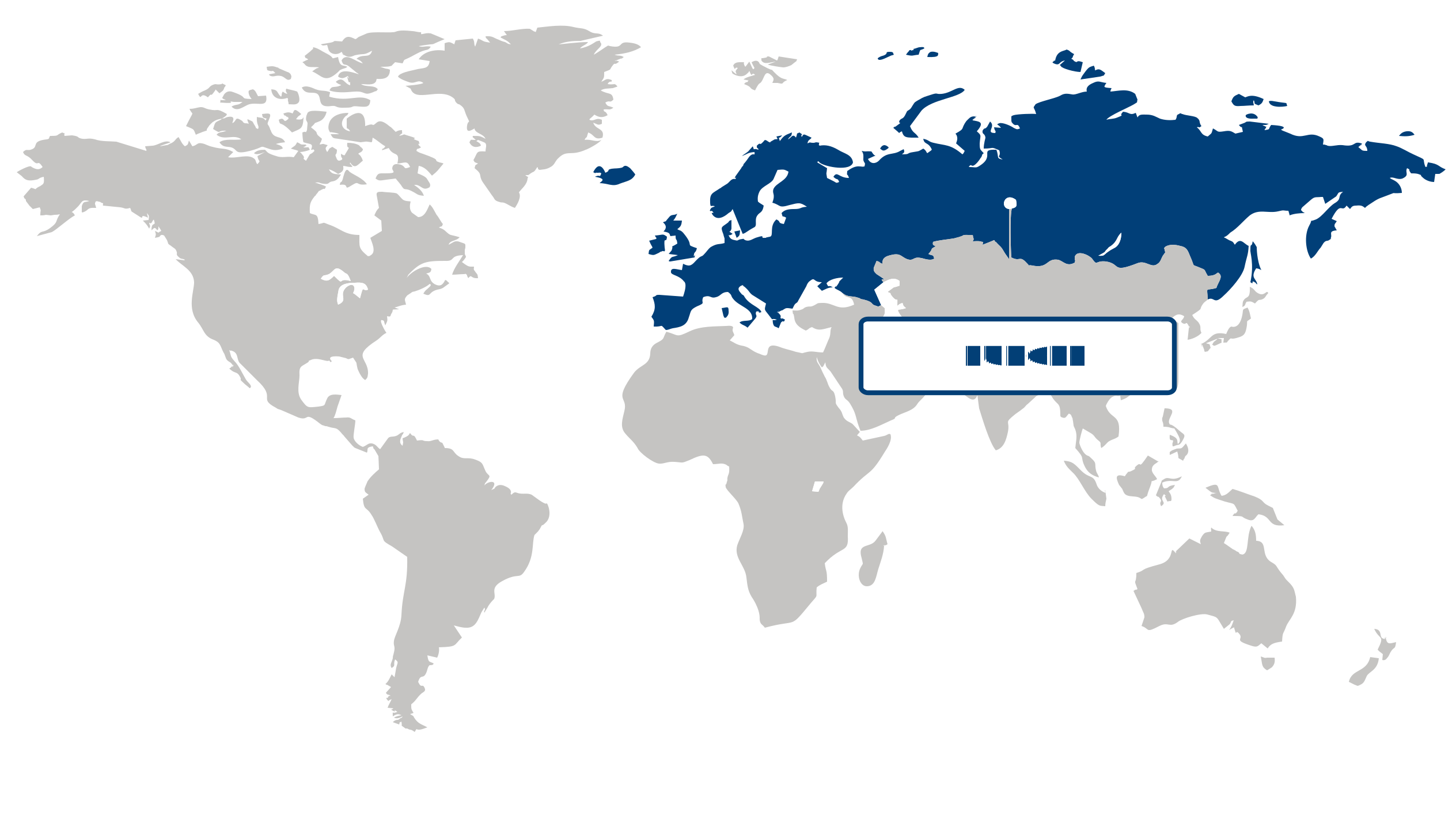
Largest Region
Europe
31.32% Market Share in 2026
Europe (Largest Region) vs Asia Pacific (Fastest-Growing Region)
In the neobanking market, Europe held the largest share at 31.32% in 2026, reflecting the region's advanced digital financial ecosystem, strong fintech adoption, and supportive regulatory environment. Consumers and businesses increasingly favor convenient, mobile-based banking services that provide streamlined account management, payments, and financial products without relying on traditional branch networks. High digital literacy and established financial infrastructure further facilitate the adoption of app-based banking solutions. In addition, regulatory initiatives supporting competition and financial innovation have encouraged the development of digital-first banking models, while growing demand for transparent, accessible, and technology-enabled financial services continues to reinforce Europe's market position.
Asia Pacific is positioned as the fastest-growing regional market, supported by expanding smartphone penetration, rapid digitalization of financial services, and a large population of consumers seeking convenient alternatives to traditional banking. The region's diverse banking landscape creates significant opportunities for neobanks to address underserved and digitally active customer segments through accessible mobile platforms. Increasing adoption of digital payments, growing e-commerce activity, and broader financial inclusion initiatives are also supporting demand for technology-driven banking services. Furthermore, continued investment in digital infrastructure and evolving regulatory frameworks are creating a more favorable environment for innovative financial institutions, strengthening the region's long-term growth potential.
Key Country Insights
The U.S. neobanking market is characterized by continuous innovation in digital financial services and customer-centric banking platforms. Financial technology providers in the U.S. are expanding integrated payment solutions, personal finance tools, and embedded banking capabilities for consumers and businesses.
Japan is expanding neobanking services alongside broader digital payment adoption and modernization of retail financial services. Financial institutions in Japan are improving user-friendly mobile platforms, digital identity verification, and integrated payment ecosystems for diverse customer segments.
South Korea benefits from advanced digital infrastructure that supports highly connected mobile banking experiences. Neobanks in South Korea are strengthening instant payments, digital lending, and AI-enabled financial management tools to enhance customer engagement and convenience.
Germany emphasizes secure digital banking supported by strong regulatory oversight and customer trust. Neobanks in Germany are enhancing mobile banking functionality, financial transparency, and digital account services while maintaining compliance with evolving financial regulations.
France continues to expand digital banking through accessible mobile-first financial solutions tailored to everyday banking needs. Neobanks in France are focusing on simplified account management, payment flexibility, and partnerships that broaden financial service accessibility.
Italy is accelerating digital transformation across consumer banking with increased demand for convenient mobile financial services. Neobanking providers in Italy are investing in intuitive digital platforms, secure payment solutions, and financial inclusion initiatives for retail customers.
Segment Leadership and Growth Trends
Account Type Segment Analysis: Business Account (Largest Segment) vs Savings Account (Fastest-Growing Segment)
The business account segment dominated the neobanking market with a 63.05% share in 2026. Its leading position is supported by the growing adoption of digital banking solutions among businesses seeking streamlined financial management, faster account services, and greater accessibility. Neobanks are increasingly positioned to address business banking requirements through digitally enabled account management, helping enterprises reduce dependence on traditional branch-based processes and supporting the broader shift toward technology-driven financial operations.
The savings account segment is the fastest-growing within the market, reflecting increasing consumer interest in convenient, digitally accessible ways to manage personal finances. The expansion of neobanking platforms is strengthening access to savings services through simplified digital experiences, supporting greater engagement with app-based banking and encouraging consumers to shift routine financial activities toward online channels.
Application Segment Analysis: Enterprises (Largest Segment) vs Personal (Fastest-Growing Segment)
In the neobanking market, the enterprises segment held the largest share of 53.55% in 2026. Its strong position reflects the increasing use of digital banking services to support business financial activities, including convenient account access and technology-enabled financial management. The ability of neobanks to deliver streamlined digital services aligns with enterprises' broader need for efficient banking operations and contributes to sustained adoption across commercial users.
The personal segment is experiencing the fastest growth as consumers increasingly favor accessible, digitally managed banking services. Neobanking platforms offer a convenient alternative for individuals seeking simplified financial interactions through digital channels, supporting greater adoption of personal banking applications. This shift toward mobile-first financial experiences is strengthening the role of personal users as an important growth area for neobanking providers.
| Report Segmentation | |||
| Segment | Sub-Segment | Largest Segment | Fastest Growing Segment |
|---|---|---|---|
| Account Type | Business Account, Savings Account | Business Account | Savings Account |
| Application | Enterprises, Personal, Others | Enterprises | Personal |
 Read our Research Approach
Competitive Landscape and Market Positioning
Prominent players in the neobanking market:
1. Revolut Ltd. (United Kingdom)
2. N26 GmbH (Germany)
3. Monzo Bank Ltd. (United Kingdom)
4. WeBank Co. Ltd. (China)
5. Atom Bank plc (United Kingdom)
6. Chime Financial Inc. (United States)
7. Nubank (Brazil)
8. Ubank Limited (Australia)
9. Fidor Bank AG (Germany)
10. Varo Bank N.A. (United States)
The neobanking market is witnessing intensified competition as providers increasingly adopt AI-driven personalization tools and data-led financial management solutions to improve customer engagement. Digital-first banking platforms are also expanding their portfolios with flexible savings tools, embedded finance features, and customized lending services designed to address evolving consumer expectations. Continuous investments in automation and user experience optimization are further strengthening operational agility while supporting long-term customer retention strategies.
Industry Development/News
| Company Name | Date | Key Development |
|---|---|---|
| Zolve | Mar-25 | Zolve secured $251 million in a Series B funding round led by Creaegis, with participation from institutional investors including HSBC and SBI Investment. This significant capital infusion is earmarked to support the cross-border neobank’s global growth strategy and the expansion of its financial service offerings for international customers. |
| Fasset | May-26 | Fasset raised $51 million in a Series B round to scale its stablecoin-powered infrastructure, including trade finance and cross-border payment solutions. The funding reinforces the company’s strategic objective to expand digital financial services across emerging markets, positioning it as a key player in next-generation banking. |
| Zeta | Feb-25 | Zeta raised $50 million from a new U.S. investor at a $2 billion valuation. This funding enhances the company’s capacity to scale its banking technology platform, which provides financial institutions with critical infrastructure to modernize core banking and payment processing capabilities. |
| Young Platform | Nov-25 | Young Platform announced plans to launch Europe’s first crypto-native neobank under the EU’s MiCA framework. By integrating traditional payment accounts and debit cards with regulated cryptocurrency trading and asset management, the platform demonstrates the accelerating convergence of digital assets and consumer neobanking services. |
| DNERO | Mar-26 | DNERO launched a borderless neobank specifically targeting the U.S.-Latin American financial corridor. The platform provides a unified digital wallet with integrated remittance and cross-border payment capabilities at a fixed fee, signaling a strategic focus on underserved segments requiring efficient, low-cost financial management across international borders. |
| Tether | May-26 | Tether partnered with Fasset to introduce a gold-backed Visa card and ATM solution. This initiative integrates tokenized gold assets into the mainstream payment network, enabling users to leverage digital assets for everyday financial transactions and expanding the utility of digital banking platforms. |
| Salt Bank | Dec-24 | Salt Bank successfully onboarded over 330,000 customers within eight months of its launch in Romania. This rapid acquisition rate highlights strong market demand for digital-first banking alternatives and validates the company’s competitive position within the regional neobanking sector. |
| Omniwire | Aug-24 | Omniwire officially launched its Banking-as-a-Service (BaaS) platform, featuring core banking, card issuing, and issuer processing modules. This infrastructure expansion provides essential technology for other digital banking providers and fintechs, facilitating the delivery of embedded financial services. |
| Jupiter | Jun-24 | Jupiter received a wallet license from the Reserve Bank of India, authorizing the platform to offer digital wallet services, UPI payments, and fund transfers. This regulatory milestone expands the company’s product suite and solidifies its operational presence within India’s highly competitive digital banking ecosystem. |
| Muvin | Feb-24 | Muvin ceased all operations following regulatory restrictions regarding its UPI co-branding arrangements. This event serves as a significant case study on the impact of regulatory compliance and evolving licensing frameworks on the operational viability and long-term sustainability of niche neobanking business models. |
Why Choose Us
Specialized Expertise: Our team comprises industry experts with a deep understanding of your market segment. We bring specialized knowledge and experience that ensures our research and consulting services are tailored to your unique needs.
Customized Solutions: We understand that every client is different. That's why we offer customized research and consulting solutions designed specifically to address your challenges and capitalize on opportunities within your industry.
Proven Results: With a track record of successful projects and satisfied clients, we have demonstrated our ability to deliver tangible results. Our case studies and testimonials speak to our effectiveness in helping clients achieve their goals.
Cutting-Edge Methodologies: We leverage the latest methodologies and technologies to gather insights and drive informed decision-making. Our innovative approach ensures that you stay ahead of the curve and gain a competitive edge in your market.
Client-Centric Approach: Your satisfaction is our top priority. We prioritize open communication, responsiveness, and transparency to ensure that we not only meet but exceed your expectations at every stage of the engagement.
Continuous Innovation: We are committed to continuous improvement and staying at the forefront of our industry. Through ongoing learning, professional development, and investment in new technologies, we ensure that our services are always evolving to meet your evolving needs.
Value for Money: Our competitive pricing and flexible engagement models ensure that you get maximum value for your investment. We are committed to delivering high-quality results that help you achieve a strong return on your investment.
Select Licence Type

