



Offshore Wind Turbine Market Size & Growth Forecast 2027–2036, By Segments (Capacity, Water Depth), Regional Demand Trends (North America, Asia Pacific, Europe), Key Country Insights (U.S., Japan, South Korea, Germany, France, Italy), and Competitive Landscape
Market Size and Growth Outlook
Offshore Wind Turbine Market size was valued at USD 24.7 billion in 2026 and is anticipated to grow at a 10.93% CAGR from 2027 to 2036, exceeding USD 69.69 billion by 2036. The industry revenue for 2027 is assessed at USD 26.97 billion.
Base Year Value (2026)
USD 24.7 billion
CAGR (2027-2036)
10.93%
Forecast Year Value (2036)
USD 69.69 billion

Historical Data Period
2022-2026

Largest Region
Europe

Forecast Period
2027-2036
Offshore Wind Turbine Market Intelligence Snapshot:
-
Regional Market Dynamics:
- Europe accounted for 50.56% of the market in 2026, supported by mature offshore projects, established grid infrastructure, experienced developers, and a well-developed marine engineering supply chain.
- Asia Pacific is projected to grow at a 12.77% CAGR as offshore projects advance, manufacturing capacity expands, and localized supply chains strengthen commercial-scale turbine installation capabilities.
-
Segment Momentum:
- Above 5 MW turbines lead with 46.43% share because higher capacity reduces unit count per project, improves energy output efficiency, and supports streamlined installation and grid integration in offshore developments.
- Shallow water sites grow fastest due to easier foundation installation, lower construction complexity, and faster project execution, making them more commercially practical for ongoing offshore wind expansion activities.
-
Market Expansion Drivers:
- Government decarbonization mandates accelerating offshore wind installation and utility-scale deployment.
- Advancements in large-capacity turbine design reducing cost per megawatt generation.
- Expansion of offshore grid transmission infrastructure enabling deeper water wind farm connectivity.
-
Leading Market Participants:
Leading players in the offshore wind turbine market include Siemens Gamesa Renewable Energy, S.A. (Spain), GE Vernova Inc. (United States), Vestas Wind Systems A/S (Denmark), Goldwind Science & Technology Co., Ltd. (China), Mitsubishi Heavy Industries, Ltd. (Japan), Nordex SE (Germany), Mingyang Smart Energy Group Co., Ltd. (China), Envision Energy (China), Shanghai Electric Wind Power Group Co., Ltd. (China).
Global Market Forecast Snapshot:
-
Market Outlook:
- 2026 Market Size: USD 24.7 billion
- 2027 Estimated Market Size: USD 26.97 billion.
- Projected Market Size: USD 69.69 billion by 2036
- Growth Forecasts: 10.93% CAGR (2027-2036)
-
Regional and Segment Outlook:
- Leading Regional Market: Europe
- High-Growth Regional Hub: Asia Pacific
- Core Revenue Segment: Above 5 MW (Capacity) | Shallow Water (<30 M Depth) (Water Depth)
- Emerging Opportunity Segment: Above 5 MW (Capacity) | Shallow Water (<30 M Depth) (Water Depth)
Market Growth Drivers and Industry Trends
Government decarbonization mandates accelerating offshore wind installation and utility-scale deployment
Government decarbonization policies are creating a supportive investment environment for the offshore wind turbine market as countries seek to reduce dependence on carbon-intensive electricity generation and expand renewable power capacity. Policy commitments, emissions-reduction targets, and renewable energy development frameworks can encourage utilities and project developers to advance large offshore wind installations. Offshore projects are particularly attractive where land availability limits onshore renewable development, while access to stronger and more consistent marine wind resources supports large-scale electricity generation.
Advancements in large-capacity turbine design reducing cost per megawatt generation
Technological improvements in turbine size, component efficiency, and engineering design are strengthening the offshore wind turbine market by enabling individual turbines to generate more electricity from each installation. Larger-capacity turbines can increase generation output while reducing the number of units, foundations, and associated components required for a given project capacity, supporting more efficient use of offshore sites. Advances in rotor dimensions, drivetrain systems, materials, and turbine controls are also helping developers address the operational demands associated with large offshore installations.
Expansion of offshore grid transmission infrastructure enabling deeper water wind farm connectivity
Development of offshore transmission networks is improving the commercial feasibility of the offshore wind turbine market by enabling electricity generated farther from shore to reach established power systems. As suitable nearshore sites become increasingly constrained, deeper-water projects can provide access to additional areas with favorable wind resources, provided that appropriate transmission infrastructure is available. Offshore substations, subsea cables, and coordinated grid connections can facilitate the integration of geographically dispersed wind farms while supporting reliable transfer of renewable electricity to onshore demand centers.
| Growth Driver Assessment Framework | |||||
| Growth Driver | Impact On CAGR | Regulatory Influence | Geographic Relevance | Adoption Rate | Impact Timeline |
|---|---|---|---|---|---|
| Government decarbonization mandates accelerating offshore wind installation and utility-scale deployment | 2.40% | High | Europe, Asia Pacific | High | Near Term |
| Advancements in large-capacity turbine design reducing cost per megawatt generation | 2.20% | Moderate | Europe, North America | High | Mid Term |
| Expansion of offshore grid transmission infrastructure enabling deeper water wind farm connectivity | 1.80% | High | Europe, Asia Pacific | Medium | Mid Term |
Unlock insights tailored to your business with our bespoke market research solutions - Click to get your customized report now!
Regional Demand Dynamics
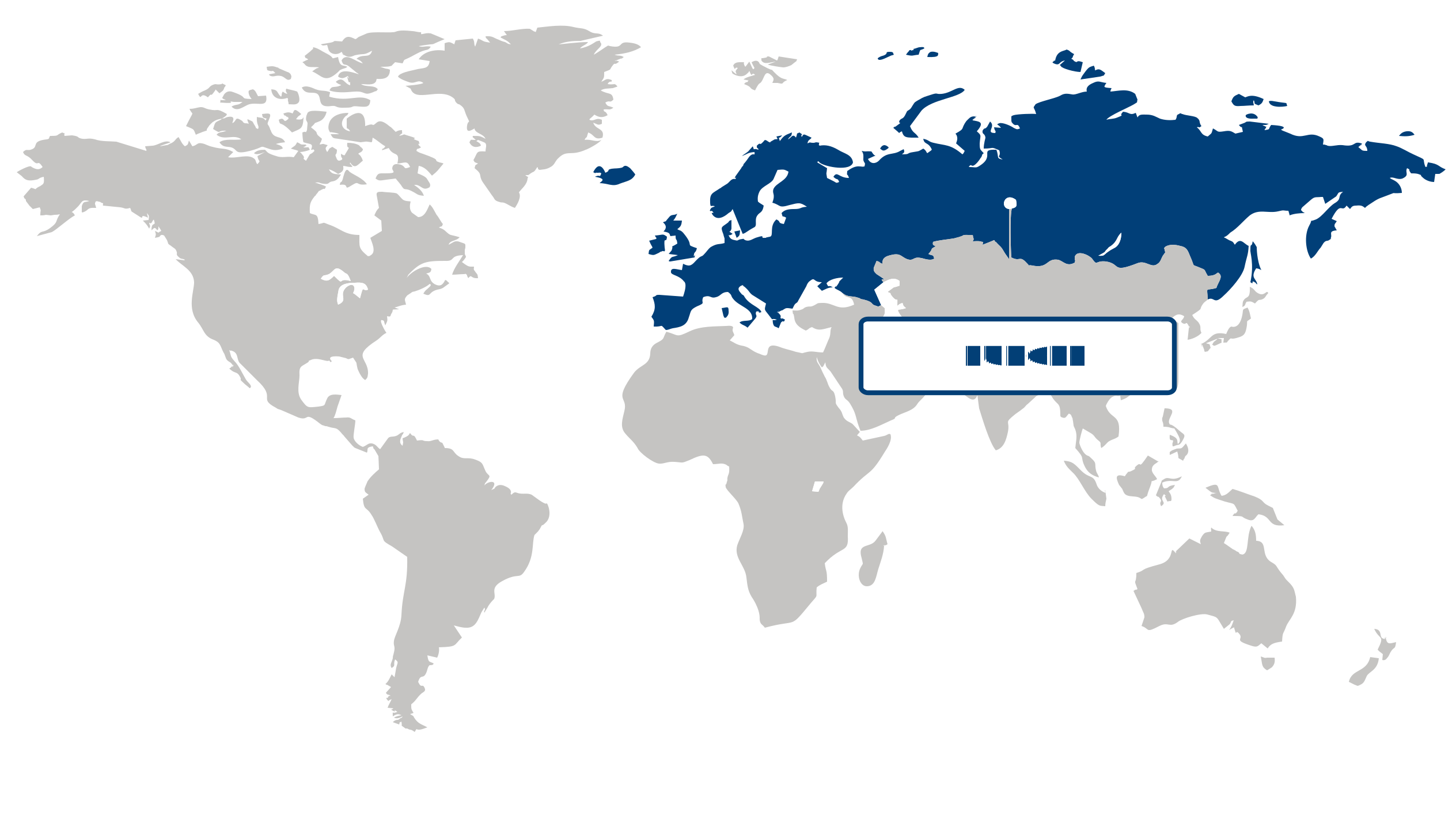
Largest Region
Europe
50.56% Market Share in 2026
Europe (Largest Region) vs Asia Pacific (Fastest-Growing Region)
Holding the largest share of 50.56% in 2026, Europe established a strong position in the offshore wind turbine market through its mature offshore renewable energy ecosystem, extensive project development experience, and sustained focus on energy transition. Supportive policy frameworks, grid modernization, and investments in large-scale offshore wind infrastructure are encouraging continued deployment. The region's established supply chain and technical expertise in offshore engineering, turbine installation, and marine infrastructure further reinforce its market position.
Asia Pacific is the fastest-growing region, propelled by expanding renewable energy investments, rising electricity demand, and increasing efforts to diversify power generation away from conventional energy sources. Extensive coastlines and favorable offshore wind resources create opportunities for large-scale project development, while improvements in transmission infrastructure and offshore engineering capabilities are strengthening deployment potential. Growing policy support for clean energy and increasing investment in renewable power infrastructure are expected to further accelerate regional adoption.
Key Country Insights
The U.S. offshore wind turbine market is driven by large-scale coastal energy projects aimed at expanding renewable capacity. Developers in the United States prioritize grid integration, turbine durability in deep-water conditions, and long-term infrastructure investment partnerships.
Japan advances offshore wind turbine deployment as part of its energy diversification strategy with a focus on maritime resilience. Development priorities include typhoon-resistant turbine design, floating offshore platforms, and localized supply chain development.
South Korea is strengthening offshore wind turbine manufacturing capabilities to support domestic and export-oriented renewable energy projects. The country prioritizes port infrastructure, large-scale fabrication, and integration with coastal industrial zones.
Germany focuses on highly engineered offshore wind turbine systems supported by strong industrial manufacturing capabilities. The country emphasizes technological efficiency, grid stability integration, and optimization of offshore installation and maintenance systems.
France develops offshore wind turbine projects under a structured regulatory framework emphasizing environmental compliance and maritime planning. Investment is concentrated on turbine efficiency, coastal ecosystem balance, and long-term energy transition targets.
Italy’s offshore wind turbine market is shaped by emerging Mediterranean projects with focus on site feasibility and regional energy diversification. Developers emphasize adapting turbine systems to variable sea conditions and expanding coastal renewable infrastructure.
Segment Leadership and Growth Trends
Capacity Segment Analysis: Above 5 MW (Largest & Fastest-Growing Segment)
The above 5 MW segment accounted for the largest share of the offshore wind turbine market at 46.43% in 2026 and is also the fastest-growing capacity category. Larger-capacity turbines can generate greater power from individual offshore installations, helping developers maximize energy output while making more effective use of constrained offshore sites. Their adoption is being supported by continued advances in turbine engineering, larger offshore project designs, and efforts to improve the efficiency of wind power generation. As offshore wind projects increasingly prioritize higher output from fewer turbine units, above 5 MW systems remain well positioned for continued expansion.
Water Depth Segment Analysis: Shallow Water (<30 M Depth) (Largest & Fastest-Growing Segment)
Shallow water (<30 M depth) represented the largest segment of the offshore wind turbine market in 2026 and is also experiencing the fastest growth, reflecting the comparatively favorable conditions these locations provide for offshore wind development. Shallower environments can simplify foundation installation, marine construction, maintenance access, and project logistics, helping reduce technical complexity during deployment. The established suitability of fixed-bottom turbine technologies in shallow waters further supports adoption, while continued development of accessible offshore areas is sustaining demand for projects located closer to shore.
| Report Segmentation | |||
| Segment | Sub-Segment | Largest Segment | Fastest Growing Segment |
|---|---|---|---|
| Capacity | Up to 3 MW, 3 MW to 5 MW, Above 5 MW | Above 5 MW | Above 5 MW |
| Water Depth | Shallow Water (<30 M Depth), Transitional Water (30-60 M Depth), Deepwater (More Than 60 M Depth) | Shallow Water (<30 M Depth) | Shallow Water (<30 M Depth) |
 Read our Research Approach
Competitive Landscape and Market Positioning
Key companies in the offshore wind turbine market:
1. Siemens Gamesa Renewable Energy S.A. (Spain)
2. GE Vernova Inc. (United States)
3. Vestas Wind Systems A/S (Denmark)
4. Goldwind Science & Technology Co. Ltd. (China)
5. Mitsubishi Heavy Industries Ltd. (Japan)
6. Nordex SE (Germany)
7. Mingyang Smart Energy Group Co. Ltd. (China)
8. Envision Energy (China)
9. Shanghai Electric Wind Power Group Co. Ltd. (China)
Renewable energy expansion is accelerating transformation in the offshore wind turbine market, driven by large-scale sustainability goals. The offshore wind turbine market is evolving through advancements in turbine efficiency and structural design. Expanding offshore infrastructure is supporting large-capacity installations. Continuous innovation is improving energy output and operational reliability.
Industry Development/News
| Company Name | Date | Key Development |
|---|---|---|
| DEME | May-25 | DEME has acquired Norwegian contractor Havfram for approximately USD 1.03 billion. This strategic acquisition integrates Havfram’s specialized installation capabilities into DEME’s operations, significantly enhancing the company’s ability to execute complex turbine and foundation installations and expanding its competitive footprint in the international offshore wind sector. |
| Vestas | May-25 | Vestas has announced plans to construct a dedicated nacelle and hub manufacturing facility in Scotland. This investment is designed to bolster regional supply chain resilience and meet the accelerating demand for offshore wind infrastructure across the United Kingdom and broader European markets. |
| Siemens Gamesa | Apr-25 | Siemens Gamesa has committed €200 million to expand its manufacturing site in Le Havre, France. The investment specifically targets increased blade production capacity, reinforcing the company's industrial scale to support the deployment of large-scale offshore wind projects across Europe. |
| China Huaneng Group / Dongfang Electric | Apr-25 | The companies have commissioned the world’s largest direct-drive floating offshore wind turbine, featuring a 17 MW capacity. This technological advancement represents a significant milestone in floating wind development, expanding the potential for deep-water turbine deployment through enhanced power generation capabilities and structural innovation. |
| Vestas | Apr-25 | Vestas has secured an 810 MW supply order for the Empire Wind 1 project in New York, marking its entry into the U.S. offshore wind turbine market. This agreement validates the company’s localized commercial strategy and strengthens its competitive positioning within the emerging U.S. offshore energy value chain. |
| ZF Wind Power | Apr-25 | ZF Wind Power has commissioned a 30 MW powertrain test rig in Belgium. The facility enables high-capacity validation of next-generation turbine gearboxes and systems, providing essential testing infrastructure required to improve the reliability and operational efficiency of large-scale offshore wind energy components. |
| DENZAI E&C Corp. / Global Wind Service | Apr-25 | The companies have formed a strategic partnership to provide integrated transport, installation, and maintenance services in Japan. This collaboration enhances regional project execution capabilities and addresses critical supply chain requirements for the Japanese offshore wind sector’s growing pipeline of utility-scale projects. |
| Mingyang Smart Energy | Mar-25 | Mingyang Smart Energy has successfully deployed a 20 MW offshore wind turbine in China. This installation represents a significant leap in turbine power output, underscoring the industry's rapid trend toward upscaling technology to improve the cost-efficiency and performance of offshore wind farms. |
| Saipem / Divento Consortium | Mar-25 | Saipem has partnered with the Divento consortium to deploy its proprietary STAR 1 floating wind technology for projects in Sicily and Sardinia. This strategic move aims to generate 1.6 terawatt-hours of annual electricity, showcasing the commercial application of advanced floating offshore foundations in the Mediterranean region. |
| Mingyang Smart Energy | Mar-25 | Mingyang Smart Energy has received priority support to establish an offshore wind turbine manufacturing facility in Scotland. The investment signifies a major effort by the company to localize its production footprint in the international market, improving supply chain agility for European wind energy developers. |
Why Choose Us
Specialized Expertise: Our team comprises industry experts with a deep understanding of your market segment. We bring specialized knowledge and experience that ensures our research and consulting services are tailored to your unique needs.
Customized Solutions: We understand that every client is different. That's why we offer customized research and consulting solutions designed specifically to address your challenges and capitalize on opportunities within your industry.
Proven Results: With a track record of successful projects and satisfied clients, we have demonstrated our ability to deliver tangible results. Our case studies and testimonials speak to our effectiveness in helping clients achieve their goals.
Cutting-Edge Methodologies: We leverage the latest methodologies and technologies to gather insights and drive informed decision-making. Our innovative approach ensures that you stay ahead of the curve and gain a competitive edge in your market.
Client-Centric Approach: Your satisfaction is our top priority. We prioritize open communication, responsiveness, and transparency to ensure that we not only meet but exceed your expectations at every stage of the engagement.
Continuous Innovation: We are committed to continuous improvement and staying at the forefront of our industry. Through ongoing learning, professional development, and investment in new technologies, we ensure that our services are always evolving to meet your evolving needs.
Value for Money: Our competitive pricing and flexible engagement models ensure that you get maximum value for your investment. We are committed to delivering high-quality results that help you achieve a strong return on your investment.
Select Licence Type

