Oil & Gas Armored Cable Market Size & Growth Forecast 2027–2036, By Segments (Armor Type, Core Type), Regional Demand Trends (North America, Asia Pacific, Europe), Key Country Insights (U.S., Japan, South Korea, Germany, France, Italy), and Competitive Landscape
Market Size and Growth Outlook
Oil & Gas Armored Cable Market size was worth USD 15.52 Billion in 2026 and is expected to grow at 6.57% CAGR between 2027 and 2036, attaining USD 29.33 Billion by 2036. The industry revenue for 2027 is estimated at USD 16.39 Billion.
Get more details on this report
Request Free Sample ReportOil & Gas Armored Cable Market Intelligence Snapshot
Regional Market Dynamics
- Europe led in 2026 through established energy infrastructure, mature pipeline and processing networks, facility modernization, and strong emphasis on operational safety and reliability.
- Asia Pacific is expanding rapidly through oil and gas infrastructure development, industrialization, energy demand, and new exploration, refining, processing, and transportation projects.
Segment Momentum
- The interlocked armor type led the market in 2026 due to its strong mechanical protection, installation flexibility, and simplified maintenance, making it a preferred choice across upstream, midstream, and downstream facilities.
- Continuously corrugated welded armor is growing rapidly because it offers superior sealing and durability in harsh environments, supporting critical installations exposed to moisture, corrosion, and mechanical stress, particularly in offshore developments.
Market Expansion Drivers
- Strict safety and environmental regulations driving adoption in oil & gas infrastructure
- Expansion of upstream and downstream oil & gas projects increasing cabling demand
- Growing need for reliable instrumentation and energy monitoring in harsh industrial environments
Leading Market Participants
- Key companies in the oil & gas armored cable market include Prysmian Group (Italy), Nexans S.A. (France), LS Cable & System Ltd. (South Korea), Sumitomo Electric Industries Ltd. (Japan), Belden Inc. (United States), Southwire Company LLC (United States), NKT A/S (Denmark), Leoni AG (Germany), Polycab India Limited (India), KEI Industries Limited (India)
Global Market Forecast Snapshot
Market Outlook
- 2026 Market Size: USD 15.52 Billion
- 2027 Estimated Market Size: USD 16.39 Billion
- Projected Market Size: USD 29.33 Billion by 2036
- Growth Forecast: 6.57% CAGR (2027-2036)
Regional and Segment Outlook
- Leading Regional Market: Europe
- High-Growth Regional Hub: Asia Pacific
- Core Revenue Segment: Interlocked (Armor Type) | Multi Core (Core Type)
- Emerging Opportunity Segment: Continuously Corrugated Welded (Armor Type) | Multi Core (Core Type)
Market Growth Drivers and Industry Trends
Strict safety and environmental regulations driving adoption in oil & gas infrastructure
The oil and gas industry operates under rigorous safety and environmental standards that require dependable electrical systems capable of performing reliably in hazardous operating environments. The oil & gas armored cable market growth is driven by the adoption of armored cabling solutions that provide enhanced mechanical protection, electrical integrity, and resistance to harsh industrial conditions. These cables help operators maintain safe and compliant electrical installations across facilities where equipment reliability is essential for uninterrupted operations.
Expansion of upstream and downstream oil & gas projects increasing cabling demand
New exploration, production, refining, and processing facilities require extensive electrical infrastructure to support complex industrial operations. Expanding investments across the energy value chain will propel the oil & gas armored cable market growth as project developers deploy armored cables for power distribution, control systems, and critical operational equipment. Their ability to withstand demanding installation environments makes them a preferred solution for large-scale oil and gas infrastructure developments.
Growing need for reliable instrumentation and energy monitoring in harsh industrial environments
Digital monitoring, process automation, and advanced instrumentation are becoming increasingly important for improving operational efficiency across oil and gas facilities. As these technologies become more widespread, the oil & gas armored cable market benefits from stronger demand for robust cabling systems that ensure secure signal transmission and dependable electrical performance under exposure to vibration, moisture, chemicals, and extreme operating conditions. Reliable cable infrastructure supports continuous communication between field instruments, monitoring equipment, and centralized control systems.
| Growth Driver | Impact on CAGR | Regulatory Influence | Geographic Relevance | Adoption Rate | Impact Timeline |
|---|---|---|---|---|---|
| Strict safety and environmental regulations driving adoption in oil & gas infrastructure | 2.3% | High | Middle East, North America | High | Near Term |
| Expansion of upstream and downstream oil & gas projects increasing cabling demand | 2.2% | High | Asia Pacific, Middle East | High | Mid Term |
| Growing need for reliable instrumentation and energy monitoring in harsh industrial environments | 2.1% | High | North America, Europe | High | Mid Term |
Unlock insights tailored to your business with our bespoke market research solutions.
Click to get your customized report now.
Regional Demand Dynamics
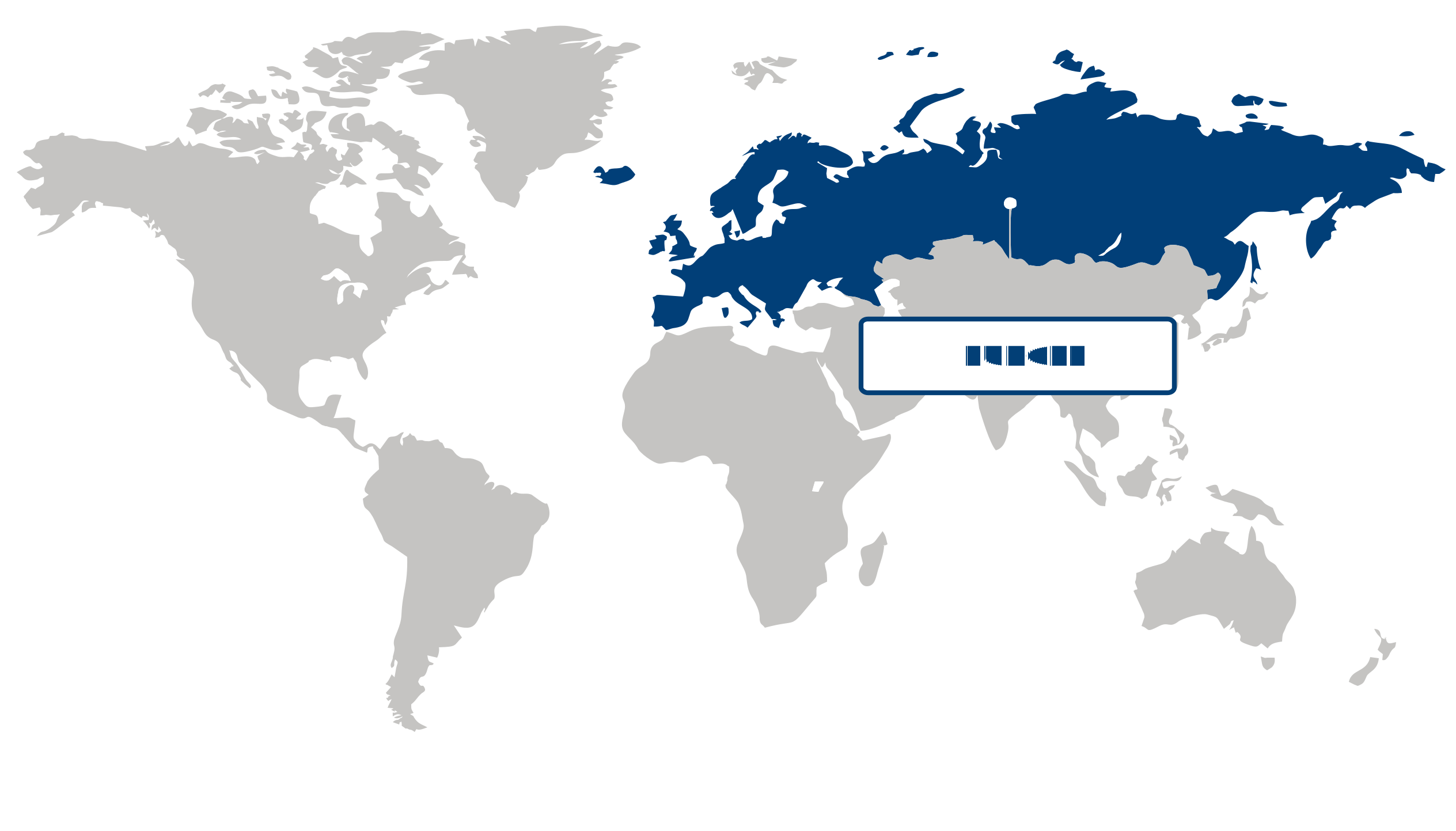
Europe (Largest Region)
Europe held the largest share of the oil & gas armored cable market in 2026, supported by its established energy infrastructure, extensive pipeline and processing networks, and continued modernization of oil and gas facilities. The region's emphasis on operational safety and infrastructure reliability is encouraging the use of armored cables that provide mechanical protection and dependable electrical performance in demanding industrial environments. Ongoing maintenance and refurbishment of mature energy assets are also sustaining demand, while offshore and onshore operations require cabling systems capable of performing under harsh conditions. Investments in energy security and infrastructure resilience further support the region's strong market position.
Asia Pacific (Fastest-Growing Region)
Asia Pacific is expected to register the fastest growth, driven by expanding oil and gas infrastructure, industrialization, and rising energy demand across emerging economies. New exploration, processing, refining, and transportation projects are creating additional requirements for robust electrical and control cabling. Rapid development of industrial facilities and energy infrastructure is also increasing the need for cables designed to withstand mechanical stress and challenging operating environments. Furthermore, investments in energy security and expansion of domestic and regional energy networks are expected to accelerate the deployment of armored cable solutions across the region.
| Parameter | North America | Asia Pacific | Europe | Latin America | MEA |
|---|---|---|---|---|---|
| Innovation Hub i Scale Nascent Developing Advanced | |||||
| Cost-Sensitive Region i Scale Low Medium High | |||||
| Regulatory Environment i Scale Restrictive Neutral Supportive | |||||
| Demand Drivers i Scale Weak Moderate Strong | |||||
| Development Stage i Scale Emerging Developing Developed | |||||
| Adoption Rate i Scale Low Medium High | |||||
| New Entrants / Startups i Scale Sparse Moderate Dense | |||||
| Macro Indicators i Scale Weak Stable Strong |
Key Country Insights
United States 🇺🇸
Upstream Infrastructure SupplyThe U.S. oil & gas armored cable market is supported by ongoing investment in upstream, midstream, and offshore assets requiring durable power and instrumentation cables. Operators prioritize products with strong mechanical protection and long service life in demanding operating environments.
Germany 🇩🇪
Industrial Engineering IntegrationGermany emphasizes high-specification armored cables for oil and gas processing facilities where operational reliability and compliance with industrial standards are essential. Manufacturers focus on supplying engineered cable solutions for complex automation and power distribution requirements.
Japan 🇯🇵
High-Durability InstallationsJapan's oil & gas armored cable market is centered on dependable cable systems for LNG terminals, refineries, and energy infrastructure. Project developers prioritize corrosion resistance, fire performance, and installation reliability to support long-term operational continuity.
South Korea 🇰🇷
Offshore Project SupportSouth Korea supports demand for oil & gas armored cables through offshore engineering, shipbuilding, and energy facility construction activities. Domestic suppliers focus on cables capable of withstanding harsh marine conditions while meeting international project specifications.
France 🇫🇷
Energy Asset ModernizationFrance continues upgrading oil and gas facilities with armored cable solutions that improve operational safety and electrical reliability. Project owners increasingly specify robust cable systems compatible with digital monitoring and modern industrial control infrastructure.
Italy 🇮🇹
Refinery Network EnhancementItaly maintains steady demand for oil & gas armored cables through refinery upgrades, pipeline facilities, and industrial energy projects. Italian buyers prioritize proven cable performance, simplified maintenance, and compliance with stringent installation and safety requirements.
Segment Leadership and Growth Trends
Oil & Gas Armored Cable Market Share (%), by Armor Type, 2026
Go beyond the chart, access full insights & data tables
Request Free Sample ReportArmor Type Segment Analysis: Interlocked (Largest Segment) vs Continuously Corrugated Welded (Fastest-Growing Segment)
The interlocked armor type segment held the largest share in the oil & gas armored cable market in 2026, owing to its widespread use in installations requiring mechanical protection, installation flexibility, and simplified maintenance. Its ability to withstand demanding operating environments while facilitating easier handling and field installation has made it a preferred solution across upstream, midstream, and downstream facilities. Continued investments in oil and gas infrastructure and reliable electrical systems further reinforced the segment's leadership in 2026.
The continuously corrugated welded armor type segment is expected to witness the fastest growth due to increasing demand for enhanced protection in harsh operating environments exposed to moisture, corrosive substances, and mechanical stress. Its superior sealing capability and durability make it particularly suitable for critical installations requiring long-term operational reliability. Expanding offshore developments and increasingly challenging operating conditions are expected to support the segment’s rapid adoption.
Core Type Segment Analysis: Multi Core (Largest & Fastest-Growing Segment)
The oil & gas armored cable market was led by the multi-core cable segment, which held the largest share in 2026 while also emerging as the fastest-growing segment. Multi-core cables are widely preferred because they enable the transmission of multiple power and control circuits within a single cable assembly, reducing installation complexity and improving space utilization. Their suitability for complex industrial systems, combined with enhanced operational efficiency and simplified maintenance, has strengthened their adoption across oil and gas facilities. Continued expansion of integrated automation and electrical infrastructure is expected to sustain the segment’s growth.
| Segment | Sub-Segment | Largest Segment | Fastest Growing |
|---|---|---|---|
| Armor Type | Interlocked, Continuously Corrugated Welded | Interlocked | Continuously Corrugated Welded |
| Core Type | Single Core, Multi Core | Multi Core | Multi Core |
Competitive Landscape and Market Positioning
Leading companies in the oil & gas armored cable market:
- Prysmian Group (Italy)
- Nexans S.A. (France)
- LS Cable & System Ltd. (South Korea)
- Sumitomo Electric Industries Ltd. (Japan)
- Belden, Inc. (United States)
- Southwire Company LLC (United States)
- NKT A/S (Denmark)
- Leoni AG (Germany)
- Polycab India Limited (India)
- KEI Industries Limited (India)
Procurement decisions in the oil and gas sector are placing greater emphasis on lifecycle reliability, prompting manufacturers to compete through material durability, operational safety, and application-specific engineering rather than standardized cable offerings. Suppliers capable of designing products for demanding offshore, downstream, and hazardous operating environments are expanding their advantage by combining technical customization with rigorous compliance to industry performance standards. Regional manufacturers continue to defend their presence through responsive delivery and localized technical support, particularly for maintenance and retrofit projects where installation schedules are compressed. This has intensified investment in manufacturing quality, testing capabilities, and specialized cable designs that withstand increasingly challenging operating conditions.
| Company | Market Share | Company Revenue | Revenue CAGR (%) | Product Portfolio | Geographic Presence | Innovation / R&D Focus | Strategic Developments |
|---|---|---|---|---|---|---|---|
| Prysmian Group (Italy) | |||||||
| Nexans S.A. (France) | |||||||
| LS Cable & System Ltd. (South Korea) | |||||||
| Sumitomo Electric Industries Ltd. (Japan) | |||||||
| Belden Inc. (United States) | |||||||
| Southwire Company LLC (United States) | |||||||
| NKT A/S (Denmark) | |||||||
| Leoni AG (Germany) | |||||||
| Polycab India Limited (India) | |||||||
| KEI Industries Limited (India) |
Industry Development/News
| Company Name | Date | Key Development |
|---|---|---|
| TiniFiber | Jul-25 | TiniFiber introduced a Direct Burial version of its patented Micro Armor Fiber cable. Featuring a steel-Kevlar armored design while maintaining a compact, lightweight structure, the new solution is engineered for underground installations to reduce installation time and operational costs in demanding environments. |
| RTE | Jul-25 | RTE and Nexans launched an industrial initiative in France to recycle aluminum from high- and extra-high-voltage power cables. Recovered metal from decommissioned transmission cables is processed and reused in new cable manufacturing, reducing carbon emissions and supporting durable metal supply chains for heavy industrial sectors like oil and gas. |
| STL | Jul-24 | STL launched a high-density armored fiber-optic cable engineered to withstand harsh conditions in oil and gas operations. Built with protective layers and bend-resistant fiber, the cable facilitates reliable performance in tight locations, improving real-time monitoring, safety systems, and overall field communication. |
| TiniFiber | Mar-24 | TiniFiber partnered with OmniCable to expand product availability and distribution reach across 18 centers. The agreement supplies over 40 SKUs of Micro Armor Fiber solutions, combining advanced cabling technology with logistics infrastructure to shorten lead times for electrical and communication projects. |
Customize Your Report
Explore examples of how this report can be tailored to different research needs, including custom segments, additional topics or chapters, and related reports. Click a section of the wheel or its numbered marker to explore the available options.
Oil & Gas Armored Cable Market — Custom Segments
| Segment | Sub-Segment |
|---|---|
| Oil & Gas Value Chain Stage | Upstream, Midstream, Downstream |
| Voltage Rating | Low Voltage, Medium Voltage, High Voltage |
| Installation Environment | Onshore, Offshore, Subsea |
Oil & Gas Armored Cable Market — Custom TOC
| Custom Chapter | Custom Details |
|---|---|
| Oilfield Electrification Demand |
|
| Hazardous Area Cable Selection Priorities |
|
| Offshore Infrastructure Opportunities |
|
Need a different cut of the data?
Request Custom ResearchWhat is the market valuation of oil & gas armored cable?
What is the forecasted size of the oil & gas armored cable industry?
How are safety regulations influencing demand for oil and gas armored cables?
Why is industrial automation increasing the importance of armored cable infrastructure in oil and gas operations?
Why is the interlocked armor type the leading segment in the oil & gas armored cable market?
Why is continuously corrugated welded armor the fastest-growing armor type?
Why does Europe hold the largest share of the oil & gas armored cable market?
What is driving armored cable growth in Asia Pacific?
Which companies dominate the oil & gas armored cable landscape?
Our Clients
"The information presented in the report was genuinely insightful. The data was clear and easy to understand, which made it much easier to interpret the findings."
Amara Raja Group
"The responsiveness and professionalism exhibited by the team were exemplary. They were readily available to address queries, provide clarifications, and offer additional insights."
ONGC
"The reports offered a comprehensive analysis of various segments within the market. The detailed insights into market trends, and regulatory landscapes were excellent."
TotalEnergies
Our Research Team & Methodology
Every Fundamental Business Insights report is built by a dedicated vertical research team, validated through a structured primary-and-secondary methodology, and reviewed for accuracy before it reaches you.
Research Team Overview
Prepared by the Energy & Power Research Team
Delivery
Published
Demand
Available
Support
Trust & Compliance
Research Domains
10 coverage areasResearch Intelligence
| Source | Reference |
|---|---|
| International Energy Agency (IEA) | www.iea.org |
| U.S. Energy Information Administration (EIA) | www.eia.gov |
| International Renewable Energy Agency (IRENA) | www.irena.org |
| International Electrotechnical Commission (IEC) | www.iec.ch |
| International Organization for Standardization (ISO) | www.iso.org |
| IEEE | www.ieee.org |
| CIGRE (International Council on Large Electric Systems) | www.cigre.org |
| World Energy Council (WEC) | www.worldenergy.org |
| U.S. Department of Energy (DOE) | www.energy.gov |
| International Atomic Energy Agency (IAEA) | www.iaea.org |
| American Petroleum Institute (API) | www.api.org |
| Society of Petroleum Engineers (SPE) | www.spe.org |
| Hydrogen Council | hydrogencouncil.com |
| Battery Council International (BCI) | batterycouncil.org |
| Global Wind Energy Council (GWEC) | gwec.net |
| SolarPower Europe | www.solarpowereurope.org |
| World Bioenergy Association (WBA) | worldbioenergy.org |
| International Hydropower Association (IHA) | www.hydropower.org |
| Edison Electric Institute (EEI) | www.eei.org |
| National Renewable Energy Laboratory (NREL) | www.nrel.gov |
Research Workflow & Quality Assurance
Data Collection
Verified information gathered through primary and secondary research.
Data Triangulation
Cross-validation using multiple independent data sources.
Forecast Modelling
Market estimates developed using historical trends and analytical models.
Analyst Validation
Findings reviewed by domain experts for accuracy and consistency.
Editorial & Quality Review
Final editorial, quality, and compliance checks before publication.
Final Publication
Released after successful completion of the internal review process.
Report Coverage
📊 Market Assessment
- Market Size & Forecast
- Market Segmentation
- Regional Analysis
- Growth Drivers & Challenges
- Market Dynamics
🏢 Competitive Intelligence
- Competitive Landscape
- Company Profiles
- Competitive Benchmarking
- Mergers & Acquisitions
- Market Share Analysis or Key Company Strategies
🔍 Strategic Analysis
- Value Chain Analysis
- Porter's Five Forces
- PESTLE Analysis
- Pricing Trends
- Supply-Demand Analysis
🚀 Future Outlook
- Technology Landscape
- Regulatory Landscape
- Investment & Funding Landscape
- Emerging Opportunities
- Future Market Outlook
Have a question about this report or need a custom scope?
Request Customization