Online Travel Booking Service Market Size & Growth Forecast 2027–2036, By Segments (Booking Method, Device, Service Type), Regional Demand Trends (North America, Asia Pacific, Europe), Key Country Insights (U.S., Japan, South Korea, Germany, France, Italy), and Competitive Landscape
Market Size and Growth Outlook
Online Travel Booking Service Market size was over USD 752.05 billion in 2026 and is likely to grow at a 8.55% CAGR between 2027 and 2036, exceeding USD 1.71 trillion by 2036. The industry revenue for 2027 is estimated at USD 806.2 billion.
Get more details on this report
Request Free Sample ReportOnline Travel Booking Service Market Intelligence Snapshot
Regional Market Dynamics
- Europe led the market in 2026 due to its mature digital travel ecosystem, high online booking penetration, strong cross-border travel activity, and well-established travel platforms supporting consistent transaction volumes.
- Asia Pacific is projected to grow at a 10.28% CAGR, driven by expanding digital access, rising mobile-first booking behavior, increasing platform adoption, and growing travel demand across emerging economies.
Segment Momentum
- Direct travel agencies dominate with a 76.8% share as travelers rely on managed booking support for complex itineraries, bundled services, and reliable coordination across multiple travel components.
- Mobile is the fastest-growing device segment as travelers prefer on-the-go booking, instant confirmations, and flexible itinerary management, aligning with app-based, real-time travel decision-making behavior.
Market Expansion Drivers
- Increasing global traveler volumes and digital booking adoption accelerating online travel platform demand.
- Rising preference for personalized and experience-driven travel boosting online booking service utilization.
- Expansion of mobile-friendly booking platforms and virtual travel visualization tools enhancing customer engagement.
Leading Market Participants
- Key companies in the online travel booking service market include Booking Holdings Inc. (United States), Expedia Group, Inc. (United States), Airbnb, Inc. (United States), Trip.com Group Limited (China), TripAdvisor, Inc. (United States), MakeMyTrip Limited (India), Despegar.com, Corp. (Uruguay), Trivago N.V. (Germany), Hostelworld Group plc (Ireland), Lastminute.com N.V. (Netherlands).
Global Market Forecast Snapshot
Market Outlook
- 2026 Market Size: USD 752.05 billion
- 2027 Estimated Market Size: USD 806.2 billion.
- Projected Market Size: USD 1.71 trillion by 2036
- Growth Forecast: 8.55% CAGR (2027-2036)
Regional and Segment Outlook
- Leading Regional Market: Europe
- High-Growth Regional Hub: Asia Pacific
- Core Revenue Segment: Direct Travel Agency (Booking Method) | Desktop (Device) | Transportation Booking (Service Type)
- Emerging Opportunity Segment: Online Booking (Booking Method) | Mobile (Device) | Accommodation Booking (Service Type)
Market Growth Drivers and Industry Trends
Increasing global traveler volumes and digital booking adoption accelerating online travel platform demand
Higher travel activity combined with widespread consumer acceptance of digital purchasing channels will drive the online travel booking service market growth as travelers increasingly use internet-based platforms to research, compare, and reserve transportation and accommodation. Digital booking services provide convenient access to multiple travel options, transparent price comparisons, itinerary management, and instant confirmation, reducing the need for offline intermediaries. Greater smartphone and internet penetration is also making online reservations accessible across a broader range of travelers, while frequent leisure and business trips encourage repeat use of digital platforms for planning and managing travel arrangements.
Rising preference for personalized and experience-driven travel boosting online booking service utilization
Demand for tailored vacations, immersive activities, and distinctive travel experiences is increasing the use of digital platforms, supporting online travel booking service market growth as consumers seek itineraries aligned with their individual interests and budgets. Online services can present travelers with combinations of accommodation, transportation, attractions, tours, and activities based on search behavior, destination preferences, and previous interactions. The growing emphasis on local experiences, wellness trips, adventure tourism, cultural activities, and customized leisure packages is encouraging consumers to move beyond standardized travel products. Detailed digital listings, customer reviews, flexible filters, and recommendation features also help travelers evaluate options before committing to a reservation.
Expansion of mobile-friendly booking platforms and virtual travel visualization tools enhancing customer engagement
Mobile-optimized interfaces and emerging visualization technologies are reshaping how travelers interact with booking platforms and will boost the online travel booking service market demand by making trip planning more interactive and convenient. Smartphone applications enable users to search and reserve travel products while commuting or during other stages of trip planning, with features such as mobile payments, alerts, digital itineraries, and real-time booking updates supporting continued engagement. Virtual tours, immersive destination previews, interactive maps, and visual property showcases can provide travelers with a clearer understanding of hotels, attractions, and destinations before purchase, helping reduce uncertainty and encouraging more informed booking decisions.
| Growth Driver | Impact on CAGR | Regulatory Influence | Geographic Relevance | Adoption Rate | Impact Timeline |
|---|---|---|---|---|---|
| Increasing global traveler volumes and digital booking adoption accelerating online travel platform demand | 2.20% | Moderate | Europe, Asia Pacific, North America | High | Near Term |
| Rising preference for personalized and experience-driven travel boosting online booking service utilization | 1.90% | Low | Asia Pacific, Europe | High | Mid Term |
| Expansion of mobile-friendly booking platforms and virtual travel visualization tools enhancing customer engagement | 1.50% | Low | North America, Asia Pacific | Emerging | Mid Term |
Unlock insights tailored to your business with our bespoke market research solutions.
Click to get your customized report now.
Regional Demand Dynamics
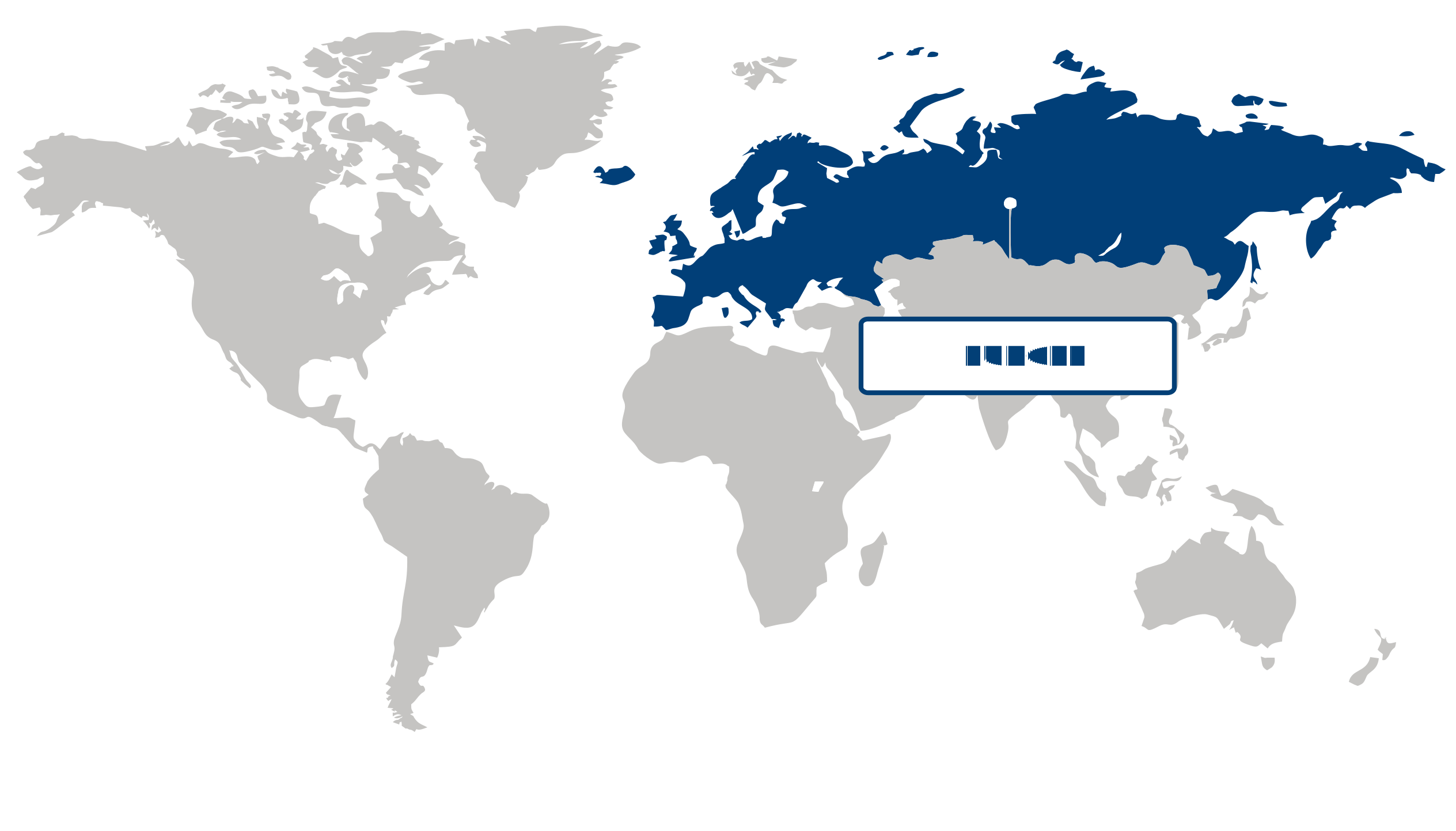
Europe (Largest Region)
Europe held the largest share of the online travel booking service market in 2026, benefiting from a mature tourism ecosystem, extensive cross-border travel activity, and high consumer familiarity with digital booking platforms. The region’s well-developed transportation infrastructure and diverse mix of leisure and business destinations support consistent demand for online travel planning and reservation services. Consumers increasingly value the convenience of comparing travel options, securing accommodations, managing itineraries, and accessing personalized recommendations through digital platforms. Strong internet penetration and established digital payment ecosystems further facilitate online transactions, while the continued integration of mobile technology and data-driven personalization is enhancing the overall booking experience.
Asia Pacific (Fastest-Growing Region)
Asia Pacific represents the fastest-growing region for the online travel booking service market, supported by expanding tourism activity, rising internet and smartphone adoption, and increasing consumer preference for digitally enabled travel planning. Growing middle-class populations and higher disposable incomes are encouraging more consumers to explore domestic and international travel, creating favorable conditions for online booking platforms. Improvements in digital payment infrastructure and mobile commerce are also making travel reservations more accessible across emerging markets. At the same time, technology-driven personalization, localized travel services, and increasing connectivity between transportation and accommodation providers are strengthening the digital travel ecosystem and supporting broader adoption of online booking services.
| Parameter | North America | Asia Pacific | Europe | Latin America | MEA |
|---|---|---|---|---|---|
| Innovation Hub i Scale Nascent Developing Advanced | |||||
| Cost-Sensitive Region i Scale Low Medium High | |||||
| Regulatory Environment i Scale Restrictive Neutral Supportive | |||||
| Demand Drivers i Scale Weak Moderate Strong | |||||
| Development Stage i Scale Emerging Developing Developed | |||||
| Adoption Rate i Scale Low Medium High | |||||
| New Entrants / Startups i Scale Sparse Moderate Dense | |||||
| Macro Indicators i Scale Weak Stable Strong |
Key Country Insights
Germany 🇩🇪
Sustainable Booking FocusGermany prioritizes transparent pricing, rail integration, and sustainable travel options within online booking services. Travel platforms in Germany increasingly enhance multi-modal itinerary planning and secure payment experiences to meet evolving consumer expectations.
France 🇫🇷
Experience-Centric TravelFrance emphasizes curated travel experiences alongside traditional accommodation and transport bookings. Online travel booking providers in France increasingly expand cultural, culinary, and regional tourism offerings while simplifying reservation management for domestic and international travelers.
Italy 🇮🇹
Regional Tourism IntegrationItaly's online travel booking service market supports diverse regional tourism through digital access to accommodations, transport, and local experiences. Platforms in Italy continue strengthening partnerships with hospitality providers to improve booking convenience across popular and secondary destinations.
Japan 🇯🇵
Convenience-Driven ReservationsJapan's online travel booking service market focuses on seamless mobile reservations, domestic tourism packages, and multilingual platform capabilities. Service providers in Japan continue improving user experience through efficient booking workflows and localized travel recommendations.
South Korea 🇰🇷
Mobile Booking InnovationSouth Korea places strong emphasis on mobile-first travel booking platforms supported by digital payment integration. Companies in South Korea enhance real-time promotions, accommodation partnerships, and personalized recommendations to encourage frequent platform engagement.
United States 🇺🇸
Digital Travel EcosystemThe U.S. online travel booking service market emphasizes integrated platforms combining flights, lodging, experiences, and loyalty programs. Providers in the U.S. continue refining AI-driven personalization and flexible booking options to strengthen customer retention across leisure and business travel.
Segment Leadership and Growth Trends
Online Travel Booking Service Market Share (%), by Booking Method, 2026
Go beyond the chart, access full insights & data tables
Request Free Sample ReportBooking Method Segment Analysis: Direct Travel Agency (Largest Segment) vs Online Booking (Fastest-Growing Segment)
Direct travel agency booking accounted for the largest share of 76.8% in the online travel booking service market in 2026, reflecting the continued value travelers place on personalized assistance and coordinated trip planning. Travel agencies can support customers with itinerary development, accommodation selection, transportation arrangements, and issue resolution, making this approach particularly relevant for complex or multi-component journeys. Established relationships with travelers and the ability to provide human guidance also help sustain demand where consumers prioritize convenience and planning support over fully self-directed booking.
Online booking is advancing rapidly as travelers increasingly seek greater flexibility, immediate access to travel options, and control over the purchasing process. Digital booking platforms allow users to compare alternatives, review availability, and complete reservations without relying on intermediary assistance. Growing comfort with digital transactions and the broader shift toward self-service travel planning are strengthening the appeal of online booking, particularly among consumers who prioritize speed, convenience, and personalized itinerary management.
Device Segment Analysis: Desktop (Largest Segment) vs Mobile (Fastest-Growing Segment)
Desktop devices represented the largest share of the online travel booking service market in 2026, supported by their suitability for detailed travel planning and comparison-intensive booking activities. Larger screens and easier navigation allow travelers to evaluate multiple flights, accommodations, packages, and itinerary components simultaneously, which remains valuable when arranging more complex trips. Desktop environments also provide a familiar interface for users who prefer reviewing extensive travel information before completing a purchase.
Mobile devices are registering the fastest growth as travel planning increasingly shifts toward convenient, on-the-go digital interactions. Smartphones allow users to search destinations, compare travel options, make reservations, and manage bookings from virtually anywhere. Mobile-first experiences, streamlined applications, digital payment capabilities, and real-time travel notifications are further encouraging travelers to rely on smartphones throughout the booking and trip-management process.
| Segment | Sub-Segment | Largest Segment | Fastest Growing |
|---|---|---|---|
| Booking Method | Online Booking, Direct Travel Agency | Direct Travel Agency | Online Booking |
| Device | Desktop, Mobile | Desktop | Mobile |
| Service Type | Vacation Packages, Accommodation Booking, Transportation Booking, Others | Transportation Booking | Accommodation Booking |
Competitive Landscape and Market Positioning
Key companies in the online travel booking service market:
1. Booking Holdings Inc. (United States)
2. Expedia Group Inc. (United States)
3. Airbnb Inc. (United States)
4. Trip.com Group Limited (China)
5. TripAdvisor Inc. (United States)
6. MakeMyTrip Limited (India)
7. Despegar.com Corp. (Uruguay)
8. Trivago N.V. (Germany)
9. Hostelworld Group plc (Ireland)
10. Lastminute.com N.V. (Netherlands)
The online travel booking service market is evolving through enhanced digital platform capabilities and personalized recommendation systems. Continuous innovation in user experience design is improving booking convenience and engagement. Expansion into new travel segments is further strengthening market reach. In the online travel booking service market, digital transformation is the primary growth enabler.
| Company | Market Share | Company Revenue | Revenue CAGR (%) | Product Portfolio | Geographic Presence | Innovation / R&D Focus | Strategic Developments |
|---|---|---|---|---|---|---|---|
| Booking Holdings Inc. (United States) | |||||||
| Expedia Group Inc. (United States) | |||||||
| Airbnb Inc. (United States) | |||||||
| Trip.com Group Limited (China) | |||||||
| TripAdvisor Inc. (United States) | |||||||
| MakeMyTrip Limited (India) | |||||||
| Despegar.com Corp. (Uruguay) | |||||||
| Trivago N.V. (Germany) | |||||||
| Hostelworld Group plc (Ireland) | |||||||
| Lastminute.com N.V. (Netherlands). |
Industry Development/News
| Company Name | Date | Key Development |
|---|---|---|
| Expedia | May-26 | Expedia enhanced its US hotel booking platform by improving price comparison capabilities, expanding trip bundling options, and strengthening its rewards program. The upgrades are aimed at increasing booking flexibility and user engagement, supporting greater platform competitiveness in the online travel booking and digital accommodation aggregation market. |
| Airbnb | Feb-26 | Airbnb reported strong booking volumes alongside the rollout of its “Reserve Now, Pay Later” feature in the US market, which achieved high adoption among eligible listings. The initiative expands payment flexibility and aims to increase conversion rates for higher-value bookings, strengthening platform engagement and supporting growth in demand for flexible travel purchasing options. |
| BCD Travel; Delta Air Lines | Jan-26 | BCD Travel and Delta Air Lines formed a strategic partnership to integrate airline content directly into corporate booking platforms. The collaboration enhances access to carrier-direct inventory within managed travel systems, reflecting a broader industry shift toward direct distribution models and improved content integration in corporate travel booking ecosystems. |
| Trip.com Group | Jan-26 | Trip.com Group faced an antitrust investigation initiated by China’s State Administration for Market Regulation, focusing on competitive practices including merchant exclusivity and ranking mechanisms. The regulatory action introduces potential compliance and operational uncertainties for the platform, reflecting increasing scrutiny of large online travel agencies in key Asian markets. |
| Expedia Group | Dec-25 | Expedia Group acquired Tiqets to expand its experiential and attractions portfolio within its broader travel ecosystem. The acquisition enhances access to non-accommodation travel content, strengthening Expedia’s diversification strategy and improving its ability to bundle lodging with experience-based offerings across its global booking platforms. |
Customize Your Report
Explore examples of how this report can be tailored to different research needs, including custom segments, additional topics or chapters, and related reports. Click a section of the wheel or its numbered marker to explore the available options.
Online Travel Booking Service Market — Custom Segments
| Segment | Sub-Segment |
|---|---|
| Traveler Type | Leisure Travelers, Business Travelers, Group & Family Travelers |
| Trip Purpose | Leisure & Vacation, Business Travel, Visiting Friends & Relatives |
| Supplier Type | Online Travel Agencies, Travel Suppliers, Metasearch & Aggregator Platforms |
Online Travel Booking Service Market — Custom TOC
| Custom Chapter | Custom Details |
|---|---|
| AI Transformation in Travel Booking |
|
| Online Travel Platform Monetization Strategies |
|
| Emerging Travel Distribution Models |
|
Need a different cut of the data?
Request Custom ResearchWhat is the current size of the online travel booking service market?
What is the forecasted size of the online travel booking service industry?
How is mobile-first booking behavior influencing the online travel booking service market?
What factors are strengthening demand for digital travel booking platforms?
Why do direct travel agencies still hold the largest share in travel bookings?
How is mobile adoption influencing online travel booking growth?
Why does Europe lead the online travel booking service market?
Why is Asia Pacific the fastest-growing region for online travel booking services?
Who are the leading players in the online travel booking service landscape?
Our Clients
"The report provided us with a clear direction, and the level of detail was beyond what we expected. I would definitely recommend their services to others."
Haier Appliances
"The collaboration with Fundamental Business Insights has added significant value to our decision-making process, and we look forward to continuing this partnership for our future market research requirements."
Luxottica Group S.p.A.
"The team at FBI delivered an exceptional research report. The insights on industry innovations were particularly impressive and added a lot of value to the overall report."
Nike
Our Research Team & Methodology
Every Fundamental Business Insights report is built by a dedicated vertical research team, validated through a structured primary-and-secondary methodology, and reviewed for accuracy before it reaches you.
Research Team Overview
Prepared by the Consumer Goods & Services Research Team
Delivery
Published
Demand
Available
Support
Trust & Compliance
Research Domains
10 coverage areasResearch Intelligence
| Source | Reference |
|---|---|
| International Organization for Standardization (ISO) | www.iso.org |
| ASTM International | www.astm.org |
| U.S. Consumer Product Safety Commission (CPSC) | www.cpsc.gov |
| European Commission – Consumer Safety | ec.europa.eu/safety-gate |
| Consumer Technology Association (CTA) | www.cta.tech |
| National Retail Federation (NRF) | nrf.com |
| World Retail Congress | www.worldretailcongress.com |
| World Travel & Tourism Council (WTTC) | wttc.org |
| UN Tourism | www.unwto.org |
| Personal Care Products Council (PCPC) | www.personalcarecouncil.org |
| Cosmetics Europe | cosmeticseurope.eu |
| International Housewares Association (IHA) | www.housewares.org |
| American Apparel & Footwear Association (AAFA) | www.aafaglobal.org |
| World Federation of the Sporting Goods Industry (WFSGI) | wfsgi.org |
| Juvenile Products Manufacturers Association (JPMA) | www.jpma.org |
| Pet Industry Joint Advisory Council (PIJAC) | pijac.org |
| International Council of Toy Industries (ICTI) | www.toy-icti.org |
| International Association of Amusement Parks and Attractions (IAAPA) | iaapa.org |
| Organisation for Economic Co-operation and Development (OECD) | www.oecd.org |
| World Bank Data | data.worldbank.org |
Research Workflow & Quality Assurance
Data Collection
Verified information gathered through primary and secondary research.
Data Triangulation
Cross-validation using multiple independent data sources.
Forecast Modelling
Market estimates developed using historical trends and analytical models.
Analyst Validation
Findings reviewed by domain experts for accuracy and consistency.
Editorial & Quality Review
Final editorial, quality, and compliance checks before publication.
Final Publication
Released after successful completion of the internal review process.
Report Coverage
📊 Market Assessment
- Market Size & Forecast
- Market Segmentation
- Regional Analysis
- Growth Drivers & Challenges
- Market Dynamics
🏢 Competitive Intelligence
- Competitive Landscape
- Company Profiles
- Competitive Benchmarking
- Mergers & Acquisitions
- Market Share Analysis or Key Company Strategies
🔍 Strategic Analysis
- Value Chain Analysis
- Porter's Five Forces
- PESTLE Analysis
- Pricing Trends
- Supply-Demand Analysis
🚀 Future Outlook
- Technology Landscape
- Regulatory Landscape
- Investment & Funding Landscape
- Emerging Opportunities
- Future Market Outlook
Have a question about this report or need a custom scope?
Request Customization