Open Banking Market Size & Growth Forecast 2027–2036, By Segments (Deployment, Services, Distribution Channel), Regional Demand Trends (North America, Asia Pacific, Europe), Key Country Insights (U.S., Japan, South Korea, Germany, France, Italy), and Competitive Landscape
Market Size and Growth Outlook
Open Banking Market size was over USD 50.56 billion in 2026 and is likely to grow at a 26.79% CAGR between 2027 and 2036, reaching USD 542.82 billion by 2036. The industry revenue for 2027 is calculated at USD 61.97 billion.
Get more details on this report
Request Free Sample ReportOpen Banking Market Intelligence Snapshot
Regional Market Dynamics
- Europe leads with 38.58% share due to mature regulatory frameworks, standardized API infrastructure, and widespread integration of open banking services across banks, fintechs, and third-party financial service providers.
- Asia Pacific grows at 29.48% CAGR driven by mobile-first banking adoption, rapid fintech expansion, and increasing investment in interoperable API-based financial platforms serving large consumer populations.
Segment Momentum
- On-premise accounted for 53.55% of the market in 2026 because financial institutions prioritize infrastructure control, secure data handling, and integration with legacy banking systems in regulated environments.
- Payments are expanding fastest as organizations increasingly adopt API-enabled account-to-account transactions that improve payment efficiency, streamline digital checkout experiences, and support connected financial ecosystems.
Market Expansion Drivers
- Rising consumer demand for seamless digital financial services accelerating open API banking adoption.
- Growing adoption of account-to-account payments improving transaction efficiency and financial data accessibility.
- Expanding fintech partnerships enabling personalized AI-driven banking and embedded finance solutions.
Leading Market Participants
- Major companies in the open banking market include Finastra Group Holdings Limited (United Kingdom), Fiserv, Inc. (United States), Capgemini SE (France), Mambu GmbH (Germany), Worldline S.A. (France), Tink AB (Sweden), Plaid Inc. (United States), Mastercard Incorporated (United States).
Global Market Forecast Snapshot
Market Outlook
- 2026 Market Size: USD 50.56 billion
- 2027 Estimated Market Size: USD 61.97 billion.
- Projected Market Size: USD 542.82 billion by 2036
- Growth Forecast: 26.79% CAGR (2027-2036)
Regional and Segment Outlook
- Leading Regional Market: Europe
- High-Growth Regional Hub: Asia Pacific
- Core Revenue Segment: On-premise (Deployment) | Banking & Capital Markets (Services) | App Markets (Distribution Channel)
- Emerging Opportunity Segment: Cloud (Deployment) | Payments (Services) | Distributors (Distribution Channel)
Market Growth Drivers and Industry Trends
Rising consumer demand for seamless digital financial services accelerating open API banking adoption
Consumers increasingly expect financial services to provide the speed, convenience, and interoperability associated with digital platforms, creating stronger demand for connected banking experiences. The open banking market is expanding as financial institutions and service providers use open APIs to securely connect accounts, payment services, and financial applications, enabling customers to access and manage services through integrated digital interfaces. Greater demand for mobile-first banking, personalized financial tools, and simplified account access is encouraging institutions to expose selected financial capabilities through API-based architectures. This shift also allows third-party applications to deliver more convenient experiences without requiring customers to navigate multiple disconnected banking platforms.
Growing adoption of account-to-account payments improving transaction efficiency and financial data accessibility
The increasing use of direct account-to-account payment mechanisms is changing how consumers and businesses initiate and settle digital transactions. Within the open banking market, these payment models can reduce dependence on traditional payment intermediaries while enabling secure connectivity between bank accounts and payment applications. Open API infrastructure allows authorized providers to access relevant financial information and initiate transactions within established authentication frameworks, improving payment visibility and reducing friction in digital commerce. Greater use of account-based transactions is also encouraging financial institutions and technology providers to develop services that combine payment initiation with access to financial account information.
Expanding fintech partnerships enabling personalized AI-driven banking and embedded finance solutions
Collaboration between banks and fintech providers is creating new pathways for delivering financial products through digital platforms and non-traditional customer interfaces. In the open banking market, these partnerships enable institutions to combine financial data access with AI-driven analytics, supporting more personalized recommendations, automated financial management, and tailored product offerings. Embedded finance applications can integrate payments, lending, account services, or other financial capabilities directly into commerce and software platforms, allowing users to access financial functions within familiar digital environments. The availability of standardized API connectivity makes it easier for fintech providers and financial institutions to coordinate these services while developing customer-specific experiences.
| Growth Driver | Impact on CAGR | Regulatory Influence | Geographic Relevance | Adoption Rate | Impact Timeline |
|---|---|---|---|---|---|
| Rising consumer demand for seamless digital financial services accelerating open API banking adoption | 2.00% | High | Europe, Asia Pacific | High | Near Term |
| Growing adoption of account-to-account payments improving transaction efficiency and financial data accessibility | 1.80% | Moderate | Europe, North America | High | Mid Term |
| Expanding fintech partnerships enabling personalized AI-driven banking and embedded finance solutions | 1.60% | Moderate | Asia Pacific, Middle East & Africa | Emerging | Mid Term |
Unlock insights tailored to your business with our bespoke market research solutions.
Click to get your customized report now.
Regional Demand Dynamics
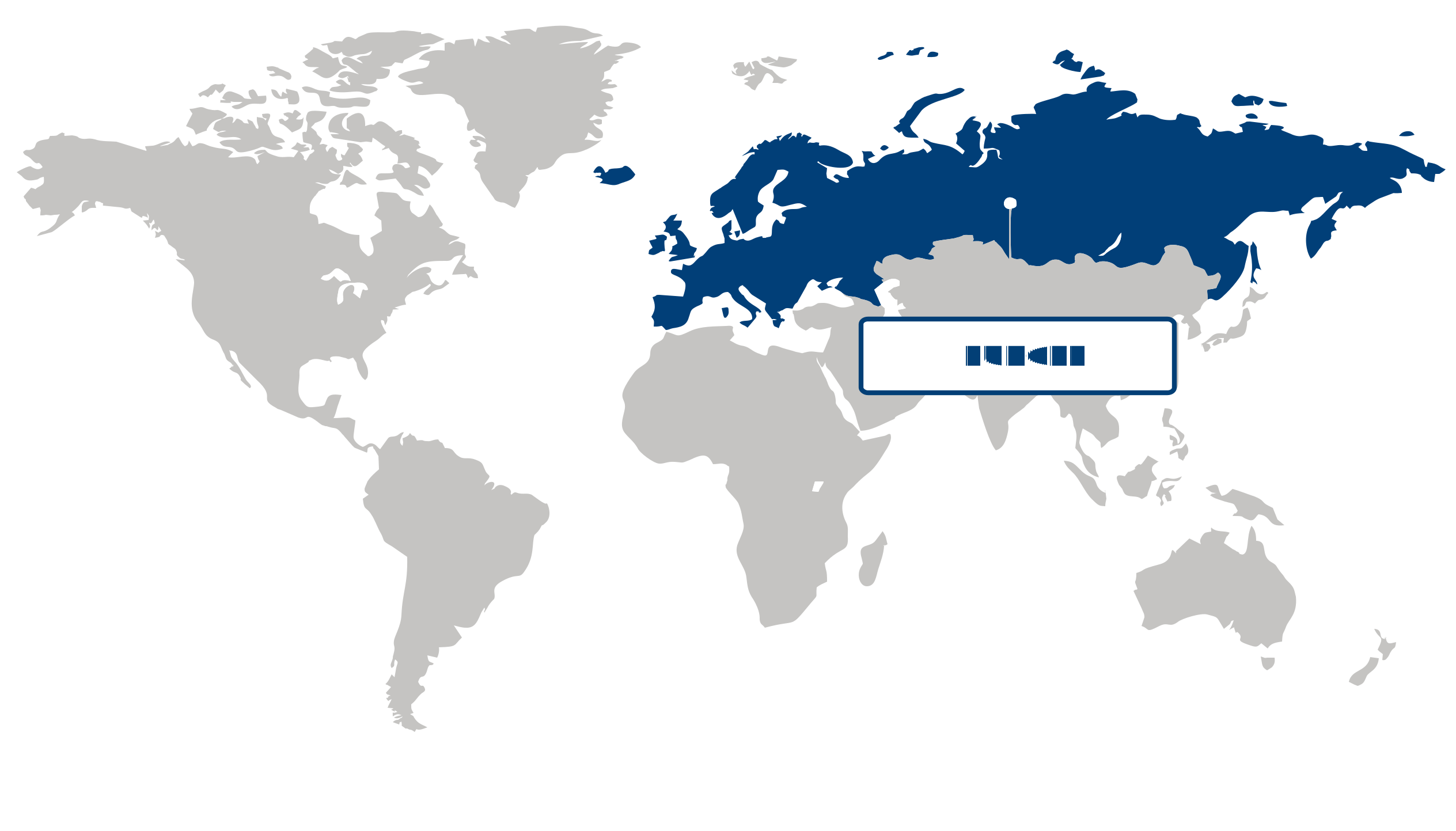
Europe (Largest Region)
In the open banking market, Europe held the largest share of 38.58% in 2026, supported by a mature regulatory environment, widespread adoption of account-to-account payments, and strong consumer acceptance of digital financial services. Regulatory frameworks promoting secure data sharing and third-party access to banking information have encouraged financial institutions and fintech providers to develop interoperable services. High digital banking penetration, sophisticated payment infrastructure, and growing demand for personalized financial products are further reinforcing regional adoption. Banks are also increasingly using open banking capabilities to improve customer engagement, streamline payments, and expand access to integrated financial services, creating a favorable environment for continued market development.
Asia Pacific (Fastest-Growing Region)
Asia Pacific is positioned as the fastest-growing region, driven by rapid digitalization of financial services, expanding smartphone and internet penetration, and increasing adoption of mobile-first banking platforms. The region's large and diverse consumer base is creating substantial opportunities for financial institutions and technology providers to introduce data-enabled financial products, embedded payment services, and personalized offerings. Regulatory initiatives supporting digital finance, along with the expansion of real-time payment ecosystems, are improving the infrastructure required for open banking models. Rising participation from digitally oriented consumers and increasing competition among financial service providers are also encouraging institutions to adopt open architectures and data-sharing capabilities.
| Parameter | North America | Asia Pacific | Europe | Latin America | MEA |
|---|---|---|---|---|---|
| Innovation Hub i Scale Nascent Developing Advanced | |||||
| Cost-Sensitive Region i Scale Low Medium High | |||||
| Regulatory Environment i Scale Restrictive Neutral Supportive | |||||
| Demand Drivers i Scale Weak Moderate Strong | |||||
| Development Stage i Scale Emerging Developing Developed | |||||
| Adoption Rate i Scale Low Medium High | |||||
| New Entrants / Startups i Scale Sparse Moderate Dense | |||||
| Macro Indicators i Scale Weak Stable Strong |
Key Country Insights
Germany 🇩🇪
Regulated Data SharingGermany’s open banking environment is shaped by strict regulatory frameworks emphasizing secure and consent-based financial data sharing. Banks and fintech firms in Germany focus on compliant API ecosystems that support digital payment services and account aggregation tools.
France 🇫🇷
Consumer Data PortabilityFrance’s open banking adoption is supported by consumer-focused financial reforms enabling secure data portability across banking platforms. Institutions in France prioritize API-driven services that enhance account aggregation, budgeting tools, and digital payment experiences.
Italy 🇮🇹
Digital Payment ModernizationItaly’s open banking market is anchored in modernization of digital payment infrastructure and increased collaboration between banks and fintech providers. Financial institutions in Italy focus on API-based services that improve transaction efficiency and customer financial management tools.
Japan 🇯🇵
Gradual Digital Banking ShiftJapan’s open banking market is evolving through gradual integration of API connectivity between banks and fintech platforms. Financial institutions prioritize controlled digital transformation while maintaining high standards of transaction security and customer data protection.
South Korea 🇰🇷
Fintech Ecosystem ConnectivitySouth Korea emphasizes strong fintech-bank connectivity through open banking frameworks supporting real-time payments and digital financial services. Banks in South Korea increasingly collaborate with fintech firms to expand user-centric financial applications and embedded banking solutions.
United States 🇺🇸
API Banking ExpansionIn the U.S., open banking is driven by growing adoption of API-based financial services enabling fintech integration with traditional banks. Financial institutions prioritize secure data-sharing frameworks to support digital payment innovation, lending platforms, and personalized financial product ecosystems.
Segment Leadership and Growth Trends
Open Banking Market Share (%), by Deployment, 2026
Go beyond the chart, access full insights & data tables
Request Free Sample ReportDeployment Segment Analysis: On-premise (Largest Segment) vs Cloud (Fastest-Growing Segment)
The on-premise segment represented the largest share of the open banking market in 2026, accounting for 53.55% of the market, supported by financial institutions' continued emphasis on direct control over sensitive banking infrastructure and data. On-premise deployments can provide organizations with greater control over security configurations, system integration, governance, and compliance requirements. The presence of established legacy infrastructure across financial institutions also contributes to continued demand for internally managed open banking environments.
Cloud is the fastest-growing deployment segment as financial institutions increasingly seek scalable infrastructure capable of supporting API-based connectivity, data exchange, and rapidly evolving digital banking services. Cloud environments can facilitate flexible resource allocation, faster deployment, and integration with modern financial technology ecosystems. Increasing digital transformation and the need to support agile open banking architectures are accelerating the shift toward cloud-based deployment.
Services Segment Analysis: Banking & Capital Markets (Largest Segment) vs Payments (Fastest-Growing Segment)
Banking & capital markets accounted for the largest share of the open banking market in 2026, representing 48.44% of the market. Open banking capabilities are closely aligned with the sector's need to securely connect financial data, improve customer experiences, and enable integration across banking platforms and third-party financial services. Increasing digitization of financial operations and demand for interconnected financial ecosystems continue to sustain adoption across banking and capital market institutions.
Payments is the fastest-growing services segment as open banking enables more connected and streamlined transaction experiences between consumers, financial institutions, and third-party providers. API-driven access can support account-based payment services, transaction initiation, and improved financial data connectivity while reducing friction across digital payment journeys. Rising consumer preference for seamless digital transactions and continued innovation in financial services are strengthening the adoption of open banking-enabled payment solutions.
| Segment | Sub-Segment | Largest Segment | Fastest Growing |
|---|---|---|---|
| Deployment | Cloud, On-premise | On-premise | Cloud |
| Services | Banking & Capital Markets, Payments, Digital Currencies, Value Added Services | Banking & Capital Markets | Payments |
| Distribution Channel | Bank Channels, App Markets, Distributors, Aggregators | App Markets | Distributors |
Competitive Landscape and Market Positioning
Top players in the open banking market:
1. Finastra Group Holdings Limited (United Kingdom)
2. Fiserv Inc. (United States)
3. Capgemini SE (France)
4. Mambu GmbH (Germany)
5. Worldline S.A. (France)
6. Tink AB (Sweden)
7. Plaid Inc. (United States)
8. Mastercard Incorporated (United States)
The open banking market is expanding through enhanced digital financial ecosystems that enable secure data sharing between institutions and third-party providers. Improved API-based infrastructure is supporting more seamless financial service integration. The open banking market is also evolving with increased focus on user-centric financial innovation and personalized banking experiences.
| Company | Market Share | Company Revenue | Revenue CAGR (%) | Product Portfolio | Geographic Presence | Innovation / R&D Focus | Strategic Developments |
|---|---|---|---|---|---|---|---|
| Finastra Group Holdings Limited (United Kingdom) | |||||||
| Fiserv Inc. (United States) | |||||||
| Capgemini SE (France) | |||||||
| Mambu GmbH (Germany) | |||||||
| Worldline S.A. (France) | |||||||
| Tink AB (Sweden) | |||||||
| Plaid Inc. (United States) | |||||||
| Mastercard Incorporated (United States). |
Industry Development/News
| Company Name | Date | Key Development |
|---|---|---|
| Kiwibank | May-26 | Kiwibank completed a full open banking rollout, becoming the first major New Zealand bank to implement these capabilities comprehensively. The initiative streamlines financial verification processes and improves data-sharing functionality, marking a significant advancement in the bank's digital infrastructure and operational service standards for both customers and intermediaries. |
| Truist Financial Corporation | Feb-26 | Truist Financial Corporation launched its initial open banking integration using Mastercard's open finance technology. This API-driven platform allows consumer and small business clients to manage financial data securely across third-party applications, improving customer control and personalization within the bank's digital ecosystem. |
| Flutterwave | Jan-26 | Flutterwave acquired open banking infrastructure provider Mono to internalize its capabilities. This strategic acquisition enhances the company's financial data connectivity and supports the development of an integrated digital financial ecosystem, significantly strengthening its competitive positioning and service infrastructure across the African market. |
| SBS | Nov-25 | SBS launched an upgraded version of its SBP Open Banking Platform, designed to facilitate next-generation digital payments and embedded finance solutions for European financial institutions. The platform enhancement aims to improve institutional agility and support the widespread adoption of secure, scalable open banking infrastructure within the region. |
| Mastercard | Sep-25 | Mastercard partnered with Paytently to launch an account-to-account open banking payment solution. This collaboration expands available payment capabilities and promotes broader adoption of bank-based digital payment infrastructure, strengthening Mastercard's ecosystem position and providing merchants with more efficient, direct payment processing alternatives. |
| Neonomics | Jan-25 | Neonomics acquired UK-based payments and data provider Ordo to scale its open banking expertise and regional footprint. The transaction consolidates the company's service portfolio and strengthens its competitive presence in the UK market by integrating Ordo’s established infrastructure and data capabilities into its broader open banking platform. |
| Fiserv | Oct-24 | Fiserv partnered with Zūm Rails to deliver open banking and instant payment capabilities in the United States. The collaboration expands access to account-based payment solutions and provides a robust framework for financial institutions and fintech providers to integrate secure, real-time banking data connectivity and transaction processing. |
| Euronet | Jun-24 | Euronet formed a strategic alliance with Fintech Galaxy to expand open banking capabilities throughout the Middle East and Africa. The partnership focuses on improving regional financial inclusion and developing more efficient account-based payment services, leveraging open banking infrastructure to modernize regional payment systems and accessibility. |
| Visa | May-24 | Visa advanced development of pay-by-bank services in the United States, expanding its account-to-account payment capabilities. The initiative supports broader market adoption of open banking by enabling direct bank payment options across various spending categories, positioning Visa to compete more effectively in the digital payments landscape. |
| Mastercard | Mar-24 | Mastercard announced plans to launch an open banking-powered digital account opening solution for U.S. debit and prepaid products. By leveraging connectivity to streamline onboarding and account creation, the initiative represents a strategic effort to enhance customer experience and operational efficiency in digital banking workflows. |
Customize Your Report
Explore examples of how this report can be tailored to different research needs, including custom segments, additional topics or chapters, and related reports. Click a section of the wheel or its numbered marker to explore the available options.
Open Banking Market — Custom Segments
| Segment | Sub-Segment |
|---|---|
| Banking Institution Type | Retail Banks, Commercial Banks, Digital Banks |
| Regulatory Model | Mandatory Open Banking, Voluntary Open Banking, Hybrid Regulatory Models |
| Revenue Model | Subscription-Based, Transaction-Based, Usage-Based |
Open Banking Market — Custom TOC
| Custom Chapter | Custom Details |
|---|---|
| API Monetization Strategy Assessment |
|
| Open Finance Expansion Readiness |
|
| FinTech Partnership Opportunity Mapping |
|
Need a different cut of the data?
Request Custom ResearchWhat is the market size of open banking?
What is the anticipated CAGR of the open banking industry?
How is demand for connected financial experiences accelerating open banking adoption?
How are fintech partnerships changing the strategic role of open banking platforms?
Why does the on-premise deployment model lead the open banking market?
Why are payments the fastest-growing service segment in the open banking market?
Why does Europe lead the open banking market?
What is driving Asia Pacific open banking market growth?
Which organizations are considered leaders in the open banking landscape?
Our Clients
"The team demonstrated a great understanding of our business needs, and the reports were tailored to address our specific concerns and objectives."
Infosys
"The report was up-to-date with the latest industry trends and technological advancements. The detailed competitive landscape analysis was quite helpful."
Zebra Technologies
"The data presented in the report was accurate and well-researched. I also found the market dynamics section particularly useful."
Arlo Technologies
Our Research Team & Methodology
Every Fundamental Business Insights report is built by a dedicated vertical research team, validated through a structured primary-and-secondary methodology, and reviewed for accuracy before it reaches you.
Research Team Overview
Prepared by the Smart Technologies Research Team
Delivery
Published
Demand
Available
Support
Trust & Compliance
Research Domains
10 coverage areasResearch Intelligence
| Source | Reference |
|---|---|
| National Institute of Standards and Technology (NIST) | www.nist.gov |
| International Organization for Standardization (ISO) | www.iso.org |
| Institute of Electrical and Electronics Engineers (IEEE) | www.ieee.org |
| Internet Engineering Task Force (IETF) | www.ietf.org |
| World Wide Web Consortium (W3C) | www.w3.org |
| Cloud Security Alliance (CSA) | cloudsecurityalliance.org |
| Open Source Initiative (OSI) | opensource.org |
| Linux Foundation | www.linuxfoundation.org |
| FinOps Foundation | www.finops.org |
| PCI Security Standards Council | www.pcisecuritystandards.org |
| SWIFT | www.swift.com |
| Financial Stability Board (FSB) | www.fsb.org |
| GSMA | www.gsma.com |
| International Telecommunication Union (ITU) | www.itu.int |
| OWASP Foundation | owasp.org |
| MITRE | www.mitre.org |
| World Economic Forum (WEF) | www.weforum.org |
| OECD Digital Economy | www.oecd.org/digital |
| World Bank Data | data.worldbank.org |
| U.S. Census Bureau | www.census.gov |
Research Workflow & Quality Assurance
Data Collection
Verified information gathered through primary and secondary research.
Data Triangulation
Cross-validation using multiple independent data sources.
Forecast Modelling
Market estimates developed using historical trends and analytical models.
Analyst Validation
Findings reviewed by domain experts for accuracy and consistency.
Editorial & Quality Review
Final editorial, quality, and compliance checks before publication.
Final Publication
Released after successful completion of the internal review process.
Report Coverage
📊 Market Assessment
- Market Size & Forecast
- Market Segmentation
- Regional Analysis
- Growth Drivers & Challenges
- Market Dynamics
🏢 Competitive Intelligence
- Competitive Landscape
- Company Profiles
- Competitive Benchmarking
- Mergers & Acquisitions
- Market Share Analysis or Key Company Strategies
🔍 Strategic Analysis
- Value Chain Analysis
- Porter's Five Forces
- PESTLE Analysis
- Pricing Trends
- Supply-Demand Analysis
🚀 Future Outlook
- Technology Landscape
- Regulatory Landscape
- Investment & Funding Landscape
- Emerging Opportunities
- Future Market Outlook
Have a question about this report or need a custom scope?
Request Customization