



Optical Data Storage Device Market Size & Forecasts 2026-2035, By Segments (Application, Device Type), Growth Opportunities, Innovation Landscape, Regulatory Shifts, Strategic Regional Insights (U.S., Japan, China, South Korea, UK, Germany, France), and Competitive Dynamics (Sony, Panasonic, Samsung, LG Electronics, Hitachi)
Market Size and Growth Outlook
Optical Data Storage Device Market size is forecasted to reach USD 11.62 billion by 2035, rising from USD 4.13 billion in 2025, at a CAGR of more than 10.9% between 2026 and 2035. In 2026, revenue is projected at USD 4.53 billion.
Base Year Value (2025)
USD 4.13 Billion
CAGR (2026-2035)
10.9%
Forecast Year Value (2035)
USD 11.62 Billion

Historical Data Period
2022-2025

Largest Region
Asia Pacific

Forecast Period
2026-2035
Key Takeaways
- Asia Pacific region garnered over 34% revenue share in 2025, supported by the manufacturing dominance of major technology hubs in Japan, China, and South Korea.
- North America region will expand at over 15.26% CAGR between 2026 and 2035, impelled by the widespread adoption of optical formats for archival storage in large-scale data centers.
- In 2025, the entertainment and media segment led the optical data storage device market with a majority share, owing to continued use in physical media distribution and archiving.
- In 2025, the blu-ray discs (BDs) segment held largest share of the market, impelled by applications in high-definition content storage and professional archiving.
- Leading organizations shaping the optical data storage device market include Sony (Japan), Panasonic (Japan), Samsung (South Korea), LG Electronics (South Korea), Hitachi (Japan), Toshiba (Japan), Philips (Netherlands), NEC (Japan), Maxell (Japan), Imation (USA).
Market Growth Drivers and Industry Trends
Growth in optical data storage for enterprise and archival applicationsLong-term retention mandates and institutional preservation needs are driving uptake of archival media across government and enterprise archives, strengthening demand in the optical data storage device market. Evidence includes the U.S. National Archives and Records Administration (NARA) guidance on durable media choices and Sony’s Optical Disc Archive deployments in broadcast and archival workflows, alongside Verbatim’s promotion of M-DISC for longevity. Established vendors can expand managed-archive services and cartridge-based ecosystems, while niche entrants can offer migration tools and validation services. Observable developments—policy emphasis on record integrity and vendor product roadmaps—point to steady institutional adoption rather than transient hype.
Adoption in high-density and long-term data storage solutions
The push for higher-capacity, stable cold storage is reshaping procurement and architecture decisions, benefiting the optical data storage device market through platformized archiving and cartridge systems. The Blu-ray Disc Association (BDA) advances higher-density Blu-ray specifications and Sony and Panasonic’s Archival Disc initiative demonstrates industry alignment on capacity and lifecycle targets. This creates opportunities for system integrators to bundle optical tiers into hybrid archives and for hardware suppliers to supply ruggedized drives and media. Given continuing standards activity and OEM product launches, buyers can expect broadened product choices and clearer interoperability paths.
Technological innovations in storage media and read/write performance
Improved materials, laser optics, and new form factors are increasing throughput and reliability, directly affecting competitiveness within the optical data storage device market. Microsoft Research’s Project Silica experiments with glass-based photonic storage (demonstrated with Warner Bros.), and ongoing R&D from Sony and Panasonic on Archival Disc formats underscore rapid innovation across media and read/write subsystems. Incumbents can leverage these advances to upsell higher-margin archival platforms, while entrants can differentiate with novel read/write hardware or software-defined access layers. Continued collaborative R&D and standards work creates a technology roadmap that stakeholders can follow to plan migrations and product investments.
Industry Restraints:
Competition from Cloud and Flash Storage — Adoption of cloud services and NAND flash-based SSDs has reduced demand for optical media as primary storage and backup, because of higher performance, easier scalability and lower total cost of ownership. Providers such as Amazon Web Services (AWS), Microsoft Azure, and Google Cloud emphasize object storage and offsite backup, and product roadmaps from Samsung Electronics and Micron highlight continuing density and cost improvements in NAND, constraining optical-device unit volumes. For incumbents (Panasonic, Sony) this forces margin pressure and need to pivot to archival niches; new entrants face high entry costs and limited addressable markets. Absent disruptive material or interface innovation, cloud and flash competition will remain the dominant restraint in the near–medium term.
Regulatory and Environmental Compliance Burdens — Stricter e‑waste and chemical restrictions increase production and end‑of‑life costs for optical devices, reducing commercial attractiveness. The European Commission’s WEEE Directive and RoHS rules raise collection, recovery and material substitution obligations, and national programs such as California’s CalRecycle expand producer responsibility. Corporate sustainability disclosures from Sony Group Corporation and Panasonic highlight material-reduction and recycling investments that raise manufacturing complexity. Established manufacturers must invest in compliant materials, take‑back logistics and testing; challengers confront higher compliance barriers to market entry. As regulators tighten circular‑economy requirements, compliance costs will continue to compress margins and steer firms toward specialized archival products or service models that internalize end‑of‑life handling.
| Growth Driver Assessment Framework | |||||
| Growth Driver | Impact On CAGR | Regulatory Influence | Geographic Relevance | Adoption Rate | Impact Timeline |
|---|---|---|---|---|---|
| Growth in optical data storage for enterprise and archival applications | 3.50% | Short term (≤ 2 yrs) | North America, Europe | Medium | Fast |
| Adoption in high-density and long-term data storage solutions | 3.70% | Medium term (2–5 yrs) | Asia Pacific, North America | Medium | Moderate |
| Technological innovations in storage media and read/write performance | 3.70% | Long term (5+ yrs) | Europe, Asia Pacific | Low | Slow |
Unlock insights tailored to your business with our bespoke market research solutions - Click to get your customized report now!
Regional Demand Dynamics
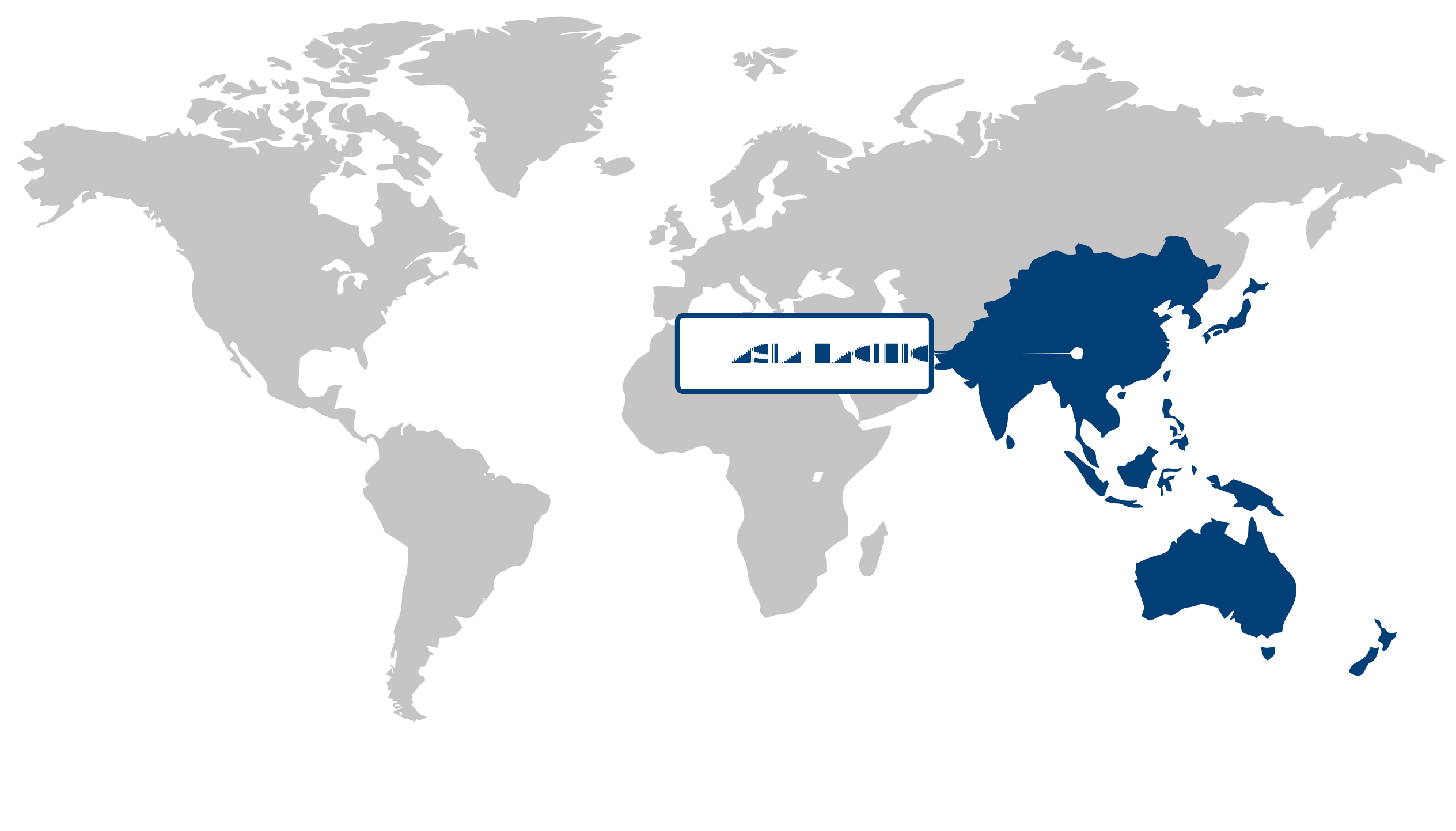
Largest Region
Asia Pacific
34% Market Share in 2025
The optical data storage device market in Asia Pacific represented more than 34.00% of the global market in 2025, driven primarily by the manufacturing dominance of technology hubs in Japan, China, and South Korea. Robust factory scale and specialized component supply chains—backed by policy support from the Ministry of Economy, Trade and Industry (Japan), the Ministry of Industry and Information Technology (China), and the Ministry of Trade, Industry and Energy (South Korea)—have kept unit costs competitive while enabling rapid technology upgrades. Evidence includes manufacturing investment statements from Sony Corporation and Samsung Electronics and industrial policy roadmaps from METI and MIIT. Given strong OEM capacity, improving yield on multilayer optical media, and mounting demand for archival and secure storage, Asia Pacific offers significant opportunities for high-density optical solutions and contract manufacturing partnerships.
Japan is positioned as a pivotal hub in Asia Pacific for the optical data storage device market, where precision manufacturing and legacy supply-chain depth sustain premium product segments. Japanese firms such as Sony Corporation, Toshiba Corporation, Panasonic Corporation, and Pioneer Corporation continue to emphasize optical engineering in corporate announcements and investor materials, while METI programs support advanced materials and process improvements. Domestic demand for industrial archival systems, combined with export-oriented OEMs, creates a high-margin segment that attracts R&D collaborations and specialist suppliers, reinforcing regional value chains and enabling Japan to anchor premium optical device innovation across Asia Pacific.
China anchors regional manufacturing scale for the optical data storage device market, supplying volume, component integration, and rapid scale-up capacity. Policies from the Ministry of Industry and Information Technology and large electronics assemblers—reflected in announcements from major OEM partners and broader manufacturing groups—have expanded production throughput and lowered time-to-market for new optical formats. China’s strengths in contract manufacturing and logistics complement Japan’s precision niche, making the region attractive for investors seeking scale, cost arbitrage, and fast commercialization of higher-capacity optical media.
North America Market Analysis:
Emerging as the fastest-growing region at a CAGR of 15.26%, North America leads the optical data storage device market as hyperscale operators and regulated archives accelerate deployment of optical formats for long-term retention. The market growth is impelled by the widespread adoption of optical formats for archival storage in large-scale data centers, prompting investments across the value chain from media manufacturers to software integrators. Evidence includes Microsoft Research's Project Silica demonstrations for archival glass storage, Sony and Panasonic's Archival Disc developments, Fujifilm's professional optical media releases, and demand signals from Amazon Web Services' Glacier cold-storage service and the National Archives and Records Administration (NARA). These dynamics create immediate opportunities in high-density media production, archival software, and certified archival services as organizations prioritize durable, energy-efficient retention.
The U.S. anchors the optical data storage device market as the primary adopter, where hyperscalers and federal archival programs drive procurement and standards. Hyperscalers such as Microsoft and Amazon are testing or scaling cold-archive solutions (Microsoft Research's Project Silica; AWS Glacier), while the National Archives and Records Administration's preservation mandates increase procurement rigor; suppliers including Sony and Fujifilm are tailoring high-capacity media and robotics for U.S. data-center footprints. This concentrated demand accelerates certification cycles, supports local manufacturing partnerships, and reduces per-unit archival costs—positioning the U.S. as a commercial launchpad that reinforces North America's leadership and creates a larger addressable market for optical archival innovations.
Europe Market Trends:
The optical data storage device market in Europe held a commanding share driven by persistent archival demand across media, government and enterprise customers and by regional priorities for durable, low-energy storage that align with the European Commission’s Circular Economy Action Plan. Strong vendor presence from Sony Corporation and Panasonic Corporation, targeted R&D activity at Fraunhofer-Gesellschaft, and procurement signals from cultural institutions and national archives illustrate a shift toward longevity-focused media and interoperable standards. Supply-chain resilience efforts and digital sovereignty debates at the EU level have reinforced investment in local manufacturing and standards, creating high-margin niches for archival optical systems and services as utilities and hyperscalers seek energy-efficient cold tiers.
The optical data storage device market in Germany plays a leading role with industrial customers and hyperscale operators favoring long-term, low-energy archival tiers; this is reflected in partner ecosystems around Deutsche Telekom’s data services and applied research at Fraunhofer-Gesellschaft. Regulatory clarity from Bundesnetzagentur and active industrial digitization programs underpin demand for certified, secure optical archives. Strategic implication: Germany’s large, standards-driven procurement and strong R&D base make it a launch market for enterprise archival solutions that can scale across Europe.
The optical data storage device market in France serves as an innovation hub where public R&D and telecom operators drive advanced use cases; CEA’s photonics work and Orange S.A.’s enterprise offerings highlight national momentum toward resilient, sovereign storage. Data protection expectations shaped by CNIL and centralized cultural-heritage digitization projects encourage adoption of verifiable, long-lived media. Strategic implication: France’s combination of research intensity and regulatory focus on data sovereignty creates a testbed for certified optical archival products that can be positioned for pan-European institutional buyers.
No card data available for this language/report.
Segment Leadership and Growth Trends
Entertainment and Media represented largest share of the optical data storage device market, anchoring the Application segment. This position reflects continued use in physical media distribution and archiving, as seen in ongoing Blu‑ray and packaged releases from Warner Bros. Home Entertainment and Sony and persistent physical-format demand cited by the International Federation of the Phonographic Industry. Collector preferences, broadcaster retention policies and institutional preservation practices at the Library of Congress reinforce steady demand while supply‑chain adjustments for limited runs improve economics. The segment creates strategic openings for major studios and boutique publishers to monetize premium editions and for archival service providers to offer certified preservation services, and regulatory retention needs and durable‑media value keep it relevant in the near to medium term.
Analysis by Device Type
Blu‑Ray Discs (BDs) held largest share of the optical data storage device market, leading the Device Type segment. Their dominance is driven by high‑definition content storage and professional archiving needs, supported by standards and roadmaps from the Blu‑ray Disc Association and product commitments from Sony and Panasonic. Examples such as Millenniata and Verbatim promoting archival BD‑R media illustrate vendor support for longevity, while BDXL capacity formats and studio workflows favor BDs amid hybrid digital transformation. This creates opportunities for manufacturers, managed‑archive specialists and studios to offer certified, high‑value archival solutions, and standards backing plus durability criteria indicate BDs will remain pertinent over the near to medium term.
| Report Segmentation | |||
| Segment | Sub-Segment | Largest Segment | Fastest Growing Segment |
|---|---|---|---|
| Application | Entertainment and Media, Educational Institutes, Manufacturing Industry, Healthcare, Banking, Financial Services and Insurance (BFSI), Others | ||
| Device Type | CD, DVDs, Erasable and Re-Writable Optical Discs, Near Field Optical Devices, Holographic Storage, High Definition DVD (HD-DVD), Blu-Ray Discs (BDs), Others | ||
 Read our Research Approach
Competitive Landscape and Market Positioning
Key players in the optical data storage device market include Sony (Japan), Panasonic (Japan), Samsung (South Korea), LG Electronics (South Korea), Hitachi (Japan), Toshiba (Japan), Philips (Netherlands), NEC (Japan), Maxell (Japan), and Imation (USA). These companies combine long-standing manufacturing expertise, proprietary media and drive IP, and broad channel footprints; Japanese firms underpin component and media quality, Korean groups drive consumer-device integration, while Philips and Imation supply standards leadership and niche enterprise solutions that shape buyer expectations and procurement patterns.The competitive landscape is defined by deliberate moves to consolidate capabilities, align across value chains, refresh product portfolios toward higher-density and archival formats, and sustain targeted R&D commitments. Those initiatives deepen customer stickiness through integrated offerings, expand reach into enterprise and professional workflows, and accelerate technical differentiation, forcing mid-tier vendors to either specialize or seek collaborative access to scale and distribution.
Strategic / Actionable Recommendations for Regional Players
North America: Prioritize engagement with hyperscalers, archive integrators, and data-protection vendors to embed optical options into long-term storage stacks; couple solution bundling with service-oriented propositions and selective IP licensing to capture enterprise archival and compliance workloads.
Asia Pacific: Leverage regional manufacturing scale and supplier networks to reduce unit costs for higher-density media and drives, while co-developing integrations with consumer electronics and edge storage OEMs to expand addressable applications and secure supply-chain advantages.
Europe: Emphasize compliance, sustainability credentials, and lifecycle services when collaborating with industrial and cultural-heritage customers; pursue partnerships that reinforce standards alignment and circularity to win public-sector and regulated archival mandates.
Why Choose Us
Specialized Expertise: Our team comprises industry experts with a deep understanding of your market segment. We bring specialized knowledge and experience that ensures our research and consulting services are tailored to your unique needs.
Customized Solutions: We understand that every client is different. That's why we offer customized research and consulting solutions designed specifically to address your challenges and capitalize on opportunities within your industry.
Proven Results: With a track record of successful projects and satisfied clients, we have demonstrated our ability to deliver tangible results. Our case studies and testimonials speak to our effectiveness in helping clients achieve their goals.
Cutting-Edge Methodologies: We leverage the latest methodologies and technologies to gather insights and drive informed decision-making. Our innovative approach ensures that you stay ahead of the curve and gain a competitive edge in your market.
Client-Centric Approach: Your satisfaction is our top priority. We prioritize open communication, responsiveness, and transparency to ensure that we not only meet but exceed your expectations at every stage of the engagement.
Continuous Innovation: We are committed to continuous improvement and staying at the forefront of our industry. Through ongoing learning, professional development, and investment in new technologies, we ensure that our services are always evolving to meet your evolving needs.
Value for Money: Our competitive pricing and flexible engagement models ensure that you get maximum value for your investment. We are committed to delivering high-quality results that help you achieve a strong return on your investment.
Select Licence Type

