Palletizing Machine Market Size & Forecasts 2026-2035, By Segments (Automation Level, Palletizing Pattern, Machine Type, End-Use Industry, Payload Capacity), Growth Opportunities, Innovation Landscape, Regulatory Shifts, Strategic Regional Insights (U.S., Japan, China, South Korea, UK, Germany, France), and Competitive Dynamics (ABB, FANUC, KUKA, Yaskawa, Mitsubishi Electric)
Market Size and Growth Outlook
Palletizing Machine Market size is estimated to increase from USD 5.39 billion in 2025 to USD 10.8 billion by 2035, supported by a CAGR exceeding 7.2% during 2026-2035. In 2026, revenues are forecast to reach USD 5.72 billion.
Get more details on this report
Request Free Sample ReportPalletizing Machine Market Intelligence Snapshot
Regional Market Dynamics
Segment Momentum
Market Expansion Drivers
Leading Market Participants
Global Market Forecast Snapshot
Market Outlook
Regional and Segment Outlook
Market Growth Drivers and Industry Trends
The increasing push for efficiency and labor cost optimization in manufacturing and logistics is a pivotal driver in the palletizing machine market. Organizations like the International Federation of Robotics (IFR) highlight a steady increase in automation adoption to meet consumer expectations for faster delivery and consistent product quality. As labor shortages intensify, particularly in regions with aging workforces such as Europe and North America, companies are accelerating investment in automated palletizing solutions to sustain throughput. This trend opens strategic opportunities for established manufacturers to expand integrated offerings and for new entrants to innovate modular systems targeting small-to-medium enterprises. The palletizing machine market will continue evolving as supply chains prioritize automation to enhance resilience and reduce reliance on manual intervention, reflecting broader digital transformation in industrial operations.
Advances in Robotic Palletizing Technology
Technological breakthroughs in robotic palletizing, including enhanced vision systems and AI-driven flexibility, are reshaping the palletizing machine market. Industry leaders like FANUC and ABB recently announced improved robotic models capable of handling diverse packaging formats with minimal reprogramming, responding to the growing demand for customized and shorter production runs. These innovations also drive energy efficiency, aligning with sustainability mandates from regulatory bodies such as the U.S. Occupational Safety and Health Administration (OSHA). This creates a strategic inflection point for incumbents to integrate smart robotics into comprehensive automation platforms and for new market players to specialize in adaptive robotics catering to niches like e-commerce fulfillment. As advancements continue, the palletizing machine market will be defined by increasingly intelligent, versatile solutions that support agile manufacturing strategies.
Impact of Enhanced Safety and Operational Regulations
The intensification of safety and operational standards for industrial automation significantly influences the palletizing machine market’s growth trajectory. Regulatory agencies, including OSHA and the European Agency for Safety and Health at Work (EU-OSHA), are enforcing stricter guidelines to mitigate workplace hazards related to robot-human interactions. Compliance with these regulations is compelling manufacturers to incorporate advanced safety features such as collaborative robot modes and real-time monitoring systems. This creates a dual opportunity: established suppliers can differentiate through certified safety-compliant products, while new entrants can focus on innovation in compliance technologies tailored to evolving regulatory frameworks. Looking ahead, the palletizing machine market will increasingly prioritize not only productivity but also operator safety and regulatory adherence, reflecting a holistic approach to industrial automation adoption.
Industry Restraints:
High Initial Capital Investment and Operational Costs
The considerable upfront costs associated with acquiring and integrating advanced palletizing machines significantly hinder market adoption, especially among small to medium-sized enterprises. According to a report from the Material Handling Industry (MHI), the expense of sophisticated robotic palletizers, including installation and customization, can exceed initial budgets, delaying ROI realization. This financial barrier restricts operational scalability as companies hesitate to commit to high-cost automation without clear short-term gains. Established players face pressure to justify capital allocation amid competing priorities, while new entrants struggle with funding access to deploy competitive technologies. Going forward, this financial constraint will likely sustain a cautious investment climate, compelling vendors to innovate cost-effective solutions and financing models to broaden market participation.
Skilled Workforce Shortage and Technical Expertise Gap
A persistent shortage of trained personnel adept in operating and maintaining complex palletizing systems impedes seamless market expansion. The World Economic Forum highlights a global mismatch between rapid automation adoption and workforce readiness, with inadequate technical training programs intensifying maintenance downtime and operational inefficiencies. Established manufacturers encounter challenges retaining talent to support sophisticated machinery, causing delays in system deployment and scaling. New entrants are further constrained by limited human capital to manage integration intricacies effectively. As automation technology evolves rapidly, this expertise gap is expected to remain a critical bottleneck, prompting increased investment in targeted workforce development initiatives and partnerships with technical institutions to sustain market growth momentum.
| Growth Driver | Impact on CAGR | Regulatory Influence | Geographic Relevance | Adoption Rate | Impact Timeline |
|---|---|---|---|---|---|
| Automation demand in manufacturing and logistics | 3.00% | Short term (≤ 2 yrs) | North America, Europe | Low | Fast |
| Technological innovation in robotic palletizing | 2.00% | Medium term (2–5 yrs) | Asia Pacific, Europe | Medium | Moderate |
| Safety and operational regulations for industrial automation | 2.20% | Long term (5+ yrs) | Europe, North America | High | Moderate |
Unlock insights tailored to your business with our bespoke market research solutions.
Click to get your customized report now.
Regional Demand Dynamics
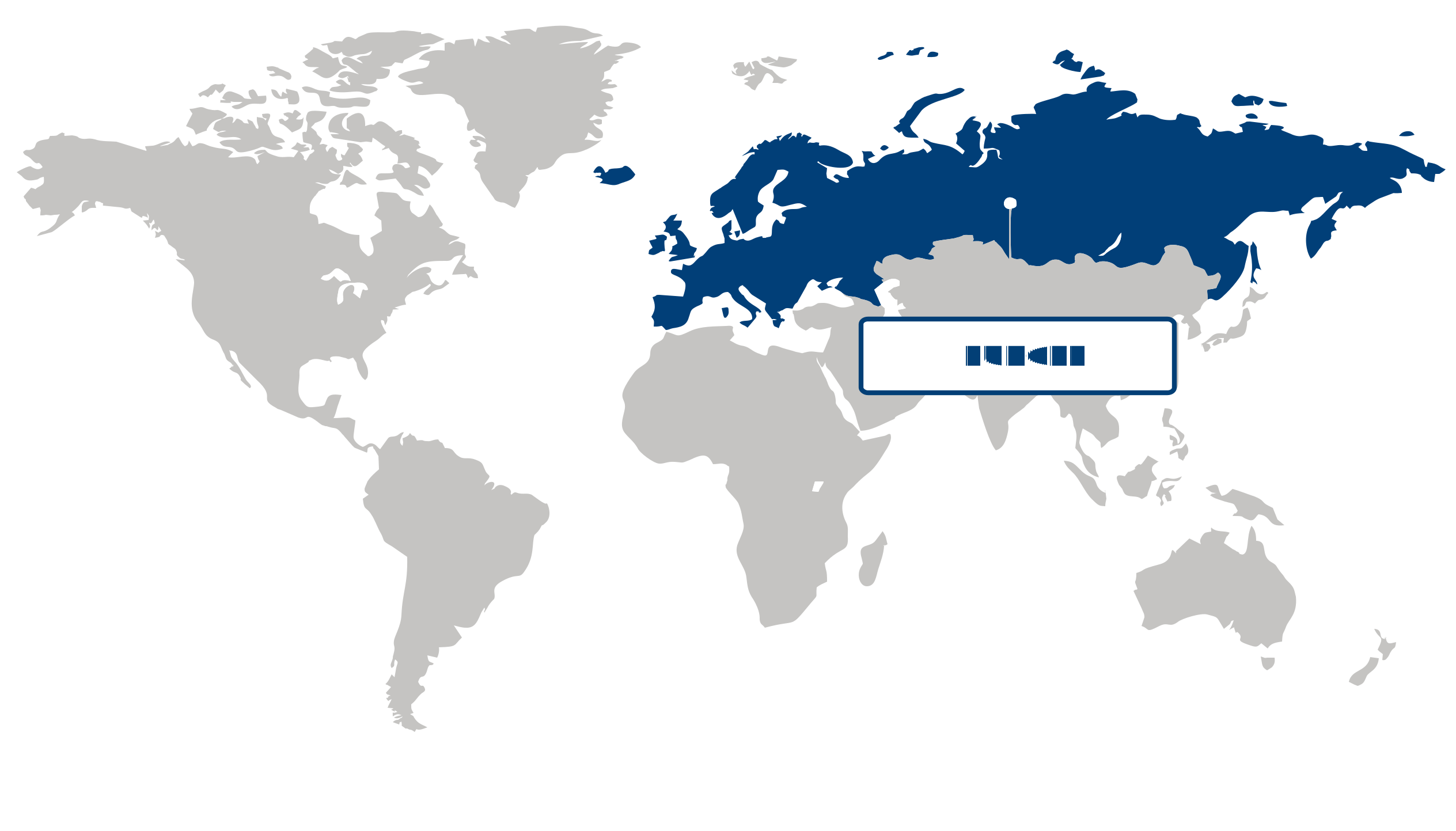
Europe captured more than 39% of the global palletizing machine market in 2025, emerging as the largest regional share due to robust automation adoption across manufacturing, food & beverage, and logistics sectors. This dominance is underpinned by Germany’s advanced industrial base, which prioritizes operational efficiency through high-tech automation solutions, as highlighted by announcements from KUKA AG and Siemens. European companies emphasize streamlined supply chains and precision robotics, consistent with EU policies incentivizing Industry 4.0 transformations and sustainable production practices. Such shifts reflect a broader move toward digitalized, flexible operations that meet rising consumer demands for faster delivery and product traceability. With ongoing investments from leading automation providers like ABB and Schneider Electric, Europe’s market stands to benefit from evolving technological capabilities and strategic shifts toward smarter manufacturing ecosystems.
Germany anchors the European palletizing machine market, driven by its role as a manufacturing powerhouse leveraging automation to enhance productivity and reduce labor costs. The German government’s Industry 4.0 initiatives and funding programs, supported by the German Federal Ministry for Economic Affairs and Energy, create a conducive environment for automation deployment. Companies such as Bosch Rexroth and Festo continuously innovate palletizing solutions to meet the demands of automotive and electronics sectors, reinforcing Germany’s leadership. France complements this trend with growing investments in food & beverage automation, where firms like Linde Material Handling integrate palletizing systems to improve warehouse throughput. Together, Germany and France solidify Europe’s pivotal position, signaling substantial opportunities for automation vendors looking to scale in these mature but evolving industrial landscapes.
Asia Pacific Market Analysis:
Asia Pacific emerged as the fastest-growing region in the palletizing machine market, registering a robust CAGR of 8.7%. This impressive growth is primarily propelled by the expansion of e-commerce operations and escalating investments in automated warehousing solutions across the region. Rapid urbanization and shifting consumer behaviors towards online shopping have intensified demand for efficient supply chain automation, prompting manufacturers and logistics providers to adopt advanced palletizing technologies. Support from government initiatives encouraging Industry 4.0 adoption, such as China’s Made in China 2025 plan and Japan’s Society 5.0 strategy, have further catalyzed automation investments. Companies like Alibaba have publicly announced massive funding in smart warehousing, confirming the region’s transformative digital supply chain shift. Given sustained growth in regional manufacturing output and e-commerce penetration, Asia Pacific offers significant opportunities for suppliers of palletizing machines aiming to capitalize on evolving operational efficiencies and sophisticated warehouse automation.
Japan plays a critical role within Asia Pacific’s palletizing machine market by leading advancements in robotics integration and automation sophistication in logistics infrastructure. With a mature industrial base focused on precision and quality, Japan’s increasing adoption of collaborative robots in warehousing—highlighted by initiatives from FANUC and Yaskawa Electric—underscores its focus on optimizing labor costs amid a shrinking workforce. These developments align with Japan’s broader policy drive to enhance operational resilience and sustainability in supply chains, creating a high-value market segment for automated palletizing solutions. Japan’s proactive regulatory framework promoting innovation enhances its position as a benchmark market for technological deployments within Asia Pacific, reinforcing the region’s drive toward automated warehousing.
China represents a pivotal growth engine in Asia Pacific’s palletizing machine market, driven by its expansive e-commerce ecosystem and governmental support for warehouse automation. The surge in online retail from players like JD.com and Pinduoduo has triggered major investments in automated fulfillment centers, integrating robotic palletizing systems to boost throughput and reduce human error. China’s strategic emphasis on modernizing logistics infrastructure through the National Logistics Hub Development Plan further incentivizes palletizing machine adoption. Additionally, the country’s competitive manufacturing environment encourages domestic machine builders to innovate rapidly, maintaining cost efficiency while enhancing technology. China’s evolving market dynamics significantly strengthen Asia Pacific’s leadership in palletizing automation and underscore its vast potential for international suppliers strategically targeting scalable warehouse automation solutions.
North America Market Trends:
North America held a commanding share in the palletizing machine market, driven by its advanced manufacturing base and robust logistics infrastructure. The region's emphasis on automation and smart manufacturing has bolstered investment in automated palletizing solutions, as evidenced by Honeywell International’s recent rollout of AI-integrated robotic palletizers to enhance operational efficiency. Additionally, the U.S. government’s incentives for Industry 4.0 adoption and stringent worker safety regulations encourage automation uptake. Rising demand in e-commerce fulfillment centers and consumer goods sectors further sustains market momentum, while environmental policies promoting energy-efficient machinery reinforce technology innovations. North America’s resilience amid supply chain disruptions and a skilled workforce adapting to digital transformation positions the region as a strategic hub, offering substantial growth opportunities in the palletizing machine market.
The U.S. represents a pivotal market within North America for the palletizing machine market, propelled by its large-scale industrial production and rapid automation adoption across diverse sectors like food and beverage, pharmaceuticals, and retail logistics. Major players such as Rockwell Automation have introduced collaborative robotic palletizing systems tailored to meet U.S. manufacturers’ demand for flexible, scalable solutions, addressing labor shortages and regulatory requirements from OSHA. Furthermore, strong consumer demand for faster delivery pushes warehousing automation, as highlighted in Logistics Management’s 2023 report on U.S. supply chain innovations. This leadership in automation integration not only reinforces the country’s market dominance but also amplifies North America’s overall potential to capture future advancements in palletizing technologies.
| Parameter | North America | Asia Pacific | Europe | Latin America | MEA |
|---|---|---|---|---|---|
| Innovation Hub i Scale Nascent Developing Advanced | |||||
| Cost-Sensitive Region i Scale Low Medium High | |||||
| Regulatory Environment i Scale Restrictive Neutral Supportive | |||||
| Demand Drivers i Scale Weak Moderate Strong | |||||
| Development Stage i Scale Emerging Developing Developed | |||||
| Adoption Rate i Scale Low Medium High | |||||
| New Entrants / Startups i Scale Sparse Moderate Dense | |||||
| Macro Indicators i Scale Weak Stable Strong |
Segment Leadership and Growth Trends
Palletizing Machine Market Share (%), by Automation Level, 2026
Go beyond the chart, access full insights & data tables
Request Free Sample ReportThe fully-automatic segment held the largest share in the palletizing machine market in 2025, driven by manufacturers and logistics operators increasingly adopting automation to enhance throughput and reduce labor costs. This leadership reflects broader trends toward digital transformation and workforce optimization as reported in ABB’s automation solutions press releases, where fully-automatic systems are shown to improve accuracy and operational efficiency significantly. The shift also aligns with global sustainability priorities by reducing waste and energy consumption through more precise material handling. For both established robotics companies and new entrants, this segment offers strategic advantages in delivering scalable and integrated automation solutions tailored to evolving supply chain complexities. Given ongoing advancements in AI and robotics, fully-automatic systems are poised to maintain market dominance by meeting demands for faster, more reliable palletizing operations across diverse industries.
Analysis by Palletizing Pattern
Multi-layer palletizing represented the largest share in the palletizing machine market in 2025, reflecting strong demand for high-density stacking solutions that optimize storage space in automated warehouse environments. This segment’s growth is closely tied to the surge in e-commerce logistics, as noted by ProMat trade show analyses, where multi-layer systems are favored for improving supply chain efficiency and throughput. Additionally, customer preferences for maximizing inventory capacity without increasing footprint underscore this segment’s appeal. Regulatory emphasis on warehouse safety and ergonomics also incentivizes automated multi-layer stacking to minimize manual handling risks. With digital warehouse management systems increasingly integrated, multi-layer palletizing provides both established players and new entrants opportunities to innovate in spatial optimization. Its relevance will continue as logistics networks prioritize compact, efficient, and scalable solutions to meet rapidly shifting consumer demand patterns.
Analysis by Machine Type
Articulated robots dominated the palletizing machine market in 2025 due to their unmatched flexibility and adaptability across diverse packaging and load types. The segment’s prominence aligns with industry endorsements from FANUC and KUKA, who emphasize these robots’ capability to handle complex palletizing tasks within automated production lines. The growing preference for versatile robotics supports manufacturers’ needs to customize palletizing operations rapidly, reflecting shifts in product variety and batch sizes. Moreover, articulated robots contribute to workforce safety by automating repetitive, ergonomic tasks in compliance with OSHA guidelines. This adaptability enables both established automation companies and startups to capture value in evolving manufacturing ecosystems. With ongoing enhancements in robot intelligence, payload capacity, and integration capabilities, articulated robots are expected to sustain leadership in the near to medium term, supporting flexible and resilient supply chains.
| Segment | Sub-Segment | Largest Segment | Fastest Growing |
|---|---|---|---|
| Automation Level | Semi-automatic, Fully-automatic | ||
| Palletizing Pattern | Single-layer Palletizing, Multi-layer Palletizing, Mixed-layer Palletizing | ||
| Machine Type | Articulated Robots, Cartesian Robots, SCARA Robots, Delta Robots | ||
| End-Use Industry | Food and Beverage, Pharmaceutical, Automotive, Logistics and Distribution, Electronics | ||
| Payload Capacity | Up to 100 kg, 100 - 500 kg, 500 - 1,000 kg, Over 1,000 kg |
Competitive Landscape and Market Positioning
The competitive landscape is dynamically shaped by extensive investments in automation technologies and industry-specific customization. Leading firms continuously refine their offerings through new machine models and enhanced control systems, advancing efficiency and flexibility. Collaborations with technology developers have accelerated integration of AI and robotics, raising competitive barriers. Expansion through strategic acquisitions has broadened product ranges and geographic reach, intensifying rivalry especially among European and Japanese leaders. These moves not only bolster market presence but also accelerate adoption of intelligent palletizing systems that respond to evolving supply chain complexities, thus positioning key players as industry frontrunners.
Strategic / Actionable Recommendations for Regional Players
For companies operating in North America, fostering cross-sector alliances and embracing digital transformation initiatives can drive differentiation. By targeting high-growth industries such as e-commerce and food & beverage, players can optimize solutions around scalability and speed. Leveraging AI-enabled robotics will enhance competitive standing amidst aggressive technological advancements.
In the Asia Pacific region, prioritizing innovation in compact and flexible palletizing units will address the diverse demands of SMEs and large manufacturers. Collaborative ventures with technology startups and suppliers can expedite adaptation of smart automation tailored to regional industrial shifts, supporting market penetration and operational resilience.
European firms should focus on integrating sustainable practices and energy-efficient technologies within their product lines to meet stringent regulatory and customer expectations. Forming partnerships across the supply chain to co-develop customizable, high-throughput solutions can sustain leadership in industrial palletizing while responding effectively to competitive pressures.
| Company | Market Share | Company Revenue | Revenue CAGR (%) | Product Portfolio | Geographic Presence | Innovation / R&D Focus | Strategic Developments |
|---|---|---|---|---|---|---|---|
| No companies available. | |||||||
Industry Development/News
| Company Name | Date | Key Development |
|---|
Customize Your Report
Explore examples of how this report can be tailored to different research needs, including custom segments, additional topics or chapters, and related reports. Click a section of the wheel or its numbered marker to explore the available options.
Palletizing Machine Market — Custom Segments
| Segment | Sub-Segment |
|---|---|
| No segment data available. | |
Palletizing Machine Market — Custom TOC
| Custom Chapter | Custom Details | ||
|---|---|---|---|
| No custom TOC data available. | |||
Need a different cut of the data?
Request Custom ResearchWhat is the expected industry size of palletizing machine by 2035?
Which territory demonstrates the strongest presence in the palletizing machine market?
In which region is the palletizing machine sector expanding most rapidly?
Where is the fully-automatic segment seeing the strongest adoption within the palletizing machine industry?
When did multi-layer palletizing sub-segment emerge as the largest sub-segment in the palletizing pattern segment of palletizing machine sector?
Why is the articulated robots segment leading in the palletizing machine industry?
Why does logistics and distribution sub-segment dominate the end-use industry segment of palletizing machine sector?
How much is the 500 - 1,000 kg segment expected to grow in the palletizing machine industry beyond 2025?
Who holds a significant market share in the palletizing machine landscape?
Our Clients
"The team at Fundamental Business Insights & Consulting demonstrated a commitment to excellence, not only in the quality of the report but also in their client-centric approach."
FANUC
"The level of detail in the market segmentation provided were particularly noteworthy. The detailed country-level insights were also very helpful."
B&R Industrial Automation GmbH
"The consultant took the time to understand our specific business objectives, ensuring that the reports were tailored to address our unique challenges and opportunities."
KUKA SE & Co. KGaA
Our Research Team & Methodology
Every Fundamental Business Insights report is built by a dedicated vertical research team, validated through a structured primary-and-secondary methodology, and reviewed for accuracy before it reaches you.
Research Team Overview
Prepared by the Industrial Automation & Equipment Research Team
Delivery
Published
Demand
Available
Support
Trust & Compliance
Research Domains
10 coverage areasResearch Intelligence
| Source | Reference |
|---|---|
| International Society of Automation (ISA) | www.isa.org |
| International Organization for Standardization (ISO) | www.iso.org |
| National Institute of Standards and Technology (NIST) | www.nist.gov |
| IEEE | www.ieee.org |
| VDMA (German Mechanical Engineering Industry Association) | www.vdma.org |
| Association for Advancing Automation (A3) | www.automate.org |
| International Federation of Robotics (IFR) | ifr.org |
| ASME (American Society of Mechanical Engineers) | www.asme.org |
| ASHRAE | www.ashrae.org |
| American Society of Heating, Refrigerating and Air-Conditioning Engineers (ASHRAE) | www.ashrae.org |
| Material Handling Industry (MHI) | www.mhi.org |
| OSHA (Occupational Safety and Health Administration) | www.osha.gov |
| National Fire Protection Association (NFPA) | www.nfpa.org |
| ASTM International | www.astm.org |
| International Electrotechnical Commission (IEC) | www.iec.ch |
| Open Process Automation Forum (The Open Group) | www.opengroup.org/open-process-automation-forum |
| AGMA (American Gear Manufacturers Association) | www.agma.org |
| Association of Equipment Manufacturers (AEM) | www.aem.org |
| Food and Agriculture Organization (FAO) | www.fao.org |
| International Labour Organization (ILO) | www.ilo.org |
Research Workflow & Quality Assurance
Data Collection
Verified information gathered through primary and secondary research.
Data Triangulation
Cross-validation using multiple independent data sources.
Forecast Modelling
Market estimates developed using historical trends and analytical models.
Analyst Validation
Findings reviewed by domain experts for accuracy and consistency.
Editorial & Quality Review
Final editorial, quality, and compliance checks before publication.
Final Publication
Released after successful completion of the internal review process.
Report Coverage
📊 Market Assessment
- Market Size & Forecast
- Market Segmentation
- Regional Analysis
- Growth Drivers & Challenges
- Market Dynamics
🏢 Competitive Intelligence
- Competitive Landscape
- Company Profiles
- Competitive Benchmarking
- Mergers & Acquisitions
- Market Share Analysis or Key Company Strategies
🔍 Strategic Analysis
- Value Chain Analysis
- Porter's Five Forces
- PESTLE Analysis
- Pricing Trends
- Supply-Demand Analysis
🚀 Future Outlook
- Technology Landscape
- Regulatory Landscape
- Investment & Funding Landscape
- Emerging Opportunities
- Future Market Outlook
Have a question about this report or need a custom scope?
Request Customization