



Panel Mounted Disconnect Switch Market Size & Growth Forecast 2027–2036, By Segments (Voltage, Product, Application), Regional Demand Trends (North America, Asia Pacific, Europe), Key Country Insights (U.S., Japan, South Korea, Germany, France, Italy), and Competitive Landscape
Market Size and Growth Outlook
Panel Mounted Disconnect Switch Market size was valued at USD 8.57 Billion in 2026 and is projected to grow at 6.04% CAGR from 2027 to 2036, crossing USD 15.41 Billion by 2036. The industry revenue for 2027 is estimated at USD 9.01 Billion.
Base Year Value (2026)
USD 8.57 Billion
CAGR (2027-2036)
6.04%
Forecast Year Value (2036)
USD 15.41 Billion

Historical Data Period
2022-2026

Largest Region
Europe

Forecast Period
2027-2036
Panel Mounted Disconnect Switch Market Intelligence Snapshot:
-
Regional Market Dynamics:
- Europe led in 2025, supported by mature industrial infrastructure, stringent electrical safety requirements, and modernization of power distribution across facilities and buildings.
- Rapid industrialization, construction activity, electrification, and investment in electrical infrastructure are expanding demand for reliable equipment protection and circuit isolation.
-
Segment Momentum:
- The high-voltage (>33 kV) segment held a 47.7% market share in 2025, driven by extensive deployment across utility transmission networks, industrial facilities, and critical infrastructure requiring dependable electrical isolation.
- The commercial segment is expanding due to growing commercial construction, wider deployment of advanced electrical distribution systems, and increasing demand for reliable power management, maintenance efficiency, and electrical safety.
-
Market Expansion Drivers:
- Rising industrial safety compliance driving electrical isolation device adoption
- Expanding manufacturing automation increasing demand for reliable power isolation systems
- Growth in control panel installations boosting compact switching device deployment
-
Leading Market Participants:
Prominent players in the panel mounted disconnect switch market include ABB Ltd. (Switzerland), Schneider Electric SE (France), Siemens AG (Germany), Eaton Corporation plc (Ireland), General Electric Company (United States), Rockwell Automation, Inc. (United States), Honeywell International Inc. (United States), Emerson Electric Co. (United States), SOCOMEC Group (France), Littelfuse, Inc. (United States)
Global Market Forecast Snapshot:
-
Market Outlook:
- 2026 Market Size: USD 8.57 Billion
- 2027 Estimated Market Size: USD 9.01 Billion
- Projected Market Size: USD 15.41 Billion by 2036
- Growth Forecasts: 6.04% CAGR (2027-2036)
-
Regional and Segment Outlook:
- Leading Regional Market: Europe
- High-Growth Regional Hub: Asia Pacific
- Core Revenue Segment: High (> 33 kV) (Voltage) | Non-Fused (Product) | Industrial (Application)
- Emerging Opportunity Segment: Low (≤ 11 kV) (Voltage) | Fused (Product) | Commercial (Application)
Market Growth Drivers and Industry Trends
Rising industrial safety compliance driving electrical isolation device adoption
Increasing emphasis on workplace electrical safety is encouraging industries to strengthen equipment isolation practices during maintenance and servicing activities. The panel mounted disconnect switch market benefits from expanding compliance requirements that prioritize safe disconnection of electrical circuits before inspection, repair, or equipment replacement. These switches play a critical role in reducing operational hazards by providing a visible and dependable means of isolating power sources, supporting safer maintenance procedures across industrial environments.
Expanding manufacturing automation increasing demand for reliable power isolation systems
The continued deployment of automated production equipment has increased the importance of dependable electrical isolation throughout manufacturing facilities. As industrial automation expands, the panel mounted disconnect switch market experiences stronger demand because automated machinery requires secure power control during installation, maintenance, and emergency shutdown procedures. Reliable isolation systems help protect personnel while minimizing operational interruptions, allowing manufacturers to maintain efficient production environments with improved equipment safety management.
Growth in control panel installations boosting compact switching device deployment
The increasing use of electrical control panels across industrial, commercial, and infrastructure applications is creating sustained demand for space-efficient switching components. The panel mounted disconnect switch market is supported by this trend as compact disconnect switches are integrated into control panel assemblies to provide accessible and reliable power isolation without increasing enclosure complexity. Their compatibility with modern panel designs and ability to simplify electrical maintenance make them essential components in increasingly sophisticated control system architectures.
| Growth Driver Assessment Framework | |||||
| Growth Driver | Impact On CAGR | Regulatory Influence | Geographic Relevance | Adoption Rate | Impact Timeline |
|---|---|---|---|---|---|
| Rising industrial safety compliance driving electrical isolation device adoption | 2.2% | High | North America, Europe | High | Near Term |
| Expanding manufacturing automation increasing demand for reliable power isolation systems | 2.1% | Moderate | Asia Pacific, North America | High | Mid Term |
| Growth in control panel installations boosting compact switching device deployment | 2% | Moderate | Europe, Asia Pacific | High | Mid Term |
Unlock insights tailored to your business with our bespoke market research solutions - Click to get your customized report now!
Regional Demand Dynamics
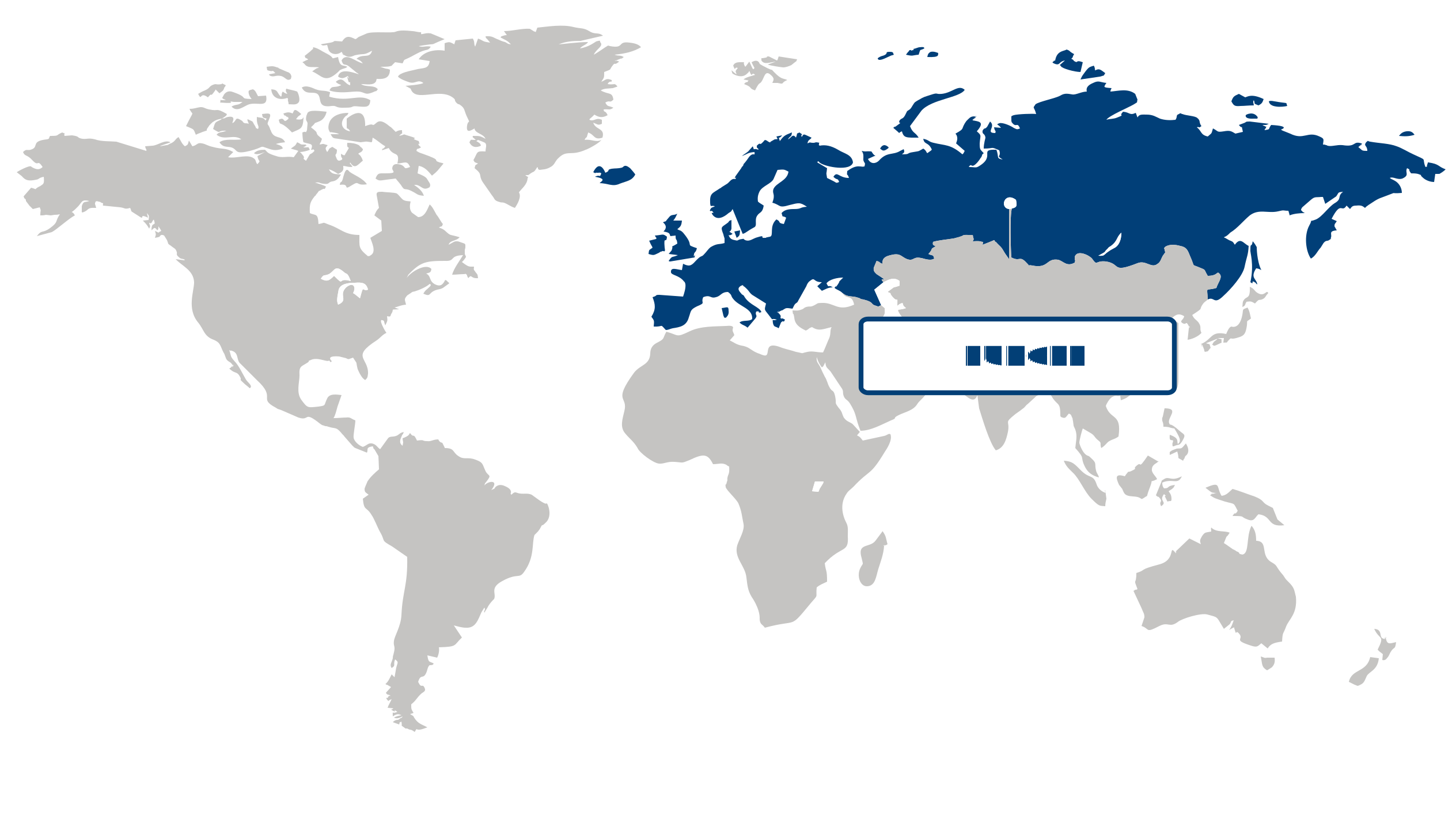
Largest Region
Europe
Largest Market Share in 2026
Europe (Largest Region) vs Asia Pacific (Fastest-Growing Region)
Europe held the largest position in the panel mounted disconnect switch market in 2026, supported by established industrial infrastructure, stringent electrical safety requirements, and continued modernization of power distribution systems. The region’s mature manufacturing and commercial sectors generate consistent demand for dependable circuit isolation and equipment protection, while regulatory emphasis on electrical safety encourages the adoption of compliant switching solutions. Ongoing upgrades across industrial facilities, commercial buildings, and energy infrastructure further reinforce the region’s established market base.
Asia Pacific is emerging as the fastest-growing regional market, driven by rapid industrialization, expanding construction activity, and increasing investment in electrical infrastructure. Growing manufacturing capacity and the development of commercial and industrial facilities are creating new requirements for reliable power distribution and equipment protection. Rising electrification and modernization of electrical systems across developing economies are also supporting adoption, while greater attention to operational safety is encouraging the integration of panel-mounted disconnect solutions into new installations.
No card data available for this language/report.
Segment Leadership and Growth Trends
Voltage Segment Analysis: High (> 33 kV) (Largest Segment) vs Low (≤ 11 kV) (Fastest-Growing Segment)
Holding the largest share of the panel mounted disconnect switch market, the high-voltage (> 33 kv) segment accounted for 47.7% of the market share in 2026. Its leadership is driven by extensive deployment across utility transmission networks, large industrial facilities, and critical infrastructure requiring dependable electrical isolation under high-power operating conditions. The expansion of transmission infrastructure, modernization of substations, and increasing investments in grid reliability continue to reinforce demand for high-voltage disconnect switches.
The low-voltage (≤ 11 kv) segment is projected to experience the fastest growth owing to rising installations in commercial buildings, light industrial facilities, and distributed energy systems. Increasing electrification, expansion of localized power distribution infrastructure, and growing emphasis on electrical safety and maintenance efficiency are encouraging wider adoption of low-voltage disconnect switches across diverse end-use applications.
Product Segment Analysis: Non-Fused (Largest Segment) vs Fused (Fastest-Growing Segment)
The non-fused segment held the largest share of the market in 2026. Its dominance is supported by widespread use in applications where overcurrent protection is provided through separate circuit protection devices, allowing disconnect switches to focus on safe equipment isolation. Their simple design, lower maintenance requirements, and cost-effective operation make non-fused products a preferred choice across industrial and utility electrical systems.
The fused segment is anticipated to register the fastest growth as industries increasingly prioritize integrated protection and isolation within a single device. Fused disconnect switches provide additional safeguards against overloads and short circuits, making them well suited for commercial facilities and modern electrical installations where equipment protection, operational safety, and regulatory compliance are becoming increasingly important.
Application Segment Analysis: Industrial (Largest Segment) vs Commercial (Fastest-Growing Segment)
The industrial segment held the largest share of the market in 2026. Strong demand is driven by the extensive use of disconnect switches in manufacturing plants, processing facilities, and heavy industrial operations where reliable equipment isolation is essential for maintenance, worker safety, and uninterrupted production. Ongoing industrial automation and investments in electrical infrastructure continue to support sustained adoption within this segment.
In the panel mounted disconnect switch market, the commercial segment is expected to witness the fastest growth. Expanding commercial construction, increasing deployment of advanced electrical distribution systems, and stricter electrical safety requirements are driving demand across offices, healthcare facilities, educational institutions, and retail complexes. The growing need for dependable power management and simplified maintenance is further accelerating adoption in commercial environments.
| Report Segmentation | |||
| Segment | Sub-Segment | Largest Segment | Fastest Growing Segment |
|---|---|---|---|
| Voltage | Low (≤ 11 kV), Medium (> 11 kV - 33 kV), High (> 33 kV) | High (> 33 kV) | Low (≤ 11 kV) |
| Product | Fused, Non-Fused | Non-Fused | Fused |
| Application | Commercial, Industrial, Utility | Industrial | Commercial |
 Read our Research Approach
Competitive Landscape and Market Positioning
Major players in the panel mounted disconnect switch market:
- ABB Ltd. (Switzerland)
- Schneider Electric SE (France)
- Siemens AG (Germany)
- Eaton Corporation plc (Ireland)
- General Electric Company (United States)
- Rockwell Automation, Inc. (United States)
- Honeywell International, Inc. (United States)
- Emerson Electric Co. (United States)
- SOCOMEC Group (France)
- Littelfuse, Inc. (United States)
Product competition is gradually moving beyond compliance with electrical safety requirements toward solutions that simplify installation, maintenance, and operational continuity across industrial and commercial environments. Equipment suppliers are introducing designs that improve enclosure compatibility, space utilization, and accessibility for routine servicing, enabling panel builders and facility operators to reduce installation effort without compromising system protection. Growing demand for digitally monitored electrical infrastructure is also encouraging the incorporation of status indication and remote monitoring capabilities, making disconnect switches a more integrated component of broader power management strategies. Purchasing preferences increasingly reflect the value of dependable operation under demanding conditions together with compatibility across diverse electrical architectures.
Industry Development/News
| Company Name | Date | Key Development |
|---|---|---|
| Socomec | Nov-24 | Socomec supplied disconnect switches for over 50 GW of solar installations in India, leveraging its SIRCO PV and INOSYS technology. The switches, designed for up to 1500 VDC, utilize patented technology to deliver a 500/750 VDC breaking capacity per pole, facilitating efficient power management and supporting the expansion of large-scale renewable energy infrastructure. |
| ABB | Feb-24 | ABB acquired SEAM Group to enhance its electrification portfolio with advanced consulting services for safety, renewable energy, and asset management. This strategic acquisition is designed to strengthen the company’s capabilities in asset modernization and solidify its market position as a provider of sustainable operational solutions for industrial and electrical infrastructure. |
| Littelfuse | Oct-23 | Littelfuse launched the J Fuse Disconnect Switch, a compact solution designed to consolidate multi-fused switch systems. The device provides manual circuit control while offering overcurrent and short-circuit protection. Available in 30 to 200 amperage ratings, the product is engineered for diverse high-demand applications, including energy storage, mining, HVAC/R systems, and solar power installations. |
| Schneider Electric | Jul-23 | Schneider Electric expanded the functionality of its TeSys VisiPacT switch range, incorporating enhanced safety features to ensure compliance with NEMA and OSHA regulatory standards. These upgrades focus on improving power disconnection reliability and operational safety for heavy-duty switch applications, strengthening the company’s competitive offering in the industrial power control segment. |
Why Choose Us
Specialized Expertise: Our team comprises industry experts with a deep understanding of your market segment. We bring specialized knowledge and experience that ensures our research and consulting services are tailored to your unique needs.
Customized Solutions: We understand that every client is different. That's why we offer customized research and consulting solutions designed specifically to address your challenges and capitalize on opportunities within your industry.
Proven Results: With a track record of successful projects and satisfied clients, we have demonstrated our ability to deliver tangible results. Our case studies and testimonials speak to our effectiveness in helping clients achieve their goals.
Cutting-Edge Methodologies: We leverage the latest methodologies and technologies to gather insights and drive informed decision-making. Our innovative approach ensures that you stay ahead of the curve and gain a competitive edge in your market.
Client-Centric Approach: Your satisfaction is our top priority. We prioritize open communication, responsiveness, and transparency to ensure that we not only meet but exceed your expectations at every stage of the engagement.
Continuous Innovation: We are committed to continuous improvement and staying at the forefront of our industry. Through ongoing learning, professional development, and investment in new technologies, we ensure that our services are always evolving to meet your evolving needs.
Value for Money: Our competitive pricing and flexible engagement models ensure that you get maximum value for your investment. We are committed to delivering high-quality results that help you achieve a strong return on your investment.
Select Licence Type

