Paper Bags Packaging Market Size & Forecasts 2026-2035, By Segments (Material, Type, End Use), Growth Opportunities, Innovation Landscape, Regulatory Shifts, Strategic Regional Insights (U.S., Japan, China, South Korea, UK, Germany, France), and Competitive Dynamics (KLOCKNER PENTAPLAST, Mondi Group, WestRock Company, Amcor plc, Sealed Air Corporation)
Market Size and Growth Outlook
Paper Bags Packaging Market size is likely to expand from USD 3.94 billion in 2025 to USD 6.36 billion by 2035, posting a CAGR above 4.9% across 2026-2035. The industry’s revenue potential for 2026 is USD 4.11 billion.
Get more details on this report
Request Free Sample ReportPaper Bags Packaging Market Intelligence Snapshot
Regional Market Dynamics
Segment Momentum
Market Expansion Drivers
Leading Market Participants
Global Market Forecast Snapshot
Market Outlook
Regional and Segment Outlook
Market Growth Drivers and Industry Trends
Retailers shifting away from single-use plastics toward renewable substrates are accelerating demand, directly shaping the paper bags packaging market through specification changes and supplier consolidation. Major retailers such as Tesco and Walmart have published packaging commitments that prioritize recyclable and fibre-based alternatives, while WRAP’s voluntary agreements in the UK have pressured supply chains to redesign carrier bags. This creates opportunities for established converters to win large contracts by scaling certified supply (Forest Stewardship Council) and for agile entrants to capture niche formats and last-mile customization. Expect continued product standardization and retailer-led procurement frameworks to drive supplier consolidation rather than fragmented supplier pools.
Growth in food delivery and e-commerce sectors
Expansion of e-commerce and on-demand food delivery is increasing demand for durable, printed, and tamper-evident fibre solutions, altering unit economics in the paper bags packaging market as volumes shift from bulk store formats to single-order shipments. Amazon’s Frustration-Free Packaging program and platforms like DoorDash extending grocery and convenience deliveries demonstrate commercial demand for lightweight, protective, and brandable paper packaging. Incumbents can leverage automated converting and fulfillment integration, while startups can specialize in insulated, grease-resistant, or multi-compartment bags for delivery. Operational integration with marketplaces and logistics providers will be a primary route to scale in the near term.
Adoption of recycled and compostable paper bags
Policy action and corporate sustainability targets are raising technical and sourcing requirements for recycled and compostable fibres, directly influencing material specs across the paper bags packaging market. The European Commission’s Single-Use Plastics Directive and suppliers such as Smurfit Kappa and DS Smith promoting recycled-fibre and compostable offerings illustrate upstream and downstream shifts. Legacy manufacturers can retrofit lines to handle post-consumer fibres and offer certification value, while new entrants can differentiate on closed-loop services, compostability validation, or localized recycling partnerships. Ongoing regulatory harmonization and third-party certification activity will steer procurement toward traceable, demonstrably circular solutions rather than unverified claims.
Industry Restraints:
Wood Pulp Supply Constraints and Price Volatility
Tighter global fibre markets and volatile pulp prices materially constrain paper-bag producers by raising input costs and creating procurement unpredictability that delays capacity expansion and product innovation. Producers such as International Paper and Stora Enso have publicly cited raw‑material cost pressure and fibre tightness in earnings releases and investor presentations, while market data from Fastmarkets has documented steep swings in northern bleached softwood kraft (NBSK) pulp prices. For incumbents this compresses margins and accelerates contract hedging and vertical integration; for new entrants it raises capital intensity and time‑to‑market. Given continuing demand for packaging and weather‑related supply disruptions, producers are likely to maintain conservative inventory strategies, longer‑term fibre contracts, and greater investment in recycled‑fiber sourcing in the near to medium term.
Inconsistent Waste Management and Recycling Infrastructure
Divergent national recycling systems and contamination rates limit the ability of paper‑bag makers to claim circularity and complicate adoption of higher recycled content, slowing market acceptance despite sustainability demand. The U.S. Environmental Protection Agency (EPA) and the European Environment Agency (EEA) report wide variance in paper collection and recycling effectiveness across jurisdictions, while UK charity WRAP highlights kerbside contamination as a barrier to fibre recovery. Brands face liability and reputational risk when end‑of‑life performance fails to meet claims, and smaller manufacturers struggle to influence municipal systems. As regulators such as the European Commission advance harmonized packaging rules, companies will need to invest in design for recyclability, supply‑chain traceability, and localized end‑of‑life partnerships to mitigate access and compliance risks over the coming years.
| Growth Driver | Impact on CAGR | Regulatory Influence | Geographic Relevance | Adoption Rate | Impact Timeline |
|---|---|---|---|---|---|
| Rising demand for retail and grocery packaging | 1.20% | Short term (≤ 2 yrs) | Europe, North America; Spillover: Asia Pacific | Medium | Fast |
| Growth in food delivery and e-commerce sectors | 1.00% | Medium term (2–5 yrs) | Asia Pacific, Europe | Low | Moderate |
| Adoption of recycled and compostable paper bags | 0.80% | Long term (5+ yrs) | North America, Europe | Medium | Slow |
Explore Growth Opportunities
Request Free Sample ReportRegional Demand Dynamics
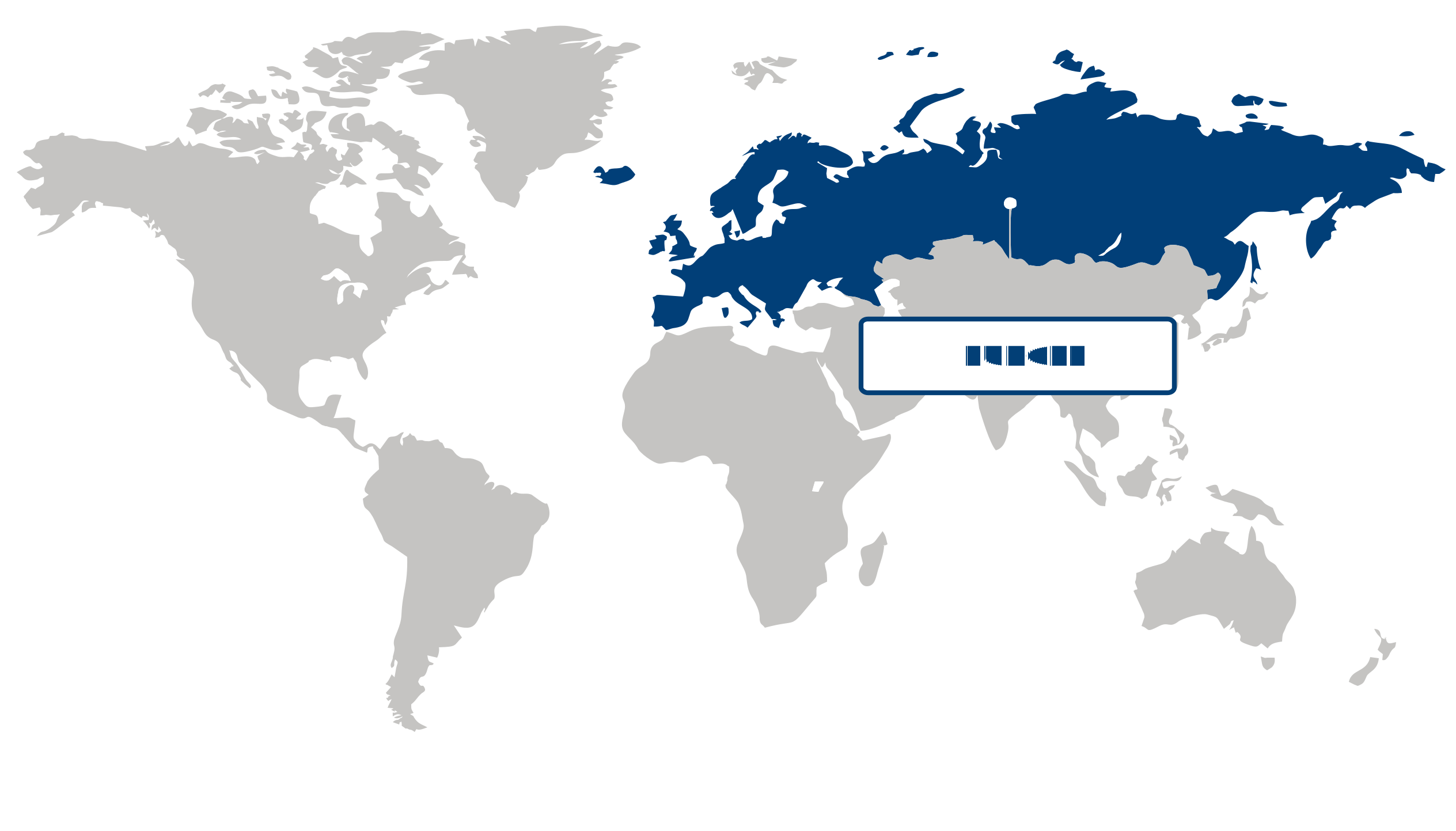
captured over 38% of the global paper bags packaging market in 2025, with Europe leading largely because of strong regulations favoring paper-based sustainable packaging solutions; the European Commission’s Single-Use Plastics Directive and the proposed Packaging and Packaging Waste Regulation have accelerated substitution away from plastics, while European Environment Agency reporting on packaging waste trends and investor interest have reinforced demand for fiber-based alternatives. Major converters such as Mondi and DS Smith have publicly expanded capacity and innovation pipelines to meet retailer demand, and these shifts are visible across supply chains and retail assortments. Given regulatory momentum and active industrial investment, Europe offers sustained opportunity for product differentiation, retrofit partnerships, and circular-fiber investments.
Germany anchors the Europe paper bags packaging market as both a large consumer base and a manufacturing hub where the VerpackG (German Packaging Act) and guidance from Umweltbundesamt (German Federal Environment Agency) push producers and retailers toward recyclable fiber solutions. Retailers including REWE Group and Lidl Germany have implemented replacements for single-use plastic bags and expanded paper packaging assortments, reflecting consumer acceptance and operational shifts in distribution and store logistics. For investors and suppliers, Germany’s mix of regulatory clarity, retail scale, and engineering capability makes it an ideal launch market for higher-value, recyclable paper bag formats that can be scaled regionally.
France plays a pivotal role in the Europe paper bags packaging market through strong national policy and public engagement—Loi AGEC (Anti-Waste Law for a Circular Economy) and programs run by ADEME (French Agency for Ecological Transition) have driven retailers and food producers to reduce plastic and trial paper alternatives. Carrefour’s public commitments to reduce plastic packaging and collaborations with fiber-packaging suppliers illustrate commercial pathways for substitution, while French consumers show high responsiveness to visible sustainable packaging solutions per French Ministry for the Ecological Transition communications. Strategically, France’s policy-driven demand and active retailer partnerships create a testing ground for premium recyclable paper bag formats and circular-design services that can be replicated across Europe.
Asia Pacific Market Analysis:
Asia Pacific emerged as the fastest-growing region in the paper bags packaging market, registering a robust CAGR of 5.6% driven by the rapidly expanding retail and foodservice sectors. Rapid growth in brick-and-mortar convenience stores, quick-service restaurants and omnichannel grocery retail—combined with stronger regulation on single-use plastics—has shifted purchase patterns toward recyclable and fiber-based packaging, raising unit demand for paper bags. Evidence includes regional economic resilience reported by the Asian Development Bank and policy momentum on plastic reduction highlighted by the United Nations Environment Programme, while large retailers such as Seven & i Holdings have public sustainability commitments that increase paper-bag adoption. Given sustained retail expansion, accelerating food delivery and stronger regulatory tailwinds, Asia Pacific presents disproportionate volume and innovation opportunities for manufacturers and converters focused on sustainable paper bag solutions.
Japan anchors premium, regulation-driven demand in the paper bags packaging market as a mature, sustainability-focused buyer with high per-capita consumption of convenience and takeout packaging. National policy action from the Ministry of the Environment on reducing single-use plastics and the widespread convenience store footprint (e.g., Seven & i Holdings’ sustainability targets) have increased demand for higher-quality, branded paper bags and smaller-batch custom runs. Japanese retailers’ emphasis on presentation and reusable-brand experiences favors premium printing, kraft and recyclable coatings, while strong logistics and skilled converters support rapid commercialization of new substrates. For suppliers, Japan offers higher margin, design-led product opportunities that reinforce regional scale plays.
China drives scale and supply-side innovation in the paper bags packaging market through enormous retail and foodservice volume and logistics modernization. Continued expansion of retail sales reported by the National Bureau of Statistics of China, combined with e-commerce and food delivery growth, boosts demand for cost-efficient paper bags at scale; parallel policy moves by the Ministry of Ecology and Environment to curb plastics further accelerate adoption. Platforms and logistics companies such as Cainiao (Alibaba Group) have publicly promoted green packaging initiatives, creating procurement pull for recycled and standardized paper bag formats. Strategically, China offers capacity, rapid product iteration and cost leadership that amplify regional growth and enable exporters and regional converters to capture volume-led opportunities across Asia Pacific.
North America Market Trends:
North America experienced moderate growth in the paper bags packaging market, driven by a mix of retail conversion, corporate sustainability commitments, and evolving regulatory frameworks that together sustain steady demand. Major retailers’ packaging targets and procurement practices—evident in Walmart’s public packaging initiatives and Starbucks Corporation’s sustainability commitments—have pulled demand toward fiber-based formats, while federal and provincial signals from the U.S. Environmental Protection Agency (EPA) and Environment and Climate Change Canada have encouraged material stewardship. Industry incumbents such as International Paper and WestRock have cited capacity and product-upgrade investments in corporate press releases, and consumer research from NielsenIQ shows continued preference for recyclable packaging. These dynamics and improving logistics networks make North America a pragmatic growth platform for expanding recyclable and branded paper-bag solutions.
The U.S. serves as the primary engine in the paper bags packaging market, where scale of retail and foodservice procurement, domestic converting capacity, and municipal policy mix shape commercial opportunity. State and municipal measures (for example, New York State Department of Environmental Conservation bag regulations and California actions tracked by the California Department of Resources Recycling and Recovery) have accelerated retailer-led switching at point of sale, while large converters and packagers such as International Paper and WestRock (through their public disclosures) have announced capacity and innovation programs to meet demand. For investors and strategists, the U.S. role implies concentrated channel entry points—national retailers and major foodservice contracts—and opportunities to leverage domestic converting scale and supply-chain partnerships to win regional share.
| Parameter | North America | Asia Pacific | Europe | Latin America | MEA |
|---|---|---|---|---|---|
| Innovation Hub i Scale Nascent Developing Advanced | |||||
| Cost-Sensitive Region i Scale Low Medium High | |||||
| Regulatory Environment i Scale Restrictive Neutral Supportive | |||||
| Demand Drivers i Scale Weak Moderate Strong | |||||
| Development Stage i Scale Emerging Developing Developed | |||||
| Adoption Rate i Scale Low Medium High | |||||
| New Entrants / Startups i Scale Sparse Moderate Dense | |||||
| Macro Indicators i Scale Weak Stable Strong |
Segment Leadership and Growth Trends
Paper Bags Packaging Market Share (%), by Material, 2026
Go beyond the chart, access full insights & data tables
Request Free Sample ReportBrown Kraft dominated the paper bags packaging market in 2025 with the largest share among material segments, driven by its high strength and cost efficiency for bulk packaging; its robustness and lower cost-per-tonne favor agricultural, chemical and industrial users seeking durable, recyclable fiber solutions. International Paper and Smurfit Kappa highlight kraft grades for industrial sacks, and the European Commission's Packaging and Packaging Waste Directive reinforces a shift to recyclable fiber, while regional pulp mill capacities and logistics efficiencies support supply. This creates scale advantages for established converters and niche specialization opportunities for emerging suppliers (e.g., tailored barriers), and continued demand from bulk sectors and regulatory focus on recyclability point to sustained relevance near term.
Analysis by Type
Self-Opening Sacks represented largest share in the paper bags packaging market in 2025, reflecting strong adoption of machine-ready formats as filling-line automation expands. The segment’s leadership is tied to increased automation in industrial filling—high-speed bagging systems and inline handling favor self-opening designs—evidenced by equipment vendors such as Syntegon Technology and Krones promoting lines optimized for these sacks. The format addresses labor constraints, throughput demands and digital process control trends driven by Siemens and Rockwell Automation, creating opportunities for large converters to supply standardized machine-compatible SKUs and for smaller players to add value through specialty valves or coatings; continued investments in packing-line automation support its near-term prominence.
Analysis by End Use
Food & Beverages held largest share in the paper bags packaging market in 2025 as growing consumer and retailer demand for sustainable, biodegradable food packaging accelerated supplier adoption of paper-based formats. Corporate commitments from Nestlé and Unilever to recyclable and fiber-first packaging, alongside guidance from the European Food Safety Authority on food-contact materials, have encouraged migration from certain plastics to paper and compostable barriers. Preference for perceived natural, low-waste packaging and retailer sustainability targets create openings for incumbents to scale certified food-grade paper lines and for challengers to introduce innovative, compliant coatings; ongoing corporate and regulatory momentum indicates the segment will remain strategically important in the near to medium term.
| Segment | Sub-Segment | Largest Segment | Fastest Growing |
|---|---|---|---|
| Material | Brown Kraft, White Kraft | ||
| Type | Sewn Open Mouth, Pinch Bottom Open Mouth, Pasted Valve, Self-Opening Sacks, Others | ||
| End Use | Food & Beverages, E-commerce, Chemicals, Agriculture, Retail, Others |
Unlock insights tailored to your business with our bespoke market research solutions.
Click to get your customized report now.
Competitive Landscape and Market Positioning
The competitive environment is characterized by portfolio realignment and closer commercial alignment with retail and foodservice chains, with leaders broadening their offer to include recyclable, compostable, and fiber‑based high‑barrier options while scaling manufacturing and process innovation. Cross‑industry joint work with mills, converters, and material scientists has accelerated introductions of paper formats tailored to e‑commerce, fresh food, and branded retail applications, and investments in automation and digital finishing are sharpening service levels and speed to market. These moves have raised the technical and service bar, reinforcing incumbents’ positions and prompting faster adoption of circular design practices across the sector.
Strategic / Actionable Recommendations for Regional Players
North America: Deepen commercial links with major retailers and quick‑service outlets to co‑develop paper bag formats that meet food safety and e‑commerce durability needs; scale pilot lines for fiber‑based barrier treatments and retrofit converting assets to improve throughput and consistency while exploring technical collaborations with mills to secure validated, recyclable substrates.
Asia Pacific: Prioritize locally sourced fiber blends and lean manufacturing collaborations to deliver cost‑competitive, branded paper bag solutions for rapid‑growth food delivery and modern trade channels; adopt digital printing and lightweighting techniques through partnerships with converters and print suppliers to enhance on‑pack communication and reduce logistics costs.
Europe: Emphasize verified circularity by aligning product specifications with municipal collection and recycling schemes and working jointly with paper designers and certified suppliers to commercialize high‑performance compostable or recycled-content bags for premium and sustainability‑focused customers; coordinate with regional research centers to accelerate barrier innovation using renewable feedstocks.
| Company | Market Share | Company Revenue | Revenue CAGR (%) | Product Portfolio | Geographic Presence | Innovation / R&D Focus | Strategic Developments |
|---|---|---|---|---|---|---|---|
| No companies available. | |||||||
Customize Your Report
Explore examples of how this report can be tailored to different research needs, including custom segments, additional topics or chapters, and related reports. Click a section of the wheel or its numbered marker to explore the available options.
Paper Bags Packaging Market — Custom Segments
| Segment | Sub-Segment |
|---|---|
| No segment data available. | |
Paper Bags Packaging Market — Custom TOC
| Custom Chapter | Chapter Details | ||
|---|---|---|---|
| No custom TOC data available. | |||
Need a different cut of the data?
Request Custom ResearchHow much is the paper bags packaging market worth?
How will the paper bags packaging industry grow in terms of size and CAGR by 2035?
What is the leading region in terms of paper bags packaging market share?
Which area is showing the greatest surge in paper bags packaging sector?
What share does brown kraft segment hold in the paper bags packaging sector as of 2025?
Where is the self-opening sacks segment seeing the strongest adoption within the paper bags packaging industry?
When did food & beverages sub-segment emerge as the largest sub-segment in the end use segment of paper bags packaging sector?
What are the key competitors in the paper bags packaging landscape?
Our Clients
"The report helped us understand emerging consumer trends in our product category. It clarified where to focus innovation for the next product launch."
LyondellBasell
"The regional forecast section was incredibly useful. We were able to identify two new potential partners in Europe thanks to the vendor mapping you included."
SABIC
"We appreciated how actionable the recommendations were. It guided us to improve supply chain resilience."
Olin Corporation
Our Research Team & Methodology
Every Fundamental Business Insights report is built by a dedicated vertical research team, validated through a structured primary-and-secondary methodology, and reviewed for accuracy before it reaches you.
Research Team Overview
Prepared by the Chemicals & Materials Research Team
Delivery
Published
Demand
Available
Support
Trust & Compliance
Research Intelligence
| Source | Reference |
|---|---|
| American Chemistry Council (ACC) | www.americanchemistry.com |
| European Chemical Industry Council (Cefic) | cefic.org |
| International Council of Chemical Associations (ICCA) | icca-chem.org |
| European Chemicals Agency (ECHA) | echa.europa.eu |
| U.S. Environmental Protection Agency (EPA) | www.epa.gov |
| ASTM International | www.astm.org |
| International Organization for Standardization (ISO) | www.iso.org |
| National Institute of Standards and Technology (NIST) | www.nist.gov |
| Plastics Industry Association (PLASTICS) | www.plasticsindustry.org |
| European Biplastics | www.european-bioplastics.org |
| The Adhesive and Sealant Council (ASC) | www.ascouncil.org |
| National Association of Corrosion Engineers (AMPP) | www.ampp.org |
| Society of Plastics Engineers (SPE) | www.4spe.org |
| International Fertilizer Association (IFA) | www.fertilizer.org |
| CropLife International | croplife.org |
| Packaging Europe | packagingeurope.com |
| Flexible Packaging Association (FPA) | www.flexpack.org |
| Battery Council International (BCI) | batterycouncil.org |
| International Copper Association (ICA) | internationalcopper.org |
| World Steel Association | worldsteel.org |
Research Workflow & Quality Assurance
Data Collection
Verified information gathered through primary and secondary research.
Data Triangulation
Cross-validation using multiple independent data sources.
Forecast Modelling
Market estimates developed using historical trends and analytical models.
Analyst Validation
Findings reviewed by domain experts for accuracy and consistency.
Editorial & Quality Review
Final editorial, quality, and compliance checks before publication.
Final Publication
Released after successful completion of the internal review process.
Report Coverage
📊 Market Assessment
- Market Size & Forecast
- Market Segmentation
- Regional Analysis
- Growth Drivers & Challenges
- Market Dynamics
🏢 Competitive Intelligence
- Competitive Landscape
- Company Profiles
- Competitive Benchmarking
- Mergers & Acquisitions
- Market Share Analysis or Key Company Strategies
🔍 Strategic Analysis
- Value Chain Analysis
- Porter's Five Forces
- PESTLE Analysis
- Pricing Trends
- Supply-Demand Analysis
🚀 Future Outlook
- Technology Landscape
- Regulatory Landscape
- Investment & Funding Landscape
- Emerging Opportunities
- Future Market Outlook
Have a question about this report or need a custom scope?
Request Customization