Personalized Skin Care Products Market Size & Growth Forecast 2027–2036, By Segments (Product, Gender, Distribution Channel, Type), Regional Demand Trends (North America, Asia Pacific, Europe), Key Country Insights (U.S., Japan, South Korea, Germany, France, Italy), and Competitive Landscape
Jump to content
Market Size and Growth Outlook
Personalized Skin Care Products Market size was assessed at USD 34.8 billion in 2026 and is poised to grow at a 10.83% CAGR between 2027 and 2036, attaining USD 97.31 billion by 2036. The industry revenue for 2027 is estimated at USD 37.97 billion.
Get more details on this report
Request Free Sample ReportPersonalized Skin Care Products Market Intelligence Snapshot
Regional Market Dynamics
- Europe accounted for 32.86% of the market in 2026, supported by strong demand for premium skincare, ingredient-focused purchasing, and established retail and e-commerce personalization channels.
- Asia Pacific is expected to grow at a 9.04% CAGR, fueled by rising beauty awareness, mobile-first shopping, online skin analysis tools, and increasing demand for customized skincare solutions.
Segment Momentum
- Face Care accounted for 61.11% of the market in 2026 because consumers prioritize personalized solutions for visible facial concerns and regularly incorporate customized products into their daily skincare routines.
- The Male segment is expanding fastest as more consumers adopt targeted skincare routines and seek products tailored to individual skin needs, supported by evolving grooming habits and growing category participation.
Market Expansion Drivers
- Rising demand for AI-driven skin analysis enabling customized dermatology-based skincare formulations.
- Growing prevalence of skin disorders increasing demand for targeted personalized skincare solutions.
- Expansion of direct-to-consumer beauty brands offering customized ingredient-based skincare kits.
Leading Market Participants
- Prominent companies in the personalized skin care products market include L'Oréal S.A. (France), The Estée Lauder Companies Inc. (U.S.), Coty Inc. (U.S.), Amway Corporation (U.S.), Curology, LLC (U.S.), PROVEN Skincare, Inc. (U.S.), Function of Beauty, LLC (U.S.), August Skincare Ltd. (U.K.), Skin Inc. (Singapore), Haut.AI (Estonia).
Global Market Forecast Snapshot
Market Outlook
- 2026 Market Size: USD 34.8 billion
- 2027 Estimated Market Size: USD 37.97 billion.
- Projected Market Size: USD 97.31 billion by 2036
- Growth Forecast: 10.83% CAGR (2027-2036)
Regional and Segment Outlook
- Leading Regional Market: Europe
- High-Growth Regional Hub: Asia Pacific
- Core Revenue Segment: Face Care (Product) | Female (Gender) | Offline (Distribution Channel) | Mass (Type)
- Emerging Opportunity Segment: Body Care (Product) | Male (Gender) | Online (Distribution Channel) | Premium (Type)
Market Growth Drivers and Industry Trends
Rising demand for AI-driven skin analysis enabling customized dermatology-based skincare formulations
AI-driven skin analysis will drive the personalized skin care products market growth by enabling more individualized assessments of consumers' skincare needs. The ability to use digital analysis to identify specific skin characteristics supports customized dermatology-based formulations and encourages consumers to move away from generalized products toward solutions tailored to their individual requirements.
Growing prevalence of skin disorders increasing demand for targeted personalized skincare solutions
Growing prevalence of skin disorders will support personalized skin care products market growth as consumers seek products that address specific skin concerns rather than relying on broad-purpose formulations. Targeted solutions can align product selection and formulation more closely with individual conditions, increasing demand for personalized approaches to routine skincare management.
Expansion of direct-to-consumer beauty brands offering customized ingredient-based skincare kits
The expansion of direct-to-consumer beauty brands will strengthen personalized skin care products market demand by making customized ingredient-based skincare kits more accessible to consumers. These offerings allow brands to provide formulations aligned with individual preferences and skincare requirements while giving consumers a more tailored purchasing experience through direct channels.
| Growth Driver | Impact on CAGR | Regulatory Influence | Geographic Relevance | Adoption Rate | Impact Timeline |
|---|---|---|---|---|---|
| Rising demand for AI-driven skin analysis enabling customized dermatology-based skincare formulations | 2.00% | Moderate | North America, Europe | High | Near Term |
| Growing prevalence of skin disorders increasing demand for targeted personalized skincare solutions | 1.80% | High | Europe, North America | High | Mid Term |
| Expansion of direct-to-consumer beauty brands offering customized ingredient-based skincare kits | 1.60% | Low | North America, Asia Pacific | High | Mid Term |
Unlock insights tailored to your business with our bespoke market research solutions.
Click to get your customized report now.
Regional Demand Dynamics
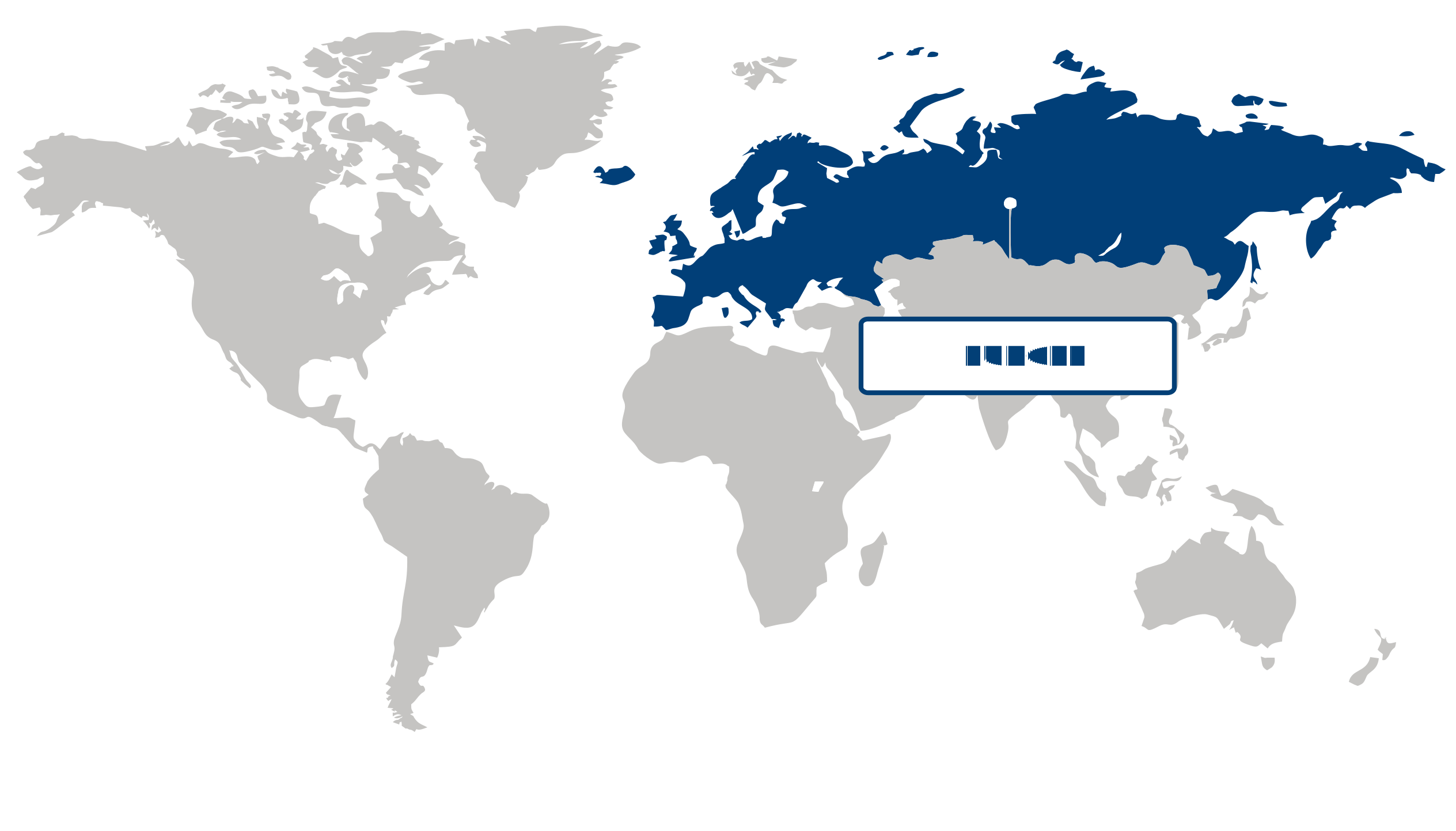
Europe (Largest Region)
Europe dominated the personalized skin care products market in 2026, accounting for a 32.86% share, supported by strong consumer awareness of skincare, established beauty and personal care industries, and growing interest in products tailored to individual skin characteristics. Consumers across the region increasingly value targeted formulations that address specific concerns such as hydration, aging, sensitivity, and uneven skin tone. The region’s emphasis on product quality, ingredient transparency, safety, and regulatory compliance also supports consumer confidence in customized skincare solutions. Advances in digital skin assessment, personalized product recommendations, and formulation technologies are further enabling brands and retailers to provide more individualized experiences, while premium beauty consumption continues to encourage demand for specialized products.
Asia Pacific (Fastest-Growing Region)
Asia Pacific represents the fastest-growing region, benefiting from rising disposable incomes, expanding beauty-conscious consumer populations, and increasing demand for skincare products designed around individual needs. Consumers are becoming more informed about skin health and are increasingly seeking solutions for concerns influenced by climate, lifestyle, pollution, and changing personal routines. Digital commerce and technology-enabled beauty consultations are improving access to personalized recommendations and specialized formulations, particularly among younger consumers. Growing interest in premium skincare, natural ingredients, and scientifically positioned products is also broadening opportunities for personalization. The region’s dynamic beauty market and rapid adoption of digital purchasing and diagnostic tools are supporting strong momentum for tailored skincare solutions.
| Parameter | North America | Asia Pacific | Europe | Latin America | MEA |
|---|---|---|---|---|---|
| Innovation HubiScaleNascentDeveloping Advanced | |||||
| Cost-Sensitive RegioniScaleLowMedium High | |||||
| Regulatory EnvironmentiScaleRestrictiveNeutral Supportive | |||||
| Demand DriversiScaleWeakModerate Strong | |||||
| Development StageiScaleEmergingDeveloping Developed | |||||
| Adoption RateiScaleLowMedium High | |||||
| New Entrants / StartupsiScaleSparseModerate Dense | |||||
| Macro IndicatorsiScaleWeakStable Strong |
Key Country Insights
Germany 🇩🇪
Science-Based FormulationsGermany emphasizes clinically supported personalized skin care products backed by dermatological expertise and high-quality ingredients. German consumers increasingly seek customized regimens that combine efficacy, sustainability, and skin compatibility.
France 🇫🇷
Premium Custom CareFrance is strengthening personalized skin care products through luxury cosmetics expertise and professional skincare services. French consumers increasingly value bespoke formulations that balance natural ingredients with proven cosmetic performance.
Italy 🇮🇹
Boutique PersonalizationItaly is expanding personalized skin care products through premium beauty brands and specialized retail experiences. Italian consumers increasingly favor customized skincare routines that reflect individual lifestyle preferences and ingredient quality expectations.
Japan 🇯🇵
Precision Beauty SolutionsJapan focuses on personalized skin care products that incorporate advanced diagnostics and premium cosmetic technologies. Japanese brands continue refining tailored routines that address aging, hydration, and sensitive skin through individualized product recommendations.
South Korea 🇰🇷
Beauty Tech IntegrationSouth Korea combines digital skin assessment technologies with innovative cosmetic development to expand personalized skin care products. South Korean consumers actively adopt AI-enabled recommendations and customized formulations that complement evolving beauty routines.
United States 🇺🇸
Data-Driven BeautyThe U.S. personalized skin care products market is advancing through AI-based skin analysis, digital consultations, and direct-to-consumer platforms. Consumers increasingly expect customized formulations that address individual skin concerns while supporting ingredient transparency.
Personalized Skin Care Products Market Share (%), by Product, 2026
Go beyond the chart, access full insights & data tables
Request Free Sample ReportProduct Segment Analysis: Face Care (Largest Segment) vs Body Care (Fastest-Growing Segment)
Face care dominated the personalized skin care products market in 2026, holding a 61.11% share of the market. Facial skin concerns are highly diverse, ranging from hydration and sensitivity to pigmentation, acne, and visible signs of aging, creating strong demand for products tailored to individual skin profiles. Personalized formulations allow consumers to address specific needs more precisely than standardized products, while increasing awareness of individualized skincare routines continues to reinforce the prominence of face care.
Body care is experiencing the fastest growth as personalization expands beyond facial routines into broader skincare needs. Consumers are increasingly seeking targeted solutions for body-specific concerns such as dryness, sensitivity, uneven tone, and texture, encouraging brands to develop more individualized formulations and regimens. The broader adoption of personalized beauty approaches and growing consumer interest in comprehensive skincare routines are supporting stronger demand for customized body care products.
Gender Segment Analysis: Female (Largest Segment) vs Male (Fastest-Growing Segment)
The female segment held the largest share of the personalized skin care products market in 2026, accounting for 81.13% of the market. Women have historically demonstrated strong engagement with specialized skincare routines and are more likely to adopt products addressing distinct concerns such as hydration, pigmentation, aging, and sensitivity. The established use of multi-step skincare regimens and growing interest in customized formulations continue to support the segment's leading position.
The male segment is expanding at the fastest pace as skincare becomes increasingly integrated into men's personal care routines. Greater awareness of skin health, grooming, appearance, and targeted treatment is encouraging male consumers to move beyond basic products toward solutions tailored to individual skin needs. Increasing acceptance of personalized beauty concepts is further widening the opportunity for customized skincare offerings designed specifically around male consumer requirements.
| Segment | Sub-Segment | Largest Segment | Fastest Growing |
|---|---|---|---|
| Product | Face Care, Body Care | Face Care | Body Care |
| Gender | Male, Female | Female | Male |
| Distribution Channel | Online, Offline | Offline | Online |
| Type | Mass, Premium | Mass | Premium |
Competitive Landscape and Market Positioning
Prominent players in the personalized skin care products market:
1. L'Oréal S.A. (France)
2. The Estée Lauder Companies Inc. (U.S.)
3. Coty Inc. (U.S.)
4. Amway Corporation (U.S.)
5. Curology LLC (U.S.)
6. PROVEN Skincare Inc. (U.S.)
7. Function of Beauty LLC (U.S.)
8. August Skincare Ltd. (U.K.)
9. Skin Inc. (Singapore)
10. Haut.AI (Estonia)
The personalized skin care products market is expanding as consumers increasingly seek tailored beauty solutions. In the personalized skin care products market, innovation in formulation and customization technologies is enabling highly targeted product development. Advanced skin analysis tools are also improving personalization accuracy and customer satisfaction.
| Company | Market Share | Company Revenue | Revenue CAGR (%) | Product Portfolio | Geographic Presence | Innovation / R&D Focus | Strategic Developments |
|---|---|---|---|---|---|---|---|
| L'Oréal S.A. (France) | |||||||
| The Estée Lauder Companies Inc. (U.S.) | |||||||
| Coty Inc. (U.S.) | |||||||
| Amway Corporation (U.S.) | |||||||
| Curology LLC (U.S.) | |||||||
| PROVEN Skincare Inc. (U.S.) | |||||||
| Function of Beauty LLC (U.S.) | |||||||
| August Skincare Ltd. (U.K.) | |||||||
| Skin Inc. (Singapore) | |||||||
| Haut.AI (Estonia). |
Industry Development / News
| Company Name | Date | Key Development |
|---|---|---|
| The Estée Lauder Companies | Apr-26 | The Estée Lauder Companies introduced an AI-based model built on a multi-ethnic dataset to quantify perceived skin age, designed to evaluate product efficacy for its Re-Nutriv longevity line. This initiative strengthens personalization capabilities by integrating clinical-style digital measurement into skincare product performance assessment and consumer targeting strategies. |
| The Estée Lauder Companies | Apr-26 | The Estée Lauder Companies announced a minority investment in 111SKIN, a clinical luxury skincare brand, reinforcing its position in personalized professional skincare. The investment expands exposure to post-procedure recovery science and supports development of customized treatment-oriented skincare solutions within high-end dermatological and aesthetic segments. |
| Beiersdorf | Mar-26 | Beiersdorf committed USD 117.5 million to a skincare innovation fund targeting startups in artificial intelligence, biotechnology, and longevity science. The initiative is aimed at accelerating development of personalized, science-driven skincare solutions and strengthening its innovation ecosystem for next-generation customized dermatological products. |
| Amorepacific | Jan-26 | Amorepacific launched the Skinsight platform developed with MIT, featuring a wearable sensor patch that detects real-time skin condition changes including moisture, tightness, and UV exposure. The system uses AI to generate hyper-personalized skincare recommendations, advancing data-driven personalization in consumer skincare diagnostics. |
| Amorepacific | Jan-26 | Amorepacific showcased an AI-powered skin analysis system integrated into Samsung’s AI Beauty Mirror at CES 2026. The solution uses optical diagnostics to assess pigmentation, redness, and wrinkles, enabling customized product recommendations and strengthening integration of AI diagnostics into personalized skincare retail ecosystems. |
| Shopify | Sep-25 | Shopify analyzed key beauty e-commerce trends shaping the personalized skincare market, emphasizing the growing role of digital platforms in enabling customized skincare commerce. The analysis highlights technology-enabled retail transformation through data-driven product recommendations and digital tools that support individualized skincare purchasing experiences across online channels. |
Customize Your Report
Explore examples of how this report can be tailored to different research needs, including custom segments, additional topics or chapters, and related reports. Click a section of the wheel or its numbered marker to explore the available options.
Personalized Skin Care Products Market — Custom Segments
| Segment | Sub-Segment |
|---|---|
| Personalization Method | AI & Algorithm-Based Personalization, DNA-Based Personalization, Skin Analysis-Based Personalization, Questionnaire-Based Personalization |
| Skin Concern | Anti-Aging & Wrinkle Care, Acne & Blemish Care, Hydration & Dryness Care, Hyperpigmentation & Uneven Tone Care, Sensitive & Redness Care |
| Subscription Model | Subscription-Based Products, One-Time Purchase Products, Replenishment-Based Programs |
Personalized Skin Care Products Market — Custom TOC
| Custom Chapter | Chapter Details |
|---|---|
| AI-Driven Personalization Ecosystem Assessment |
|
| Consumer Skin Diagnostics and Digital Consultation Trends |
|
| Prestige Retail and DTC Channel Strategy Analysis |
|
Need a different cut of the data?
Request Custom ResearchFrequently Asked Questions
What is the market size of personalized skin care products?
How is the personalized skin care products industry expected to grow over the next 10 years?
How is AI-driven skin analysis influencing personalization strategies in skincare product development?
Why are direct-to-consumer brands accelerating growth in the personalized skincare market?
Why does Face Care dominate the personalized skin care products market?
Why is the Male segment the fastest-growing in the personalized skin care products market?
Why does Europe lead the personalized skin care products market?
What is driving growth in the personalized skin care products market across Asia Pacific?
Which organizations are considered leaders in the personalized skin care products landscape?
Our Clients
"The report provided us with a clear direction, and the level of detail was beyond what we expected. I would definitely recommend their services to others."
Haier Appliances
"The collaboration with Fundamental Business Insights has added significant value to our decision-making process, and we look forward to continuing this partnership for our future market research requirements."
Luxottica Group S.p.A.
"The team at FBI delivered an exceptional research report. The insights on industry innovations were particularly impressive and added a lot of value to the overall report."
Nike
Our Research Team & Methodology
Every Fundamental Business Insights report is built by a dedicated vertical research team, validated through a structured primary-and-secondary methodology, and reviewed for accuracy before it reaches you.
Delivery
Published
Available
Support
- Market Size & Forecast
- Market Segmentation
- Regional Analysis
- Growth Drivers & Challenges
- Market Dynamics
- Competitive Landscape
- Company Profiles
- Competitive Benchmarking
- Mergers & Acquisitions
- Market Share Analysis or Key Company Strategies
- Value Chain Analysis
- Porter's Five Forces
- PESTLE Analysis
- Pricing Trends
- Supply-Demand Analysis
- Technology Landscape
- Regulatory Landscape
- Investment & Funding Landscape
- Emerging Opportunities
- Future Market Outlook