Photopolymers Market Size & Growth Forecast 2027–2036, By Segments (Performance, Technology, Application), Regional Demand Trends (North America, Asia Pacific, Europe), Key Country Insights (U.S., Japan, South Korea, Germany, France, Italy), and Competitive Landscape
Market Size and Growth Outlook
Photopolymers Market size was over USD 3.8 billion in 2026 and is likely to grow at a 10.74% CAGR between 2027 and 2036, surpassing USD 10.54 billion by 2036. The industry revenue for 2027 is estimated at USD 4.14 billion.
Get more details on this report
Request Free Sample ReportPhotopolymers Market Intelligence Snapshot
Regional Market Dynamics
- Europe holds a 55.56% share due to its mature manufacturing base and consistent industrial demand for precision applications requiring reliable photopolymer performance and established production standards.
- Asia Pacific is growing at an 11.87% CAGR, supported by industrialization, expanding manufacturing activity, and rising adoption of advanced material technologies in high-volume production environments.
Segment Momentum
- High Performance photopolymers held a 40.86% share in 2026 because buyers in demanding applications prioritize material reliability, precision, durability, and consistent performance over lower-cost alternatives.
- DLP is the fastest-growing technology because it supports faster curing and more efficient production cycles while maintaining part quality, making it attractive for scaling photopolymer manufacturing workflows.
Market Expansion Drivers
- Rising adoption of high-precision 3D printing accelerating photopolymer consumption across manufacturing sectors.
- Growing demand for dental prosthetics and surgical modeling expanding stereolithography material usage.
- Increasing automotive prototyping and spare-part manufacturing strengthening industrial photopolymer applications.
Leading Market Participants
- Leading companies in the photopolymers market include Henkel AG & Co. KGaA (Germany), Arkema S.A. (France), Stratasys Ltd. (Israel), BASF SE (Germany), Keystone Industries (USA), Formlabs Inc. (USA), Carbon, Inc. (USA), Evonik Industries AG (Germany), RAHN AG (Switzerland), Liqcreate (Netherlands).
Global Market Forecast Snapshot
Market Outlook
- 2026 Market Size: USD 3.8 billion
- 2027 Estimated Market Size: USD 4.14 billion.
- Projected Market Size: USD 10.54 billion by 2036
- Growth Forecast: 10.74% CAGR (2027-2036)
Regional and Segment Outlook
- Leading Regional Market: Europe
- High-Growth Regional Hub: Asia Pacific
- Core Revenue Segment: High Performance (Performance) | Stereolithography (SLA) (Technology) | Dental (Application)
- Emerging Opportunity Segment: Mid Performance (Performance) | Digital Light Processing (DLP) (Technology) | Dental (Application)
Market Growth Drivers and Industry Trends
Rising adoption of high-precision 3D printing accelerating photopolymer consumption across manufacturing sectors
The rising use of high-precision 3D printing will drive the photopolymers market as manufacturers increasingly rely on additive manufacturing for producing components with intricate geometries, fine details, and controlled dimensional accuracy. Photopolymer-based materials are well suited to processes requiring rapid curing and precise layer formation, supporting applications where conventional manufacturing methods can involve greater material usage or longer production cycles. Their compatibility with advanced stereolithography and related printing technologies also enables manufacturers to develop detailed parts and functional prototypes across diverse production environments.
Growing demand for dental prosthetics and surgical modeling expanding stereolithography material usage
Growing demand for customized dental prosthetics and accurate surgical models will propel the photopolymers market by increasing the use of stereolithography materials in healthcare applications. Photopolymers enable the production of highly detailed structures that can replicate patient-specific anatomical features and support the fabrication of dental models, prosthetic components, and surgical planning aids. The ability to translate digital designs into precise physical models facilitates customized treatment workflows while improving the practicality of digitally enabled dental and surgical manufacturing.
Increasing automotive prototyping and spare-part manufacturing strengthening industrial photopolymer applications
Increasing adoption of additive manufacturing for automotive prototyping and spare-part production will boost the photopolymers market by expanding material requirements beyond conventional design applications. Photopolymer-based printing allows automotive manufacturers to produce detailed prototypes, validate component designs, and evaluate fit and form before committing to larger-scale production processes. The same capabilities support the manufacture of specialized or replacement parts in situations where low-volume production, design flexibility, and rapid iteration are important considerations.
| Growth Driver | Impact on CAGR | Regulatory Influence | Geographic Relevance | Adoption Rate | Impact Timeline |
|---|---|---|---|---|---|
| Rising adoption of high-precision 3D printing accelerating photopolymer consumption across manufacturing sectors | 2.00% | Moderate | Europe, North America, Asia Pacific | High | Near Term |
| Growing demand for dental prosthetics and surgical modeling expanding stereolithography material usage | 1.80% | Moderate | Europe, North America | High | Mid Term |
| Increasing automotive prototyping and spare-part manufacturing strengthening industrial photopolymer applications | 1.50% | Low | North America, Europe, Asia Pacific | High | Mid Term |
Explore Growth Opportunities
Request Free Sample ReportRegional Demand Dynamics
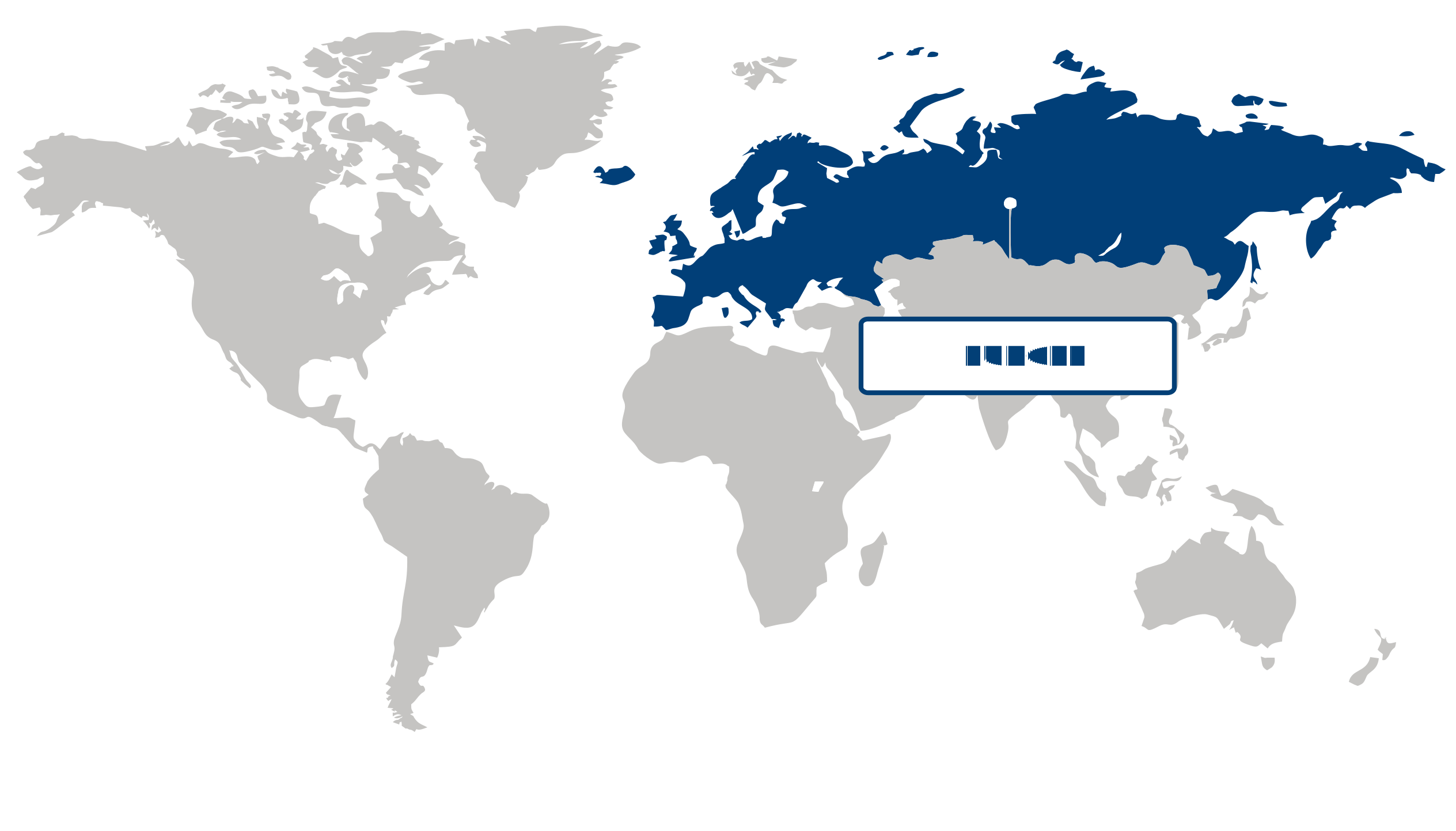
Europe (Largest Region)
Holding the largest share of the photopolymers market in 2026, Europe accounted for 55.56% share, supported by established advanced manufacturing capabilities and strong demand for high-performance materials across printing, electronics, coatings, and industrial applications. The region’s emphasis on precision manufacturing, product quality, and material innovation is encouraging wider use of photopolymer technologies. Increasing adoption of additive manufacturing and continued development of specialized light-curable materials are also strengthening the region’s position.
Asia Pacific (Fastest-Growing Region)
Asia Pacific is the fastest-growing region, driven by expanding manufacturing activity, rising adoption of digital production technologies, and growing demand for advanced polymer materials. Increasing industrialization and the development of electronics, automotive, healthcare, and consumer goods manufacturing are creating broader application opportunities for photopolymers. Greater investment in additive manufacturing and production automation is further supporting regional demand, while the shift toward higher-value manufacturing is encouraging the adoption of materials that provide greater precision and processing flexibility.
| Parameter | North America | Asia Pacific | Europe | Latin America | MEA |
|---|---|---|---|---|---|
| Innovation Hub i Scale Nascent Developing Advanced | |||||
| Cost-Sensitive Region i Scale Low Medium High | |||||
| Regulatory Environment i Scale Restrictive Neutral Supportive | |||||
| Demand Drivers i Scale Weak Moderate Strong | |||||
| Development Stage i Scale Emerging Developing Developed | |||||
| Adoption Rate i Scale Low Medium High | |||||
| New Entrants / Startups i Scale Sparse Moderate Dense | |||||
| Macro Indicators i Scale Weak Stable Strong |
Key Country Insights
Germany 🇩🇪
Industrial Production MaterialsGermany emphasizes high-performance photopolymers for industrial manufacturing, precision engineering, and advanced 3D printing applications. German material developers continue refining formulations that support production quality and demanding engineering requirements.
France 🇫🇷
Specialty Resin ApplicationsFrance is expanding photopolymer utilization across industrial printing, healthcare, and advanced manufacturing applications requiring specialized material performance. French manufacturers increasingly prioritize innovative resin formulations that align with demanding production and product quality standards.
Italy 🇮🇹
Manufacturing Process EnhancementItaly is increasing photopolymer adoption in industrial design, additive manufacturing, and precision production applications. Italian manufacturers continue integrating advanced photopolymer materials to improve production flexibility and support specialized manufacturing requirements.
Japan 🇯🇵
Precision Material DevelopmentJapan continues advancing photopolymer technologies for electronics, healthcare, and precision manufacturing applications. Japanese manufacturers focus on developing materials with improved processing accuracy, durability, and compatibility with high-value industrial production environments.
South Korea 🇰🇷
Electronics Material InnovationSouth Korea utilizes photopolymers extensively across electronics manufacturing, display technologies, and advanced additive manufacturing applications. Material suppliers in South Korea continue investing in formulations that support precision processing and evolving industrial requirements.
United States 🇺🇸
Advanced Manufacturing MaterialsU.S. demand for photopolymers is supported by expanding applications in additive manufacturing, electronics, medical devices, and advanced printing technologies. Manufacturers in the U.S. continue developing specialized formulations that improve performance across industrial production processes.
Segment Leadership and Growth Trends
Photopolymers Market Share (%), by Performance, 2026
Go beyond the chart, access full insights & data tables
Request Free Sample ReportPerformance Segment Analysis: High Performance (Largest Segment) vs Mid Performance (Fastest-Growing Segment)
The high-performance segment led the photopolymers market with a 40.86% share in 2026, supported by demand for materials capable of meeting stringent requirements for durability, precision, chemical resistance, and dimensional stability. These characteristics make high-performance photopolymers attractive for demanding applications where conventional materials may not provide the required combination of mechanical and functional properties. Continued development of advanced manufacturing processes, particularly in applications requiring highly precise polymer structures, is reinforcing demand for performance-oriented photopolymer formulations.
The mid-performance segment is expanding as manufacturers and end users seek a balance between functional performance, processing flexibility, and material cost. Its broader applicability across applications that do not require the highest material specifications is widening the addressable opportunity for these formulations. Improvements in photopolymer chemistry and processing technologies are also enabling mid-performance materials to meet increasingly diverse application requirements while supporting greater adoption of additive and light-based manufacturing processes.
Technology Segment Analysis: Stereolithography (SLA) (Largest Segment) vs Digital Light Processing (DLP) (Fastest-Growing Segment)
In the photopolymers market, stereolithography (SLA) accounted for the largest share of 59.86% in 2026, reflecting its established position in producing detailed components with smooth surfaces and high dimensional accuracy. The technology remains attractive for applications requiring intricate geometries and precise prototyping, while continued improvements in resin formulations and printing capabilities are expanding its practical use. Its established manufacturing ecosystem and ability to support increasingly sophisticated applications further reinforce the position of SLA-based photopolymer processing.
Digital light processing (DLP) is gaining traction as advances in digital projection and photopolymer curing enable efficient production of highly detailed parts. The ability to cure an entire layer through projected light can support faster processing and consistent feature reproduction, making DLP increasingly relevant for applications requiring productivity alongside precision. Expanding use in specialized manufacturing, prototyping, and customized production is supporting its growing adoption as users seek more efficient light-based fabrication technologies.
| Segment | Sub-Segment | Largest Segment | Fastest Growing |
|---|---|---|---|
| Performance | Low Performance, Mid Performance, High Performance | High Performance | Mid Performance |
| Technology | Stereolithography (SLA), Digital Light Processing (DLP), Continuous Digital Light Processing (cDLP) | Stereolithography (SLA) | Digital Light Processing (DLP) |
| Application | Dental, Medical, Audiology, Jewelry, Automotive, Prototyping, Industrial/Engineering, Electronics (including Connectors), Consumer Goods, Others | Dental | Dental |
Unlock insights tailored to your business with our bespoke market research solutions.
Click to get your customized report now.
Competitive Landscape and Market Positioning
Major players in the photopolymers market:
1. Henkel AG & Co. KGaA (Germany)
2. Arkema S.A. (France)
3. Stratasys Ltd. (Israel)
4. BASF SE (Germany)
5. Keystone Industries (USA)
6. Formlabs Inc. (USA)
7. Carbon Inc. (USA)
8. Evonik Industries AG (Germany)
9. RAHN AG (Switzerland)
10. Liqcreate (Netherlands)
The photopolymers market is experiencing notable growth in advanced material development for 3D printing, industrial prototyping, and specialty manufacturing applications. Companies are focusing on improving resin durability, curing efficiency, and application flexibility to meet evolving performance requirements across end-use industries. The introduction of high-performance formulations designed for precision manufacturing is also strengthening product differentiation in the photopolymers market.
| Company | Market Share | Company Revenue | Revenue CAGR (%) | Product Portfolio | Geographic Presence | Innovation / R&D Focus | Strategic Developments |
|---|---|---|---|---|---|---|---|
| Henkel AG & Co. KGaA (Germany) | |||||||
| Arkema S.A. (France) | |||||||
| Stratasys Ltd. (Israel) | |||||||
| BASF SE (Germany) | |||||||
| Keystone Industries (USA) | |||||||
| Formlabs Inc. (USA) | |||||||
| Carbon Inc. (USA) | |||||||
| Evonik Industries AG (Germany) | |||||||
| RAHN AG (Switzerland) | |||||||
| Liqcreate (Netherlands). |
Industry Development/News
| Company Name | Date | Key Development |
|---|---|---|
| polySpectra | Apr-25 | polySpectra and Tethon 3D jointly launched ThOR 10, a composite photopolymer resin designed for industrial 3D printing. The material combines polySpectra’s thermally stable Cyclic Olefin Resin with Tethon 3D’s ceramic fillers, creating a rugged formulation with enhanced impact strength and structural stiffness for heavy-duty industrial applications. |
| Henkel | Apr-23 | Henkel launched Loctite 3D IND249, a high-performance photopolymer resin engineered for industrial 3D printing applications. Featuring high stiffness, strong mechanical properties, and elevated temperature resistance, the material is specifically optimized for manufacturing aids and production mold tooling. |
Customize Your Report
Explore examples of how this report can be tailored to different research needs, including custom segments, additional topics or chapters, and related reports. Click a section of the wheel or its numbered marker to explore the available options.
Photopolymers Market — Custom Segments
| Segment | Sub-Segment |
|---|---|
| Resin Chemistry | Epoxy-Based Photopolymers, Acrylate-Based Photopolymers, Methacrylate-Based Photopolymers, Polyester-Based Photopolymers, Polyurethane-Based Photopolymers |
| Form Factor | Liquid Resins, Solid Resins, Photopolymer Films, Photopolymer Sheets |
| Distribution Channel | Direct Sales, Distributors & Specialty Chemical Suppliers, Online & Digital Sales Channels |
Photopolymers Market — Custom TOC
| Custom Chapter | Chapter Details |
|---|---|
| Emerging Application White Space Assessment |
|
| Sustainability Transition and Regulatory Compliance Roadmap |
|
| Intellectual Property and Patent Landscape Analysis |
|
Need a different cut of the data?
Request Custom ResearchWhat is the current revenue of the photopolymers market?
What are the growth projections for the photopolymers industry?
How is high-precision 3D printing driving demand in the photopolymers market?
Which application trends are strengthening commercial demand for photopolymer materials?
Why do High Performance photopolymers hold the largest market share?
What is fueling growth in the Digital Light Processing (DLP) segment?
Why does Europe dominate the photopolymers market?
What is fueling Asia Pacific’s growth in photopolymers?
Which companies are driving growth in the photopolymers landscape?
Our Clients
"The report helped us understand emerging consumer trends in our product category. It clarified where to focus innovation for the next product launch."
LyondellBasell
"The regional forecast section was incredibly useful. We were able to identify two new potential partners in Europe thanks to the vendor mapping you included."
SABIC
"We appreciated how actionable the recommendations were. It guided us to improve supply chain resilience."
Olin Corporation
Our Research Team & Methodology
Every Fundamental Business Insights report is built by a dedicated vertical research team, validated through a structured primary-and-secondary methodology, and reviewed for accuracy before it reaches you.
Research Team Overview
Prepared by the Chemicals & Materials Research Team
Delivery
Published
Demand
Available
Support
Trust & Compliance
Research Intelligence
| Source | Reference |
|---|---|
| American Chemistry Council (ACC) | www.americanchemistry.com |
| European Chemical Industry Council (Cefic) | cefic.org |
| International Council of Chemical Associations (ICCA) | icca-chem.org |
| European Chemicals Agency (ECHA) | echa.europa.eu |
| U.S. Environmental Protection Agency (EPA) | www.epa.gov |
| ASTM International | www.astm.org |
| International Organization for Standardization (ISO) | www.iso.org |
| National Institute of Standards and Technology (NIST) | www.nist.gov |
| Plastics Industry Association (PLASTICS) | www.plasticsindustry.org |
| European Biplastics | www.european-bioplastics.org |
| The Adhesive and Sealant Council (ASC) | www.ascouncil.org |
| National Association of Corrosion Engineers (AMPP) | www.ampp.org |
| Society of Plastics Engineers (SPE) | www.4spe.org |
| International Fertilizer Association (IFA) | www.fertilizer.org |
| CropLife International | croplife.org |
| Packaging Europe | packagingeurope.com |
| Flexible Packaging Association (FPA) | www.flexpack.org |
| Battery Council International (BCI) | batterycouncil.org |
| International Copper Association (ICA) | internationalcopper.org |
| World Steel Association | worldsteel.org |
Research Workflow & Quality Assurance
Data Collection
Verified information gathered through primary and secondary research.
Data Triangulation
Cross-validation using multiple independent data sources.
Forecast Modelling
Market estimates developed using historical trends and analytical models.
Analyst Validation
Findings reviewed by domain experts for accuracy and consistency.
Editorial & Quality Review
Final editorial, quality, and compliance checks before publication.
Final Publication
Released after successful completion of the internal review process.
Report Coverage
📊 Market Assessment
- Market Size & Forecast
- Market Segmentation
- Regional Analysis
- Growth Drivers & Challenges
- Market Dynamics
🏢 Competitive Intelligence
- Competitive Landscape
- Company Profiles
- Competitive Benchmarking
- Mergers & Acquisitions
- Market Share Analysis or Key Company Strategies
🔍 Strategic Analysis
- Value Chain Analysis
- Porter's Five Forces
- PESTLE Analysis
- Pricing Trends
- Supply-Demand Analysis
🚀 Future Outlook
- Technology Landscape
- Regulatory Landscape
- Investment & Funding Landscape
- Emerging Opportunities
- Future Market Outlook
Have a question about this report or need a custom scope?
Request Customization