Plant-based Creamer Market Size & Growth Forecast 2027–2036, By Segments (Form, Product Type, Distribution Channel, End Use, Flavor), Regional Demand Trends (North America, Asia Pacific, Europe), Key Country Insights (U.S., Japan, South Korea, Germany, France, Italy), and Competitive Landscape
Jump to Content
Market Size and Growth Outlook
Plant-based Creamer Market size was valued at USD 4.51 Billion in 2026 and is anticipated to grow at 4.64% CAGR from 2027 to 2036, attaining USD 7.1 Billion by 2036. The industry revenue for 2027 is estimated at USD 4.68 Billion.
Get more details on this report
Request Free Sample ReportPlant-based Creamer Market Intelligence Snapshot
Regional Market Dynamics
- Europe led in 2026 due to strong awareness of plant-based nutrition, established dairy-alternative demand, and preferences for sustainable, health-oriented, and clean-label products.
- Asia Pacific is projected to grow fastest as urbanization, evolving dietary preferences, expanding middle-income populations, and awareness of dairy alternatives increase adoption.
Segment Momentum
- Liquid creamers accounted for 63.07% of the market in 2026 because consumers value their convenience, smooth texture, easy blending, and dairy-like taste, supported by continuous product innovation and expanding flavor options.
- Oat-based creamers are expected to grow the fastest as consumers increasingly prefer creamy, allergen-friendly, and sustainably sourced dairy alternatives with strong compatibility for specialty coffee beverages.
Market Expansion Drivers
- Rising demand for dairy alternatives driving plant-based creamer consumption globally
- Increasing health consciousness and vegan diets boosting plant-based beverage ingredient adoption
- Expansion of retail vegan product portfolios increasing mainstream plant-based creamer availability
Leading Market Participants
- Prominent companies in the plant-based creamer market include Danone S.A. (France), Nestlé S.A. (Switzerland), General Mills Inc. (USA), Chobani LLC (USA), Oatly Group AB (Sweden), Califia Farms LLC (USA), Alpro (Danone) (Belgium), Valio Ltd. (Finland), Kerry Group plc (Ireland), FrieslandCampina (Netherlands)
Global Market Forecast Snapshot
Market Outlook
- 2026 Market Size: USD 4.51 Billion
- 2027 Estimated Market Size: USD 4.68 Billion
- Projected Market Size: USD 7.1 Billion by 2036
- Growth Forecast: 4.64% CAGR (2027-2036)
Regional and Segment Outlook
- Leading Regional Market: Europe
- High-Growth Regional Hub: Asia Pacific
- Core Revenue Segment: Liquid Creamers (Form) | Soy-based Creamers (Product Type) | Supermarkets and Hypermarkets (Distribution Channel) | Retail (End Use) | Original/Unflavored (Flavor)
- Emerging Opportunity Segment: Liquid Creamers (Form) | Oat-based Creamers (Product Type) | Online Retail (Distribution Channel) | Coffee Shops and Cafes (End Use) | Vanilla (Flavor)
Market Growth Drivers and Industry Trends
Rising demand for dairy alternatives driving plant-based creamer consumption globally
Shifting consumer preferences toward non-dairy food and beverage options are increasing the adoption of plant-derived ingredients across households and commercial applications. The plant-based creamer market growth is supported by rising demand for alternatives that provide dairy-like texture and flavor while catering to consumers seeking flexible dietary choices. Coffee culture expansion, changing consumption habits, and increased availability of plant-based formulations are encouraging manufacturers to develop diverse creamer options derived from sources such as oats, almonds, and other plant ingredients.
Increasing health consciousness and vegan diets boosting plant-based beverage ingredient adoption
Growing awareness around nutrition, ingredient transparency, and animal-free diets is influencing purchasing decisions among health-focused consumers. The plant-based creamer market is gaining momentum as vegan lifestyles and wellness-oriented preferences encourage greater use of plant-based beverage additives in home and foodservice applications. Consumers are increasingly evaluating products based on perceived health benefits, clean-label positioning, and compatibility with dietary preferences, prompting broader innovation in plant-based creamer formulations.
Expansion of retail vegan product portfolios increasing mainstream plant-based creamer availability
Retailers are expanding dedicated vegan and alternative food sections, improving consumer access to plant-based beverage products. The plant-based creamer market growth will be propelled by wider distribution networks, increased shelf visibility, and mainstream acceptance of dairy-free products across supermarkets and online channels. Retail portfolio expansion allows manufacturers to reach new customer segments beyond traditional vegan consumers, supporting greater product discovery and repeat purchasing.
| Growth Driver | Impact on CAGR | Regulatory Influence | Geographic Relevance | Adoption Rate | Impact Timeline |
|---|---|---|---|---|---|
| Rising demand for dairy alternatives driving plant-based creamer consumption globally | 1.7% | Low | North America, Europe | High | Near Term |
| Increasing health consciousness and vegan diets boosting plant-based beverage ingredient adoption | 1.6% | Low | North America, Asia Pacific | High | Near Term |
| Expansion of retail vegan product portfolios increasing mainstream plant-based creamer availability | 1.5% | Low | Europe, Asia Pacific | High | Mid Term |
Go beyond the chart, access full insights & data tables
Request Free Sample ReportRegional Demand Dynamics
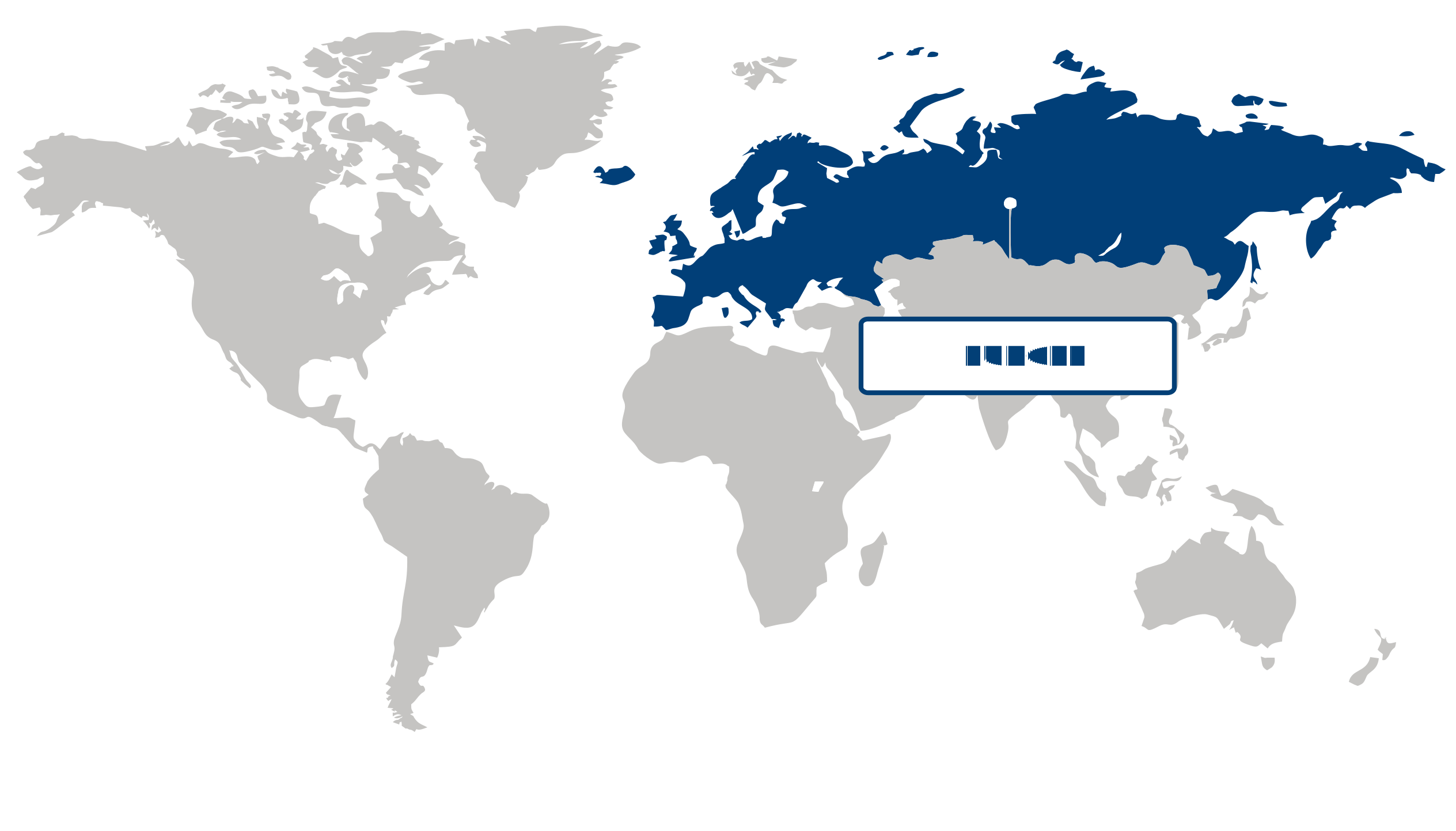
Europe (Largest Region)
Europe maintained the leading position in the plant-based creamer market in 2026, supported by strong consumer awareness of plant-based nutrition, established demand for dairy alternatives, and growing preferences for sustainable and health-oriented food products. The region's mature alternative beverage market and increasing interest in clean-label and environmentally conscious consumption are encouraging broader adoption of plant-based creamers. Expanding product availability across retail and foodservice channels is also strengthening consumer access and supporting continued market development.
Asia Pacific (Fastest-Growing Region)
Asia Pacific is expected to register the fastest growth, driven by rising urbanization, changing dietary preferences, and increasing consumer exposure to plant-based food and beverage options. Growing awareness of dairy alternatives and demand for convenient beverage ingredients are creating opportunities for plant-based creamers across household and foodservice applications. The region's expanding middle-income consumer base and evolving preferences toward healthier and more sustainable choices are further supporting the adoption of plant-based alternatives.
| Parameter | North America | Asia Pacific | Europe | Latin America | MEA |
|---|---|---|---|---|---|
| Innovation HubiScaleNascentDeveloping Advanced | |||||
| Cost-Sensitive RegioniScaleLowMedium High | |||||
| Regulatory EnvironmentiScaleRestrictiveNeutral Supportive | |||||
| Demand DriversiScaleWeakModerate Strong | |||||
| Development StageiScaleEmergingDeveloping Developed | |||||
| Adoption RateiScaleLowMedium High | |||||
| New Entrants / StartupsiScaleSparseModerate Dense | |||||
| Macro IndicatorsiScaleWeakStable Strong |
Key Country Insights
United States 🇺🇸
Retail Innovation FocusThe U.S. plant-based creamer market is shaped by expanding dairy-free product portfolios across retail and foodservice channels. Manufacturers prioritize clean-label ingredients, flavor diversification, and functional formulations that align with evolving consumer beverage preferences.
Germany 🇩🇪
Clean Label FormulationsGermany emphasizes plant-based creamers with simple ingredient lists and sustainable sourcing. Producers increasingly focus on oat- and almond-based alternatives while responding to demand for environmentally responsible packaging and premium coffee applications.
Japan 🇯🇵
Convenience Beverage IntegrationJapan integrates plant-based creamers into ready-to-drink coffee and convenience retail formats. Companies refine texture, taste, and shelf stability to meet consumer expectations for premium beverages and everyday convenience.
South Korea 🇰🇷
Café Menu ExpansionSouth Korea's vibrant café culture encourages wider adoption of plant-based creamers across specialty beverages. Local suppliers emphasize innovative flavors, barista-friendly performance, and products that appeal to younger health-conscious consumers.
France 🇫🇷
Premium Culinary ApplicationsFrance supports plant-based creamers that complement premium coffee and culinary preparations. Manufacturers focus on improving sensory quality and natural ingredient profiles to satisfy both foodservice professionals and retail consumers.
Italy 🇮🇹
Espresso Companion SolutionsItaly develops plant-based creamers tailored for espresso-based beverages without compromising texture or flavor. Suppliers invest in formulations that meet expectations of cafés and consumers seeking dairy alternatives within traditional coffee culture.
Plant-based Creamer Market Share (%), by Form, 2026
Unlock insights tailored to your business with our bespoke market research solutions.
Click to get your customized report now.
Go beyond the chart, access full insights & data tables
Request Free Sample ReportForm Segment Analysis: Liquid Creamers (Largest & Fastest-Growing Segment)
The liquid creamers segment dominated the plant-based creamer market, accounting for 63.07% of the market share in 2026, while also emerging as the fastest-growing form. Its leadership is driven by strong consumer preference for ready-to-use creamers that offer convenience, smooth texture, and easy blending with coffee, tea, and other beverages. Liquid formulations closely replicate the taste and mouthfeel of traditional dairy creamers, making them increasingly popular among consumers seeking plant-based alternatives. Continuous product innovation, expanding flavor portfolios, and growing demand for refrigerated dairy substitutes further reinforce the segment's leading position.
Product Type Segment Analysis: Soy-based Creamers (Largest Segment) vs Oat-based Creamers (Fastest-Growing Segment)
The soy-based creamers segment held 39.42% of the market share in 2026, making it the largest product category. Soy-based creamers continue to benefit from their established market presence, balanced nutritional profile, and broad acceptance across foodservice and retail channels. Their versatility in hot and cold beverages, reliable functionality, and widespread availability have contributed to sustained consumer preference and consistent demand, supporting the segment's dominant position.
Within the plant-based creamer market, the oat-based creamers segment is projected to witness the fastest growth as consumers increasingly seek creamy, allergen-friendly, and sustainably sourced dairy alternatives. Oat-based formulations are gaining popularity for their smooth consistency, neutral flavor profile, and compatibility with specialty coffee beverages. Rising interest in clean-label products and environmentally conscious consumption continues to accelerate adoption across both household and commercial applications.
Distribution Channel Segment Analysis: Supermarkets and Hypermarkets (Largest Segment) vs Online Retail (Fastest-Growing Segment)
The supermarkets and hypermarkets distribution channel accounted for the largest share of the market in 2026, supported by extensive product availability, strong brand visibility, and the convenience of one-stop shopping. Consumers continue to favor these retail outlets because they offer a wide selection of plant-based creamers, opportunities for product comparison, and immediate product access. Their established retail infrastructure and high customer traffic continue to sustain the segment's leadership.
The online retail channel is expected to grow at the fastest pace as digital commerce platforms expand their offerings of plant-based food and beverage products. The increasing popularity of home delivery services, subscription-based purchasing, and access to a broader range of specialty products is encouraging more consumers to purchase plant-based creamers online. Growing digital engagement and improved e-commerce accessibility are further strengthening the segment's growth outlook.
| Segment | Sub-Segment | Largest Segment | Fastest Growing |
|---|---|---|---|
| Form | Liquid Creamers, Powdered Creamers | Liquid Creamers | Liquid Creamers |
| Product Type | Soy-based Creamers, Almond-based Creamers, Oat-based Creamers, Coconut-based Creamers, Rice-based Creamers, Others | Soy-based Creamers | Oat-based Creamers |
| Distribution Channel | Supermarkets and Hypermarkets, Convenience Stores, Online Retail, Specialty Stores, Direct-to-consumer (DTC) | Supermarkets and Hypermarkets | Online Retail |
| End Use | Coffee Shops and Cafes, Retail, Foodservice, Bakery and Confectionery, Others | Retail | Coffee Shops and Cafes |
| Flavor | Original/Unflavored, Vanilla, Hazelnut, Chocolate, Caramel, Others | Original/Unflavored | Vanilla |
Competitive Landscape and Market Positioning
Top players in the plant-based creamer market:
- Danone S.A. (France)
- Nestlé S.A. (Switzerland)
- General Mills, Inc. (USA)
- Chobani LLC (USA)
- Oatly Group AB (Sweden)
- Califia Farms LLC (USA)
- Alpro (Danone) (Belgium)
- Valio Ltd. (Finland)
- Kerry Group plc (Ireland)
- FrieslandCampina (Netherlands)
The plant-based creamer market is evolving beyond simple dairy alternatives, with competition increasingly centered on ingredient quality, sensory performance, and formulation versatility across beverage applications. Producers are refining texture, flavor stability, and nutritional profiles to appeal to a broader consumer base while responding to growing expectations for clean-label and sustainably sourced ingredients. Competitive differentiation is also extending into product adaptability, enabling suppliers to address diverse consumption preferences through specialized formulations that balance functionality with evolving wellness trends.
| Company | Market Share | Company Revenue | Revenue CAGR (%) | Product Portfolio | Geographic Presence | Innovation / R&D Focus | Strategic Developments |
|---|---|---|---|---|---|---|---|
| Danone S.A. (France) | |||||||
| Nestlé S.A. (Switzerland) | |||||||
| General Mills Inc. (USA) | |||||||
| Chobani LLC (USA) | |||||||
| Oatly Group AB (Sweden) | |||||||
| Califia Farms LLC (USA) | |||||||
| Alpro (Danone) (Belgium) | |||||||
| Valio Ltd. (Finland) | |||||||
| Kerry Group plc (Ireland) | |||||||
| FrieslandCampina (Netherlands) |
Industry Development/News
| Company Name | Date | Key Development |
|---|---|---|
| Organic Valley | Oct-25 | Organic Valley introduced a new line of sustainable plant-based creamers, marking a strategic expansion into the dairy alternatives category. The launch leverages the company's farm diversity and sustainability initiatives to capture evolving consumer demand for dairy-free alternatives. |
| Vinamilk | Dec-24 | Vinamilk expanded its regional product footprint in Vietnam by releasing a nine-grain plant-based creamer. The launch marks a strategic entry into the regional dairy-free creamer space utilizing a unique multi-grain formulation. |
| MALK | May-24 | MALK broadened its dairy-free creamer portfolio through the strategic launch of three clean-label plant-based creamers, including Vanilla Almond, Caramel Almond, and Lightly Sweetened Oat varieties, providing new formulation options to the market. |
| Califia Farms | Mar-24 | Califia Farms expanded its market footprint by introducing new plant-based creamers in vanilla, brown sugar, and lavender flavors, diversifying its product portfolio to capture evolving flavor preferences in the dairy-free segment. |
| MPearlRock | Jan-24 | MPearlRock acquired the plant-based coffee creamer brand nutpods, directly expanding its portfolio within the emerging consumer packaged goods sector. This strategic acquisition enhances the firm's presence and positioning within the rapidly growing dairy-free creamer segment. |
| Nestlé | Mar-23 | Nestlé expanded its core Coffee-Mate portfolio through the launch of new vegan creamers formulated from a blend of almond and oat milk, strengthening its competitive positioning and scale in the dairy-free market. |
Customize Your Report
Explore examples of how this report can be tailored to different research needs, including custom segments, additional topics or chapters, and related reports. Click a section of the wheel or its numbered marker to explore the available options.
Plant-based Creamer Market — Custom Segments
| Segment | Sub-Segment |
|---|---|
| Sweetener Type | Unsweetened, Sugar-Sweetened, Naturally Sweetened, Artificially Sweetened |
| Nutritional Profile | Standard, Low-Fat, Low-Sugar, High-Protein, Fortified |
| Price Tier | Economy, Mid-Range, Premium |
Plant-based Creamer Market — Custom TOC
| Custom Chapter | Chapter Details |
|---|---|
| Foodservice Adoption Opportunity Mapping |
|
| Consumer Taste and Texture Preference Intelligence |
|
| Retailer Private-Label Opportunity Assessment |
|
Need a different cut of the data?
Request Custom ResearchFrequently Asked Questions
What is the market size of plant-based creamer?
What is the expected industry size of plant-based creamer by 2036?
How are changing dietary preferences influencing plant-based creamer demand?
Why is retail expansion important to mainstream plant-based creamer adoption?
Why do liquid creamers dominate the plant-based creamer market?
Which product type is expected to witness the fastest growth in the plant-based creamer market?
Why does Europe lead the plant-based creamer market?
How is Asia Pacific expected to drive plant-based creamer growth?
Which organizations are considered leaders in the plant-based creamer landscape?
Our Clients
"The report provided a thorough look at market trends, technological advancements, and the competitive landscape. The depth of insights was really valuable."
ITC Limited
"We would highly recommend Fundamental Business Insights & Consulting to anyone looking for reliable, detailed, and comprehensive market research in the Food industry."
Tyson Foods
"The clarity and presentation of the information were commendable. The report was delivered timely, which made the overall experience smooth and convenient."
Mondelēz International
Our Research Team & Methodology
Every Fundamental Business Insights report is built by a dedicated vertical research team, validated through a structured primary-and-secondary methodology, and reviewed for accuracy before it reaches you.
Delivery
Published
Available
Support
- Market Size & Forecast
- Market Segmentation
- Regional Analysis
- Growth Drivers & Challenges
- Market Dynamics
- Competitive Landscape
- Company Profiles
- Competitive Benchmarking
- Mergers & Acquisitions
- Market Share Analysis or Key Company Strategies
- Value Chain Analysis
- Porter's Five Forces
- PESTLE Analysis
- Pricing Trends
- Supply-Demand Analysis
- Technology Landscape
- Regulatory Landscape
- Investment & Funding Landscape
- Emerging Opportunities
- Future Market Outlook