



Polycarbonate Market Size & Growth Forecast 2027–2036, By Segments (Application), Regional Demand Trends (North America, Asia Pacific, Europe), Key Country Insights (U.S., Japan, South Korea, Germany, France, Italy), and Competitive Landscape
Market Size and Growth Outlook
Polycarbonate Market size was over USD 25.9 billion in 2026 and is likely to grow at a 4.66% CAGR between 2027 and 2036, surpassing USD 40.84 billion by 2036. The industry revenue for 2027 is assessed at USD 26.92 billion.
Base Year Value (2026)
USD 25.9 billion
CAGR (2027-2036)
4.66%
Forecast Year Value (2036)
USD 40.84 billion

Historical Data Period
2022-2026

Largest Region
Asia Pacific

Forecast Period
2027-2036
Polycarbonate Market Intelligence Snapshot:
-
Regional Market Dynamics:
- Asia Pacific captured 59.85% of the market in 2026, supported by its extensive manufacturing base, established processing capacity, dense industrial supply chains, and strong downstream demand.
- Europe is projected to expand at a 4.22% CAGR as manufacturers increasingly adopt polycarbonate for applications requiring durability, weight reduction, processing flexibility, and regulatory compliance.
-
Segment Momentum:
- Electrical & Electronics leads the market because polycarbonate is widely used in housings, connectors, and panels requiring durability, electrical insulation, dimensional stability, and design flexibility for high-volume manufacturing.
- Automotive & Transportation is expanding fastest as manufacturers increasingly adopt polycarbonate to support lightweight vehicle designs, complex components, and evolving performance and styling requirements.
-
Market Expansion Drivers:
- Increasing automotive lightweighting initiatives driving polycarbonate component adoption in electric vehicles.
- Rising demand for durable electronic housings boosting high-performance polycarbonate consumption.
- Expanding recyclable and bio-based polycarbonate innovation supporting sustainable material portfolios.
-
Leading Market Participants:
Leading companies in the polycarbonate market include Covestro AG (Germany), SABIC (Saudi Arabia), Lotte Chemical Corporation (South Korea), Teijin Limited (Japan), Mitsubishi Engineering-Plastics Corporation (Japan), Trinseo plc (United States), Idemitsu Kosan Co., Ltd. (Japan), Chi Mei Corporation (Taiwan), LG Chem Ltd. (South Korea), RTP Company (United States).
Global Market Forecast Snapshot:
-
Market Outlook:
- 2026 Market Size: USD 25.9 billion
- 2027 Estimated Market Size: USD 26.92 billion.
- Projected Market Size: USD 40.84 billion by 2036
- Growth Forecasts: 4.66% CAGR (2027-2036)
-
Regional and Segment Outlook:
- Leading Regional Market: Asia Pacific
- High-Growth Regional Hub: Europe
- Core Revenue Segment: Electrical & Electronics (Application)
- Emerging Opportunity Segment: Automotive & Transportation (Application)
Market Growth Drivers and Industry Trends
Increasing automotive lightweighting initiatives driving polycarbonate component adoption in electric vehicles
Increasing automotive lightweighting initiatives will drive the polycarbonate market growth as vehicle manufacturers seek materials that can reduce component weight while maintaining durability and design flexibility. Polycarbonate offers a combination of impact resistance, dimensional stability, and processing versatility that makes it suitable for selected automotive components, including interior parts, glazing-related applications, lighting elements, and electrical components. In electric vehicles, reducing unnecessary vehicle mass can support energy efficiency and driving performance, strengthening interest in lightweight engineering materials.
Rising demand for durable electronic housings boosting high-performance polycarbonate consumption
Rising demand for durable electronic housings is supporting the polycarbonate market as manufacturers require materials that can protect sensitive components while accommodating increasingly compact and complex device designs. Polycarbonate provides impact resistance, electrical insulation properties, and molding flexibility, allowing it to be used for housings, covers, connectors, and other protective components. Growing deployment of consumer electronics, electrical equipment, and connected devices is increasing the need for materials capable of withstanding mechanical stress and demanding operating environments.
Expanding recyclable and bio-based polycarbonate innovation supporting sustainable material portfolios
The polycarbonate market is gaining opportunities from the development of recyclable and bio-based material solutions as manufacturers seek to reduce dependence on conventional fossil-based feedstocks and improve material circularity. Advances in recycling processes can enable greater recovery and reuse of polycarbonate materials, while bio-based feedstocks provide an alternative pathway for reducing the reliance on traditional raw materials. These developments are supporting the creation of more sustainable material portfolios while retaining the performance characteristics required for demanding engineering and industrial applications.
| Growth Driver Assessment Framework | |||||
| Growth Driver | Impact On CAGR | Regulatory Influence | Geographic Relevance | Adoption Rate | Impact Timeline |
|---|---|---|---|---|---|
| Increasing automotive lightweighting initiatives driving polycarbonate component adoption in electric vehicles | 1.90% | Moderate | Asia Pacific, Europe | High | Mid Term |
| Rising demand for durable electronic housings boosting high-performance polycarbonate consumption | 1.70% | Low | Asia Pacific, North America | High | Near Term |
| Expanding recyclable and bio-based polycarbonate innovation supporting sustainable material portfolios | 1.30% | High | Europe, North America | Emerging | Long Term |
Unlock insights tailored to your business with our bespoke market research solutions - Click to get your customized report now!
Regional Demand Dynamics
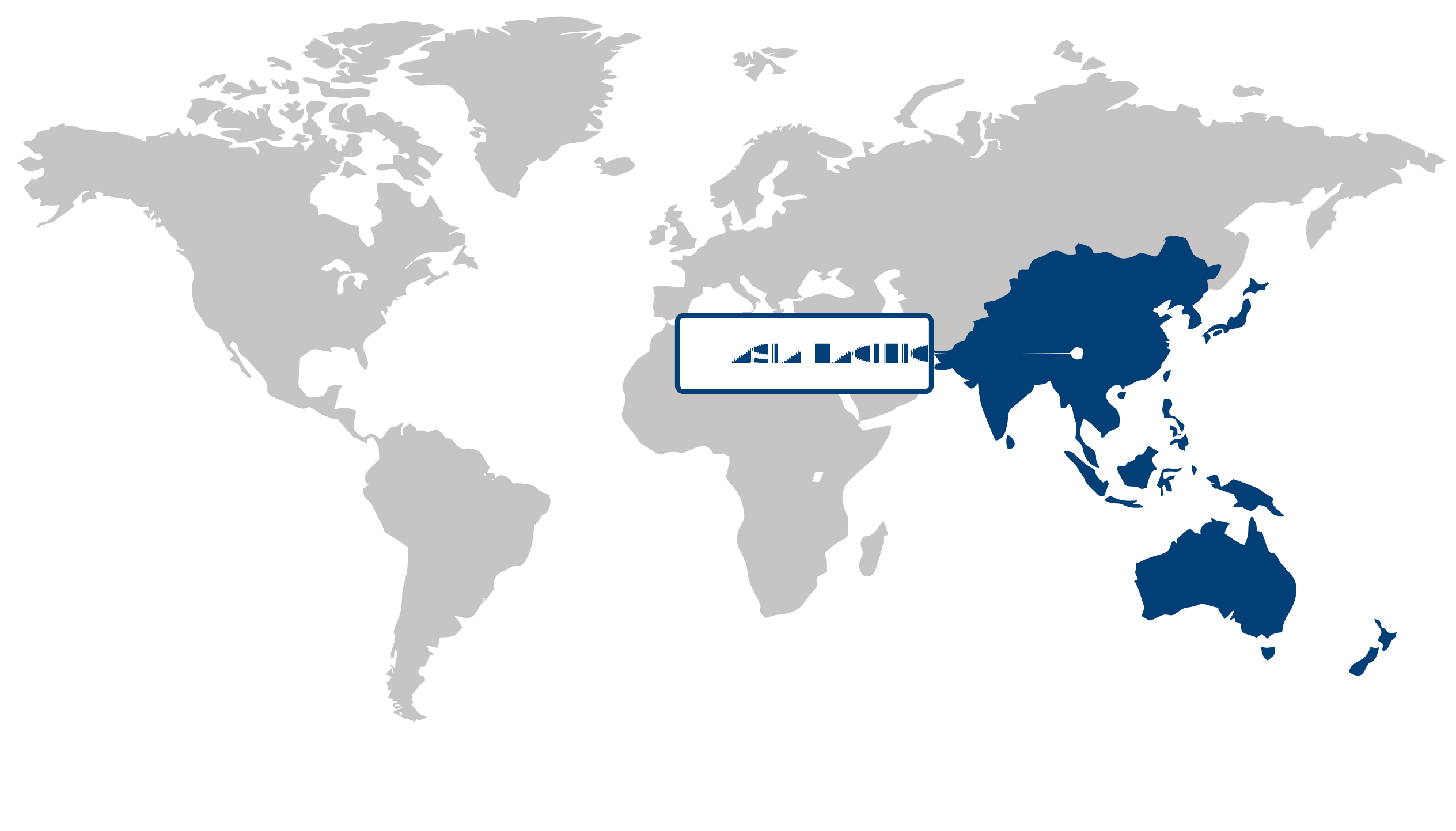
Largest Region
Asia Pacific
59.85% Market Share in 2026
Asia Pacific (Largest Region) vs Europe (Fastest-Growing Region)
Asia Pacific dominated the polycarbonate market, accounting for a 59.85% share in 2026. The region's leading position is supported by its extensive manufacturing base, strong demand from automotive and electronics industries, and expanding construction and consumer goods sectors. Polycarbonate's combination of impact resistance, lightweight characteristics, optical performance, and design flexibility makes it suitable for applications ranging from electronic components and automotive parts to glazing, safety products, and consumer products. Rapid industrialization and urban development are also supporting consumption, while the expansion of manufacturing capacity and supply chains across the region strengthens the availability and utilization of polycarbonate materials. Continued investment in electronics manufacturing, mobility, and infrastructure is expected to sustain substantial regional demand.
Europe is projected to be the fastest-growing region, supported by increasing demand for lightweight, durable, and high-performance materials across automotive, electrical, electronics, construction, and industrial applications. The region's focus on resource efficiency and vehicle weight reduction is encouraging manufacturers to consider advanced polymers as alternatives to heavier materials in selected applications. Growing emphasis on energy-efficient buildings and modernized infrastructure is also creating opportunities for polycarbonate products used in glazing and related applications. At the same time, sustainability initiatives and advances in material processing and recycling are encouraging greater attention to efficient polymer use, supporting the adoption of polycarbonate in applications where its performance characteristics provide clear functional advantages.
Key Country Insights
The U.S. polycarbonate market is driven by demand from automotive, electrical, electronics, and medical device manufacturing. Manufacturers prioritize high-performance grades that support lightweight designs, durability, and compliance with demanding industrial specifications.
Japan emphasizes premium polycarbonate materials for electronics, automotive components, and optical applications requiring exceptional dimensional stability. Manufacturers continue refining advanced resin formulations that improve product performance and production efficiency.
South Korea supports strong polycarbonate demand through electronics manufacturing, battery technologies, and consumer device production. Local processors increasingly adopt specialized resin grades that meet stringent performance and design requirements for advanced applications.
Germany relies on polycarbonate for precision engineering applications across automotive production, industrial equipment, and electrical components. Buyers emphasize material consistency, processing efficiency, and sustainable production practices to meet evolving manufacturing requirements.
France encourages broader use of polycarbonate solutions that align with circular economy initiatives and industrial sustainability objectives. Manufacturers increasingly explore recyclable materials and efficient processing methods while maintaining product quality across end-use sectors.
Italy utilizes polycarbonate across industrial manufacturing, consumer goods, and automotive supply chains where design flexibility is valued. Processors focus on versatile resin grades that enable efficient molding operations while meeting application-specific performance expectations.
Segment Leadership and Growth Trends
Application Segment Analysis: Electrical & Electronics (Largest Segment) vs Automotive & Transportation (Fastest-Growing Segment)
The electrical & electronics segment held the largest share of the polycarbonate market in 2026, reflecting the material's suitability for components that require durability, electrical insulation, dimensional stability, and impact resistance. Polycarbonate is widely valued in electronic housings, electrical components, and other applications where lightweight construction and reliable performance are important. Continued development of consumer electronics and electrical systems, alongside demand for materials that support compact and durable product designs, is reinforcing the segment's established position.
Automotive & transportation is the fastest-growing application segment, supported by the industry's ongoing emphasis on vehicle lightweighting, energy efficiency, and advanced component design. Polycarbonate can replace heavier conventional materials in selected applications while providing strong impact resistance and design flexibility. The expansion of electric and technologically advanced vehicles is also creating additional opportunities for lightweight polymer components, particularly where manufacturers seek to improve vehicle efficiency without compromising functionality and durability.
| Report Segmentation | |||
| Segment | Sub-Segment | Largest Segment | Fastest Growing Segment |
|---|---|---|---|
| Application | Automotive & Transportation, Electrical & Electronics, Construction, Packaging, Medical Devices, Others | Electrical & Electronics | Automotive & Transportation |
 Read our Research Approach
Competitive Landscape and Market Positioning
Major players in the polycarbonate market:
1. Covestro AG (Germany)
2. SABIC (Saudi Arabia)
3. Lotte Chemical Corporation (South Korea)
4. Teijin Limited (Japan)
5. Mitsubishi Engineering-Plastics Corporation (Japan)
6. Trinseo plc (United States)
7. Idemitsu Kosan Co. Ltd. (Japan)
8. Chi Mei Corporation (Taiwan)
9. LG Chem Ltd. (South Korea)
10. RTP Company (United States)
The polycarbonate market is expanding through rising demand for high-performance engineering plastics across automotive, construction, and electronics sectors. Continuous innovation in material properties is improving durability and versatility. Ongoing research in polymer chemistry is enhancing performance characteristics, while expanding industrial applications are supporting steady market growth.
Industry Development/News
| Company Name | Date | Key Development |
|---|---|---|
| ADNOC | May-25 | ADNOC secured European Commission approval for its €11.7 billion acquisition of Covestro. The transaction marks a major consolidation in the global chemicals sector, significantly expanding ADNOC's asset base and strategic exposure to advanced polycarbonate and specialty materials markets. |
| Trinseo | Nov-24 | Trinseo agreed to sell its polycarbonate technology license and its Stade, Germany, manufacturing assets to Deepak Chem Tech Limited. The strategic divestment facilitates Trinseo's restructuring while enabling Deepak to acquire production equipment and fast-track its entry into the European polycarbonate manufacturing sector. |
| Covestro | Jan-25 | Covestro initiated a major manufacturing capacity expansion for tailor-made polycarbonates at its facility in Herbon, Ohio. The capital investment introduces new production lines to satisfy escalating North American demand across the automotive, electronics, and specialty film sectors while optimizing regional lead times. |
| Deepak Chem Tech Limited | Apr-25 | Deepak Chem Tech approved a ₹3,500 crore greenfield investment project dedicated to building an integrated polycarbonate manufacturing platform. The capital deployment significantly enhances domestic production capabilities and establishes a robust footprint across the polycarbonate value chain. |
| CNOOC and Shell Petrochemicals Company (CSPC) | Jan-25 | CSPC finalized its investment decision for the Huizhou Polycarbonate Project, part of a broader 57 billion yuan petrochemical capital initiative. The project expands industrial polycarbonate production capacity and solidifies the manufacturing footprint of the Huizhou petrochemical complex. |
| Deepak Advanced Materials | Mar-25 | Deepak Advanced Materials inaugurated a polycarbonate compounding plant in Gujarat, India. The new facility provides localized, value-added processing to supply customized polycarbonate granules directly to domestic automotive, electronics, and construction markets, effectively mitigating local reliance on imported materials. |
| Deepak Chem Tech Limited | May-26 | Deepak Chem Tech Limited signed a long-term supply agreement with Praxair India, a Linde subsidiary, to construct an on-site HyCO plant in Dahej, Gujarat. The infrastructure partnership secures essential feedstock supply for Deepak's upcoming polycarbonate manufacturing facility, stabilizing its upstream supply chain. |
| Brett Martin | Aug-25 | Brett Martin partnered with Amerilux International to establish new polycarbonate roofing sheet manufacturing capacity in Wisconsin. The joint initiative expands the company's production footprint into the United States and strengthens localized supply chain capabilities for the regional construction market. |
| Mitsubishi Gas Chemical Company (MGC) | Apr-26 | Mitsubishi Gas Chemical announced plans to permanent cease polycarbonate production at its Kashima Plant by March 2028 due to ongoing profitability challenges. The operational shutdown represents a major structural consolidation and capacity reduction within the global polycarbonate supply landscape. |
| Teijin | Nov-25 | Teijin engineered a solvent-based recycling technology capable of processing waste into recycled polycarbonate resin with virgin-grade properties. This material innovation advances circular economy initiatives and commercializes new high-performance recycled polycarbonate options for automotive and electronics applications. |
Why Choose Us
Specialized Expertise: Our team comprises industry experts with a deep understanding of your market segment. We bring specialized knowledge and experience that ensures our research and consulting services are tailored to your unique needs.
Customized Solutions: We understand that every client is different. That's why we offer customized research and consulting solutions designed specifically to address your challenges and capitalize on opportunities within your industry.
Proven Results: With a track record of successful projects and satisfied clients, we have demonstrated our ability to deliver tangible results. Our case studies and testimonials speak to our effectiveness in helping clients achieve their goals.
Cutting-Edge Methodologies: We leverage the latest methodologies and technologies to gather insights and drive informed decision-making. Our innovative approach ensures that you stay ahead of the curve and gain a competitive edge in your market.
Client-Centric Approach: Your satisfaction is our top priority. We prioritize open communication, responsiveness, and transparency to ensure that we not only meet but exceed your expectations at every stage of the engagement.
Continuous Innovation: We are committed to continuous improvement and staying at the forefront of our industry. Through ongoing learning, professional development, and investment in new technologies, we ensure that our services are always evolving to meet your evolving needs.
Value for Money: Our competitive pricing and flexible engagement models ensure that you get maximum value for your investment. We are committed to delivering high-quality results that help you achieve a strong return on your investment.
Select Licence Type

