Portable Hydrogen Generator Market Size & Growth Forecast 2027–2036, By Segments (Process, Application, Capacity), Regional Demand Trends (North America, Asia Pacific, Europe), Key Country Insights (U.S., Japan, South Korea, Germany, France, Italy), and Competitive Landscape
Market Size and Growth Outlook
Portable Hydrogen Generator Market size was around USD 184.4 Million in 2026 and is slated to grow at 8.8% CAGR from 2027 to 2036, attaining USD 428.6 Million by 2036. The industry revenue for 2027 is estimated at USD 198.17 Million.
Get more details on this report
Request Free Sample ReportPortable Hydrogen Generator Market Intelligence Snapshot
Regional Market Dynamics
- Europe accounted for 33.26% in 2026, supported by clean-energy policies, hydrogen infrastructure development, renewable integration, and investment in decentralized low-emission energy solutions.
- North America is expected to grow fastest as hydrogen investment, decentralized energy projects, renewable integration, and demand for energy resilience expand adoption.
Segment Momentum
- Electrolysis is the leading and fastest-growing process because it enables clean hydrogen production without direct carbon emissions while supporting renewable energy integration, decentralized generation, and improved system portability.
- Fuel cells are the fastest-growing application as demand rises for reliable, low-emission power across transportation, backup power, and portable energy systems using on-site hydrogen generation.
Market Expansion Drivers
- Emission reduction mandates accelerating adoption of low-carbon portable hydrogen systems
- Growing emergency and backup power needs driving portable hydrogen deployment
- Advancements in compact hydrogen storage improving mobile energy system feasibility
Leading Market Participants
- Key companies in the portable hydrogen generator market include Air Liquide (France), Air Products and Chemicals, Inc. (United States), Linde plc (Ireland), Nel ASA (Norway), McPhy Energy S.A. (France), Plug Power Inc. (United States), ITM Power plc (United Kingdom), Praxair Technology, Inc. (United States), Teledyne Technologies Incorporated (United States), RIX Industries (United States)
Global Market Forecast Snapshot
Market Outlook
- 2026 Market Size: USD 184.4 Million
- 2027 Estimated Market Size: USD 198.17 Million
- Projected Market Size: USD 428.6 Million by 2036
- Growth Forecast: 8.8% CAGR (2027-2036)
Regional and Segment Outlook
- Leading Regional Market: Europe
- High-Growth Regional Hub: North America
- Core Revenue Segment: Electrolysis (Process) | Fuel Cells (Application) | <100 Nm3/h (Capacity)
- Emerging Opportunity Segment: Electrolysis (Process) | Fuel Cells (Application) | <100 Nm3/h (Capacity)
Market Growth Drivers and Industry Trends
Emission reduction mandates accelerating adoption of low-carbon portable hydrogen systems
Strengthening environmental regulations and decarbonization initiatives are encouraging industries to adopt cleaner energy technologies that reduce dependence on conventional fossil-fuel-powered equipment. This shift will drive the portable hydrogen generator market growth as organizations seek compact energy solutions capable of supporting low-emission operations across diverse applications. Portable hydrogen systems provide an attractive alternative for temporary power, field operations, and mobile equipment by enabling cleaner energy generation while helping users comply with evolving sustainability requirements. Their ability to support flexible deployment also aligns with broader efforts to reduce carbon emissions across industrial and commercial activities.
Growing emergency and backup power needs driving portable hydrogen deployment
The increasing need for dependable emergency power across disaster response, telecommunications, healthcare, and critical infrastructure is expanding interest in portable energy systems that can be rapidly deployed when conventional electricity sources become unavailable. The portable hydrogen generator market is propelled by demand for backup solutions that offer quiet operation, reduced emissions, and extended power availability compared with traditional alternatives. These systems are particularly valuable in remote locations and temporary installations where dependable electricity is essential for maintaining communications, supporting essential equipment, and ensuring operational continuity during unexpected disruptions.
Advancements in compact hydrogen storage improving mobile energy system feasibility
Ongoing innovation in hydrogen storage technologies is improving the practicality of portable power systems by enhancing energy density, transportation convenience, and operational safety. These developments will boost the portable hydrogen generator market demand as more efficient storage solutions enable mobile hydrogen systems to serve a broader range of industrial, commercial, and emergency applications. Improved system integration, lighter components, and simplified handling requirements make portable generators easier to deploy across field environments while supporting reliable energy delivery in situations where mobility and flexible installation are critical operational requirements.
| Growth Driver | Impact on CAGR | Regulatory Influence | Geographic Relevance | Adoption Rate | Impact Timeline |
|---|---|---|---|---|---|
| Emission reduction mandates accelerating adoption of low-carbon portable hydrogen systems | 2% | High | Europe, North America | Emerging | Mid Term |
| Growing emergency and backup power needs driving portable hydrogen deployment | 1.7% | Moderate | Asia Pacific, North America | Medium | Near Term |
| Advancements in compact hydrogen storage improving mobile energy system feasibility | 1.5% | Moderate | Europe, Asia Pacific | Emerging | Mid Term |
Explore Growth Opportunities
Request Free Sample ReportRegional Demand Dynamics
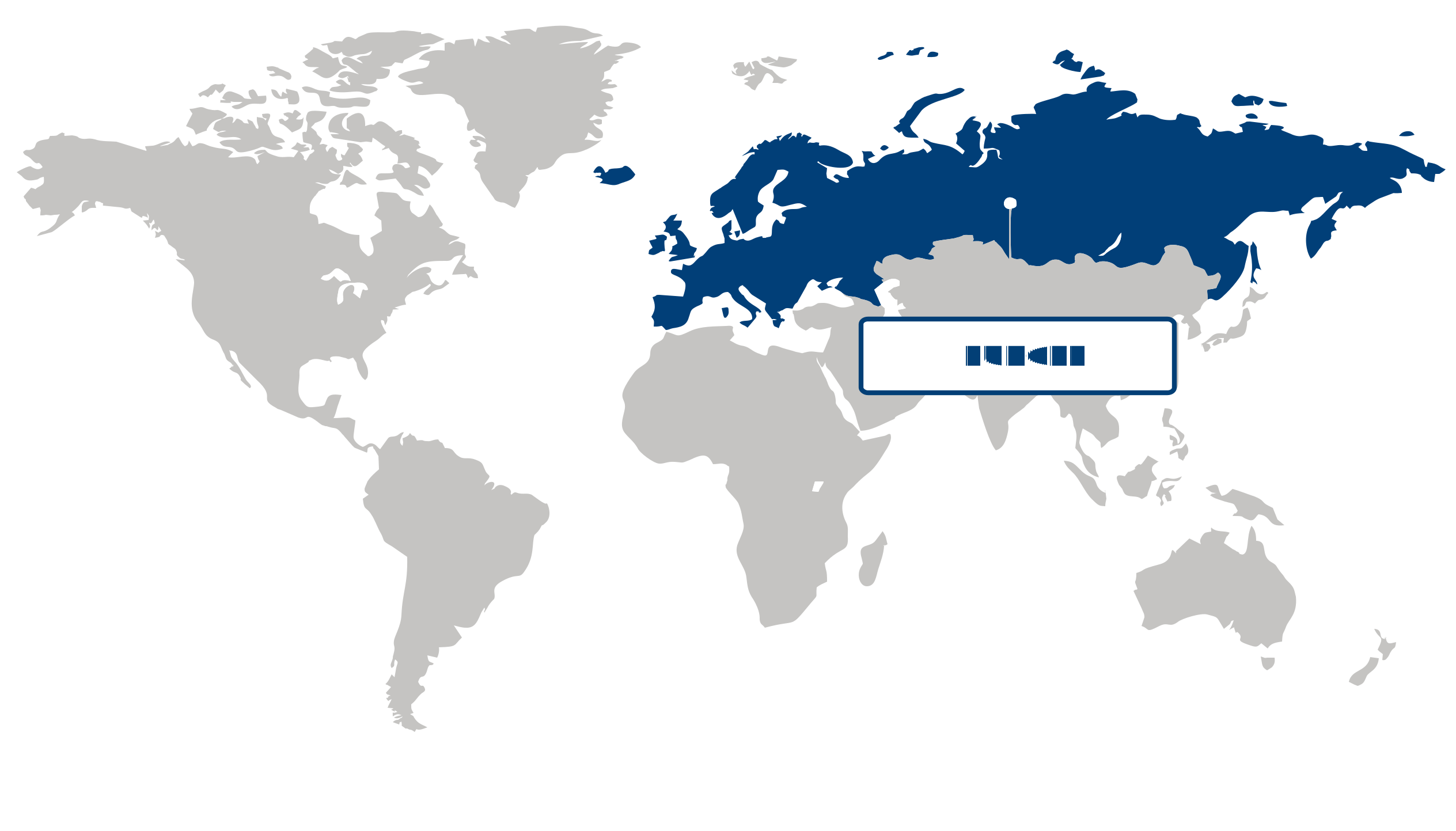
Europe (Largest Region)
Europe accounted for the largest share of the portable hydrogen generator market in 2026, representing 33.26%. The region's position is supported by strong emphasis on clean energy transition, development of hydrogen infrastructure, and growing interest in decentralized hydrogen production. Increasing efforts to reduce carbon emissions across industrial and energy applications are encouraging investment in hydrogen technologies that can provide flexible and low-emission energy solutions. Supportive policy frameworks, expanding renewable energy integration, and increasing focus on hydrogen as an energy carrier are further strengthening demand for portable generation technologies.
North America (Fastest-Growing Region)
North America is anticipated to experience the fastest growth in the portable hydrogen generator market, supported by increasing investment in hydrogen technologies and rising interest in flexible, decentralized energy generation. Growing efforts to develop low-carbon energy systems are creating opportunities for portable hydrogen generators across industrial, backup power, research, and remote applications. Expansion of hydrogen-related infrastructure and increasing integration of renewable energy with hydrogen production are also encouraging technology adoption. The region's focus on energy resilience and cleaner power solutions is expected to further support market growth.
| Parameter | North America | Asia Pacific | Europe | Latin America | MEA |
|---|---|---|---|---|---|
| Innovation Hub i Scale Nascent Developing Advanced | |||||
| Cost-Sensitive Region i Scale Low Medium High | |||||
| Regulatory Environment i Scale Restrictive Neutral Supportive | |||||
| Demand Drivers i Scale Weak Moderate Strong | |||||
| Development Stage i Scale Emerging Developing Developed | |||||
| Adoption Rate i Scale Low Medium High | |||||
| New Entrants / Startups i Scale Sparse Moderate Dense | |||||
| Macro Indicators i Scale Weak Stable Strong |
Key Country Insights
United States 🇺🇸
Mobile Clean EnergyThe U.S. is expanding interest in portable hydrogen generators for temporary power, defense, and remote industrial applications. End users value flexible deployment, lower-emission operation, and compatibility with evolving hydrogen supply infrastructure.
Germany 🇩🇪
Hydrogen Innovation DeploymentGermany supports portable hydrogen generator adoption through industrial decarbonization initiatives and field power applications. Buyers prioritize compact systems, operational safety, and integration with expanding hydrogen production and distribution networks.
Japan 🇯🇵
Distributed Hydrogen ApplicationsJapan advances portable hydrogen generators for emergency response, commercial facilities, and decentralized energy solutions. Product development emphasizes lightweight designs, fuel efficiency, and dependable operation within the country's established hydrogen ecosystem.
South Korea 🇰🇷
Fuel Cell IntegrationSouth Korea encourages portable hydrogen generator deployment alongside investments in hydrogen mobility and fuel cell technologies. Market demand favors efficient, transportable systems capable of supporting industrial, construction, and backup power requirements.
France 🇫🇷
Low-Emission Field PowerFrance is incorporating portable hydrogen generators into temporary power projects, infrastructure maintenance, and public sector applications. Procurement increasingly reflects interest in quieter operation and reduced environmental impact compared with conventional portable generators.
Italy 🇮🇹
Flexible Energy DeploymentItaly is evaluating portable hydrogen generators for construction sites, events, and remote commercial operations requiring cleaner mobile power. Buyers seek practical solutions that simplify deployment while supporting evolving sustainability objectives.
Segment Leadership and Growth Trends
Portable Hydrogen Generator Market Share (%), by Process, 2026
Go beyond the chart, access full insights & data tables
Request Free Sample ReportProcess Segment Analysis: Electrolysis (Largest & Fastest-Growing Segment)
In the portable hydrogen generator market, the electrolysis process segment held the largest position in 2026 and also emerged as the fastest-growing segment. Its leadership is driven by the increasing preference for clean hydrogen production methods that eliminate direct carbon emissions during generation. Electrolysis aligns well with the growing integration of renewable energy sources, enabling decentralized hydrogen production while supporting sustainability objectives across industrial and commercial applications. Advancements in electrolyzer efficiency, improved system portability, and declining technology costs are further strengthening the adoption of electrolysis-based portable hydrogen generators across a wide range of end-use environments.
Application Segment Analysis: Fuel Cells (Largest & Fastest-Growing Segment)
The portable hydrogen generator market was led by the fuel cells application segment in 2026, which also represented the fastest-growing application category. Rising demand for reliable and low-emission power solutions across transportation, backup power, and portable energy systems has significantly accelerated the deployment of hydrogen fuel cells. Portable hydrogen generators provide a convenient on-site hydrogen supply, reducing dependence on centralized infrastructure while improving operational flexibility. Continued innovation in fuel cell technologies, coupled with increasing emphasis on energy efficiency and clean mobility, is expected to reinforce the segment’s strong market position.
Capacity Segment Analysis: <100 Nm3/h (Largest & Fastest-Growing Segment)
Holding the leading position in the portable hydrogen generator market in 2026, the less than 100 Nm3/h capacity segment also registered as the fastest-growing category. This segment benefits from strong demand for compact and portable hydrogen generation systems designed for small-scale industrial operations, research facilities, emergency power applications, and mobile deployments. Its ease of installation, lower operational complexity, and suitability for distributed hydrogen production make it an attractive solution for users seeking flexible hydrogen supply without extensive infrastructure. Increasing adoption of localized clean energy systems is expected to sustain the momentum of this capacity segment.
| Segment | Sub-Segment | Largest Segment | Fastest Growing |
|---|---|---|---|
| Process | Steam Reformer, Electrolysis, Others | Electrolysis | Electrolysis |
| Application | Chemical Processing, Petroleum Recovery, Fuel Cells, Refinery, Others | Fuel Cells | Fuel Cells |
| Capacity | <100 Nm3/h, 100 - 2,000 Nm3/h, >2,000 Nm3/h | <100 Nm3/h | <100 Nm3/h |
Unlock insights tailored to your business with our bespoke market research solutions.
Click to get your customized report now.
Competitive Landscape and Market Positioning
Top players in the portable hydrogen generator market:
- Air Liquide (France)
- Air Products and Chemicals, Inc. (United States)
- Linde plc (Ireland)
- Nel ASA (Norway)
- McPhy Energy S.A. (France)
- Plug Power, Inc. (United States)
- ITM Power plc (United Kingdom)
- Praxair Technology, Inc. (United States)
- Teledyne Technologies Incorporated (United States)
- RIX Industries (United States)
Innovation within the portable hydrogen generator market is increasingly centered on making hydrogen production more practical for decentralized applications, prompting competitors to prioritize portability, operational simplicity, and integration flexibility. Development efforts are moving toward systems that require less infrastructure while improving safety, energy efficiency, and compatibility with diverse end-use environments. At the same time, differentiation is emerging through advances in control systems, modular configurations, and reliability under varying operating conditions, reflecting a gradual transition from technology validation toward commercially deployable solutions tailored to specialized user requirements.
| Company | Market Share | Company Revenue | Revenue CAGR (%) | Product Portfolio | Geographic Presence | Innovation / R&D Focus | Strategic Developments |
|---|---|---|---|---|---|---|---|
| Air Liquide (France) | |||||||
| Air Products and Chemicals Inc. (United States) | |||||||
| Linde plc (Ireland) | |||||||
| Nel ASA (Norway) | |||||||
| McPhy Energy S.A. (France) | |||||||
| Plug Power Inc. (United States) | |||||||
| ITM Power plc (United Kingdom) | |||||||
| Praxair Technology Inc. (United States) | |||||||
| Teledyne Technologies Incorporated (United States) | |||||||
| RIX Industries (United States) |
Industry Development/News
| Company Name | Date | Key Development |
|---|---|---|
| Air Liquide | Jul-24 | Extended its agreement with the Paris 2024 Olympic and Paralympic Games Organising Committee to supply renewable hydrogen to power five electro-hydrogen generators across competition venues in Versailles and Saint-Quentin-en-Yvelines. The deployment provided temporary clean off-grid electrical capacity to operate telecom network infrastructure during major sporting events. |
| Air Liquide | Apr-23 | Installed EODev's GEH2 electro-hydrogen power generator at its Les Loges-en-Josas R&D facility for emergency backup and off-grid electricity supply. Fueled by high-pressure hydrogen canister racks via a pressure regulation module, the automated 50 kW system delivers instant zero-emission power, demonstrating commercial viability for temporary public events and remote construction sites. |
Customize Your Report
Explore examples of how this report can be tailored to different research needs, including custom segments, additional topics or chapters, and related reports. Click a section of the wheel or its numbered marker to explore the available options.
Portable Hydrogen Generator Market — Custom Segments
| Segment | Sub-Segment |
|---|---|
| Deployment Environment | Construction & Temporary Sites, Remote & Off-Grid Sites, Industrial Facilities, Laboratories & Research Facilities, Mobile & Emergency Applications |
| Ownership Model | Owned Equipment, Rental & Leasing, Hydrogen-as-a-Service |
| Customer Type | Industrial Manufacturers, Energy & Utilities Companies, Research & Educational Institutions, Transportation & Mobility Operators, Government & Defense Organizations |
Portable Hydrogen Generator Market — Custom TOC
| Custom Chapter | Chapter Details |
|---|---|
| Portable Hydrogen Application Prioritization |
|
| Hydrogen Fuel Supply & Distribution Strategy |
|
| Portable Generator Commercialization Pathways |
|
Need a different cut of the data?
Request Custom ResearchHow big is the portable hydrogen generator market?
How is the portable hydrogen generator industry projected to perform over the next decade?
How are decarbonization mandates influencing portable hydrogen generator adoption?
What is improving the feasibility of portable hydrogen power systems?
Why does the electrolysis process dominate the portable hydrogen generator market?
Which application is growing the fastest in the portable hydrogen generator market?
Why does Europe lead the portable hydrogen generator market?
How is North America creating faster growth opportunities for portable hydrogen generators?
Who are the major participants shaping the portable hydrogen generator landscape?
Our Clients
"The information presented in the report was genuinely insightful. The data was clear and easy to understand, which made it much easier to interpret the findings."
Amara Raja Group
"The responsiveness and professionalism exhibited by the team were exemplary. They were readily available to address queries, provide clarifications, and offer additional insights."
ONGC
"The reports offered a comprehensive analysis of various segments within the market. The detailed insights into market trends, and regulatory landscapes were excellent."
TotalEnergies
Our Research Team & Methodology
Every Fundamental Business Insights report is built by a dedicated vertical research team, validated through a structured primary-and-secondary methodology, and reviewed for accuracy before it reaches you.
Research Team Overview
Prepared by the Energy & Power Research Team
Delivery
Published
Demand
Available
Support
Trust & Compliance
Research Intelligence
| Source | Reference |
|---|---|
| International Energy Agency (IEA) | www.iea.org |
| U.S. Energy Information Administration (EIA) | www.eia.gov |
| International Renewable Energy Agency (IRENA) | www.irena.org |
| International Electrotechnical Commission (IEC) | www.iec.ch |
| International Organization for Standardization (ISO) | www.iso.org |
| IEEE | www.ieee.org |
| CIGRE (International Council on Large Electric Systems) | www.cigre.org |
| World Energy Council (WEC) | www.worldenergy.org |
| U.S. Department of Energy (DOE) | www.energy.gov |
| International Atomic Energy Agency (IAEA) | www.iaea.org |
| American Petroleum Institute (API) | www.api.org |
| Society of Petroleum Engineers (SPE) | www.spe.org |
| Hydrogen Council | hydrogencouncil.com |
| Battery Council International (BCI) | batterycouncil.org |
| Global Wind Energy Council (GWEC) | gwec.net |
| SolarPower Europe | www.solarpowereurope.org |
| World Bioenergy Association (WBA) | worldbioenergy.org |
| International Hydropower Association (IHA) | www.hydropower.org |
| Edison Electric Institute (EEI) | www.eei.org |
| National Renewable Energy Laboratory (NREL) | www.nrel.gov |
Research Workflow & Quality Assurance
Data Collection
Verified information gathered through primary and secondary research.
Data Triangulation
Cross-validation using multiple independent data sources.
Forecast Modelling
Market estimates developed using historical trends and analytical models.
Analyst Validation
Findings reviewed by domain experts for accuracy and consistency.
Editorial & Quality Review
Final editorial, quality, and compliance checks before publication.
Final Publication
Released after successful completion of the internal review process.
Report Coverage
📊 Market Assessment
- Market Size & Forecast
- Market Segmentation
- Regional Analysis
- Growth Drivers & Challenges
- Market Dynamics
🏢 Competitive Intelligence
- Competitive Landscape
- Company Profiles
- Competitive Benchmarking
- Mergers & Acquisitions
- Market Share Analysis or Key Company Strategies
🔍 Strategic Analysis
- Value Chain Analysis
- Porter's Five Forces
- PESTLE Analysis
- Pricing Trends
- Supply-Demand Analysis
🚀 Future Outlook
- Technology Landscape
- Regulatory Landscape
- Investment & Funding Landscape
- Emerging Opportunities
- Future Market Outlook
Have a question about this report or need a custom scope?
Request Customization