Pots and Planters Market Size & Growth Forecast 2027–2036, By Segments (Material, Installation, Type, Category, Distribution Channel, End Use, Price), Regional Demand Trends (North America, Asia Pacific, Europe), Key Country Insights (U.S., Japan, South Korea, Germany, France, Italy), and Competitive Landscape
Market Size and Growth Outlook
Pots and Planters Market size was worth USD 18.53 Billion in 2026 and is poised to grow at 5.72% CAGR between 2027 and 2036, reaching USD 32.32 Billion by 2036. The industry revenue for 2027 is assessed at USD 19.43 Billion.
Get more details on this report
Request Free Sample ReportPots and Planters Market Intelligence Snapshot
Regional Market Dynamics
- Europe led in 2026, supported by strong gardening culture, home decoration demand, urban gardening, established retail infrastructure, and growing interest in sustainable planting solutions.
- Asia Pacific is expanding rapidly through urbanization, middle-class consumption, indoor and balcony gardening, rising incomes, and wider e-commerce access to planter products.
Segment Momentum
- Natural materials accounted for 62.43% of the market in 2026 because consumers increasingly prefer sustainable, nature-inspired products that combine organic aesthetics with broad suitability for residential and commercial spaces.
- Vertical planters are the fastest-growing type as urban gardening and space-efficient landscaping gain popularity, enabling attractive plant displays in apartments, balconies, offices, and other compact environments.
Market Expansion Drivers
- Urbanization and compact living trends driving demand for space-efficient gardening solutions
- Rising DIY gardening and landscaping activities boosting decorative planter consumption
- Increasing adoption of sustainable gardening materials supporting eco-friendly planter demand
Leading Market Participants
- Top companies in the pots and planters market include The HC Companies (United States), Keter Group (Israel), Lechuza (Germany), Elho (Netherlands), Deroma S.p.A. (Italy), Scheurich GmbH & Co. KG (Germany), Pöppelmann GmbH & Co. KG (Germany), East Jordan Plastics, Inc. (United States), Bloem Living LLC (United States), Crescent Garden (United States)
Global Market Forecast Snapshot
Market Outlook
- 2026 Market Size: USD 18.53 Billion
- 2027 Estimated Market Size: USD 19.43 Billion
- Projected Market Size: USD 32.32 Billion by 2036
- Growth Forecast: 5.72% CAGR (2027-2036)
Regional and Segment Outlook
- Leading Regional Market: Europe
- High-Growth Regional Hub: Asia Pacific
- Core Revenue Segment: Natural (Material) | Interior Space (Installation) | Floor Planters (Type) | Conventional (Category) | Offline (Distribution Channel) | Residential (End Use) | Medium (Price)
- Emerging Opportunity Segment: Natural (Material) | Interior Space (Installation) | Vertical Planters (Type) | Smart (Category) | Online (Distribution Channel) | Commercial (End Use) | High (Price)
Market Growth Drivers and Industry Trends
Urbanization and compact living trends driving demand for space-efficient gardening solutions
The increasing prevalence of urban living is creating favorable conditions for the pots and planters market as consumers seek practical gardening solutions suited to apartments, balconies, rooftops, and other limited spaces. Compact planters enable individuals to cultivate ornamental plants, herbs, and small vegetables without requiring large outdoor areas, making home gardening more accessible in densely populated environments. Manufacturers are responding with space-efficient designs that combine functionality with aesthetic appeal to complement modern residential settings.
Rising DIY gardening and landscaping activities boosting decorative planter consumption
Growing interest in home improvement and personal landscaping projects is expected to propel the pots and planters market by increasing demand for decorative and functional planting containers. Consumers are investing in customized indoor and outdoor garden spaces that reflect personal style while enhancing residential and commercial environments. This trend encourages product diversification through a wider range of materials, shapes, finishes, and designs that accommodate varying gardening preferences and landscape aesthetics.
Increasing adoption of sustainable gardening materials supporting eco-friendly planter demand
Rising environmental awareness is strengthening the pots and planters market as consumers increasingly favor gardening products manufactured from sustainable and recyclable materials. Eco-friendly planters made from renewable, recycled, or biodegradable resources align with broader sustainability goals while supporting responsible gardening practices. Manufacturers are expanding environmentally conscious product portfolios by introducing durable alternatives that reduce material waste and appeal to environmentally aware households and landscaping professionals.
| Growth Driver | Impact on CAGR | Regulatory Influence | Geographic Relevance | Adoption Rate | Impact Timeline |
|---|---|---|---|---|---|
| Urbanization and compact living trends driving demand for space-efficient gardening solutions | 2% | Low | Asia Pacific, Europe | High | Near Term |
| Rising DIY gardening and landscaping activities boosting decorative planter consumption | 1.8% | Low | North America, Europe | High | Mid Term |
| Increasing adoption of sustainable gardening materials supporting eco-friendly planter demand | 1.6% | Moderate | Europe, North America | Medium | Mid Term |
Explore Growth Opportunities
Request Free Sample ReportRegional Demand Dynamics
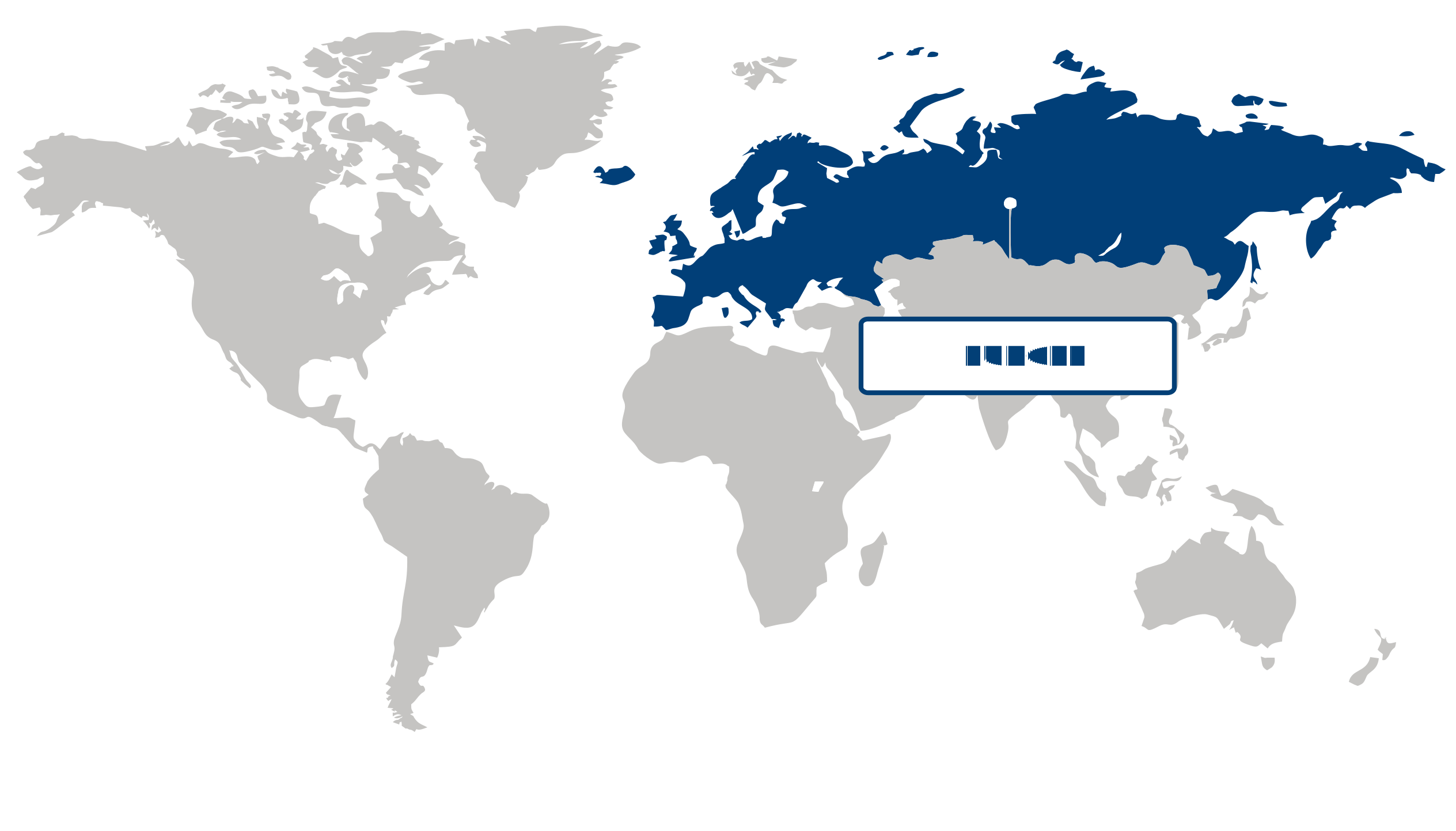
Europe (Largest Region)
Europe held the largest position in the pots and planters market in 2026, supported by strong gardening and horticulture culture, widespread interest in home decoration, and established demand for products that combine functionality with aesthetic appeal. Urban gardening and indoor plant cultivation have gained relevance as consumers seek ways to incorporate greenery into residential and commercial spaces. The region's established home improvement and gardening retail infrastructure also provides broad distribution channels for ceramic, plastic, metal, and other planter materials. In addition, growing interest in sustainable living is encouraging demand for durable, reusable, and environmentally conscious planting solutions, supporting continued product innovation across the region.
Asia Pacific (Fastest-Growing Region)
Asia Pacific is emerging as the fastest-growing regional market, driven by rapid urbanization, expanding middle-class consumption, and increasing interest in indoor and balcony gardening. Limited outdoor space in densely populated cities is encouraging consumers to use compact pots and planters for decorative and functional greenery. Rising disposable incomes and growing home improvement activity are further supporting purchases of aesthetically designed gardening products. The expansion of e-commerce and modern retail channels is also improving access to diverse planter designs and materials, while increasing awareness of plants for indoor environments is creating additional demand across residential and commercial settings.
| Parameter | North America | Asia Pacific | Europe | Latin America | MEA |
|---|---|---|---|---|---|
| Innovation Hub i Scale Nascent Developing Advanced | |||||
| Cost-Sensitive Region i Scale Low Medium High | |||||
| Regulatory Environment i Scale Restrictive Neutral Supportive | |||||
| Demand Drivers i Scale Weak Moderate Strong | |||||
| Development Stage i Scale Emerging Developing Developed | |||||
| Adoption Rate i Scale Low Medium High | |||||
| New Entrants / Startups i Scale Sparse Moderate Dense | |||||
| Macro Indicators i Scale Weak Stable Strong |
Key Country Insights
United States 🇺🇸
Outdoor Living DemandThe U.S. pots and planters market is supported by growing interest in home gardening, landscaping, and outdoor living spaces. Manufacturers in the U.S. are introducing lightweight, weather-resistant, and sustainable planter designs that appeal to residential and commercial buyers alike.
Germany 🇩🇪
Sustainable Garden SolutionsGermany emphasizes durable pots and planters made from recyclable materials and designed for long-term outdoor use. Consumers in Germany increasingly prefer products that combine environmental responsibility with functional design for residential and urban gardening applications.
Japan 🇯🇵
Space-Efficient GardeningJapan prioritizes compact pots and planters that suit balconies, indoor gardening, and limited urban living spaces. Manufacturers in Japan continue developing aesthetically refined and lightweight products that support decorative planting while maximizing space efficiency.
South Korea 🇰🇷
Urban Lifestyle AppealSouth Korea is experiencing strong interest in decorative pots and planters that complement indoor greenery and modern home interiors. Brands in South Korea are expanding innovative designs and sustainable materials to meet evolving consumer preferences for urban gardening products.
France 🇫🇷
Decorative Landscape FocusFrance values pots and planters that combine decorative appeal with practical performance for gardens, patios, and interior spaces. Manufacturers in France increasingly emphasize premium finishes, sustainable materials, and contemporary designs suited to residential landscaping.
Italy 🇮🇹
Design-Centric Outdoor DécorItaly highlights pots and planters that reflect decorative craftsmanship and complement residential as well as hospitality landscapes. Producers in Italy continue introducing premium ceramic, terracotta, and composite designs that balance visual appeal with durability for indoor and outdoor applications.
Segment Leadership and Growth Trends
Pots and Planters Market Share (%), by Material, 2026
Go beyond the chart, access full insights & data tables
Request Free Sample ReportMaterial Segment Analysis: Natural (Largest & Fastest-Growing Segment)
Natural materials held the largest share of the pots and planters market, accounting for 62.43% in 2026, and also represented the fastest-growing material segment. The strong position of natural pots and planters is supported by rising consumer interest in organic aesthetics, sustainable living, and environmentally conscious home and commercial spaces. Materials such as wood, stone, terracotta, and other naturally derived options provide distinctive textures and visual appeal that complement interior décor, gardens, balconies, and landscaped environments. Their ability to create a more organic connection with nature is particularly attractive as consumers increasingly incorporate greenery into residential and commercial spaces. The same sustainability trend is supporting continued growth in natural materials. Consumers and businesses are increasingly seeking products that align with environmentally responsible design preferences, while the growing popularity of biophilic interiors and nature-inspired landscaping is creating additional opportunities for natural planters. Their aesthetic versatility and compatibility with a broad range of plants further strengthen demand, allowing the segment to benefit from both functional gardening needs and the wider movement toward natural-looking décor.
Installation Segment Analysis: Interior Space (Largest & Fastest-Growing Segment)
Interior space applications accounted for the largest share of the pots and planters market and were also the fastest-growing installation segment in 2026. The segment is supported by the increasing integration of plants into homes, offices, hospitality venues, retail environments, and other indoor spaces. Interior planters are increasingly used not only for plant cultivation but also as decorative elements that enhance the visual appeal of living and working environments. Growing interest in indoor greenery and biophilic design is encouraging the use of planters across a wider range of interior settings. The expansion of indoor planting is also supported by the desire to improve the ambiance and perceived comfort of enclosed spaces. Consumers and businesses are increasingly incorporating plants into interiors to create more attractive, natural, and welcoming environments. The availability of planters in different sizes, designs, and materials further enables their use across diverse spaces, supporting continued adoption of interior applications.
Type Segment Analysis: Floor Planters (Largest Segment) vs Vertical Planters (Fastest-Growing Segment)
Floor planters held the largest share of the pots and planters market in 2026, supported by their broad applicability across residential, commercial, indoor, and outdoor environments. Their larger capacity and stable placement make them suitable for accommodating a wide range of plant varieties, including decorative plants and larger greenery. Floor planters are also widely used as prominent décor elements, allowing consumers and businesses to combine plant cultivation with interior and landscape design objectives. Their versatility and ease of placement continue to support strong demand across multiple end-use environments.
Vertical planters are projected to experience the fastest growth as space-efficient gardening becomes increasingly important in urban and compact environments. These systems enable users to cultivate plants while making efficient use of walls and vertical surfaces, making them attractive for apartments, balconies, offices, and other areas with limited floor space. The growing popularity of urban gardening, vertical landscaping, and space-conscious interior design is creating favorable conditions for adoption. In addition, vertical planters can contribute to visually striking green installations, supporting their growing use in both residential and commercial settings.
| Segment | Sub-Segment | Largest Segment | Fastest Growing |
|---|---|---|---|
| Material | Natural, Synthetic | Natural | Natural |
| Installation | Interior Space, Exterior Space | Interior Space | Interior Space |
| Type | Floor Planters, Hanging Planters, Wall-mounted Planters, Tabletop Planters, Vertical Planters, Others | Floor Planters | Vertical Planters |
| Category | Smart, Conventional | Conventional | Smart |
| Distribution Channel | Online, Offline | Offline | Online |
| End Use | Residential, Commercial | Residential | Commercial |
| Price | Low, Medium, High | Medium | High |
Unlock insights tailored to your business with our bespoke market research solutions.
Click to get your customized report now.
Competitive Landscape and Market Positioning
Major players in the pots and planters market:
- The HC Companies (United States)
- Keter Group (Israel)
- Lechuza (Germany)
- Elho (Netherlands)
- Deroma S.p.A. (Italy)
- Scheurich GmbH & Co. KG (Germany)
- Pöppelmann GmbH & Co. KG (Germany)
- East Jordan Plastics, Inc. (United States)
- Bloem Living LLC (United States)
- Crescent Garden (United States)
Competition is gradually shifting from conventional container manufacturing toward design-led and sustainability-oriented offerings that appeal to both residential and commercial landscaping projects. Manufacturers are investing in lightweight materials, weather-resistant construction, and aesthetically versatile collections that complement contemporary indoor and outdoor spaces while reducing transportation and handling challenges. At the same time, customization, environmentally responsible materials, and the ability to respond quickly to changing décor trends are becoming stronger differentiators, prompting suppliers to build flexible production capabilities and broader product ranges rather than relying on standardized designs alone.
| Company | Market Share | Company Revenue | Revenue CAGR (%) | Product Portfolio | Geographic Presence | Innovation / R&D Focus | Strategic Developments |
|---|---|---|---|---|---|---|---|
| The HC Companies (United States) | |||||||
| Keter Group (Israel) | |||||||
| Lechuza (Germany) | |||||||
| Elho (Netherlands) | |||||||
| Deroma S.p.A. (Italy) | |||||||
| Scheurich GmbH & Co. KG (Germany) | |||||||
| Pöppelmann GmbH & Co. KG (Germany) | |||||||
| East Jordan Plastics Inc. (United States) | |||||||
| Bloem Living LLC (United States) | |||||||
| Crescent Garden (United States) |
Industry Development/News
| Company Name | Date | Key Development |
|---|---|---|
| Lechuza | Jul-25 | Lechuza established a strategic partnership with Instadecor Ltd to expand its commercial distribution network across the UK and Ireland. The collaboration strengthens Lechuza's logistical presence and market access within competitive European retail channels. |
| Crescent Garden | Jun-25 | Crescent Garden commercialized the Mod Large Self-Watering TruDrop Trough Planter, targeting the commercial landscaping segment. The modular design integrates a high-efficiency self-watering system to reduce maintenance cycles and optimize commercial space planning. |
| Ugaoo | Feb-25 | Ugaoo secured ₹47 crore in a Series A funding round led by V3 Ventures. The capital injection is designated to scale manufacturing operations to 500,000 plants per month and expand its cultivation footprint to 100 acres over two years. |
| Sereno | Feb-25 | Sereno scaled its circular manufacturing operations by upcycling post-consumer plastic waste into specialized, recyclable planters and architectural furniture, directly targeting the growing enterprise demand for sustainable building and design materials. |
| HC Companies | May-24 | HC Companies acquired Classic Home & Garden to consolidate its decorative garden product portfolio. This strategic acquisition expands product diversity and establishes a comprehensive, one-stop supply solution for commercial growers and retail distributors. |
Customize Your Report
Explore examples of how this report can be tailored to different research needs, including custom segments, additional topics or chapters, and related reports. Click a section of the wheel or its numbered marker to explore the available options.
Pots and Planters Market — Custom Segments
| Segment | Sub-Segment |
|---|---|
| Design Style | Traditional, Contemporary, Minimalist, Decorative & Ornamental, Rustic & Natural |
| Plant Category Served | Indoor Foliage Plants, Flowering Plants, Succulents & Cacti, Herbs & Edible Plants, Trees & Shrubs |
| Sustainability Profile | Recycled-Content, Recyclable, Biodegradable & Compostable, Sustainably Sourced, Conventional |
Pots and Planters Market — Custom TOC
| Custom Chapter | Chapter Details |
|---|---|
| Commercial Landscaping Demand & Product Opportunity |
|
| Material & Design Preference Shifts |
|
| Sustainability-Led Product Innovation |
|
Need a different cut of the data?
Request Custom ResearchWhat is the current size of the pots and planters market?
How much is the pots and planters industry expected to grow by 2036?
How are urban living trends reshaping demand for pots and planters?
How are sustainability preferences influencing product development in the pots and planters market?
Why do natural materials dominate the pots and planters market?
Which type of planter is expected to grow the fastest?
What makes Europe the largest market for pots and planters?
Why is Asia Pacific the fastest-growing region for pots and planters?
Who are the leading players in the pots and planters landscape?
Our Clients
"The report provided us with a clear direction, and the level of detail was beyond what we expected. I would definitely recommend their services to others."
Haier Appliances
"The collaboration with Fundamental Business Insights has added significant value to our decision-making process, and we look forward to continuing this partnership for our future market research requirements."
Luxottica Group S.p.A.
"The team at FBI delivered an exceptional research report. The insights on industry innovations were particularly impressive and added a lot of value to the overall report."
Nike
Our Research Team & Methodology
Every Fundamental Business Insights report is built by a dedicated vertical research team, validated through a structured primary-and-secondary methodology, and reviewed for accuracy before it reaches you.
Research Team Overview
Prepared by the Consumer Goods & Services Research Team
Delivery
Published
Demand
Available
Support
Trust & Compliance
Research Intelligence
| Source | Reference |
|---|---|
| International Organization for Standardization (ISO) | www.iso.org |
| ASTM International | www.astm.org |
| U.S. Consumer Product Safety Commission (CPSC) | www.cpsc.gov |
| European Commission – Consumer Safety | ec.europa.eu/safety-gate |
| Consumer Technology Association (CTA) | www.cta.tech |
| National Retail Federation (NRF) | nrf.com |
| World Retail Congress | www.worldretailcongress.com |
| World Travel & Tourism Council (WTTC) | wttc.org |
| UN Tourism | www.unwto.org |
| Personal Care Products Council (PCPC) | www.personalcarecouncil.org |
| Cosmetics Europe | cosmeticseurope.eu |
| International Housewares Association (IHA) | www.housewares.org |
| American Apparel & Footwear Association (AAFA) | www.aafaglobal.org |
| World Federation of the Sporting Goods Industry (WFSGI) | wfsgi.org |
| Juvenile Products Manufacturers Association (JPMA) | www.jpma.org |
| Pet Industry Joint Advisory Council (PIJAC) | pijac.org |
| International Council of Toy Industries (ICTI) | www.toy-icti.org |
| International Association of Amusement Parks and Attractions (IAAPA) | iaapa.org |
| Organisation for Economic Co-operation and Development (OECD) | www.oecd.org |
| World Bank Data | data.worldbank.org |
Research Workflow & Quality Assurance
Data Collection
Verified information gathered through primary and secondary research.
Data Triangulation
Cross-validation using multiple independent data sources.
Forecast Modelling
Market estimates developed using historical trends and analytical models.
Analyst Validation
Findings reviewed by domain experts for accuracy and consistency.
Editorial & Quality Review
Final editorial, quality, and compliance checks before publication.
Final Publication
Released after successful completion of the internal review process.
Report Coverage
📊 Market Assessment
- Market Size & Forecast
- Market Segmentation
- Regional Analysis
- Growth Drivers & Challenges
- Market Dynamics
🏢 Competitive Intelligence
- Competitive Landscape
- Company Profiles
- Competitive Benchmarking
- Mergers & Acquisitions
- Market Share Analysis or Key Company Strategies
🔍 Strategic Analysis
- Value Chain Analysis
- Porter's Five Forces
- PESTLE Analysis
- Pricing Trends
- Supply-Demand Analysis
🚀 Future Outlook
- Technology Landscape
- Regulatory Landscape
- Investment & Funding Landscape
- Emerging Opportunities
- Future Market Outlook
Have a question about this report or need a custom scope?
Request Customization