



Recyclable Packaging Market Size & Growth Forecast 2027–2036, By Segments (Material, Product, Application), Regional Demand Trends (North America, Asia Pacific, Europe), Key Country Insights (U.S., Japan, South Korea, Germany, France, Italy), and Competitive Landscape
Market Size and Growth Outlook
Recyclable Packaging Market size was assessed at USD 229.93 billion in 2026 and is poised to grow at a 5.89% CAGR between 2027 and 2036, exceeding USD 407.52 billion by 2036. The industry revenue for 2027 is calculated at USD 241.33 billion.
Base Year Value (2026)
USD 229.93 billion
CAGR (2027-2036)
5.89%
Forecast Year Value (2036)
USD 407.52 billion

Historical Data Period
2022-2026

Largest Region
Europe

Forecast Period
2027-2036
Recyclable Packaging Market Intelligence Snapshot:
-
Regional Market Dynamics:
- Europe leads with 37.10% share due to a mature packaging value chain, strong collection and sorting systems, and integration of recycled-content requirements into packaging decisions.
- Growth is driven by rising packaging consumption, increased shift toward recyclable materials, expanding industrial demand, and gradual modernization of recycling infrastructure across the region.
-
Segment Momentum:
- Plastics accounted for 41.34% of the market in 2026, supported by widespread use across food, beverage, personal care, and household packaging, along with compatibility with established recycling and collection systems.
- Bags & Pouches are the fastest-growing product segment because they reduce material use, improve transport efficiency, and increasingly benefit from designs that better align with recycling system requirements.
-
Market Expansion Drivers:
- Rising environmental sustainability awareness driving demand for eco-friendly and recyclable packaging materials.
- Stringent government regulations promoting plastic reduction and mandatory recyclable packaging adoption.
- Increasing brand-driven ESG commitments accelerating transition toward circular packaging supply chains.
-
Leading Market Participants:
Key companies in the recyclable packaging market include Amcor plc (Australia), Sealed Air Corporation (United States), Tetra Pak International S.A. (Switzerland), Huhtamäki Oyj (Finland), Mondi plc (United Kingdom), DS Smith plc (United Kingdom), ProAmpac LLC (United States), WestRock Company (United States), Ball Corporation (United States), Ardagh Group S.A. (Luxembourg).
Global Market Forecast Snapshot:
-
Market Outlook:
- 2026 Market Size: USD 229.93 billion
- 2027 Estimated Market Size: USD 241.33 billion.
- Projected Market Size: USD 407.52 billion by 2036
- Growth Forecasts: 5.89% CAGR (2027-2036)
-
Regional and Segment Outlook:
- Leading Regional Market: Europe
- High-Growth Regional Hub: Asia Pacific
- Core Revenue Segment: Plastics (Material) | Bottles & Jars (Product) | Food & Beverages (Application)
- Emerging Opportunity Segment: Paper & Paperboard (Material) | Bags & Pouches (Product) | Healthcare & Pharmaceuticals (Application)
Market Growth Drivers and Industry Trends
Rising environmental sustainability awareness driving demand for eco-friendly and recyclable packaging materials
Growing awareness of packaging waste and its environmental consequences is influencing consumers and businesses to favor materials that can be recovered and recycled. The recyclable packaging market will benefit as manufacturers and packaging buyers increasingly consider environmental performance when selecting materials for food, beverages, personal care, household products, and other applications. This shift is also encouraging packaging developers to improve material compatibility with existing recycling systems while reducing reliance on formats that create greater waste-management challenges.
Stringent government regulations promoting plastic reduction and mandatory recyclable packaging adoption
Government measures aimed at reducing plastic waste and improving packaging recyclability are encouraging businesses to redesign packaging formats and materials. For the recyclable packaging market, regulatory requirements can accelerate the transition away from difficult-to-recycle packaging by creating stronger demand for materials that meet established environmental and waste-management standards. Compliance considerations are increasingly becoming part of packaging procurement and product-development decisions, prompting manufacturers to incorporate recyclable solutions into packaging strategies across multiple end-use sectors.
Increasing brand-driven ESG commitments accelerating transition toward circular packaging supply chains
Corporate sustainability strategies are encouraging brands to strengthen the environmental performance of their packaging and establish more circular material flows. The recyclable packaging market will see increased demand as companies seek packaging solutions that support resource recovery, reduce material waste, and align with broader environmental, social, and governance objectives. These commitments are also encouraging closer collaboration among packaging producers, material suppliers, recyclers, and product manufacturers to improve the collection, reuse, and recycling potential of packaging materials across supply chains.
| Growth Driver Assessment Framework | |||||
| Growth Driver | Impact On CAGR | Regulatory Influence | Geographic Relevance | Adoption Rate | Impact Timeline |
|---|---|---|---|---|---|
| Rising environmental sustainability awareness driving demand for eco-friendly and recyclable packaging materials | 2.10% | High | Europe, North America | High | Near Term |
| Stringent government regulations promoting plastic reduction and mandatory recyclable packaging adoption | 2.00% | High | Europe, Asia Pacific | High | Near Term |
| Increasing brand-driven ESG commitments accelerating transition toward circular packaging supply chains | 1.70% | Moderate | North America, Europe | High | Mid Term |
Unlock insights tailored to your business with our bespoke market research solutions - Click to get your customized report now!
Regional Demand Dynamics
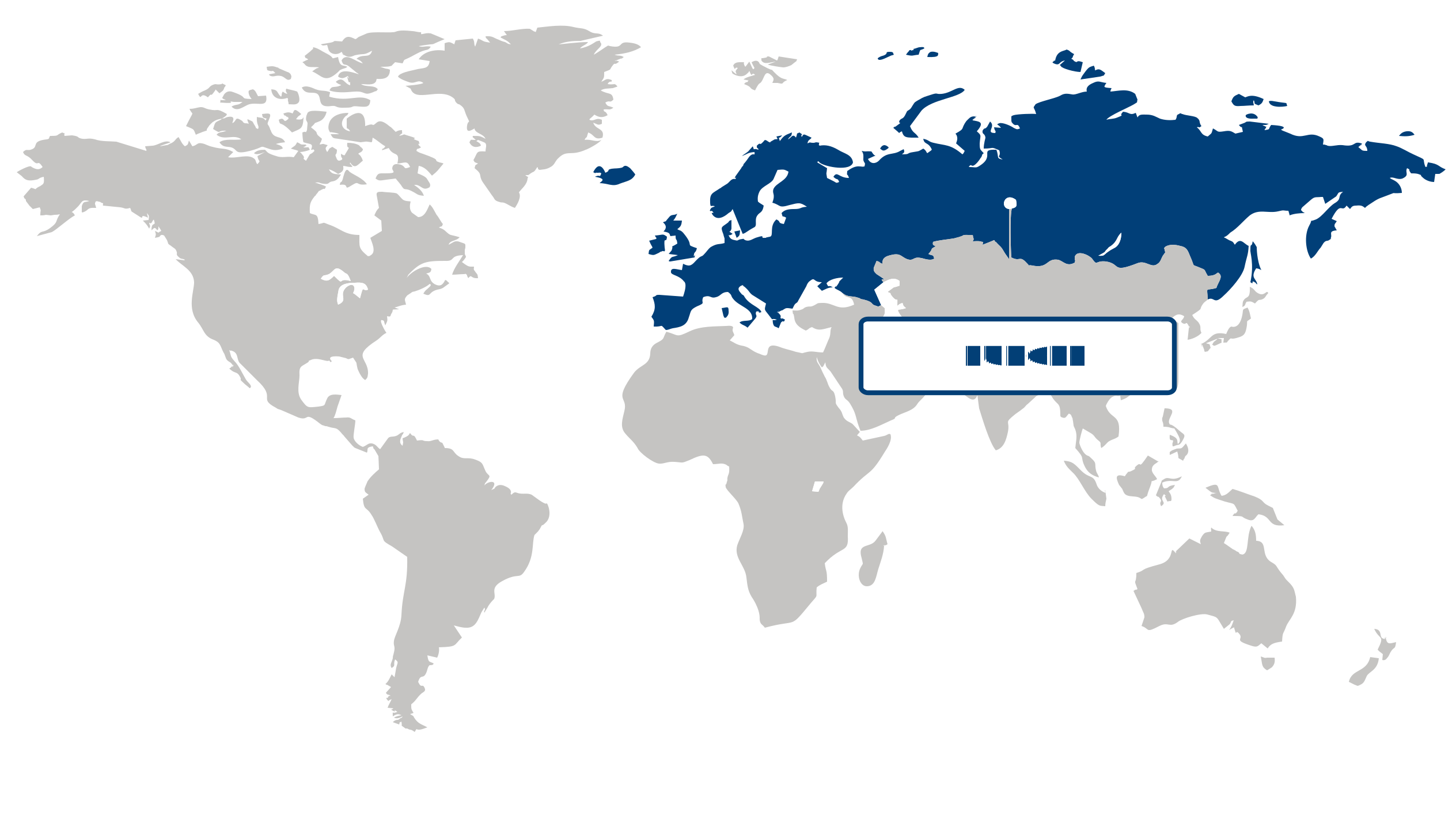
Largest Region
Europe
37.1% Market Share in 2026
Europe (Largest Region) vs Asia Pacific (Fastest-Growing Region)
Europe held the largest share of the recyclable packaging market at 37.10% in 2026, reflecting strong environmental awareness, established waste-management infrastructure, and sustained emphasis on reducing packaging waste. Regulatory pressure to improve packaging sustainability is encouraging manufacturers and retailers to increase the use of recyclable materials and redesign packaging for improved recovery and reuse. Growing consumer preference for environmentally responsible products is further influencing packaging decisions across food and beverage, personal care, healthcare, and other sectors. The region’s mature recycling ecosystem and focus on circular economy principles are supporting the transition away from difficult-to-recover packaging formats. Continued investment in sustainable materials, collection systems, and packaging innovation is strengthening Europe’s position in the market.
Asia Pacific represents the fastest-growing region in the recyclable packaging market, supported by rapid urbanization, expanding consumer markets, and increasing concern over packaging waste and environmental sustainability. Growing consumption of packaged goods is creating greater demand for packaging solutions that can align with evolving environmental expectations and waste-management priorities. Governments and industries across the region are increasingly encouraging resource efficiency, improved recycling practices, and the adoption of more sustainable packaging formats. At the same time, expanding manufacturing capabilities and rising investment in modern packaging technologies are helping producers transition toward recyclable materials. Increasing awareness among consumers and businesses is expected to further accelerate the adoption of recyclable packaging across the region.
Key Country Insights
The U.S. recyclable packaging market is expanding as consumer brands redesign packaging to improve material recovery and meet sustainability commitments. Manufacturers are investing in recyclable material innovations and packaging formats compatible with existing recycling infrastructure across the U.S.
Japan is advancing recyclable packaging through lightweight designs and material simplification that improve recycling efficiency. Companies in Japan are balancing product protection, consumer convenience, and environmental performance in packaging development strategies.
South Korea is strengthening recyclable packaging through the development of advanced recyclable polymers and sustainable packaging technologies. Packaging manufacturers are collaborating with consumer goods companies to improve recyclability while maintaining product performance.
Germany prioritizes recyclable packaging solutions designed for efficient collection, sorting, and material reuse. Packaging producers are refining mono-material designs and improving recyclability to align with established circular economy practices.
France is encouraging recyclable packaging solutions that reduce material complexity and support circular packaging objectives. Businesses in France increasingly prioritize packaging designs that improve recovery rates while maintaining brand presentation and functionality.
Italy is enhancing recyclable packaging through material innovation in flexible and consumer packaging applications. Italian manufacturers are focusing on recyclable structures, production efficiency, and packaging solutions that support evolving sustainability requirements across multiple industries.
Segment Leadership and Growth Trends
Material Segment Analysis: Plastics (Largest Segment) vs Paper & Paperboard (Fastest-Growing Segment)
Plastics segment accounted for the largest share of the recyclable packaging market in 2026, with a 41.34% share. Its leading position reflects the extensive use of plastic packaging across food, beverage, household, personal care, and industrial applications, where lightweight construction, durability, moisture resistance, and design flexibility are important. The development of recyclable plastic formats is allowing packaging producers to retain many functional advantages of plastics while responding to increasing demand for improved end-of-life management. Greater emphasis on circular packaging systems and the recovery and reuse of plastic materials is supporting continued investment in recyclable plastic solutions.
Paper & paperboard is expected to be the fastest-growing material segment as packaging producers and consumers increasingly favor fiber-based formats with strong recyclability characteristics. Paper and paperboard can provide a renewable and widely recyclable alternative for applications where lightweight construction and printability are valued. Growing efforts to reduce dependence on difficult-to-recycle packaging structures, together with increasing interest in fiber-based packaging designs, are encouraging substitution and innovation across consumer and commercial packaging applications.
Product Segment Analysis: Bottles & Jars (Largest Segment) vs Bags & Pouches (Fastest-Growing Segment)
Bottles & jars segment held the largest share of the recyclable packaging market in 2026, accounting for a 32.86% share. Their widespread use across beverages, food, personal care, household products, and other packaged goods provides a broad demand base for recyclable packaging formats. Bottles and jars also offer practical advantages in product protection, storage, handling, and consumer usability, while established collection and recycling systems support the continued use of recyclable versions. Increasing focus on packaging circularity is encouraging producers to improve material compatibility with recycling streams while maintaining functional performance.
Bags & pouches are projected to be the fastest-growing product segment as brands and packaging manufacturers increasingly seek lightweight formats that can reduce material use while maintaining convenience and product protection. Flexible structures are particularly attractive for applications requiring efficient storage, transport, dispensing, and resealing. Innovation in recyclable flexible packaging is also expanding the range of products that can be packaged in bags and pouches, while consumer demand for convenient and resource-efficient formats is creating additional opportunities for recyclable solutions.
| Report Segmentation | |||
| Segment | Sub-Segment | Largest Segment | Fastest Growing Segment |
|---|---|---|---|
| Material | Plastics, Paper & Paperboard, Glass, Metal, Others | Plastics | Paper & Paperboard |
| Product | Bottles & Jars, Bags & Pouches, Boxes & Cartons, Trays & Containers, Drums & Cans, Others | Bottles & Jars | Bags & Pouches |
| Application | Food & Beverages, Healthcare & Pharmaceuticals, Personal Care & Cosmetics, Industrial & Chemical, Consumer Goods, Others | Food & Beverages | Healthcare & Pharmaceuticals |
 Read our Research Approach
Competitive Landscape and Market Positioning
Key companies in the recyclable packaging market:
1. Amcor plc (Australia)
2. Sealed Air Corporation (United States)
3. Tetra Pak International S.A. (Switzerland)
4. Huhtamäki Oyj (Finland)
5. Mondi plc (United Kingdom)
6. DS Smith plc (United Kingdom)
7. ProAmpac LLC (United States)
8. WestRock Company (United States)
9. Ball Corporation (United States)
10. Ardagh Group S.A. (Luxembourg)
Sustainability-focused product development continues to reshape the recyclable packaging market. Industry stakeholders are introducing lightweight, reusable, and recyclable material solutions designed to reduce environmental impact while maintaining packaging functionality and durability. Expanding regulatory support for circular economy practices and growing consumer preference for eco-conscious packaging are also intensifying innovation and market competition.
Industry Development/News
| Company Name | Date | Key Development |
|---|---|---|
| Nestlé | Mar-25 | Nestlé invested €15 million in its Girona facility in Spain to transition Nescafé soluble coffee and Dolce Gusto capsules to recyclable packaging formats. This capital expenditure supports the industrial-scale conversion of key beverage production lines to more circular and environmentally compliant solutions, marking a significant step in the company's long-term strategy for sustainable packaging. |
| Amcor | Mar-26 | Amcor is expanding production capacity at its Lugo di Vicenza facility in Italy through the addition of a new production line, laboratory, and warehouse. This upgrade enables increased output of high-barrier, recycle-ready films, such as AmLite HeatFlex, for food and healthcare applications, strengthening the company’s position in circular, high-heat retort packaging markets. |
| AeroFlexx | May-26 | AeroFlexx partnered with Packaging Imolese to expand its footprint in Italy, focusing on sustainable, private-label packaging for household and personal care applications. This collaboration addresses growing European demand for eco-friendly, flexible packaging solutions, allowing AeroFlexx to scale its commercial presence and operations within the fast-moving consumer goods sector. |
| Nfinite | Nov-25 | Nfinite secured funding via the NRC IRAP program to scale high-barrier, paper-based packaging production in Ontario, Canada. The investment supports the development of a pilot facility and an industrial-scale plant capable of producing millions of square meters annually. This initiative reinforces the shift toward fiber-based alternatives in the recyclable packaging market, enhancing regional supply chain capabilities. |
| FlexPak | Jan-26 | FlexPak introduced PrimeTear technology, designed specifically for mono-material polyethylene structures to address common performance hurdles in recyclable films. By achieving consistent tear functionality, the innovation enables broader industry adoption of recycle-ready flexible packaging, facilitating the technical transition toward mono-material systems across food and consumer goods manufacturing. |
| Mars | Sep-25 | Mars introduced recyclable WHISKAS pet food pouches, designed for compatibility with existing recycling infrastructure. This redesign achieves a 46% reduction in carbon footprint, representing a material shift toward circular, flexible packaging in the pet food segment. The rollout highlights the integration of sustainability improvements into large-scale, mass-market consumer product supply chains. |
| Smurfit Kappa | Dec-23 | Smurfit Kappa developed a recyclable Lx polyethylene film designed to replace nylon in bag-in-box applications. The film offers comparable strength and barrier properties, providing a sustainable alternative for sectors including wine, juice, and dairy. This development reflects a strategic focus on material innovation to enhance the circularity of liquid packaging solutions without compromising product safety or quality. |
| Berry Global Inc. | Oct-23 | Berry Global launched 20 and 25-liter containers containing 35% recycled content, achieving UN approval for the transport of hazardous goods. The containers provide a high-performance, lightweight, and stackable solution that allows industrial customers to meet sustainability targets while maintaining regulatory compliance for sensitive, high-risk product logistics. |
Why Choose Us
Specialized Expertise: Our team comprises industry experts with a deep understanding of your market segment. We bring specialized knowledge and experience that ensures our research and consulting services are tailored to your unique needs.
Customized Solutions: We understand that every client is different. That's why we offer customized research and consulting solutions designed specifically to address your challenges and capitalize on opportunities within your industry.
Proven Results: With a track record of successful projects and satisfied clients, we have demonstrated our ability to deliver tangible results. Our case studies and testimonials speak to our effectiveness in helping clients achieve their goals.
Cutting-Edge Methodologies: We leverage the latest methodologies and technologies to gather insights and drive informed decision-making. Our innovative approach ensures that you stay ahead of the curve and gain a competitive edge in your market.
Client-Centric Approach: Your satisfaction is our top priority. We prioritize open communication, responsiveness, and transparency to ensure that we not only meet but exceed your expectations at every stage of the engagement.
Continuous Innovation: We are committed to continuous improvement and staying at the forefront of our industry. Through ongoing learning, professional development, and investment in new technologies, we ensure that our services are always evolving to meet your evolving needs.
Value for Money: Our competitive pricing and flexible engagement models ensure that you get maximum value for your investment. We are committed to delivering high-quality results that help you achieve a strong return on your investment.
Select Licence Type

