Recycled Plastic Packaging Market Size & Growth Forecast 2027–2036, By Segments (Plastic Type, Recycling Process, End Use Industry, Source), Regional Demand Trends (North America, Asia Pacific, Europe), Key Country Insights (U.S., Japan, South Korea, Germany, France, Italy), and Competitive Landscape
Jump to content
Market Size and Growth Outlook
Recycled Plastic Packaging Market size was assessed at USD 38.49 Billion in 2026 and is poised to grow at 11.44% CAGR between 2027 and 2036, attaining USD 113.7 Billion by 2036. The industry revenue for 2027 is calculated at USD 42.3 Billion.
Get more details on this report
Request Free Sample ReportRecycled Plastic Packaging Market Intelligence Snapshot
Regional Market Dynamics
- Europe accounted for 38.02% in 2026, supported by circular economy priorities, regulatory attention to plastic waste, established recycling infrastructure, and sustainable packaging demand.
- Asia Pacific is poised for fastest growth as packaging demand expands, recycling capabilities improve, and businesses increasingly integrate sustainability into packaging strategies.
Segment Momentum
- PET accounted for 38.77% of the market share in 2026 and was also the fastest-growing plastic type because of its recyclability, lightweight strength, and broad suitability for beverage, food, and consumer goods packaging.
- Chemical recycling is the fastest-growing process as it can handle complex and contaminated plastic waste while supporting demand for higher-quality recycled materials through continued technological advancements and investment.
Market Expansion Drivers
- Regulatory EPR mandates accelerating adoption of recycled plastic packaging across industries
- Corporate ESG commitments driving large-scale transition toward circular packaging materials
- Improved recycling and sorting infrastructure increasing availability of high-quality post-consumer resin
Leading Market Participants
- Leading players in the recycled plastic packaging market include Berry Global Inc. (United States), Sealed Air Corporation (United States), Smurfit Kappa Group plc (Ireland), Mondi Group (United Kingdom), DS Smith Plc (United Kingdom), Amcor plc (Australia), Huhtamaki Oyj (Finland), Novolex Holdings, Inc. (United States), Pactiv Evergreen Inc. (United States), Plastipak Holdings, Inc. (United States)
Global Market Forecast Snapshot
Market Outlook
- 2026 Market Size: USD 38.49 Billion
- 2027 Estimated Market Size: USD 42.3 Billion
- Projected Market Size: USD 113.7 Billion by 2036
- Growth Forecast: 11.44% CAGR (2027-2036)
Regional and Segment Outlook
- Leading Regional Market: Europe
- High-Growth Regional Hub: Asia Pacific
- Core Revenue Segment: PET (Polyethylene Terephthalate) (Plastic Type) | Mechanical Recycling (Recycling Process) | Food and Beverage (End Use Industry) | Plastic Bottles (Source)
- Emerging Opportunity Segment: PET (Polyethylene Terephthalate) (Plastic Type) | Chemical Recycling (Recycling Process) | Food and Beverage (End Use Industry) | Plastic Bottles (Source)
Market Growth Drivers and Industry Trends
Regulatory EPR mandates accelerating adoption of recycled plastic packaging across industries
Extended producer responsibility (EPR) frameworks are reshaping packaging strategies by making manufacturers and brand owners more accountable for the collection, recycling, and end-of-life management of packaging materials. As compliance obligations become more comprehensive across multiple industries, these regulations will drive the recycled plastic packaging market growth by encouraging businesses to incorporate recycled content into packaging designs and reduce dependence on virgin plastics. Companies are also redesigning product portfolios to meet evolving environmental requirements while strengthening waste management partnerships and material recovery initiatives that support greater integration of recycled plastics into commercial packaging applications.
Corporate ESG commitments driving large-scale transition toward circular packaging materials
Sustainability has become a central element of corporate decision-making, with organizations integrating circular economy principles into procurement, manufacturing, and packaging operations. Growing environmental, social, and governance priorities will propel the recycled plastic packaging market growth as businesses increasingly replace conventional packaging materials with recycled alternatives that align with internal sustainability objectives and stakeholder expectations. This shift encourages long-term investments in recyclable packaging formats, responsible sourcing practices, and supply chain collaboration that improves the use of secondary raw materials across consumer and industrial packaging segments.
Improved recycling and sorting infrastructure increasing availability of high-quality post-consumer resin
Investments in modern recycling facilities and advanced sorting technologies are enhancing the quality and consistency of recovered plastic materials available for manufacturing. The recycled plastic packaging market demand is strengthened as improved infrastructure enables producers to access reliable supplies of high-quality post-consumer resin suitable for a wider range of packaging applications. Enhanced material separation processes, better contamination control, and more efficient collection systems allow manufacturers to meet performance requirements while expanding the practical use of recycled plastics across diverse packaging formats.
| Growth Driver | Impact on CAGR | Regulatory Influence | Geographic Relevance | Adoption Rate | Impact Timeline |
|---|---|---|---|---|---|
| Regulatory EPR mandates accelerating adoption of recycled plastic packaging across industries | 2.9% | High | Europe, North America | High | Near Term |
| Corporate ESG commitments driving large-scale transition toward circular packaging materials | 2.6% | High | North America, Europe, Asia Pacific | High | Near Term |
| Improved recycling and sorting infrastructure increasing availability of high-quality post-consumer resin | 2.2% | Moderate | Asia Pacific, Europe | High | Mid Term |
Unlock insights tailored to your business with our bespoke market research solutions.
Click to get your customized report now.
Regional Demand Dynamics
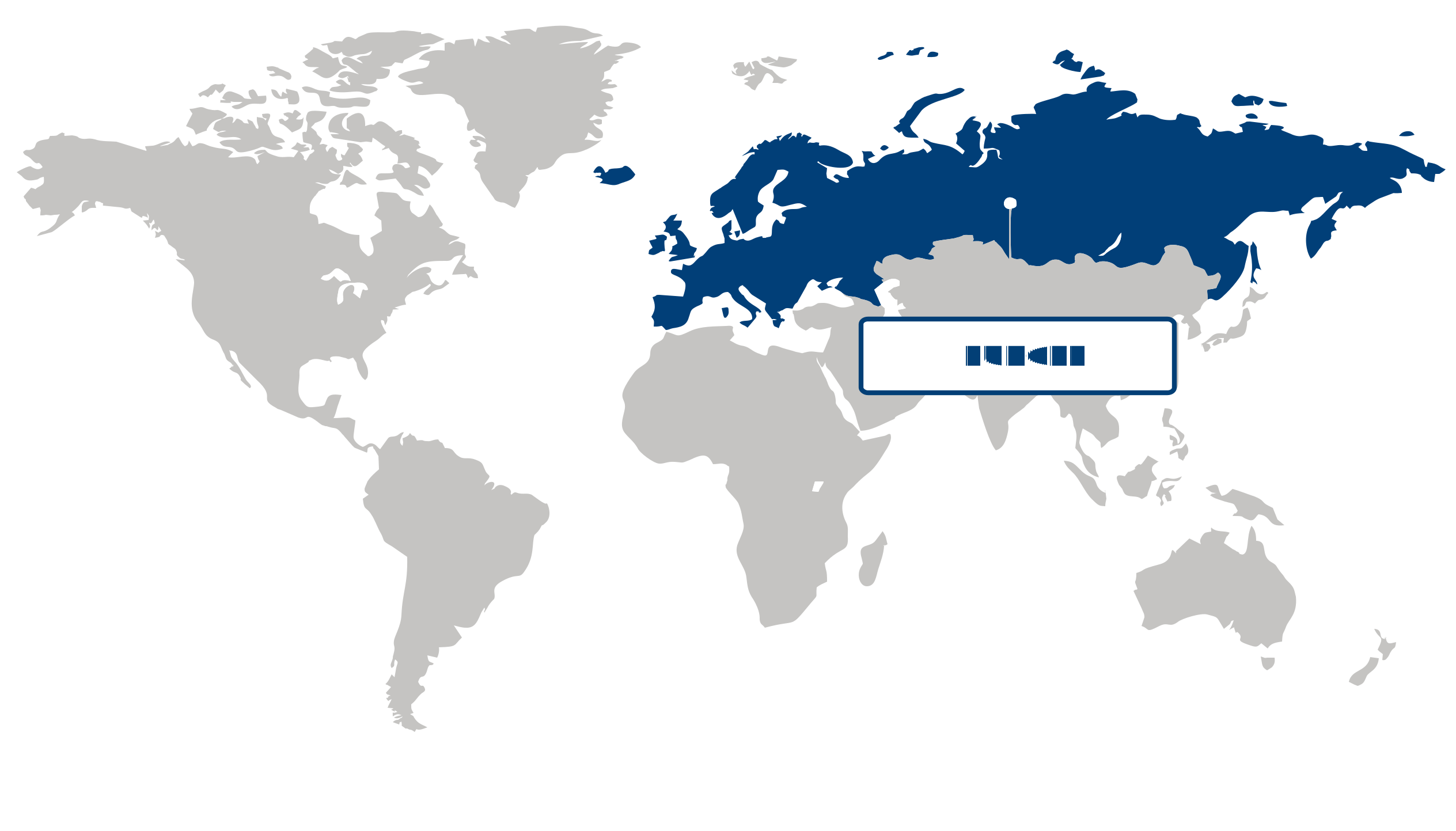
Europe (Largest Region)
Europe accounted for the largest share of 38.02% in the recycled plastic packaging market in 2026, reflecting strong emphasis on circular economy practices, sustainable packaging, and resource efficiency. Regulatory attention toward plastic waste reduction is encouraging businesses to increase the use of recycled materials and adopt packaging formats with improved environmental performance. Growing consumer preference for sustainable products is reinforcing this transition across food, beverage, personal care, and other packaging-intensive industries. Established recycling infrastructure and increasing efforts to incorporate recycled plastics into packaging supply chains further support the region's leading position.
Asia Pacific (Fastest-Growing Region)
Asia Pacific is poised to experience the fastest growth in the recycled plastic packaging market as manufacturers and consumers increasingly focus on reducing plastic waste and improving material sustainability. Expanding packaging demand across consumer goods and industrial sectors is creating a larger requirement for recycled plastic inputs, while growing environmental awareness is encouraging businesses to reconsider conventional packaging materials. Investments in recycling capabilities and improvements in waste collection and processing systems are supporting the development of regional supply chains. The increasing integration of sustainability objectives into packaging strategies is expected to accelerate adoption across the region.
| Parameter | North America | Asia Pacific | Europe | Latin America | MEA |
|---|---|---|---|---|---|
| Innovation HubiScaleNascentDeveloping Advanced | |||||
| Cost-Sensitive RegioniScaleLowMedium High | |||||
| Regulatory EnvironmentiScaleRestrictiveNeutral Supportive | |||||
| Demand DriversiScaleWeakModerate Strong | |||||
| Development StageiScaleEmergingDeveloping Developed | |||||
| Adoption RateiScaleLowMedium High | |||||
| New Entrants / StartupsiScaleSparseModerate Dense | |||||
| Macro IndicatorsiScaleWeakStable Strong |
Key Country Insights
United States 🇺🇸
Circular Packaging InnovationThe U.S. recycled plastic packaging market is advancing through investments in food-grade recycled resins, lightweight packaging, and corporate sustainability commitments. Brands are strengthening supply partnerships to improve recycled content while meeting evolving regulatory and consumer expectations.
Germany 🇩🇪
Closed-Loop Packaging SystemsGermany emphasizes high-quality recycling streams and packaging circularity supported by strict waste management practices. Manufacturers are prioritizing recyclable designs and stable recycled polymer supply to align with industrial and environmental requirements.
Japan 🇯🇵
Material Quality FocusJapan focuses on premium recycled plastic packaging supported by precise sorting technologies and consistent material quality. Packaging producers are improving resin performance for consumer goods while balancing functionality with sustainability objectives.
South Korea 🇰🇷
Sustainable Packaging IntegrationSouth Korea is expanding recycled plastic packaging adoption through consumer product manufacturers seeking sustainable packaging alternatives. Companies are investing in advanced recycling technologies and design improvements to enhance recycled material utilization.
France 🇫🇷
Eco-Design AdoptionFrance is encouraging recycled plastic packaging through eco-design initiatives and stronger packaging sustainability requirements. Brand owners are incorporating higher recycled content while redesigning packaging formats to improve recyclability across product categories.
Italy 🇮🇹
Flexible Packaging TransitionItaly is integrating recycled plastics into flexible and consumer packaging applications while maintaining product performance. Packaging converters are adapting manufacturing processes to accommodate recycled materials and evolving customer sustainability requirements.
Recycled Plastic Packaging Market Share (%), by Plastic Type, 2026
Go beyond the chart, access full insights & data tables
Request Free Sample ReportPlastic Type Segment Analysis: PET (Polyethylene Terephthalate) (Largest & Fastest-Growing Segment)
The PET (polyethylene terephthalate) segment dominated the recycled plastic packaging market with a market share of 38.77% in 2026 and also represented the fastest-growing segment. PET remains the preferred recycled plastic due to its excellent recyclability, lightweight properties, strength, and suitability for a broad range of packaging applications. Strong demand from beverage, food, and consumer goods manufacturers, together with increasing emphasis on circular economy initiatives and sustainable packaging, continues to support its widespread adoption. Improvements in recycling technologies and the growing availability of high-quality recycled PET further reinforce the segment’s leading position.
Recycling Process Segment Analysis: Mechanical Recycling (Largest Segment) vs Chemical Recycling (Fastest-Growing Segment)
Mechanical recycling held the largest share of the recycling process segment in 2026. The process remains widely adopted because of its established infrastructure, cost efficiency, and capability to convert post-consumer plastic waste into reusable packaging materials with relatively straightforward processing. Its extensive use across major packaging applications continues to support stable demand as manufacturers increase the incorporation of recycled content into their products.
In the recycled plastic packaging market, the chemical recycling segment is emerging as the fastest-growing process. Its growth is driven by the ability to process more complex and contaminated plastic waste streams that are difficult to recycle mechanically. Continued technological advancements and increasing demand for higher-quality recycled materials suitable for demanding packaging applications are encouraging greater investment and adoption, supporting the segment’s rapid expansion.
End Use Industry Segment Analysis: Food and Beverage (Largest & Fastest-Growing Segment)
The food and beverage end-use industry led the recycled plastic packaging market in 2026 while also representing the fastest-growing segment. Strong demand for sustainable packaging solutions, combined with increasing consumer preference for environmentally responsible products, continues to accelerate the use of recycled plastic packaging throughout the industry. Manufacturers are incorporating recycled materials into bottles, containers, trays, and flexible packaging to meet sustainability objectives while maintaining product quality and safety. Ongoing regulatory support for recycled content and continued innovation in food-grade recycled plastics further strengthen the segment’s long-term growth potential.
| Segment | Sub-Segment | Largest Segment | Fastest Growing |
|---|---|---|---|
| Plastic Type | PET (Polyethylene Terephthalate), HDPE (High-Density Polyethylene), LDPE (Low-Density Polyethylene), PP (Polypropylene), PS (Polystyrene), Others | PET (Polyethylene Terephthalate) | PET (Polyethylene Terephthalate) |
| Recycling Process | Mechanical Recycling, Chemical Recycling | Mechanical Recycling | Chemical Recycling |
| End Use Industry | Food and Beverage, Consumer Goods, Healthcare, Industrial, Others | Food and Beverage | Food and Beverage |
| Source | Plastic Bottles, Plastic Films, Polymer Foam, Fibers, Others | Plastic Bottles | Plastic Bottles |
Competitive Landscape and Market Positioning
Top players in the recycled plastic packaging market:
- Berry Global, Inc. (United States)
- Sealed Air Corporation (United States)
- Smurfit Kappa Group plc (Ireland)
- Mondi Group (United Kingdom)
- DS Smith Plc (United Kingdom)
- Amcor plc (Australia)
- Huhtamaki Oyj (Finland)
- Novolex Holdings, Inc. (United States)
- Pactiv Evergreen, Inc. (United States)
- Plastipak Holdings, Inc. (United States)
Material innovation and processing capability are becoming more decisive competitive differentiators than production scale alone, as suppliers work to improve the consistency, appearance, and functional performance of recycled packaging. Competition is increasingly shaped by the ability to secure reliable post-consumer feedstock while delivering packaging solutions that satisfy evolving sustainability expectations without compromising product protection or manufacturing efficiency. Producers are also expanding investments in advanced sorting, purification, and traceability technologies to strengthen quality assurance, while greater emphasis on circular design principles encourages the development of packaging formats that simplify collection and reprocessing. This gradual shift rewards manufacturers capable of combining supply chain resilience with regulatory readiness and application-specific material expertise.
| Company | Market Share | Company Revenue | Revenue CAGR (%) | Product Portfolio | Geographic Presence | Innovation / R&D Focus | Strategic Developments |
|---|---|---|---|---|---|---|---|
| Berry Global Inc. (United States) | |||||||
| Sealed Air Corporation (United States) | |||||||
| Smurfit Kappa Group plc (Ireland) | |||||||
| Mondi Group (United Kingdom) | |||||||
| DS Smith Plc (United Kingdom) | |||||||
| Amcor plc (Australia) | |||||||
| Huhtamaki Oyj (Finland) | |||||||
| Novolex Holdings Inc. (United States) | |||||||
| Pactiv Evergreen Inc. (United States) | |||||||
| Plastipak Holdings Inc. (United States) |
Industry Development / News
| Company Name | Date | Key Development |
|---|---|---|
| Boral | Jul-25 | Boral is transitioning its bagged dry mix product line, including concrete and mortar, from paper to fully recyclable plastic packaging at its Maldon facility. This phased rollout reflects a strategic commitment to circular packaging solutions and reduces reliance on traditional non-recyclable materials in heavy-duty construction applications. |
| Mars | Jun-25 | Mars collaborated with Berry Global to launch pantry jars for major confectionery brands including M&M's and Skittles, utilizing 100% mechanically recycled post-consumer plastic. The project demonstrates the successful scale-up of rigid recycled plastic applications for global snack food products. |
| Burts | Jun-25 | Burts implemented new crisp packaging containing 55% post-consumer recycled plastic. As the first hand-cooked crisp brand to reach this threshold of recycled content, the development highlights the advancement of sustainable materials integration within the competitive snack food packaging sector. |
| Mondelēz International | May-25 | Mondelēz International partnered with Amcor to deploy packaging featuring 80% certified recycled plastic for 300 million Cadbury sharing bars in the UK and Ireland. This initiative represents a material advancement in the commercialization of flexible recycled-content packaging for high-volume confectionery products. |
| Saica | May-25 | Saica partnered with Mondelēz International to introduce paper-based, recyclable multipack bags for Cadbury biscuits in the UK. The transition is designed to improve recyclability and is projected to reduce virgin plastic consumption by approximately 145 tonnes annually. |
| Amcor | Apr-25 | Amcor finalized its acquisition of Berry Global on April 30, 2025. This strategic consolidation creates a global leader in consumer packaging, significantly enhancing operational scale, material science capabilities, and the capacity to deliver recycled-content packaging solutions across international markets. |
| Novolex | Apr-25 | Novolex completed the $6.7 billion acquisition of Pactiv Evergreen. This merger integrates extensive production and recycling assets across North America and Europe, creating one of the largest food packaging producers and enhancing supply chain resilience for post-consumer recycled plastic materials. |
| Constantia Flexibles | Mar-25 | Constantia Flexibles completed the acquisition of a majority stake in Aluflexpack AG in March 2025. The move consolidates significant flexible packaging expertise and expands the availability of high-performance recyclable laminates, strengthening the company's ability to offer sustainable, material-efficient packaging solutions to its global consumer and pharmaceutical customer base. |
| International Paper | Jan-25 | International Paper finalized its acquisition of DS Smith on January 31, 2025. This transaction establishes a leading global force in sustainable packaging, influencing competitive dynamics within the sector by accelerating the development of fiber-based alternatives and advancing circular packaging integration strategies. |
| Banyan Nation | Nov-24 | Banyan Nation secured approximately $800,000 in seed funding to scale its high-technology plastic cleaning and rHDPE/rPP resin production operations. The investment expands capacity for high-quality, traceable recycled resins, addressing supply constraints in the regional recycled plastic packaging value chain. |
Customize Your Report
Explore examples of how this report can be tailored to different research needs, including custom segments, additional topics or chapters, and related reports. Click a section of the wheel or its numbered marker to explore the available options.
Recycled Plastic Packaging Market — Custom Segments
| Segment | Sub-Segment |
|---|---|
| Packaging Format | Bottles & Jars, Trays & Containers, Films & Wraps, Bags & Pouches, Caps & Closures |
| Recycled Content Level | Post-Consumer Recycled (PCR) Content, Post-Industrial Recycled (PIR) Content, PCR-PIR Blended Content |
| Packaging Rigidity | Rigid Packaging, Flexible Packaging, Semi-Rigid Packaging |
Recycled Plastic Packaging Market — Custom TOC
| Custom Chapter | Chapter Details |
|---|---|
| Recycled Content Sourcing Strategy |
|
| Circular Packaging Economics |
|
| Packaging Format Transition Roadmap |
|
Need a different cut of the data?
Request Custom ResearchFrequently Asked Questions
What is the market valuation of recycled plastic packaging?
What is the projected value of the recycled plastic packaging industry by 2036?
How are Extended Producer Responsibility regulations influencing recycled plastic packaging adoption?
Why is recycling infrastructure becoming strategically important for recycled plastic packaging suppliers?
Why does PET dominate the recycled plastic packaging market?
Which recycling process is expanding the fastest in the recycled plastic packaging market?
Why does Europe lead the recycled plastic packaging market?
How is Asia Pacific supporting future growth in recycled plastic packaging?
Which companies dominate the recycled plastic packaging landscape?
Our Clients
"The report helped us understand emerging consumer trends in our product category. It clarified where to focus innovation for the next product launch."
LyondellBasell
"The regional forecast section was incredibly useful. We were able to identify two new potential partners in Europe thanks to the vendor mapping you included."
SABIC
"We appreciated how actionable the recommendations were. It guided us to improve supply chain resilience."
Olin Corporation
Our Research Team & Methodology
Every Fundamental Business Insights report is built by a dedicated vertical research team, validated through a structured primary-and-secondary methodology, and reviewed for accuracy before it reaches you.
Delivery
Published
Available
Support
- Market Size & Forecast
- Market Segmentation
- Regional Analysis
- Growth Drivers & Challenges
- Market Dynamics
- Competitive Landscape
- Company Profiles
- Competitive Benchmarking
- Mergers & Acquisitions
- Market Share Analysis or Key Company Strategies
- Value Chain Analysis
- Porter's Five Forces
- PESTLE Analysis
- Pricing Trends
- Supply-Demand Analysis
- Technology Landscape
- Regulatory Landscape
- Investment & Funding Landscape
- Emerging Opportunities
- Future Market Outlook