Refueling Aircraft Market Size & Growth Forecast 2027–2036, By Segments (Aircraft, Component, Medium), Regional Demand Trends (North America, Asia Pacific, Europe), Key Country Insights (U.S., Japan, South Korea, Germany, France, Italy), and Competitive Landscape
Market Size and Growth Outlook
Refueling Aircraft Market size was worth USD 13.88 Billion in 2026 and is expected to grow at 2.16% CAGR between 2027 and 2036, surpassing USD 17.19 Billion by 2036. The industry revenue for 2027 is estimated at USD 14.13 Billion.
Get more details on this report
Request Free Sample ReportRefueling Aircraft Market Intelligence Snapshot
Regional Market Dynamics
- Europe held 37.8% in 2026, supported by established aviation infrastructure, extensive aircraft fleets, airport modernization, and strong demand for efficient refueling systems.
- Asia Pacific is the fastest-growing region, driven by rising air traffic, airport development, expanding aviation capacity, military aviation investments, and infrastructure upgrades.
Segment Momentum
- Military aircraft held 45.58% of the market in 2026, driven by the need to extend mission range, enhance operational flexibility, support long-duration defense operations, and strengthen strategic mobility.
- Helicopters are the fastest-growing segment as evolving military missions, advances in refueling technologies, and rising demand for extended endurance in search and rescue, special operations, and tactical missions accelerate adoption.
Market Expansion Drivers
- Increasing defense modernization programs driving demand for aerial refueling capabilities for extended missions
- Rising geopolitical tensions increasing procurement of strategic airborne refueling platforms
- Advancements in aerospace refueling systems enhancing operational efficiency and mission endurance
Leading Market Participants
- Leading players in the refueling aircraft market include Airbus SE (France), Boeing Company (USA), BAE Systems plc (UK), Lockheed Martin Corporation (USA), Northrop Grumman Corporation (USA), Rolls-Royce Holdings plc (UK), L3Harris Technologies, Inc. (USA), Israel Aerospace Industries Ltd. (Israel), Embraer S.A. (Brazil)
Global Market Forecast Snapshot
Market Outlook
- 2026 Market Size: USD 13.88 Billion
- 2027 Estimated Market Size: USD 14.13 Billion
- Projected Market Size: USD 17.19 Billion by 2036
- Growth Forecast: 2.16% CAGR (2027-2036)
Regional and Segment Outlook
- Leading Regional Market: Europe
- High-Growth Regional Hub: Asia Pacific
- Core Revenue Segment: Military (Aircraft) | Refueling Pods (Component) | Air-to-Air Refueling (Medium)
- Emerging Opportunity Segment: Helicopter (Aircraft) | Refueling Pods (Component) | Air-to-Air Refueling (Medium)
Market Growth Drivers and Industry Trends
Increasing defense modernization programs driving demand for aerial refueling capabilities for extended missions
Military forces are investing in advanced aviation capabilities to improve operational readiness, strategic reach, and mission flexibility across increasingly complex defense environments. This trend will drive the refueling aircraft market growth as aerial refueling platforms enable combat aircraft, surveillance assets, and transport fleets to remain operational for longer durations without frequent ground-based refueling. Modernization initiatives also prioritize interoperability and force projection, increasing the importance of reliable airborne refueling capabilities within contemporary military operations.
Rising geopolitical tensions increasing procurement of strategic airborne refueling platforms
Evolving regional security concerns are encouraging governments to strengthen military preparedness through investments in long-range airpower and rapid deployment capabilities. The refueling aircraft market gains momentum as defense organizations expand tanker aircraft fleets to support sustained aerial operations, joint exercises, and strategic deterrence missions. Enhanced airborne refueling capacity also enables air forces to operate across greater distances while improving responsiveness during multinational and expeditionary operations.
Advancements in aerospace refueling systems enhancing operational efficiency and mission endurance
Technological improvements in refueling equipment, aircraft systems, and mission management capabilities are increasing the effectiveness of modern tanker operations. These advancements will propel the refueling aircraft market growth by enabling faster fuel transfer, greater compatibility with diverse aircraft platforms, and improved operational precision during complex aerial refueling missions. Enhanced system reliability and integration with advanced avionics further support extended mission endurance across a wide range of military aviation applications.
| Growth Driver | Impact on CAGR | Regulatory Influence | Geographic Relevance | Adoption Rate | Impact Timeline |
|---|---|---|---|---|---|
| Increasing defense modernization programs driving demand for aerial refueling capabilities for extended missions | 2% | High | North America, Europe | Medium | Mid Term |
| Rising geopolitical tensions increasing procurement of strategic airborne refueling platforms | 1.7% | High | Middle East & Africa, Europe | Medium | Mid Term |
| Advancements in aerospace refueling systems enhancing operational efficiency and mission endurance | 1.5% | Moderate | North America, Asia Pacific | Medium | Long Term |
Explore Growth Opportunities
Request Free Sample ReportRegional Demand Dynamics
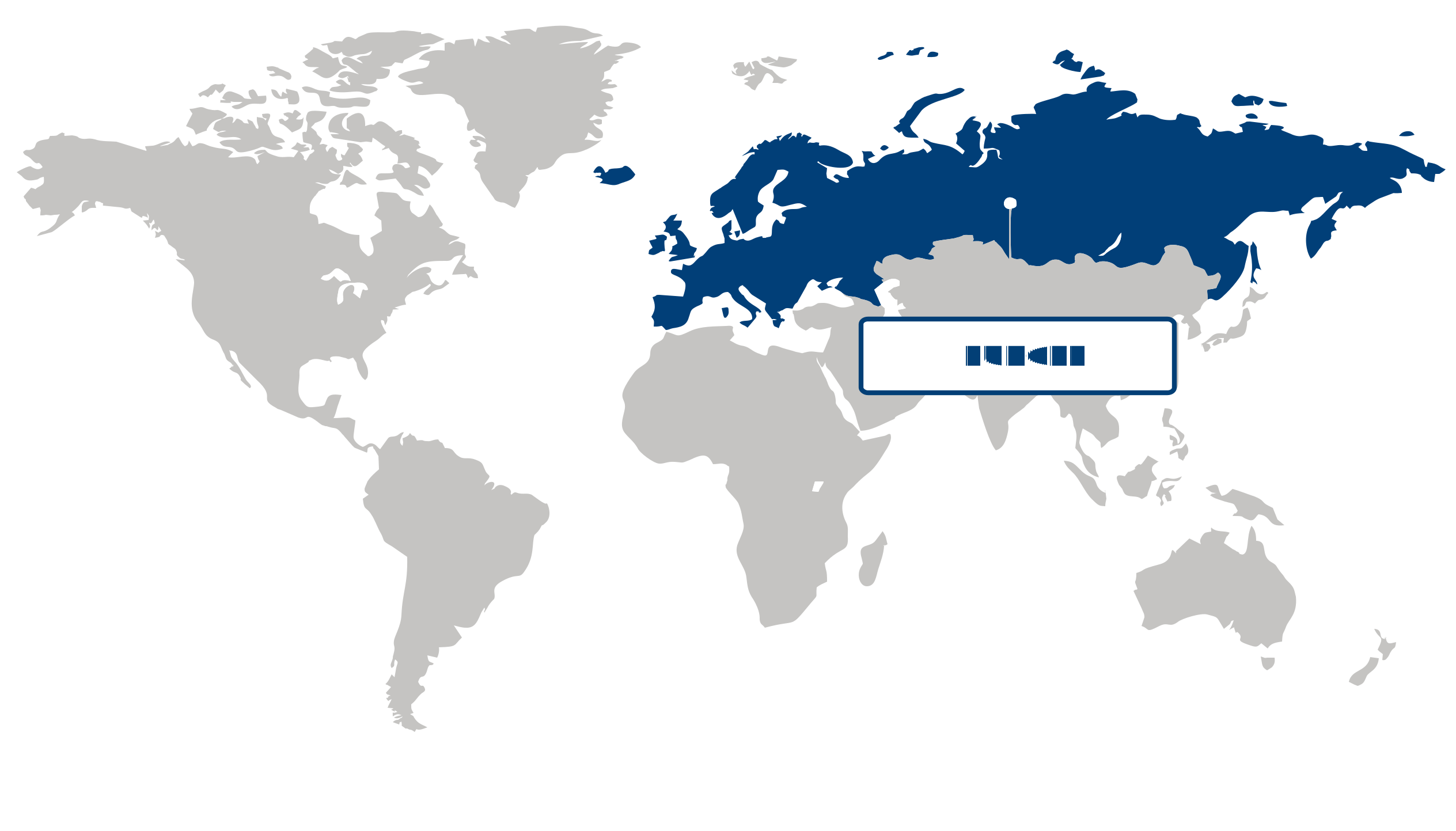
Europe (Largest Region)
Europe held the largest share of the refueling aircraft market at 37.8% in 2026, supported by its well-established aviation infrastructure, extensive commercial and military aircraft fleets, and mature network of airports and aviation service facilities. The region benefits from sustained investments in airport modernization, aircraft fleet maintenance, and ground-support infrastructure, which strengthen demand for reliable and efficient aircraft refueling systems. Stringent aviation safety and environmental standards also encourage the adoption of advanced refueling equipment designed to improve operational efficiency, safety, and fuel-handling performance. In addition, Europe’s strong aerospace ecosystem and emphasis on sustainable aviation infrastructure support continued market development.
Asia Pacific (Fastest-Growing Region)
Asia Pacific is emerging as the fastest-growing regional market, driven by expanding air passenger traffic, airport infrastructure development, and increasing investments in aviation capacity. Rapid urbanization and economic growth across several countries are encouraging the construction and modernization of airports, creating additional requirements for aircraft ground-handling and refueling infrastructure. Growing military aviation capabilities in the region also contribute to demand for specialized refueling systems. Furthermore, efforts to improve airport efficiency, strengthen aviation connectivity, and upgrade operational infrastructure are supporting the adoption of more advanced refueling technologies across both commercial and defense aviation.
| Parameter | North America | Asia Pacific | Europe | Latin America | MEA |
|---|---|---|---|---|---|
| Innovation Hub i Scale Nascent Developing Advanced | |||||
| Cost-Sensitive Region i Scale Low Medium High | |||||
| Regulatory Environment i Scale Restrictive Neutral Supportive | |||||
| Demand Drivers i Scale Weak Moderate Strong | |||||
| Development Stage i Scale Emerging Developing Developed | |||||
| Adoption Rate i Scale Low Medium High | |||||
| New Entrants / Startups i Scale Sparse Moderate Dense | |||||
| Macro Indicators i Scale Weak Stable Strong |
Key Country Insights
United States 🇺🇸
Fleet Modernization FocusThe U.S. refueling aircraft market emphasizes replacing aging tanker fleets while expanding operational flexibility for joint and long-range missions. Procurement priorities center on advanced avionics, fuel transfer efficiency, and interoperability with next-generation defense platforms.
Germany 🇩🇪
Multinational Capability IntegrationGermany prioritizes refueling aircraft that strengthen multinational defense cooperation and shared operational capabilities. The country is investing in interoperable tanker platforms, digital mission systems, and maintenance readiness to support collaborative European air operations.
Japan 🇯🇵
Extended Reach SupportJapan continues enhancing its refueling aircraft capabilities to improve the endurance of air defense and maritime surveillance missions. Procurement strategies focus on reliable tanker availability, mission flexibility, and compatibility with an expanding fleet of modern combat aircraft.
South Korea 🇰🇷
Operational Readiness EnhancementSouth Korea is strengthening refueling aircraft capabilities to support rapid deployment and sustained air operations across diverse mission profiles. Market activity reflects demand for advanced tanker systems, efficient maintenance programs, and seamless integration with existing defense assets.
France 🇫🇷
Expeditionary Air SupportFrance emphasizes refueling aircraft that support overseas deployments and multi-role military operations. Investment priorities include efficient fuel transfer technologies, mission adaptability, and integrated communication systems that enhance operational effectiveness across allied missions.
Italy 🇮🇹
Alliance Mission CompatibilityItaly focuses on refueling aircraft that reinforce participation in multinational defense operations while improving fleet availability. Procurement efforts prioritize interoperable tanker platforms, lifecycle support services, and modernization initiatives aligned with evolving operational requirements.
Segment Leadership and Growth Trends
Refueling Aircraft Market Share (%), by Aircraft, 2026
Go beyond the chart, access full insights & data tables
Request Free Sample ReportAircraft Segment Analysis: Military (Largest Segment) vs Helicopter (Fastest-Growing Segment)
The military aircraft segment led the refueling aircraft market with a 45.58% share in 2026. Its dominant position is driven by the critical role aerial refueling plays in extending mission range, enhancing operational flexibility, and supporting long-duration defense operations. Military forces worldwide continue to prioritize airborne refueling capabilities to strengthen strategic mobility and maintain readiness across diverse operational environments. The increasing emphasis on force projection and sustained air operations has contributed significantly to the segment’s leadership.
The helicopter segment is projected to be the fastest-growing category as modern military and specialized aviation missions increasingly require extended endurance and operational reach. Advancements in refueling technologies and evolving mission requirements are expanding the feasibility of aerial refueling for helicopter platforms. Growing demand for enhanced mobility in search and rescue, special operations, and tactical missions is expected to support continued growth within this segment.
Component Segment Analysis: Refueling Pods (Largest & Fastest-Growing Segment)
The refueling pods segment accounted for the largest share of 33.48% in 2026 and was also the fastest-growing component segment in the refueling aircraft market. Refueling pods are widely utilized because they provide flexible aerial refueling capabilities and can be integrated with various aircraft platforms without requiring extensive structural modifications. Their operational versatility allows air forces to expand refueling capacity efficiently while supporting a broad range of mission profiles. Increasing focus on adaptable and cost-effective aerial refueling solutions, combined with the need for enhanced operational reach, continues to drive demand for refueling pod systems.
Medium Segment Analysis: Air-to-Air Refueling (Largest & Fastest-Growing Segment)
The air-to-air refueling medium segment held the largest share and emerged as the fastest-growing segment in 2026. Its prominence stems from its essential role in extending aircraft endurance, increasing mission effectiveness, and enabling sustained operations over long distances. Air-to-air refueling supports a wide range of military and strategic aviation requirements by reducing dependence on ground-based refueling infrastructure. As defense organizations continue to emphasize rapid deployment capabilities and operational flexibility, demand for advanced air-to-air refueling systems remains strong, reinforcing the segment’s market leadership.
| Segment | Sub-Segment | Largest Segment | Fastest Growing |
|---|---|---|---|
| Aircraft | Commercial, Military, Helicopter | Military | Helicopter |
| Component | Aviation Refueller, Dispenser, Refueling Pods, Probe & Drogue, Others | Refueling Pods | Refueling Pods |
| Medium | Air-to-Air Refueling, Tanking Method | Air-to-Air Refueling | Air-to-Air Refueling |
Unlock insights tailored to your business with our bespoke market research solutions.
Click to get your customized report now.
Competitive Landscape and Market Positioning
Major players in the refueling aircraft market:
- Airbus SE (France)
- Boeing Company (USA)
- BAE Systems plc (UK)
- Lockheed Martin Corporation (USA)
- Northrop Grumman Corporation (USA)
- Rolls-Royce Holdings plc (UK)
- L3Harris Technologies, Inc. (USA)
- Israel Aerospace Industries Ltd. (Israel)
- Embraer S.A. (Brazil)
Manufacturers are strengthening their competitive positions by advancing aircraft designs that support greater operational flexibility, extended mission endurance, and compatibility with evolving aerial refueling requirements. Engineering expertise is increasingly centered on improving fuel transfer reliability, mission adaptability, and maintenance efficiency, encouraging sustained investment in specialized aerospace technologies rather than incremental platform enhancements alone. Competitive pressure is also encouraging greater emphasis on modular configurations and digital system integration that simplify operational planning while accommodating diverse defense and strategic deployment needs.
| Company | Market Share | Company Revenue | Revenue CAGR (%) | Product Portfolio | Geographic Presence | Innovation / R&D Focus | Strategic Developments |
|---|---|---|---|---|---|---|---|
| Airbus SE (France) | |||||||
| Boeing Company (USA) | |||||||
| BAE Systems plc (UK) | |||||||
| Lockheed Martin Corporation (USA) | |||||||
| Northrop Grumman Corporation (USA) | |||||||
| Rolls-Royce Holdings plc (UK) | |||||||
| L3Harris Technologies Inc. (USA) | |||||||
| Israel Aerospace Industries Ltd. (Israel) | |||||||
| Embraer S.A. (Brazil) |
Industry Development/News
| Company Name | Date | Key Development |
|---|---|---|
| Boeing | May-26 | Boeing completed the delivery of the initial KC-46A Gideon aerial refueling aircraft to the Israeli Air Force. This milestone marks the introduction of a next-generation tanker platform designed to replace Israel's legacy refueling fleet and significantly enhance its long-range strategic operational capabilities. |
| Boeing | Apr-26 | Boeing's first production-representative MQ-25 Stingray successfully completed its maiden flight. This achievement marks a critical technical milestone in advancing carrier-based unmanned aerial refueling capabilities, validating autonomous flight technologies intended for future U.S. Navy carrier air wing operations. |
| Northrop Grumman | Feb-26 | Northrop Grumman formed a strategic partnership with Embraer to offer the KC-390 tactical aerial refueling aircraft to the U.S. Air Force. The collaboration targets dispersed operational requirements, introducing a new competitive tanker solution to enhance flexibility in contested environments. |
| Boeing | Dec-25 | Boeing delivered its 100th KC-46A Pegasus aerial refueling aircraft to the U.S. Air Force. The delivery represents a major manufacturing milestone for the program, securing steady-state production throughput and reinforcing the multi-year modernization of the military's strategic tanker fleet. |
| Saab | Nov-25 | Saab's Gripen E fighter achieved formal certification for aerial refueling utilizing Embraer's KC-390 Millennium tanker. Executed in coordination with the Brazilian Air Force, this operational milestone expands the fighter platform's mission radius and enhances interoperability across global defense fleets. |
| United Aircraft Corporation | Oct-25 | The Chinese Air Force ordered 20 Il-78MK-90A aerial refueling aircraft from Russia. This significant procurement indicates a major fleet expansion aimed at strengthening the military's long-range logistics, strategic projection, and airborne refueling capabilities. |
| Boeing | Jul-25 | The U.S. Air Force committed to procure up to 75 additional KC-46 aerial refueling aircraft, opting to forego a new competitive bidding process. This decision extends the production longevity of Boeing's Pegasus platform and stabilizes the defense contractor's long-term manufacturing backlog. |
| Embraer | Mar-25 | Embraer disclosed that the adoption of its KC-390 platform by the U.S. Air Force is contingent upon integrating a standard rigid aerial refueling boom. The ongoing technical development highlights a critical engineering hurdle necessary for competing against established domestic platforms. |
| Boeing | Nov-24 | Boeing secured a $2.4 billion contract modification from the U.S. Air Force to supply 15 additional KC-46A Pegasus aerial refueling aircraft. The contract expands the defense department's capital commitment, sustaining industrial capacity and modernizing active aerial tanker assets. |
| Embraer | Oct-24 | Embraer and L3Harris mutually terminated their partnership to promote the C-390 aircraft to the U.S. Air Force. The dissolution marks a significant strategic pivot, altering the aircraft's market positioning and market entry strategy within the competitive U.S. defense sector. |
Customize Your Report
Explore examples of how this report can be tailored to different research needs, including custom segments, additional topics or chapters, and related reports. Click a section of the wheel or its numbered marker to explore the available options.
Refueling Aircraft Market — Custom Segments
| Segment | Sub-Segment |
|---|---|
| Mission Type | Strategic Airlift, Tactical Operations, Long-Range Strike, Air Superiority & Combat Air Patrol, Special Operations |
| Tanker Ownership | National Military Fleets, Allied & Multinational Fleets, Government-Owned Contractor-Operated Fleets |
| Procurement Model | New Aircraft Procurement, Fleet Modernization & Replacement, Conversion of Existing Aircraft, Leasing & Contractor-Based Acquisition |
Refueling Aircraft Market — Custom TOC
| Custom Chapter | Chapter Details |
|---|---|
| Aircraft Refueling Fleet Modernization Outlook |
|
| Procurement & Acquisition Landscape |
|
| Refueling Infrastructure Development Priorities |
|
Need a different cut of the data?
Request Custom ResearchHow large is the refueling aircraft market?
What is the anticipated CAGR of the refueling aircraft industry?
Why are defense modernization programs increasing demand for refueling aircraft?
How are technological advancements strengthening the refueling aircraft market?
Why do military aircraft lead the refueling aircraft market?
Why are helicopters the fastest-growing aircraft segment in the refueling aircraft market?
Why does Europe lead the refueling aircraft market?
How is Asia Pacific driving growth in the refueling aircraft market?
Who holds a significant market share in the refueling aircraft landscape?
Our Clients
"The reports offered a comprehensive view of the Food and Beverage landscape, covering market trends, consumer behavior, and competitive dynamics."
Terma A/S
"Our experience in acquiring market research reports has been outstanding — the depth of analysis and actionable insights have proven invaluable."
The Aerospace Corporation
"Fundamental Business Insights demonstrated a keen understanding of our business needs, delivering reports tailored to our specific objectives."
Kongsberg Gruppen
Our Research Team & Methodology
Every Fundamental Business Insights report is built by a dedicated vertical research team, validated through a structured primary-and-secondary methodology, and reviewed for accuracy before it reaches you.
Research Team Overview
Prepared by the Aerospace & Defence Research Team
Delivery
Published
Demand
Available
Support
Trust & Compliance
Research Intelligence
| Source | Reference |
|---|---|
| International Civil Aviation Organization (ICAO) | www.icao.int |
| International Air Transport Association (IATA) | www.iata.org |
| Federal Aviation Administration (FAA) | www.faa.gov |
| European Union Aviation Safety Agency (EASA) | www.easa.europa.eu |
| Aerospace Industries Association (AIA) | www.aia-aerospace.org |
| NATO | www.nato.int |
| U.S. Department of Defense (DoD) | www.defense.gov |
| Defense Advanced Research Projects Agency (DARPA) | www.darpa.mil |
| National Aeronautics and Space Administration (NASA) | www.nasa.gov |
| European Space Agency (ESA) | www.esa.int |
| SAE International | www.sae.org |
| RTCA | www.rtca.org |
| ASTM International | www.astm.org |
| International Organization for Standardization (ISO) | www.iso.org |
| National Institute of Standards and Technology (NIST) | www.nist.gov |
| International Organization for Standardization - Aerospace (IAQG standards via 9100 series) | iaqg.org |
| Airports Council International (ACI World) | aci.aero |
| Missile Defense Agency (MDA) | www.mda.mil |
| Stockholm International Peace Research Institute (SIPRI) | www.sipri.org |
| Jane's (Janes) | www.janes.com |
Research Workflow & Quality Assurance
Data Collection
Verified information gathered through primary and secondary research.
Data Triangulation
Cross-validation using multiple independent data sources.
Forecast Modelling
Market estimates developed using historical trends and analytical models.
Analyst Validation
Findings reviewed by domain experts for accuracy and consistency.
Editorial & Quality Review
Final editorial, quality, and compliance checks before publication.
Final Publication
Released after successful completion of the internal review process.
Report Coverage
📊 Market Assessment
- Market Size & Forecast
- Market Segmentation
- Regional Analysis
- Growth Drivers & Challenges
- Market Dynamics
🏢 Competitive Intelligence
- Competitive Landscape
- Company Profiles
- Competitive Benchmarking
- Mergers & Acquisitions
- Market Share Analysis or Key Company Strategies
🔍 Strategic Analysis
- Value Chain Analysis
- Porter's Five Forces
- PESTLE Analysis
- Pricing Trends
- Supply-Demand Analysis
🚀 Future Outlook
- Technology Landscape
- Regulatory Landscape
- Investment & Funding Landscape
- Emerging Opportunities
- Future Market Outlook
Have a question about this report or need a custom scope?
Request Customization