Remote Vehicle Diagnostics Market Size & Growth Forecast 2027–2036, By Segments (Connectivity, Vehicle, Offering, Application), Regional Demand Trends (North America, Asia Pacific, Europe), Key Country Insights (U.S., Japan, South Korea, Germany, France, Italy), and Competitive Landscape
Jump to Content
Market Size and Growth Outlook
Remote Vehicle Diagnostics Market size was around USD 18.8 Billion in 2026 and is slated to grow at 17.06% CAGR from 2027 to 2036, exceeding USD 90.83 Billion by 2036. The industry revenue for 2027 is assessed at USD 21.57 Billion.
Get more details on this report
Request Free Sample ReportRemote Vehicle Diagnostics Market Intelligence Snapshot
Regional Market Dynamics
- Europe led in 2026 due to its mature automotive industry, widespread connectivity, and strong focus on vehicle safety, emissions, and efficient maintenance.
- Asia Pacific is expanding rapidly through connected mobility infrastructure, growing vehicle fleets, telecommunications improvements, and rising adoption of electric and software-defined vehicles.
Segment Momentum
- Diagnostics equipment leads the market because onboard hardware is essential for accurately collecting, transmitting, and interpreting vehicle performance data, supporting reliable remote monitoring and fault detection.
- Software is projected to grow the fastest as cloud analytics, artificial intelligence, and predictive maintenance enable continuous monitoring, remote troubleshooting, over-the-air updates, and connected vehicle management.
Market Expansion Drivers
- Rising fleet predictive maintenance adoption enabling real-time remote vehicle health monitoring systems
- Expansion of connected vehicle infrastructure accelerating OEM telematics-based diagnostic integration
- Growing commercial fleet digitalization increasing demand for cloud-based remote fault detection platforms
Leading Market Participants
- Top companies in the remote vehicle diagnostics market include Robert Bosch GmbH (Germany), Continental AG (Germany), Denso Corporation (Japan), ZF Friedrichshafen AG (Germany), Valeo SE (France), Geotab Inc. (Canada), Verizon Connect (United States), Harman International Industries, Inc. (United States), General Motors Company (United States), Octo Telematics S.p.A. (Italy)
Global Market Forecast Snapshot
Market Outlook
- 2026 Market Size: USD 18.8 Billion
- 2027 Estimated Market Size: USD 21.57 Billion
- Projected Market Size: USD 90.83 Billion by 2036
- Growth Forecast: 17.06% CAGR (2027-2036)
Regional and Segment Outlook
- Leading Regional Market: Europe
- High-Growth Regional Hub: Asia Pacific
- Core Revenue Segment: Cellular (4G / LTE / 5G) (Connectivity) | Passenger Cars (Vehicle) | Diagnostics Equipment (Offering) | Vehicle Health Alert (Application)
- Emerging Opportunity Segment: Cellular (4G / LTE / 5G) (Connectivity) | Commercial Vehicle (Vehicle) | Software (Offering) | Vehicle Health Alert (Application)
Market Growth Drivers and Industry Trends
Rising fleet predictive maintenance adoption enabling real-time remote vehicle health monitoring systems
Fleet operators are increasingly shifting from reactive maintenance practices to predictive service models that identify potential issues before they result in costly vehicle downtime. The remote vehicle diagnostics market will drive growth by enabling continuous monitoring of vehicle health through connected diagnostic systems that analyze performance data and detect early signs of component degradation. Access to real-time operational insights allows maintenance teams to schedule repairs more efficiently while improving fleet reliability and optimizing asset utilization.
Expansion of connected vehicle infrastructure accelerating OEM telematics-based diagnostic integration
The growing deployment of connected vehicle technologies is enabling manufacturers to integrate advanced diagnostic capabilities directly into vehicle platforms throughout their operational lifecycle. The remote vehicle diagnostics market growth is driven by original equipment manufacturers expanding telematics-enabled systems that support continuous performance monitoring, software diagnostics, and remote troubleshooting. These integrated capabilities improve service efficiency by allowing manufacturers and fleet operators to identify faults remotely, streamline maintenance planning, and enhance overall vehicle performance management.
Growing commercial fleet digitalization increasing demand for cloud-based remote fault detection platforms
Digital transformation across commercial transportation is encouraging fleet operators to adopt cloud-enabled platforms that centralize vehicle performance data and maintenance information. The remote vehicle diagnostics market will propel growth through cloud-based fault detection solutions that aggregate diagnostic information from connected vehicles, enabling faster issue identification and data-driven maintenance decisions. Centralized access to operational intelligence also improves fleet oversight, supports proactive maintenance workflows, and enhances coordination between drivers, service providers, and fleet management teams.
| Growth Driver | Impact on CAGR | Regulatory Influence | Geographic Relevance | Adoption Rate | Impact Timeline |
|---|---|---|---|---|---|
| Rising fleet predictive maintenance adoption enabling real-time remote vehicle health monitoring systems | 2% | High | North America, Europe | High | Near Term |
| Expansion of connected vehicle infrastructure accelerating OEM telematics-based diagnostic integration | 1.8% | Moderate | Asia Pacific, North America | High | Near Term |
| Growing commercial fleet digitalization increasing demand for cloud-based remote fault detection platforms | 1.6% | Moderate | Europe, Asia Pacific | High | Mid Term |
Unlock insights tailored to your business with our bespoke market research solutions.
Click to get your customized report now.
Regional Demand Dynamics
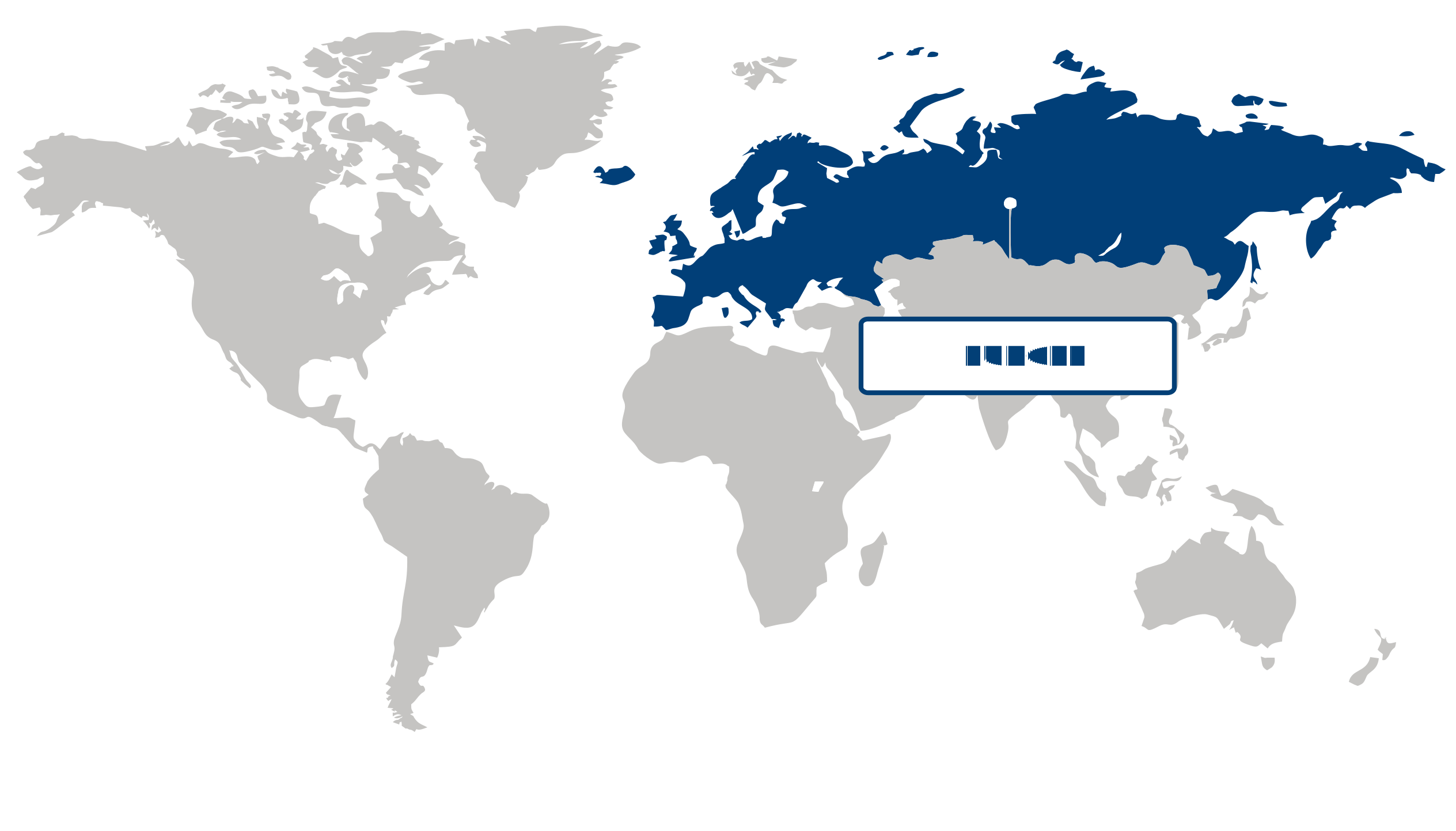
Europe (Largest Region)
Europe held the largest share of the remote vehicle diagnostics market in 2026, supported by a mature automotive industry, widespread vehicle connectivity, and strong emphasis on vehicle safety, maintenance, and emissions management. The region's established regulatory focus on road safety and environmental performance encourages the use of advanced diagnostic technologies capable of monitoring vehicle conditions remotely. Increasing integration of connected vehicle systems is also enabling manufacturers, fleet operators, and service providers to identify faults more efficiently, optimize maintenance activities, and reduce vehicle downtime. The continued shift toward software-enabled automotive services further strengthens demand for remote diagnostic capabilities.
Asia Pacific (Fastest-Growing Region)
Asia Pacific is emerging as the fastest-growing regional market, driven by expanding vehicle ownership, rapid development of connected mobility infrastructure, and increasing adoption of digital automotive technologies. Growing commercial and passenger vehicle fleets are creating greater demand for efficient maintenance solutions, particularly in densely populated urban markets where vehicle availability and operating efficiency are critical. Investments in connected vehicle ecosystems and improvements in telecommunications infrastructure are supporting real-time transmission of vehicle data. In addition, the expansion of electric and software-defined vehicles is creating new opportunities for remote monitoring, predictive maintenance, and diagnostics across the region.
| Parameter | North America | Asia Pacific | Europe | Latin America | MEA |
|---|---|---|---|---|---|
| Innovation HubiScaleNascentDeveloping Advanced | |||||
| Cost-Sensitive RegioniScaleLowMedium High | |||||
| Regulatory EnvironmentiScaleRestrictiveNeutral Supportive | |||||
| Demand DriversiScaleWeakModerate Strong | |||||
| Development StageiScaleEmergingDeveloping Developed | |||||
| Adoption RateiScaleLowMedium High | |||||
| New Entrants / StartupsiScaleSparseModerate Dense | |||||
| Macro IndicatorsiScaleWeakStable Strong |
Key Country Insights
United States 🇺🇸
Connected Fleet InnovationThe U.S. remote vehicle diagnostics market is shaped by large commercial fleets and connected vehicle platforms seeking predictive maintenance and reduced downtime. Automakers and telematics providers in the U.S. are increasingly integrating cloud-based diagnostics with subscription-driven service models.
Germany 🇩🇪
OEM Integration HubGermany prioritizes embedded diagnostics capabilities that support premium vehicle brands and advanced aftersales services. German manufacturers are expanding remote monitoring functions to enable software-defined vehicles and improve maintenance efficiency across passenger and commercial segments.
Japan 🇯🇵
Reliability-Centric DiagnosticsJapan emphasizes remote diagnostics solutions that reinforce vehicle reliability and lifecycle management. Automotive companies in Japan are integrating diagnostics with preventive servicing programs and connected mobility platforms to improve customer retention and operational performance.
South Korea 🇰🇷
Software Vehicle TransitionSouth Korea is aligning remote diagnostics with its transition toward software-defined and connected vehicles. Domestic automakers are increasing investments in over-the-air capabilities and real-time vehicle health monitoring to strengthen digital service ecosystems.
France 🇫🇷
Mobility Service IntegrationFrance is using remote vehicle diagnostics to support fleet operators, shared mobility providers, and connected transport services. The market in France is seeing increased demand for diagnostic platforms that improve maintenance scheduling and reduce operational interruptions.
Italy 🇮🇹
Aftermarket Service DigitizationItaly's remote vehicle diagnostics market is driven by demand for digital tools that modernize independent workshops and fleet maintenance operations. Service providers in Italy are adopting connected diagnostic systems to improve repair efficiency and customer service offerings.
Remote Vehicle Diagnostics Market Share (%), by Connectivity, 2026
Go beyond the chart, access full insights & data tables
Request Free Sample ReportConnectivity Segment Analysis: Cellular (4G / LTE / 5G) (Largest & Fastest-Growing Segment)
The remote vehicle diagnostics market was led by the cellular (4G/LTE/5G) connectivity segment, which captured 88.2% in 2026, while also emerging as the fastest-growing segment. Cellular connectivity enables continuous real-time communication between vehicles and remote diagnostic platforms, allowing timely monitoring of vehicle health, predictive maintenance, software updates, and fault detection. The rapid expansion of connected vehicle ecosystems, broader deployment of high-speed mobile networks, and increasing demand for fleet management and telematics solutions continue to reinforce the dominant and accelerating adoption of cellular connectivity.
Vehicle Segment Analysis: Passenger Cars (Largest Segment) vs Commercial Vehicle (Fastest-Growing Segment)
Holding the largest share of the remote vehicle diagnostics market, the passenger car segment dominated in 2026. Rising consumer demand for connected vehicle technologies, enhanced safety features, and proactive maintenance services has significantly increased the adoption of remote diagnostics in passenger vehicles. Automakers are also integrating advanced connectivity features to improve vehicle performance, customer convenience, and ownership experience.
The commercial vehicle segment is expected to grow at the fastest pace as fleet operators increasingly adopt remote diagnostic solutions to maximize vehicle uptime and improve operational efficiency. Real-time monitoring of engine performance, maintenance requirements, and vehicle health enables businesses to reduce unexpected breakdowns and optimize fleet utilization, making remote diagnostics an increasingly valuable operational tool.
Offering Segment Analysis: Diagnostics Equipment (Largest Segment) vs Software (Fastest-Growing Segment)
The diagnostics equipment segment accounted for the largest share of the remote vehicle diagnostics market in 2026. Specialized diagnostic hardware remains essential for collecting, transmitting, and interpreting vehicle performance data with high accuracy. The growing installation of onboard diagnostic systems and connected hardware across modern vehicles continues to support strong demand for diagnostics equipment.
The software segment is anticipated to register the fastest growth as cloud-based analytics, artificial intelligence, and predictive maintenance capabilities become increasingly important in vehicle management. Software platforms enable continuous monitoring, remote troubleshooting, and actionable performance insights while supporting over-the-air updates and seamless integration with connected mobility ecosystems.
| Segment | Sub-Segment | Largest Segment | Fastest Growing |
|---|---|---|---|
| Connectivity | Cellular (4G / LTE / 5G), Bluetooth, Wi-Fi, Satellite, Others | Cellular (4G / LTE / 5G) | Cellular (4G / LTE / 5G) |
| Vehicle | Passenger Cars, Commercial Vehicle | Passenger Cars | Commercial Vehicle |
| Offering | Diagnostics Equipment, Software | Diagnostics Equipment | Software |
| Application | Automatic Crash Notification, Vehicle Tracking, Vehicle Health Alert, Roadside Assistance | Vehicle Health Alert | Vehicle Health Alert |
Competitive Landscape and Market Positioning
Major players in the remote vehicle diagnostics market:
- Robert Bosch GmbH (Germany)
- Continental AG (Germany)
- Denso Corporation (Japan)
- ZF Friedrichshafen AG (Germany)
- Valeo SE (France)
- Geotab, Inc. (Canada)
- Verizon Connect (United States)
- Harman International Industries, Inc. (United States)
- General Motors Company (United States)
- Octo Telematics S.p.A. (Italy)
Software-driven innovation is steadily altering competitive dynamics in the remote vehicle diagnostics market as the value proposition expands from fault detection toward continuous vehicle intelligence and predictive operational support. Market participants are refining analytics capabilities, cloud-based diagnostic platforms, and remote service functionalities that enable faster issue identification and more proactive maintenance decisions. This evolution is encouraging competition around the quality of diagnostic algorithms, interoperability with connected vehicle ecosystems, and the ability to translate large volumes of operational data into actionable maintenance insights. At the same time, growing attention to cybersecurity, data privacy, and scalable platform integration is prompting providers to strengthen secure digital architectures, making long-term ecosystem compatibility an increasingly important differentiator across both commercial and passenger vehicle applications.
| Company | Market Share | Company Revenue | Revenue CAGR (%) | Product Portfolio | Geographic Presence | Innovation / R&D Focus | Strategic Developments |
|---|---|---|---|---|---|---|---|
| Robert Bosch GmbH (Germany) | |||||||
| Continental AG (Germany) | |||||||
| Denso Corporation (Japan) | |||||||
| ZF Friedrichshafen AG (Germany) | |||||||
| Valeo SE (France) | |||||||
| Geotab Inc. (Canada) | |||||||
| Verizon Connect (United States) | |||||||
| Harman International Industries Inc. (United States) | |||||||
| General Motors Company (United States) | |||||||
| Octo Telematics S.p.A. (Italy) |
Industry Development/News
| Company Name | Date | Key Development |
|---|---|---|
| Bosch | Mar-25 | Bosch released its ADS X software version 6.6, expanding diagnostic coverage to 2024 and 2025 vehicle models. The update adds more than 10,000 special tests, advanced ADAS calibration, and bi-directional test functions, significantly improving the depth of remote and workshop-level electronic system troubleshooting. |
| Mahindra | Feb-25 | Mahindra enhanced its after-sales ecosystem by introducing AI-enabled predictive diagnostics and remote vehicle diagnostics for software-defined vehicles. This strategic deployment, integrated with dedicated electric vehicle service infrastructure and battery repair centers, improves real-time vehicle health monitoring and strengthens the automaker's connected vehicle ownership capabilities. |
| Kia India | Feb-25 | Kia India surpassed the milestone of 500,000 connected vehicles on road via its Kia Connect platform, driven primarily by the adoption of its Seltos model. This expansion scales the company's connected vehicle ecosystem, providing a broader foundation for advanced remote monitoring, digital telematics, and vehicle diagnostics services. |
| Bosch | Oct-24 | Bosch introduced an upgraded automotive middleware stack designed for software-defined vehicle architectures. By facilitating over-the-air feature deployment and seamless communication between sensors, electronic control units, and cloud services, the platform enhances the core infrastructure required for continuous remote vehicle monitoring and advanced diagnostics. |
| Geotab | Jul-24 | Geotab launched a next-generation cloud-based fleet intelligence suite featuring AI-powered predictive maintenance and real-time emissions tracking. The solution utilizes remote vehicle data to forecast mechanical failures and optimize maintenance schedules, allowing commercial fleets to mitigate operational downtime and meet stringent environmental regulations. |
Customize Your Report
Explore examples of how this report can be tailored to different research needs, including custom segments, additional topics or chapters, and related reports. Click a section of the wheel or its numbered marker to explore the available options.
Remote Vehicle Diagnostics Market — Custom Segments
| Segment | Sub-Segment |
|---|---|
| Fleet Operating Model | Captive Fleets, Third-Party Fleets, Rental & Leasing Fleets, Ride-Hailing & Mobility Fleets |
| Deployment Model | Cloud-Based, On-Premises, Hybrid |
| Revenue Model | Subscription-Based, Usage-Based, Per-Vehicle Licensing, One-Time License & Maintenance |
Remote Vehicle Diagnostics Market — Custom TOC
| Custom Chapter | Chapter Details |
|---|---|
| Remote Vehicle Health Management |
|
| Predictive Maintenance Monetization |
|
| Diagnostic Data Commercialization |
|
Need a different cut of the data?
Request Custom ResearchFrequently Asked Questions
What is the market valuation of remote vehicle diagnostics?
What are the growth projections for the remote vehicle diagnostics industry?
How is predictive maintenance reshaping demand in the remote vehicle diagnostics market?
Why are connected vehicle platforms accelerating remote diagnostics adoption?
Why is diagnostics equipment the largest offering segment in the remote vehicle diagnostics market?
Which offering segment is expected to grow the fastest in the remote vehicle diagnostics market?
Why does Europe lead the remote vehicle diagnostics market?
Why is Asia Pacific the fastest-growing market for remote vehicle diagnostics?
Which companies dominate the remote vehicle diagnostics landscape?
Our Clients
"The team surpassed our expectations with the report depth. The actionable insights provided proved crucial in navigating market challenges."
Tata Motors
"We found the report to be very informative. The expertise and attention to market nuances significantly influenced our business direction."
DENSO Corporation
"The consumer survey findings were quite good. We now have a clearer picture of the customer churning and retention strategy."
HL Mando
Our Research Team & Methodology
Every Fundamental Business Insights report is built by a dedicated vertical research team, validated through a structured primary-and-secondary methodology, and reviewed for accuracy before it reaches you.
Delivery
Published
Available
Support
- Market Size & Forecast
- Market Segmentation
- Regional Analysis
- Growth Drivers & Challenges
- Market Dynamics
- Competitive Landscape
- Company Profiles
- Competitive Benchmarking
- Mergers & Acquisitions
- Market Share Analysis or Key Company Strategies
- Value Chain Analysis
- Porter's Five Forces
- PESTLE Analysis
- Pricing Trends
- Supply-Demand Analysis
- Technology Landscape
- Regulatory Landscape
- Investment & Funding Landscape
- Emerging Opportunities
- Future Market Outlook