



Remote Weapon Station Market Size & Growth Forecast 2027–2036, By Segments (Platform, Application, Weapon Type, Mobility), Regional Demand Trends (North America, Asia Pacific, Europe), Key Country Insights (U.S., Japan, South Korea, Germany, France, Italy), and Competitive Landscape
Market Size and Growth Outlook
Remote Weapon Station Market size was around USD 14.07 Billion in 2026 and is slated to grow at 10.49% CAGR from 2027 to 2036, reaching USD 38.15 Billion by 2036. The industry revenue for 2027 is calculated at USD 15.32 Billion.
Base Year Value (2026)
USD 14.07 Billion
CAGR (2027-2036)
10.49%
Forecast Year Value (2036)
USD 38.15 Billion

Historical Data Period
2022-2026

Largest Region
Europe

Forecast Period
2027-2036
Remote Weapon Station Market Intelligence Snapshot:
-
Regional Market Dynamics:
- Europe led in 2025, supported by defense modernization, force-protection priorities, aging-platform replacement, and demand for digitally integrated remotely operated military systems.
- Asia Pacific is expanding rapidly as governments strengthen military readiness, modernize armored and naval assets, and increase adoption of remotely operated systems.
-
Segment Momentum:
- Land platforms held a 49.29% market share in 2025 due to broad deployment across ground vehicles and fixed installations, supported by modernization efforts, advanced sensor integration, and improved situational awareness.
- Homeland security is the fastest-growing application as agencies strengthen border protection, critical infrastructure security, and perimeter monitoring through remotely operated systems that enhance surveillance and response from protected positions.
-
Market Expansion Drivers:
- Rising global defense modernization programs accelerating adoption of remote weapon systems
- Increasing asymmetric warfare and border security threats driving unmanned combat system deployment
- Expansion of naval and land unmanned platforms boosting integrated remote turret adoption
-
Leading Market Participants:
Prominent players in the remote weapon station market include Rheinmetall AG (Germany), BAE Systems plc (United Kingdom), Kongsberg Gruppen ASA (Norway), General Dynamics Corporation (United States), RTX Corporation (United States), Elbit Systems Ltd. (Israel), Rafael Advanced Defense Systems Ltd. (Israel), Thales Group (France), Leonardo S.p.A. (Italy), Saab AB (Sweden)
Global Market Forecast Snapshot:
-
Market Outlook:
- 2026 Market Size: USD 14.07 Billion
- 2027 Estimated Market Size: USD 15.32 Billion
- Projected Market Size: USD 38.15 Billion by 2036
- Growth Forecasts: 10.49% CAGR (2027-2036)
-
Regional and Segment Outlook:
- Leading Regional Market: Europe
- High-Growth Regional Hub: Asia Pacific
- Core Revenue Segment: Land (Platform) | Military (Application) | Lethal Weapons (Weapon Type) | Moving (Mobility)
- Emerging Opportunity Segment: Airborne (Platform) | Homeland Security (Application) | Lethal Weapons (Weapon Type) | Moving (Mobility)
Market Growth Drivers and Industry Trends
Rising global defense modernization programs accelerating adoption of remote weapon systems
Governments across multiple regions are prioritizing defense modernization to improve operational effectiveness, force protection, and battlefield readiness, creating sustained demand for advanced weapon platforms. As military procurement strategies increasingly focus on replacing legacy manually operated systems with digitally controlled alternatives, the remote weapon station market will drive growth through the integration of remotely operated firepower across armored vehicles, tactical platforms, and fixed defense installations. These systems enhance operator survivability by allowing personnel to engage threats from protected positions while supporting greater targeting precision, improved situational awareness, and compatibility with modern command-and-control architectures. Modernization initiatives also encourage interoperability between weapons, sensors, and communication systems, making remote weapon stations an important component of next-generation defense capabilities.
Increasing asymmetric warfare and border security threats driving unmanned combat system deployment
The evolving nature of security challenges, including irregular conflicts, cross-border infiltration, and insurgent activities, is prompting defense agencies to deploy technologies that reduce personnel exposure while maintaining continuous surveillance and rapid response capabilities. Growing reliance on unmanned combat systems will propel the remote weapon station market growth as armed forces seek remotely controlled weapon platforms capable of operating effectively in high-risk environments. These systems support persistent monitoring, accurate threat engagement, and flexible deployment across difficult terrain, enabling military units and border security forces to respond quickly without placing operators in direct danger. Their ability to integrate with advanced electro-optical sensors and target acquisition technologies further strengthens operational effectiveness during complex security missions.
Expansion of naval and land unmanned platforms boosting integrated remote turret adoption
The increasing deployment of autonomous and remotely operated platforms across both naval and ground operations is creating new opportunities for integrated weapon solutions that combine mobility with precision engagement. Within this transition, the remote weapon station market benefits from the growing requirement for compact, stabilized remote turrets designed to function seamlessly on unmanned surface vessels, unmanned ground vehicles, and other autonomous defense platforms. Integrated systems improve mission flexibility by enabling surveillance, reconnaissance, and defensive operations from a single platform while reducing onboard crew requirements. Platform designers are also emphasizing modular architectures that allow weapon stations to accommodate different calibers, sensor packages, and mission profiles without extensive structural modifications.
| Growth Driver Assessment Framework | |||||
| Growth Driver | Impact On CAGR | Regulatory Influence | Geographic Relevance | Adoption Rate | Impact Timeline |
|---|---|---|---|---|---|
| Rising global defense modernization programs accelerating adoption of remote weapon systems | 2.5% | High | North America, Europe | High | Near Term |
| Increasing asymmetric warfare and border security threats driving unmanned combat system deployment | 2.3% | High | Middle East & Africa, Europe | High | Near Term |
| Expansion of naval and land unmanned platforms boosting integrated remote turret adoption | 2% | High | North America, Asia Pacific | High | Mid Term |
Unlock insights tailored to your business with our bespoke market research solutions - Click to get your customized report now!
Regional Demand Dynamics
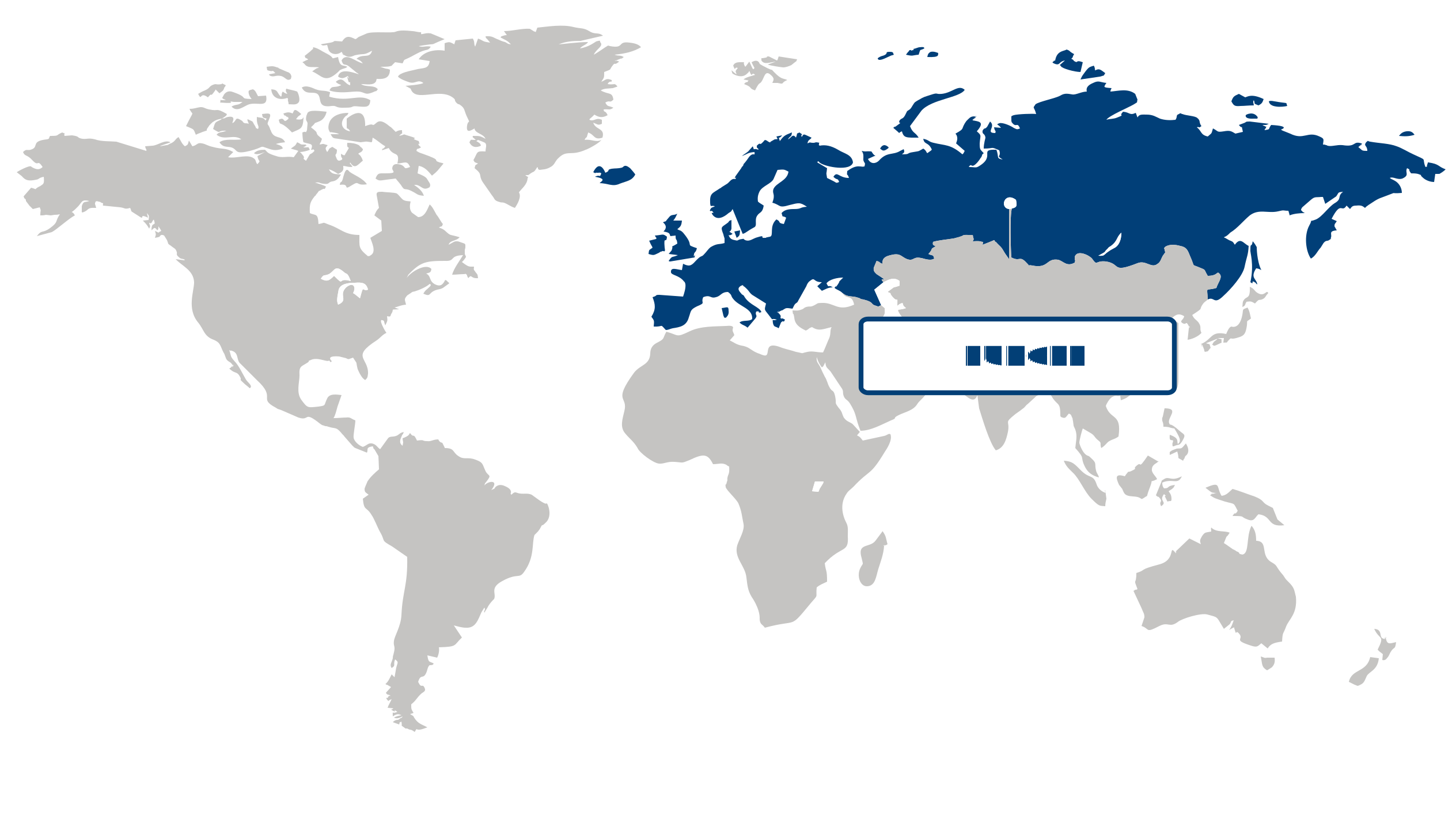
Largest Region
Europe
Largest Market Share in 2026
Europe (Largest Region) vs Asia Pacific (Fastest-Growing Region)
Europe accounted for the largest regional position in the remote weapon station market in 2026, supported by defense modernization programs, increasing emphasis on force protection, and the replacement of aging military platforms. European armed forces are prioritizing digitally integrated and remotely operated weapon systems that can enhance situational awareness while reducing direct exposure of personnel to hostile environments. The modernization of armored vehicles and other land-based platforms, together with greater interoperability requirements among allied forces, is supporting demand for advanced remote weapon stations with integrated sensing and targeting capabilities.
Asia Pacific is projected to register the fastest growth as regional governments strengthen military readiness and expand investments in advanced defense platforms. Territorial security concerns, modernization of armored and naval assets, and growing requirements for precision-enabled weapon systems are encouraging adoption of remotely operated solutions. The increasing integration of electro-optical sensors, fire-control systems, stabilization technologies, and network-centric capabilities is further supporting market expansion, particularly as regional defense forces seek greater operational flexibility and improved protection for personnel.
No card data available for this language/report.
Segment Leadership and Growth Trends
Platform Segment Analysis: Land (Largest Segment) vs Airborne (Fastest-Growing Segment)
The land platform segment accounted for the largest share of the remote weapon station market, reaching 49.29% in 2026. Its leading position is supported by the broad deployment of remotely operated systems across ground vehicles, fixed defense installations, and other land-based platforms. Land-based remote weapon stations provide military and security forces with enhanced surveillance, targeting, and response capabilities while helping reduce direct exposure of personnel. Growing investments in ground-force modernization, the integration of advanced sensors, and the demand for improved situational awareness are supporting continued adoption across land platforms. The versatility of these systems across a wide range of terrestrial defense and security applications further reinforces their market position.
Airborne platforms are expected to experience the fastest growth as defense forces increasingly explore remotely operated weapon systems for aerial platforms that require advanced sensing, targeting, and lightweight integration capabilities. Growing emphasis on unmanned and technologically advanced airborne systems is creating opportunities for remote weapon station technologies that can support enhanced operational flexibility. Continued development of compact systems, improved sensor integration, and network-enabled command capabilities is supporting the expansion of airborne applications. The increasing focus on extending the capabilities of aerial platforms while reducing direct personnel exposure is further strengthening demand in this segment.
Application Segment Analysis: Military (Largest Segment) vs Homeland Security (Fastest-Growing Segment)
Military applications represented the largest segment of the remote weapon station market in 2026, driven by the widespread use of remotely operated systems to enhance force protection, surveillance, and operational capabilities. Defense organizations are increasingly integrating remote weapon stations into modern platforms to improve situational awareness and enable personnel to operate from more protected positions. Ongoing military modernization, growing adoption of networked defense technologies, and the need for advanced response capabilities are supporting demand across military applications. The integration of remote weapon stations with sophisticated sensors and command systems is further strengthening their role in modern defense operations.
Homeland security is projected to be the fastest-growing application as security agencies increase the use of advanced remote technologies to protect borders, critical infrastructure, and strategically important facilities. Remote weapon stations can support surveillance and response functions while enabling operators to manage systems from safer locations. Rising demand for persistent monitoring, enhanced perimeter security, and rapid response capabilities is creating favorable conditions for adoption in homeland security. The growing convergence of surveillance, communications, and remotely operated security technologies is expected to further support the segment's expansion.
Weapon Type Segment Analysis: Lethal Weapons (Largest & Fastest-Growing Segment)
Lethal weapons constituted the largest and fastest-growing weapon type in the remote weapon station market in 2026. Demand is supported by the continued requirement for remotely operated systems capable of delivering armed engagement capabilities while improving operator protection and maintaining effective control over weapon systems. Advances in targeting technologies, sensor integration, and remote fire-control systems are enhancing the operational value of lethal weapon configurations. As defense and security organizations continue to modernize their platforms and seek improved precision, survivability, and response effectiveness, lethal weapon systems remain a key area of demand within the remote weapon station market.
| Report Segmentation | |||
| Segment | Sub-Segment | Largest Segment | Fastest Growing Segment |
|---|---|---|---|
| Platform | Land, Naval, Airborne | Land | Airborne |
| Application | Military, Homeland Security | Military | Homeland Security |
| Weapon Type | Lethal Weapons, Non-lethal Weapons | Lethal Weapons | Lethal Weapons |
| Mobility | Fixed, Moving | Moving | Moving |
 Read our Research Approach
Competitive Landscape and Market Positioning
Key companies in the remote weapon station market:
- Rheinmetall AG (Germany)
- BAE Systems plc (United Kingdom)
- Kongsberg Gruppen ASA (Norway)
- General Dynamics Corporation (United States)
- RTX Corporation (United States)
- Elbit Systems Ltd. (Israel)
- Rafael Advanced Defense Systems Ltd. (Israel)
- Thales Group (France)
- Leonardo S.p.A. (Italy)
- Saab AB (Sweden)
Competitive priorities are shifting toward highly integrated platforms that combine precision stabilization, advanced sensing, and digital fire control into adaptable weapon systems for diverse operational environments. Suppliers are expanding beyond standalone hardware by emphasizing modular architectures that simplify integration across multiple vehicle and platform types while allowing future capability upgrades. The increasing importance of software-driven targeting, situational awareness, and interoperability with broader defense command networks is raising the technological threshold for participation, encouraging sustained investment in system integration, electronic resilience, and lifecycle support rather than incremental mechanical improvements alone.
Industry Development/News
| Company Name | Date | Key Development |
|---|---|---|
| Kongsberg | May-26 | Kongsberg and Mesko S.A. entered a strategic partnership to integrate the Piorun air defence missile system with Kongsberg’s Protector remote weapon stations. This collaboration enhances the offensive capabilities of remote systems by combining kinetic weapon options with missile integration, directly addressing the requirements of international defense markets for multi-role air defense solutions. |
| EOS Defence Systems | Mar-26 | EOS received an Indian naval order for the R800 naval remote weapon station. This contract supports the company's expansion strategy within the maritime defense sector, providing the Indian Navy with an advanced, stabilized remote weapon system capable of enhancing lethality and target engagement precision for various surface vessel platforms. |
| Milrem Robotics | Feb-26 | Milrem Robotics and EOS Defence Systems signed a teaming agreement to develop networked unmanned ground combat systems. This partnership combines autonomous ground vehicle technology with remote weapon capability, aiming to create advanced, modular combat solutions that enhance the operational flexibility and safety of future unmanned military platforms. |
| EOS Defence Systems | Dec-25 | EOS Defence Systems secured a multi-year USD 22 million contract to supply enhanced remote weapon systems for a major US Army ground combat platform. This award establishes a critical operational footprint for EOS in the US defense market and provides a strategic pathway for securing larger production orders within expanded domestic defense programs. |
| US Defense Companies | Oct-25 | Two US defense contractors formed a partnership to upgrade existing remote weapon stations with advanced software for autonomous drone detection and engagement. This development marks a significant shift in counter-unmanned aerial system (C-UAS) technology, enhancing the ability of military ground platforms to neutralize aerial threats autonomously without manual operator intervention. |
| Rheinmetall AG | Sep-25 | Rheinmetall unveiled the CT-025, a crewless remotely controlled turret designed for advanced digital combat environments. The system features autonomous targeting and C-UAS capabilities, demonstrating the industry’s shift toward integrating high-level AI-driven fire control into remote weapon station platforms to improve firepower efficiency and situational awareness in modernized land combat. |
| Kongsberg | Aug-25 | Kongsberg secured a full-rate production contract from the US Marine Corps for remotely operated turrets to be integrated into the ACV-30 amphibious combat vehicle. This contract reflects the continued reliance on remote weapon systems to provide precise, stabilized lethality while protecting personnel in highly maneuverable, amphibious combat environments. |
| Rafael Advanced Defense Systems | Apr-25 | Rafael demonstrated its Typhoon 30 remote weapon station successfully neutralizing drone threats during desert drills. By validating the system’s effectiveness against aerial targets on modular platforms, Rafael has expanded the potential deployment scenarios for the Typhoon series, positioning it as a highly capable C-UAS solution for both naval and land-based applications. |
| Kongsberg | Jun-24 | Kongsberg launched the NOMADS mobile short-range air defense system, which incorporates advanced remote weapon station integration. By combining mobility with short-range air defense capabilities, the system addresses the critical need for mobile, autonomous weapon platforms capable of providing effective protection for maneuvering land forces against diverse aerial threats. |
| Patria | Mar-24 | Patria and Kongsberg formalized a cooperative agreement to supply weapon stations for Finland and Sweden under the Common Armoured Vehicle System (CAVS) program. This integration effort streamlines the procurement and deployment of remote weapon stations into armored vehicle fleets, facilitating regional standardization and enhanced interoperability for Nordic defense forces. |
Why Choose Us
Specialized Expertise: Our team comprises industry experts with a deep understanding of your market segment. We bring specialized knowledge and experience that ensures our research and consulting services are tailored to your unique needs.
Customized Solutions: We understand that every client is different. That's why we offer customized research and consulting solutions designed specifically to address your challenges and capitalize on opportunities within your industry.
Proven Results: With a track record of successful projects and satisfied clients, we have demonstrated our ability to deliver tangible results. Our case studies and testimonials speak to our effectiveness in helping clients achieve their goals.
Cutting-Edge Methodologies: We leverage the latest methodologies and technologies to gather insights and drive informed decision-making. Our innovative approach ensures that you stay ahead of the curve and gain a competitive edge in your market.
Client-Centric Approach: Your satisfaction is our top priority. We prioritize open communication, responsiveness, and transparency to ensure that we not only meet but exceed your expectations at every stage of the engagement.
Continuous Innovation: We are committed to continuous improvement and staying at the forefront of our industry. Through ongoing learning, professional development, and investment in new technologies, we ensure that our services are always evolving to meet your evolving needs.
Value for Money: Our competitive pricing and flexible engagement models ensure that you get maximum value for your investment. We are committed to delivering high-quality results that help you achieve a strong return on your investment.
Select Licence Type

