Road Safety System Market Size & Growth Forecast 2027–2036, By Segments (Service, Solution), Regional Demand Trends (North America, Asia Pacific, Europe), Key Country Insights (U.S., Japan, South Korea, Germany, France, Italy), and Competitive Landscape
Market Size and Growth Outlook
Road Safety System Market size was worth USD 5.9 billion in 2026 and is expected to grow at a 12.83% CAGR between 2027 and 2036, attaining USD 19.73 billion by 2036. The industry revenue for 2027 is calculated at USD 6.54 billion.
Get more details on this report
Request Free Sample ReportRoad Safety System Market Intelligence Snapshot
Regional Market Dynamics
- Europe holds 29.20% share due to mature transport infrastructure, strong regulatory frameworks, widespread traffic monitoring and enforcement systems, and continuous investments in signaling and upgrades.
- Asia Pacific is projected at 19.6% CAGR driven by rapid urbanization, rising vehicle density, congestion management needs, and adoption of sensor-based intelligent traffic safety infrastructure.
Segment Momentum
- Professional Services held a 76.29% share in 2026 because road safety projects require specialized expertise for planning, deployment, integration, customization, and alignment with operational and compliance requirements.
- ANPR/ALPR is the fastest-growing solution segment as agencies increasingly use automated vehicle identification and traffic monitoring capabilities to support broader enforcement and operational use cases across road networks.
Market Expansion Drivers
- Government-led road safety initiatives accelerating deployment of intelligent traffic enforcement systems.
- Rising connected vehicle adoption increasing demand for integrated road monitoring infrastructure.
- Expanding smart city transportation projects driving investments in AI-enabled traffic analytics platforms.
Leading Market Participants
- Prominent companies in the road safety system market include Verra Mobility (USA), Conduent Incorporated (USA), Cubic Corporation (USA), Dahua Technology Co., Ltd. (China), Motorola Solutions, Inc. (USA), Jenoptik AG (Germany), Kapsch TrafficCom AG (Austria), Siemens AG (Germany), Sensys Gatso Group AB (Sweden), Vitronic Dr.-Ing. Stein Bildverarbeitungssysteme GmbH (Germany).
Global Market Forecast Snapshot
Market Outlook
- 2026 Market Size: USD 5.9 billion
- 2027 Estimated Market Size: USD 6.54 billion.
- Projected Market Size: USD 19.73 billion by 2036
- Growth Forecast: 12.83% CAGR (2027-2036)
Regional and Segment Outlook
- Leading Regional Market: Europe
- High-Growth Regional Hub: Asia Pacific
- Core Revenue Segment: Professional Services (Service) | Red Light & Speed Enforcement (Solution)
- Emerging Opportunity Segment: Managed Services (Service) | Automatic Number/License Plate Recognition (ANPR/ALPR) (Solution)
Market Growth Drivers and Industry Trends
Government-led road safety initiatives accelerating deployment of intelligent traffic enforcement systems
Government-led efforts to improve road safety are strengthening the road safety system market by encouraging the adoption of technologies that can identify violations and support more effective traffic management. Intelligent enforcement systems can combine cameras, sensors, automated detection, and digital processing to monitor speeding, signal violations, unsafe driving behavior, and other road-related incidents. Such systems can improve the ability of authorities to monitor high-risk locations while reducing reliance on continuous manual enforcement. Increasing emphasis on technology-supported traffic regulation is also encouraging integration between enforcement equipment and broader transportation management infrastructure.
Rising connected vehicle adoption increasing demand for integrated road monitoring infrastructure
The growing presence of connected vehicles is creating new requirements for the road safety system market as transportation networks increasingly exchange information between vehicles, roadside equipment, and traffic management platforms. Connected vehicle technologies can provide information related to traffic conditions, road hazards, vehicle movement, and other operational events, allowing road infrastructure to respond more effectively to changing conditions. Integrated monitoring systems can combine these vehicle-generated inputs with roadside sensors and traffic data to support situational awareness and safety management. As connectivity becomes more embedded in vehicle and transportation systems, infrastructure operators are placing greater emphasis on interoperable monitoring and communication capabilities.
Expanding smart city transportation projects driving investments in AI-enabled traffic analytics platforms
Smart city transportation initiatives are increasing investment in the road safety system market as municipalities seek more intelligent approaches to managing traffic flow and improving roadway safety. AI-enabled analytics platforms can process information from cameras, sensors, connected infrastructure, and other transportation sources to identify congestion patterns, detect incidents, and assess changing road conditions. These capabilities allow traffic authorities to move beyond basic monitoring toward data-driven management of intersections, corridors, and high-traffic areas. Integration with wider smart city platforms also enables transportation data to support coordinated traffic operations and infrastructure planning.
| Growth Driver | Impact on CAGR | Regulatory Influence | Geographic Relevance | Adoption Rate | Impact Timeline |
|---|---|---|---|---|---|
| Government-led road safety initiatives accelerating deployment of intelligent traffic enforcement systems | 2.00% | High | Europe, Asia Pacific | High | Near Term |
| Rising connected vehicle adoption increasing demand for integrated road monitoring infrastructure | 1.80% | Moderate | North America, Asia Pacific | High | Mid Term |
| Expanding smart city transportation projects driving investments in AI-enabled traffic analytics platforms | 1.60% | High | Asia Pacific, Middle East | Emerging | Long Term |
Unlock insights tailored to your business with our bespoke market research solutions.
Click to get your customized report now.
Regional Demand Dynamics
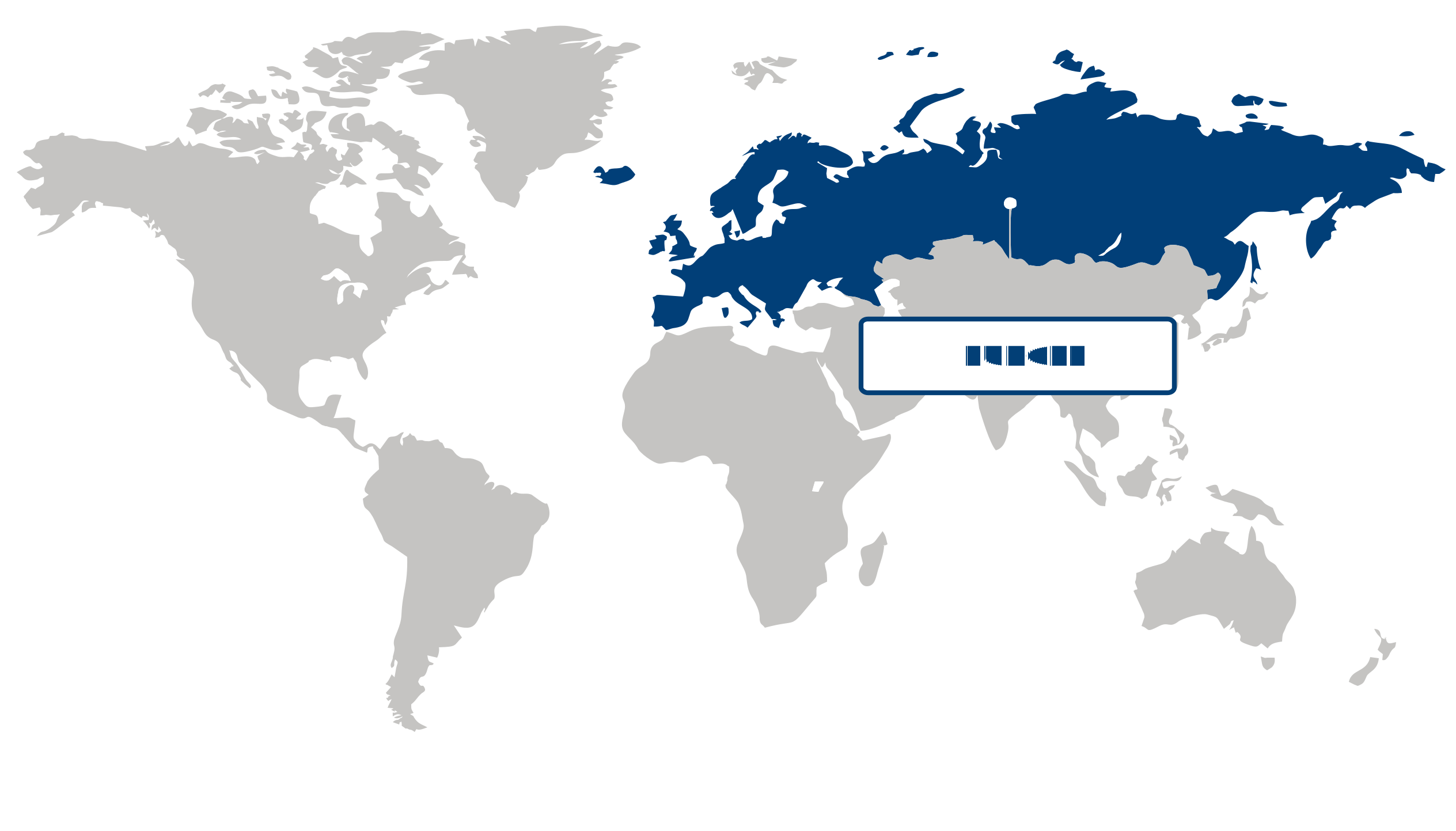
Europe (Largest Region)
Europe held the largest share of 29.20% in the road safety system market in 2026, supported by strong road safety policies, mature transportation infrastructure, and sustained emphasis on reducing traffic-related risks. Governments and transport authorities are increasingly integrating intelligent safety technologies into road networks and vehicles, including collision prevention, traffic monitoring, driver assistance, and incident detection solutions. The region's focus on vehicle and infrastructure safety, combined with established regulatory frameworks, is encouraging continued investment in systems designed to improve situational awareness and protect road users.
Asia Pacific (Fastest-Growing Region)
Asia Pacific is the fastest-growing region, fueled by expanding urban transportation networks, rising vehicle use, and substantial investment in road infrastructure. Rapid urbanization is increasing the need for technologies that can manage traffic complexity, improve intersection safety, and identify hazardous conditions in real time. Growing adoption of connected mobility solutions and intelligent transportation infrastructure is further strengthening demand, particularly as governments and infrastructure operators seek to improve road efficiency while addressing safety challenges associated with expanding transport networks.
| Parameter | North America | Asia Pacific | Europe | Latin America | MEA |
|---|---|---|---|---|---|
| Innovation Hub i Scale Nascent Developing Advanced | |||||
| Cost-Sensitive Region i Scale Low Medium High | |||||
| Regulatory Environment i Scale Restrictive Neutral Supportive | |||||
| Demand Drivers i Scale Weak Moderate Strong | |||||
| Development Stage i Scale Emerging Developing Developed | |||||
| Adoption Rate i Scale Low Medium High | |||||
| New Entrants / Startups i Scale Sparse Moderate Dense | |||||
| Macro Indicators i Scale Weak Stable Strong |
Key Country Insights
Germany 🇩🇪
Connected Transport StandardsGermany advances road safety systems by combining intelligent transport infrastructure with automotive safety innovation. German authorities and industry participants continue integrating digital traffic management solutions that enhance road efficiency and driver safety.
France 🇫🇷
Integrated Mobility SafetyFrance strengthens road safety systems through coordinated investments in intelligent transport infrastructure and digital traffic management. French transportation authorities continue enhancing monitoring capabilities that improve roadway safety and support multimodal mobility planning.
Italy 🇮🇹
Traffic Network ModernizationItaly modernizes road safety systems by upgrading traffic monitoring, highway management, and urban mobility infrastructure. Italian authorities increasingly adopt digital safety technologies that improve incident detection and support more efficient transportation operations.
Japan 🇯🇵
Urban Traffic ResilienceJapan prioritizes road safety systems that support dense urban mobility, aging populations, and efficient traffic operations. Japanese municipalities increasingly deploy intelligent monitoring and adaptive traffic control technologies to strengthen road network reliability.
South Korea 🇰🇷
Smart Infrastructure DeploymentSouth Korea integrates road safety systems with smart city initiatives and connected transportation networks. Investments across South Korea increasingly focus on intelligent traffic monitoring, automated enforcement, and data-driven road management solutions.
United States 🇺🇸
Intelligent Mobility UpgradesThe U.S. expands road safety systems through connected transportation infrastructure, traffic management platforms, and vehicle safety technologies. Public agencies and technology providers increasingly collaborate to improve real-time monitoring and incident response capabilities.
Segment Leadership and Growth Trends
Road Safety System Market Share (%), by Service, 2026
Go beyond the chart, access full insights & data tables
Request Free Sample ReportService Segment Analysis: Professional Services (Largest Segment) vs Managed Services (Fastest-Growing Segment)
Professional services segment accounted for the largest share of the road safety system market, representing 76.29% in 2026. Its strong position is associated with the specialized expertise required to design, implement, integrate, and optimize road safety infrastructure across complex transportation environments. Governments and transportation authorities increasingly require professional support to ensure that safety systems align with roadway conditions, enforcement requirements, and broader traffic management objectives. Demand for system planning, installation guidance, integration, and technical consulting therefore remains central to the deployment of advanced road safety solutions.
Managed services is projected to be the fastest-growing service category as road authorities increasingly seek continuous monitoring, system management, maintenance, and operational support. Outsourcing these activities can help transportation organizations maintain reliable safety infrastructure while reducing the burden of managing increasingly sophisticated technologies internally. The growing emphasis on real-time traffic oversight, system availability, and proactive maintenance is further supporting demand for managed service models.
Solution Segment Analysis: Red Light & Speed Enforcement (Largest Segment) vs Automatic Number/License Plate Recognition (ANPR/ALPR) (Fastest-Growing Segment)
Red light & speed enforcement segment led the road safety system market, accounting for 59% in 2026. Its prominent position is driven by the continued focus of transportation authorities on controlling unsafe driving behavior and improving compliance with traffic regulations. Automated monitoring of speeding and red-light violations enables authorities to identify offenses more consistently while reducing reliance on manual enforcement. The broader emphasis on road safety, traffic discipline, and technology-enabled enforcement continues to support adoption of these systems across urban and highway environments.
Automatic Number/License plate recognition (ANPR/ALPR) is expected to be the fastest-growing solution as transportation authorities increasingly adopt automated vehicle identification and monitoring capabilities. These systems can support traffic enforcement, vehicle tracking, access control, and broader transportation management activities through automated recognition of vehicle registration information. Their ability to integrate with digital enforcement infrastructure and improve the efficiency of traffic monitoring is strengthening demand as road networks become more technology-enabled.
| Segment | Sub-Segment | Largest Segment | Fastest Growing |
|---|---|---|---|
| Service | Professional Services, Managed Services | Professional Services | Managed Services |
| Solution | Red Light & Speed Enforcement, Incident Detection & Response, Automatic Number/License Plate Recognition (ANPR/ALPR), Others | Red Light & Speed Enforcement | Automatic Number/License Plate Recognition (ANPR/ALPR) |
Competitive Landscape and Market Positioning
Prominent players in the road safety system market:
1. Verra Mobility (USA)
2. Conduent Incorporated (USA)
3. Cubic Corporation (USA)
4. Dahua Technology Co. Ltd. (China)
5. Motorola Solutions Inc. (USA)
6. Jenoptik AG (Germany)
7. Kapsch TrafficCom AG (Austria)
8. Siemens AG (Germany)
9. Sensys Gatso Group AB (Sweden)
10. Vitronic Dr.-Ing. Stein Bildverarbeitungssysteme GmbH (Germany)
The road safety system market is gaining momentum with increasing adoption of intelligent traffic management solutions and advanced driver assistance technologies. Developers are focusing on collision prevention systems, real-time traffic monitoring, and connected infrastructure platforms to improve transportation safety outcomes. Government initiatives supporting smart mobility and accident reduction are further accelerating growth in the road safety system market.
| Company | Market Share | Company Revenue | Revenue CAGR (%) | Product Portfolio | Geographic Presence | Innovation / R&D Focus | Strategic Developments |
|---|---|---|---|---|---|---|---|
| Verra Mobility (USA) | |||||||
| Conduent Incorporated (USA) | |||||||
| Cubic Corporation (USA) | |||||||
| Dahua Technology Co. Ltd. (China) | |||||||
| Motorola Solutions Inc. (USA) | |||||||
| Jenoptik AG (Germany) | |||||||
| Kapsch TrafficCom AG (Austria) | |||||||
| Siemens AG (Germany) | |||||||
| Sensys Gatso Group AB (Sweden) | |||||||
| Vitronic Dr.-Ing. Stein Bildverarbeitungssysteme GmbH (Germany). |
Industry Development/News
| Company Name | Date | Key Development |
|---|---|---|
| Transport Ministry (Trinidad and Tobago) | May-26 | The government ministry announced a dual-focused initiative to launch a national road safety awareness campaign alongside the rollout of a regulated "checkered band" maxi taxi system. The standardized fleet framework is designed to provide safe, structured public transport services to underserved rural communities while strengthening localized road safety governance. |
| Road Safety Trust | Mar-26 | The independent grant-giving organization published a 10-year anniversary impact study highlighting its long-term research contributions to UK transit networks. Having invested over £13 million across 120-plus research projects, the organization successfully expanded the empirical evidence base used to shape national road safety policy and government decision-making frameworks. |
| Transoft Solutions | Aug-25 | The transportation software company launched VERALYTIX, a cloud-based predictive road safety management platform. The technology integrates computer vision and artificial intelligence (AI) to evaluate spatial conflicts, enabling transit engineers to analyze vehicle-to-pedestrian near-miss risks and deploy preventative infrastructure solutions. |
| Verra Mobility | Mar-25 | The transport safety corporation partnered with Verizon Connect to embed its specialized tolling management, citation routing, and vehicle compliance microservices natively into Verizon's commercial fleet telematics software ecosystem. |
| Thales | Feb-25 | The technology group collaborated with Cubic Telecom to introduce embedded subscriber identity module (eSIM)-enabled connected-vehicle tracking architectures, providing traffic enforcement agencies with advanced vehicle-to-everything (V2X) verification capabilities. |
| Siemens Mobility | Feb-25 | The transport engineering firm secured a landmark EUR 2.8 billion (USD 3.024 billion) control, signaling, and safety infrastructure contract from German railway operator Deutsche Bahn, expanding its multi-modal automated network compliance portfolio. |
| ISS (Intelligent Security Systems) | Jan-25 | The security software vendor debuted Intellisection, an end-to-end AI-powered video intelligence suite. Built with deep neural networks, the modular platform automates intersection data collection, conflict monitoring, and real-time accident alerts to support urban traffic planning. |
| Indra | Jan-25 | A corporate joint venture led by Indra (51%), along with Kapsch TrafficCom (33%) and Worldline (16%), secured a USD 97.1 million contract from public transit authorities in Spain to deploy national radar hardware systems and back-office violation processing software. |
| Verra Mobility Corporation | Jun-24 | The smart mobility specialist partnered with Hayden AI to accelerate the commercialization of machine learning-based mobile perception tools across the U.S. The alliance combines Hayden's automated perception tech with Verra's system integration to deliver transit lane enforcement capabilities. |
| Sensys Gatso Group | May-24 | The traffic enforcement provider finalized a five-year contract renewal with the City of Libertyville, Illinois, valued at USD 0.512 million, to upgrade localized red-light traffic enforcement intersections with 4K multi-tracking video cameras. |
Customize Your Report
Explore examples of how this report can be tailored to different research needs, including custom segments, additional topics or chapters, and related reports. Click a section of the wheel or its numbered marker to explore the available options.
Road Safety System Market — Custom Segments
| Segment | Sub-Segment |
|---|---|
| Road Infrastructure Type | Urban Roads, Highways & Expressways, Rural Roads, Tunnels & Bridges |
| Ownership & Operating Model | Government-Owned & Operated, Public-Private Partnership, Privately Owned & Operated, Toll Road Operators |
| Project Type | New Infrastructure Projects, Road Safety Upgrades, System Modernization & Replacement, Network Expansion Projects |
Road Safety System Market — Custom TOC
| Custom Chapter | Custom Details |
|---|---|
| National Road Safety Investment Prioritization |
|
| Intelligent Transportation Infrastructure Readiness Assessment |
|
| Urban Mobility Safety Transformation Outlook |
|
Need a different cut of the data?
Request Custom ResearchHow much revenue does the road safety system market generate?
What is the forecasted size of the road safety system industry?
Why are government road safety initiatives driving investment in integrated enforcement platforms?
How is connected vehicle adoption influencing infrastructure modernization in the road safety system market?
Why do professional services dominate the road safety system market?
How is ANPR/ALPR shaping growth in the road safety system market?
Why does Europe lead the road safety system market?
How is Asia Pacific expanding in road safety systems?
What are the prominent companies operating in the road safety system landscape?
Our Clients
"The team surpassed our expectations with the report depth. The actionable insights provided proved crucial in navigating market challenges."
Tata Motors
"We found the report to be very informative. The expertise and attention to market nuances significantly influenced our business direction."
DENSO Corporation
"The consumer survey findings were quite good. We now have a clearer picture of the customer churning and retention strategy."
HL Mando
Our Research Team & Methodology
Every Fundamental Business Insights report is built by a dedicated vertical research team, validated through a structured primary-and-secondary methodology, and reviewed for accuracy before it reaches you.
Research Team Overview
Prepared by the Automotive & Transportation Research Team
Delivery
Published
Demand
Available
Support
Trust & Compliance
Research Domains
10 coverage areasResearch Intelligence
| Source | Reference |
|---|---|
| International Organization of Motor Vehicle Manufacturers (OICA) | www.oica.net |
| SAE International | www.sae.org |
| International Energy Agency (IEA) | www.iea.org |
| International Transport Forum (ITF) | www.itf-oecd.org |
| International Road Federation (IRF) | www.irf.global |
| International Organization for Standardization (ISO) | www.iso.org |
| United Nations Economic Commission for Europe (UNECE) | unece.org |
| National Highway Traffic Safety Administration (NHTSA) | www.nhtsa.gov |
| U.S. Department of Transportation (USDOT) | www.transportation.gov |
| European Automobile Manufacturers' Association (ACEA) | www.acea.auto |
| Society of Indian Automobile Manufacturers (SIAM) | www.siam.in |
| International Air Transport Association (IATA) | www.iata.org |
| International Civil Aviation Organization (ICAO) | www.icao.int |
| International Maritime Organization (IMO) | www.imo.org |
| International Union of Railways (UIC) | uic.org |
| American Public Transportation Association (APTA) | www.apta.com |
| International Federation of Robotics (IFR) | ifr.org |
| CharIN | www.charin.global |
| World Shipping Council | www.worldshipping.org |
| International Federation of Freight Forwarders Associations (FIATA) | fiata.org |
Research Workflow & Quality Assurance
Data Collection
Verified information gathered through primary and secondary research.
Data Triangulation
Cross-validation using multiple independent data sources.
Forecast Modelling
Market estimates developed using historical trends and analytical models.
Analyst Validation
Findings reviewed by domain experts for accuracy and consistency.
Editorial & Quality Review
Final editorial, quality, and compliance checks before publication.
Final Publication
Released after successful completion of the internal review process.
Report Coverage
📊 Market Assessment
- Market Size & Forecast
- Market Segmentation
- Regional Analysis
- Growth Drivers & Challenges
- Market Dynamics
🏢 Competitive Intelligence
- Competitive Landscape
- Company Profiles
- Competitive Benchmarking
- Mergers & Acquisitions
- Market Share Analysis or Key Company Strategies
🔍 Strategic Analysis
- Value Chain Analysis
- Porter's Five Forces
- PESTLE Analysis
- Pricing Trends
- Supply-Demand Analysis
🚀 Future Outlook
- Technology Landscape
- Regulatory Landscape
- Investment & Funding Landscape
- Emerging Opportunities
- Future Market Outlook
Have a question about this report or need a custom scope?
Request Customization