Second-Hand Fashion Market Size & Growth Forecast 2027–2036, By Segments (Product Type, Consumer Group, Distribution Channel, Price Range), Regional Demand Trends (North America, Asia Pacific, Europe), Key Country Insights (U.S., Japan, South Korea, Germany, France, Italy), and Competitive Landscape
Jump to Content
Market Size and Growth Outlook
Second-Hand Fashion Market size was assessed at USD 226.13 Billion in 2026 and is poised to grow at 11.13% CAGR between 2027 and 2036, surpassing USD 649.64 Billion by 2036. The industry revenue for 2027 is calculated at USD 247.91 Billion.
Get more details on this report
Request Free Sample ReportSecond-Hand Fashion Market Intelligence Snapshot
Regional Market Dynamics
- Europe led in 2026 through strong consumer acceptance of resale, circular fashion awareness, organized resale channels, and expanding digital marketplaces.
- Asia Pacific is growing fastest as digital commerce, rising fashion consciousness, disposable incomes, and access to e-commerce and digital payments expand resale participation.
Segment Momentum
- Clothing accounted for 58.94% of the market in 2026, supported by broad product availability, value-oriented purchasing, and growing consumer acceptance of resale as a sustainable fashion shopping channel.
- Men represent the fastest-growing consumer group as rising interest in affordable, sustainable fashion and improved access through online resale platforms encourage greater participation in second-hand shopping.
Market Expansion Drivers
- Rising environmental awareness driving demand for sustainable and circular fashion consumption
- Cost-effective apparel alternatives increasing adoption of resale and thrift platforms
- Digital resale marketplaces expanding accessibility and scalability of second-hand clothing trade
Leading Market Participants
- Top companies in the second-hand fashion market include ThredUp Inc. (United States), The RealReal, Inc. (United States), Poshmark, Inc. (United States), Vinted UAB (Lithuania), Vestiaire Collective (France), eBay Inc. (United States), StockX LLC (United States), Grailed, Inc. (United States), Goodwill Industries International, Inc. (United States), Buffalo Exchange Ltd. (United States)
Global Market Forecast Snapshot
Market Outlook
- 2026 Market Size: USD 226.13 Billion
- 2027 Estimated Market Size: USD 247.91 Billion
- Projected Market Size: USD 649.64 Billion by 2036
- Growth Forecast: 11.13% CAGR (2027-2036)
Regional and Segment Outlook
- Leading Regional Market: Europe
- High-Growth Regional Hub: Asia Pacific
- Core Revenue Segment: Clothing (Product Type) | Women (Consumer Group) | Online (Distribution Channel) | Low (Price Range)
- Emerging Opportunity Segment: Accessories (Product Type) | Men (Consumer Group) | Online (Distribution Channel) | High (Price Range)
Market Growth Drivers and Industry Trends
Rising environmental awareness driving demand for sustainable and circular fashion consumption
Growing consumer concern over textile waste, resource conservation, and the environmental impact of fast fashion is reshaping purchasing behavior across global apparel markets. This shift will drive the second-hand fashion market growth as consumers increasingly embrace circular consumption models that extend the lifespan of clothing through resale, reuse, and recommerce. Retailers and fashion platforms are also incorporating resale initiatives into their business strategies, encouraging responsible consumption while reducing unnecessary garment disposal and supporting more sustainable wardrobe choices.
Cost-effective apparel alternatives increasing adoption of resale and thrift platforms
Economic considerations are motivating consumers to seek affordable fashion options without compromising product variety or brand preferences. The second-hand fashion market benefits from this trend because resale and thrift platforms provide access to quality apparel at lower prices than newly manufactured alternatives, attracting budget-conscious shoppers across diverse demographic groups. The availability of branded, vintage, and premium clothing through resale channels also broadens purchasing options while encouraging repeat engagement with second-hand retail ecosystems.
Digital resale marketplaces expanding accessibility and scalability of second-hand clothing trade
Online resale platforms are transforming the way consumers buy and sell pre-owned apparel by simplifying product discovery, secure transactions, and nationwide or cross-border shipping. Expanding digital infrastructure is accelerating the second-hand fashion market as technology-enabled marketplaces connect a larger pool of buyers and sellers through user-friendly interfaces, authentication services, and personalized recommendations. Integrated payment solutions, logistics support, and data-driven pricing tools further improve transaction efficiency while enabling resale businesses to scale operations across multiple regions.
| Growth Driver | Impact on CAGR | Regulatory Influence | Geographic Relevance | Adoption Rate | Impact Timeline |
|---|---|---|---|---|---|
| Rising environmental awareness driving demand for sustainable and circular fashion consumption | 2% | Moderate | Europe, North America | High | Near Term |
| Cost-effective apparel alternatives increasing adoption of resale and thrift platforms | 1.8% | Low | North America, Asia Pacific | High | Near Term |
| Digital resale marketplaces expanding accessibility and scalability of second-hand clothing trade | 1.6% | Low | Global | High | Mid Term |
Unlock insights tailored to your business with our bespoke market research solutions.
Click to get your customized report now.
Regional Demand Dynamics
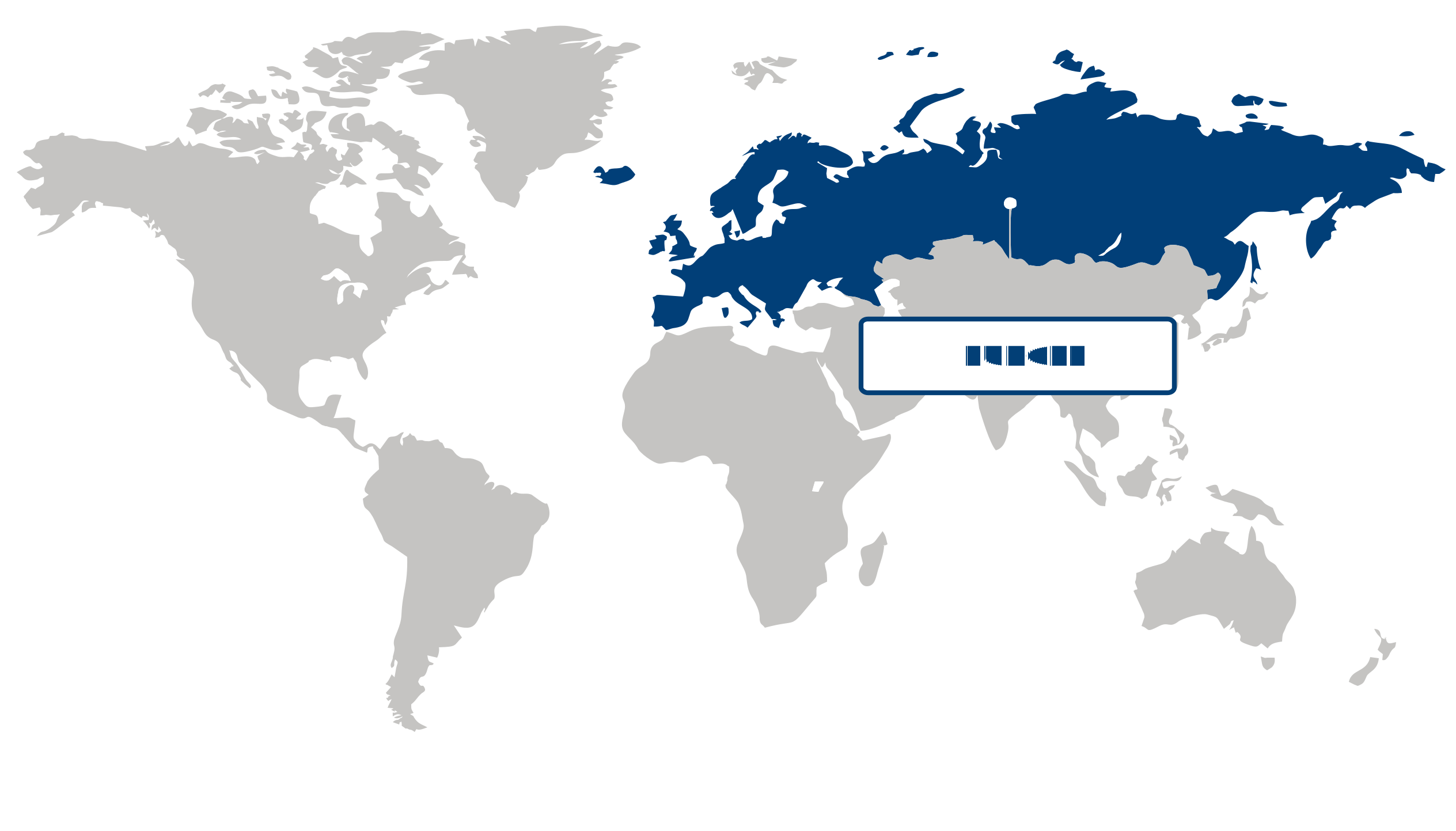
Europe (Largest Region)
Europe held the largest share of the second-hand fashion market in 2026. The region benefits from strong consumer acceptance of resale and pre-owned apparel, supported by growing awareness of circular fashion, waste reduction, and sustainable consumption. Consumers are increasingly viewing second-hand clothing as an accessible way to extend garment lifecycles while obtaining distinctive or affordable fashion products. The development of organized resale channels and digital marketplaces is also improving product accessibility and encouraging participation among a broader range of consumers.
Asia Pacific (Fastest-Growing Region)
Asia Pacific is expected to be the fastest-growing regional market, driven by rising fashion consciousness, expanding digital commerce, and increasing interest in affordable clothing options. A large and increasingly connected consumer base is creating favorable conditions for online resale platforms and peer-to-peer transactions. Growing awareness of sustainable consumption, combined with rising disposable incomes and greater access to digital payment and e-commerce infrastructure, is further encouraging consumers to participate in second-hand fashion. These trends are helping resale models expand beyond traditional informal channels into more organized and technology-enabled marketplaces.
| Parameter | North America | Asia Pacific | Europe | Latin America | MEA |
|---|---|---|---|---|---|
| Innovation HubiScaleNascentDeveloping Advanced | |||||
| Cost-Sensitive RegioniScaleLowMedium High | |||||
| Regulatory EnvironmentiScaleRestrictiveNeutral Supportive | |||||
| Demand DriversiScaleWeakModerate Strong | |||||
| Development StageiScaleEmergingDeveloping Developed | |||||
| Adoption RateiScaleLowMedium High | |||||
| New Entrants / StartupsiScaleSparseModerate Dense | |||||
| Macro IndicatorsiScaleWeakStable Strong |
Key Country Insights
United States 🇺🇸
Digital Resale ExpansionThe U.S. continues expanding second-hand fashion through online resale platforms, branded recommerce programs, and consumer demand for affordable apparel. Retailers increasingly invest in authentication, logistics, and digital marketplace capabilities to strengthen customer confidence.
Germany 🇩🇪
Circular Retail AdoptionGermany integrates second-hand fashion into broader circular economy initiatives supported by both retailers and consumers. German businesses focus on transparent product grading, efficient collection networks, and resale models that extend garment lifecycles.
Japan 🇯🇵
Premium Pre-Owned DemandJapan maintains a well-established market for second-hand fashion where quality inspection and product condition are central purchasing factors. Consumers in Japan value authenticated luxury resale alongside carefully curated everyday apparel selections.
South Korea 🇰🇷
Trend-Driven Resale CultureSouth Korea combines fashion-conscious consumers with growing acceptance of digital resale platforms for branded apparel. Businesses increasingly emphasize authenticated listings, convenient mobile transactions, and rapid inventory turnover to match changing fashion preferences.
France 🇫🇷
Luxury Resale EcosystemFrance strengthens second-hand fashion through established demand for premium apparel and designer goods. French resale businesses prioritize authentication expertise, curated product offerings, and sustainable consumption models that appeal to value-conscious shoppers.
Italy 🇮🇹
Designer Circular CommerceItaly expands second-hand fashion through resale of luxury and premium clothing supported by growing consumer interest in sustainable purchasing. Italian retailers increasingly develop refurbishment, authentication, and omnichannel resale capabilities to enhance product value and customer trust.
Second-Hand Fashion Market Share (%), by Product Type, 2026
Go beyond the chart, access full insights & data tables
Request Free Sample ReportProduct Type Segment Analysis: Clothing (Largest Segment) vs Accessories (Fastest-Growing Segment)
The clothing segment led the second-hand fashion market in 2026, accounting for 58.94% of the market. Clothing represents a broad and frequently traded category within resale fashion, offering consumers access to a wide variety of styles and products at more accessible prices than new apparel. Increasing consumer interest in value-oriented shopping and more sustainable consumption is encouraging the circulation of pre-owned garments. The growing acceptance of resale as an established fashion purchasing channel is further supporting the segment's strong market position.
Accessories are the fastest-growing product type, supported by increasing consumer interest in extending the lifecycle of fashion items beyond traditional apparel. Pre-owned bags, footwear, jewelry, and other accessories can provide distinctive styles and perceived value while supporting more circular consumption practices. Growing interest in vintage and unique fashion pieces, combined with expanding acceptance of second-hand purchasing, is creating favorable conditions for stronger accessories resale activity.
Consumer Group Segment Analysis: Women (Largest Segment) vs Men (Fastest-Growing Segment)
The women segment captured the largest share of the second-hand fashion market in 2026, representing 57.77%. Women's fashion encompasses a broad range of clothing and accessories, providing substantial opportunities for resale across changing styles, occasions, and price points. Increasing awareness of value-conscious shopping and sustainable fashion consumption is encouraging more women to participate in resale markets. The broad availability and variety of pre-owned women's fashion products further support the segment's leading position.
The men segment is the fastest-growing consumer group, reflecting increasing acceptance of second-hand fashion among male consumers. Greater awareness of affordability, product value, and sustainable consumption is encouraging men to explore resale channels for clothing and accessories. The expansion of online resale platforms and improved availability of curated second-hand products are also making pre-owned fashion more accessible, helping broaden participation among male shoppers.
Distribution Channel Segment Analysis: Online (Largest & Fastest-Growing Segment)
The online segment dominated the second-hand fashion market in 2026 and was also the fastest-growing distribution channel. Digital resale platforms provide consumers with convenient access to extensive selections of pre-owned clothing and accessories without the geographic limitations associated with physical stores. Online channels also make it easier to compare products, discover distinctive items, communicate with sellers, and participate in resale transactions. Increasing consumer comfort with digital shopping, combined with the growing visibility of circular fashion, continues to strengthen online second-hand fashion adoption.
| Segment | Sub-Segment | Largest Segment | Fastest Growing |
|---|---|---|---|
| Product Type | Clothing, Accessories | Clothing | Accessories |
| Consumer Group | Men, Women, Kids | Women | Men |
| Distribution Channel | Online, Offline | Online | Online |
| Price Range | Low, Medium, High | Low | High |
Competitive Landscape and Market Positioning
Leading companies in the second-hand fashion market:
- ThredUp, Inc. (United States)
- The RealReal, Inc. (United States)
- Poshmark, Inc. (United States)
- Vinted UAB (Lithuania)
- Vestiaire Collective (France)
- eBay, Inc. (United States)
- StockX LLC (United States)
- Grailed, Inc. (United States)
- Goodwill Industries International, Inc. (United States)
- Buffalo Exchange Ltd. (United States)
Competitive momentum in the second-hand fashion market is shifting toward ecosystem development rather than simple product resale. Market participants are expanding authentication capabilities, digital merchandising, and streamlined logistics to improve buyer confidence and accelerate inventory turnover, while also enhancing seller experiences through simplified listing and fulfillment processes. At the same time, businesses with access to strong sourcing networks and curated product selections are distinguishing themselves from volume-driven competitors by emphasizing quality assurance and brand credibility. This evolution is gradually redefining competition around operational efficiency, trust, and customer retention instead of price alone.
| Company | Market Share | Company Revenue | Revenue CAGR (%) | Product Portfolio | Geographic Presence | Innovation / R&D Focus | Strategic Developments |
|---|---|---|---|---|---|---|---|
| ThredUp Inc. (United States) | |||||||
| The RealReal Inc. (United States) | |||||||
| Poshmark Inc. (United States) | |||||||
| Vinted UAB (Lithuania) | |||||||
| Vestiaire Collective (France) | |||||||
| eBay Inc. (United States) | |||||||
| StockX LLC (United States) | |||||||
| Grailed Inc. (United States) | |||||||
| Goodwill Industries International Inc. (United States) | |||||||
| Buffalo Exchange Ltd. (United States) |
Industry Development/News
| Company Name | Date | Key Development |
|---|---|---|
| Kappahl Group | Jun-26 | Kappahl Group acquired a majority stake in Arkivet Second Hand through a definitive strategic agreement. The transaction directly strengthens the company's circular fashion framework and accelerates its operational expansion within the rapidly growing second-hand fashion market. |
| Vinted | Jun-26 | Vinted established a strategic partnership with Australia Post to serve as its core delivery partner, supporting the platform's official commercial launch in Australia. This initiative strengthens Vinted's global logistics network and facilitates direct entry into the Australian second-hand fashion ecosystem. |
| eBay | Jun-26 | eBay's proposed acquisition of second-hand fashion marketplace Depop entered a Phase 1 merger inquiry by the UK Competition and Markets Authority. This regulatory evaluation follows the previously announced $1.2 billion transaction with Etsy, impacting competitive dynamics within the global resale sector. |
| Zalando | May-26 | Zalando partnered with Vestiaire Collective to significantly expand its pre-owned inventory by integrating authenticated designer second-hand garments. This collaboration opens Zalando's pre-owned category to external marketplace partners, substantially reinforcing its position in the circular fashion ecosystem. |
| Yaga | Oct-25 | Yaga secured €4 million in a pre-Series A funding round designed to accelerate the operational expansion of its second-hand fashion marketplace. The capital injection will primarily fund the platform's strategic growth initiatives across Africa and the Middle East and North Africa region. |
| 2nd STREET | May-25 | Japanese second-hand fashion retailer 2nd STREET expanded its international retail footprint by opening its first brick-and-mortar outlet in Hong Kong. This strategic move strengthens the company's physical presence and competitive positioning within the expanding Asian resale fashion market. |
| Dabchy | Feb-25 | Dabchy secured a pre-Series A funding round led by Janngo Capital to accelerate the regional expansion of its second-hand fashion platform. The investment will be deployed to diversify the company's product offerings and further develop its core e-commerce marketplace infrastructure. |
| Saha Group | Dec-24 | Saha Group partnered with Japanese company Ragtag to officially launch the second-hand fashion retail brand within Thailand. This cross-border alliance expands Saha Group's operational footprint and capitalizing on consumer demand within the growing Southeast Asian circular fashion market. |
| Fleek | Nov-24 | Fleek raised £17 million through successful Seed and Series A funding rounds, backed by prominent technology and retail investors including Shopify's President. The capital injection is allocated to scale platform development and support the rapid growth of its fashion marketplace. |
| Vinted | Oct-24 | Vinted raised €340 million in a funding round at a €5 billion valuation, providing substantial growth capital to the platform. The investment is structured to fortify Vinted's leading market position and support the long-term expansion of its online second-hand fashion marketplace across Europe. |
Customize Your Report
Explore examples of how this report can be tailored to different research needs, including custom segments, additional topics or chapters, and related reports. Click a section of the wheel or its numbered marker to explore the available options.
Second-Hand Fashion Market — Custom Segments
| Segment | Sub-Segment |
|---|---|
| Transaction Model | Consignment, Peer-to-Peer, Buyout & Resale, Trade-In |
| Seller Type | Individual Sellers, Professional Resellers, Retailers & Brands, Thrift & Charity Organizations |
| Garment Condition | New With Tags, Like New, Gently Used, Heavily Used |
Second-Hand Fashion Market — Custom TOC
| Custom Chapter | Chapter Details |
|---|---|
| Consumer Resale Behavior and Adoption Dynamics |
|
| Circular Fashion Ecosystem and Business Models |
|
| Luxury Resale Opportunity and Trust Framework |
|
Need a different cut of the data?
Request Custom ResearchFrequently Asked Questions
How large is the second-hand fashion market?
How is the second-hand fashion industry projected to perform over the next decade?
How are sustainability trends accelerating growth in the second-hand fashion market?
Why are digital resale platforms becoming strategically important in the second-hand fashion market?
Why does clothing dominate the second-hand fashion market?
Which consumer group is expanding the fastest in the second-hand fashion market?
Why does Europe lead the second-hand fashion market?
How is Asia Pacific accelerating second-hand fashion growth?
Who holds a significant market share in the second-hand fashion landscape?
Our Clients
"The report provided us with a clear direction, and the level of detail was beyond what we expected. I would definitely recommend their services to others."
Haier Appliances
"The collaboration with Fundamental Business Insights has added significant value to our decision-making process, and we look forward to continuing this partnership for our future market research requirements."
Luxottica Group S.p.A.
"The team at FBI delivered an exceptional research report. The insights on industry innovations were particularly impressive and added a lot of value to the overall report."
Nike
Our Research Team & Methodology
Every Fundamental Business Insights report is built by a dedicated vertical research team, validated through a structured primary-and-secondary methodology, and reviewed for accuracy before it reaches you.
Delivery
Published
Available
Support
- Market Size & Forecast
- Market Segmentation
- Regional Analysis
- Growth Drivers & Challenges
- Market Dynamics
- Competitive Landscape
- Company Profiles
- Competitive Benchmarking
- Mergers & Acquisitions
- Market Share Analysis or Key Company Strategies
- Value Chain Analysis
- Porter's Five Forces
- PESTLE Analysis
- Pricing Trends
- Supply-Demand Analysis
- Technology Landscape
- Regulatory Landscape
- Investment & Funding Landscape
- Emerging Opportunities
- Future Market Outlook