



Secure Logistics Market Size & Growth Forecast 2027–2036, By Segments (Type, Mode of Transport, End-User, Application), Regional Demand Trends (North America, Asia Pacific, Europe), Key Country Insights (U.S., Japan, South Korea, Germany, France, Italy), and Competitive Landscape
Market Size and Growth Outlook
Secure Logistics Market size was estimated at USD 107.6 billion in 2026 and is projected to grow at a 8.65% CAGR from 2027 to 2036, crossing USD 246.67 billion by 2036. The industry revenue for 2027 is assessed at USD 115.43 billion.
Base Year Value (2026)
USD 107.6 billion
CAGR (2027-2036)
8.65%
Forecast Year Value (2036)
USD 246.67 billion

Historical Data Period
2022-2026

Largest Region
Europe

Forecast Period
2027-2036
Secure Logistics Market Intelligence Snapshot:
-
Regional Market Dynamics:
- Europe’s 44.10% share is driven by mature banking networks, established cash management systems, armored transport infrastructure, and consistent demand from retail and financial institutions.
- Asia Pacific’s 10.4% CAGR is driven by rising cash circulation, expanding organized retail, increasing financial access, and growing demand for secure logistics services.
-
Segment Momentum:
- Static solutions held a 62.48% share in 2026 because organizations rely on secure storage environments for valuables, cash, and sensitive assets where continuous monitoring and controlled protection are priorities.
- Air is the fastest-growing transport mode as demand increases for rapid, long-distance movement of high-value shipments where delivery speed and strict transit timelines are critical.
-
Market Expansion Drivers:
- Expanding banking networks and ATM infrastructure increasing demand for cash-in-transit security services.
- Integration of IoT, AI, and blockchain enhancing real-time tracking and logistics security efficiency.
- Rising movement of high-value goods including pharmaceuticals and electronics boosting secure transport demand.
-
Leading Market Participants:
Prominent players in the secure logistics market include Brink’s Incorporated (United States), GardaWorld Corporation (Canada), Prosegur Compañía de Seguridad, S.A. (Spain), Loomis AB (Sweden), Securitas AB (Sweden), G4S Limited (United Kingdom), Allied Universal (United States), CMS Info Systems Limited (India), MALCA-AMIT Group of Companies (Hong Kong), CargoGuard GmbH (Germany).
Global Market Forecast Snapshot:
-
Market Outlook:
- 2026 Market Size: USD 107.6 billion
- 2027 Estimated Market Size: USD 115.43 billion.
- Projected Market Size: USD 246.67 billion by 2036
- Growth Forecasts: 8.65% CAGR (2027-2036)
-
Regional and Segment Outlook:
- Leading Regional Market: Europe
- High-Growth Regional Hub: Asia Pacific
- Core Revenue Segment: Static (Type) | Road (Mode of Transport) | Financial Institutions (End-User) | Cash Management (Application)
- Emerging Opportunity Segment: Mobile (Type) | Air (Mode of Transport) | Government (End-User) | Manufacturing (Application)
Market Growth Drivers and Industry Trends
Expanding banking networks and ATM infrastructure increasing demand for cash-in-transit security services
Expanding banking networks and ATM infrastructure will drive the secure logistics market growth by increasing the frequency and geographic reach of cash movement between financial institutions, automated teller machines, retail locations, and cash-processing facilities. As financial networks expand into new locations, specialized services are required to collect, transport, replenish, and securely manage physical currency. Secure transportation vehicles, monitoring systems, trained personnel, and controlled handling procedures become essential components of these operations, particularly where large volumes of cash must be moved across dispersed banking networks.
Integration of IoT, AI, and blockchain enhancing real-time tracking and logistics security efficiency
The integration of IoT, AI, and blockchain is transforming the secure logistics market through stronger visibility, automated monitoring, and more reliable control over sensitive shipments. IoT-enabled devices can provide continuous information on vehicle locations, cargo conditions, and security events, while AI can support route optimization, anomaly detection, and risk assessment. Blockchain-based systems can additionally strengthen transaction and custody records by creating more traceable information flows across multiple parties, enabling logistics operators to coordinate security processes with greater operational transparency.
Rising movement of high-value goods including pharmaceuticals and electronics boosting secure transport demand
The rising movement of high-value goods will boost the secure logistics market demand as pharmaceuticals, electronics, luxury products, and other sensitive cargo require greater protection against theft, tampering, and unauthorized access during transportation. Pharmaceutical shipments can also involve strict handling requirements because product integrity may depend on controlled environmental conditions and secure custody, while high-value electronics carry significant financial exposure during transit. These requirements encourage the use of monitored vehicles, secure packaging, specialized handling procedures, and real-time shipment oversight for sensitive cargo movements.
| Growth Driver Assessment Framework | |||||
| Growth Driver | Impact On CAGR | Regulatory Influence | Geographic Relevance | Adoption Rate | Impact Timeline |
|---|---|---|---|---|---|
| Expanding banking networks and ATM infrastructure increasing demand for cash-in-transit security services | 2.00% | High | Europe, Asia Pacific | High | Near Term |
| Integration of IoT, AI, and blockchain enhancing real-time tracking and logistics security efficiency | 1.80% | High | North America, Europe | High | Mid Term |
| Rising movement of high-value goods including pharmaceuticals and electronics boosting secure transport demand | 1.60% | High | Asia Pacific, Middle East & Africa | Emerging | Mid Term |
Unlock insights tailored to your business with our bespoke market research solutions - Click to get your customized report now!
Regional Demand Dynamics
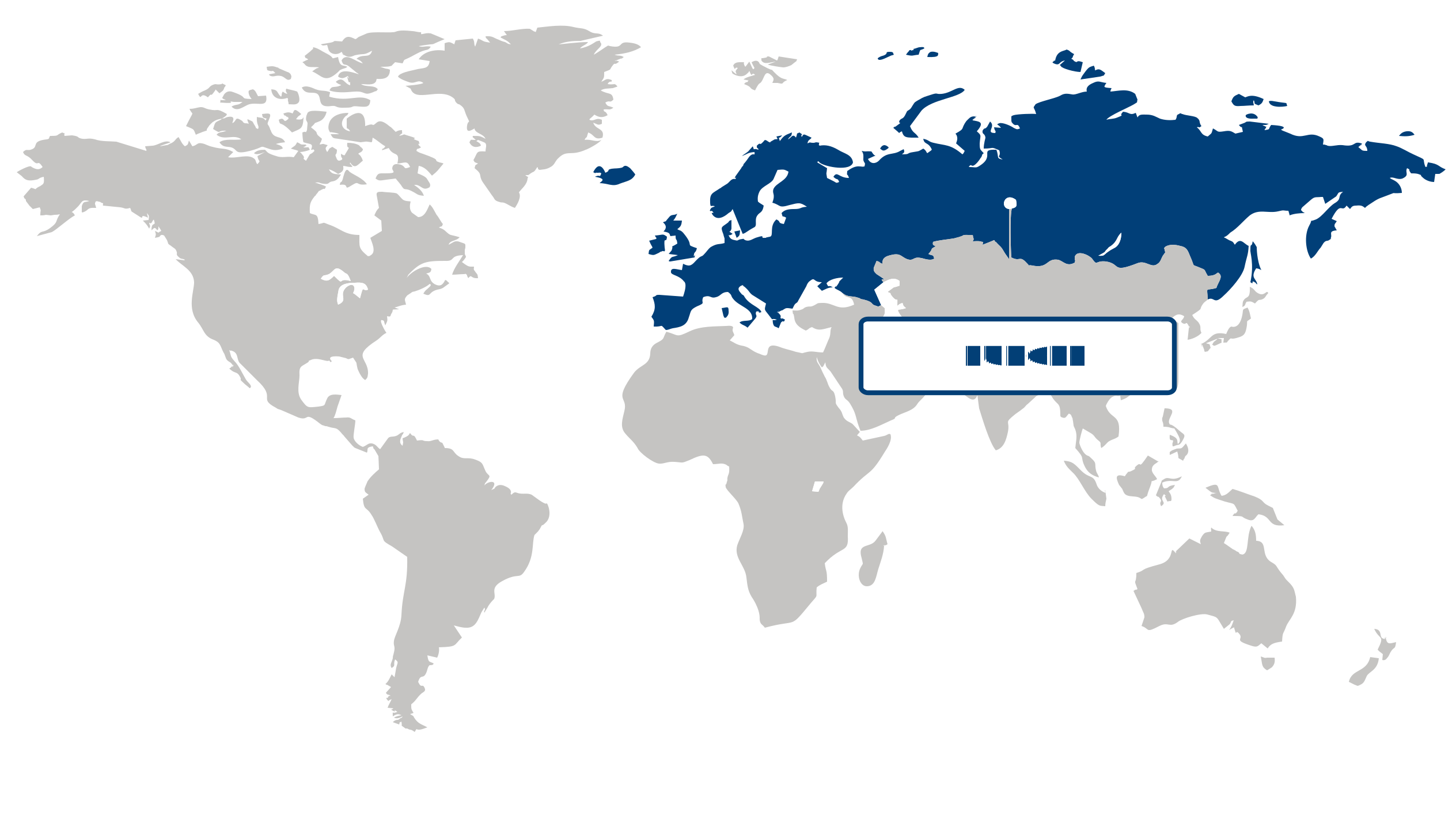
Largest Region
Europe
44.1% Market Share in 2026
Europe (Largest Region) vs Asia Pacific (Fastest-Growing Region)
Europe led the secure logistics market with a 44.10% share in 2026, supported by well-developed transportation infrastructure, established security standards, and strong demand for protected movement of high-value and sensitive goods. The region's mature logistics ecosystem enables the integration of advanced tracking, monitoring, access-control, and risk-management solutions across supply chains. Increasing concerns surrounding theft, cargo security, and supply-chain resilience are encouraging logistics operators to strengthen protection measures, while regulatory requirements and cross-border trade complexity further support demand for secure logistics services.
Asia Pacific is experiencing the fastest growth, fueled by expanding trade activity, rapid development of logistics infrastructure, and increasing movement of high-value goods across regional supply chains. The growth of e-commerce, manufacturing, pharmaceuticals, and other security-sensitive industries is creating greater requirements for reliable cargo protection and real-time shipment visibility. Investments in digital tracking, automated security systems, and modern logistics facilities are improving supply-chain resilience and supporting wider adoption of secure logistics solutions.
Key Country Insights
The U.S. secure logistics market focuses on protecting cash, pharmaceuticals, electronics, and confidential assets through integrated transport and monitoring services. Companies increasingly invest in advanced tracking technologies and risk-managed logistics operations to strengthen shipment security.
Japan prioritizes secure logistics services built around reliability, operational precision, and controlled handling of valuable shipments. Organizations seek providers capable of combining secure transportation with advanced monitoring and consistent service quality.
South Korea is expanding secure logistics capabilities through real-time tracking, automated monitoring, and digitally connected transport operations. Businesses increasingly favor logistics providers that enhance shipment visibility while reducing operational security risks.
Germany emphasizes secure logistics solutions that safeguard high-value industrial products and sensitive manufacturing components. Businesses increasingly require traceable transport services supported by strict operational controls and reliable chain-of-custody management.
France places strong emphasis on secure logistics services that comply with strict handling requirements for financial assets, luxury goods, and healthcare products. Service providers continue enhancing secure transport capabilities through specialized infrastructure and operational oversight.
Italy prioritizes secure logistics solutions for valuable retail products, financial assets, and specialized industrial goods. Companies increasingly adopt secure transportation models that improve accountability and reduce supply chain vulnerabilities during distribution.
Segment Leadership and Growth Trends
Type Segment Analysis: Static (Largest Segment) vs Mobile (Fastest-Growing Segment)
The static segment dominated the secure logistics market in 2026, accounting for a 62.48% share. Its leading position is supported by the extensive use of fixed secure facilities, including vaults, cash processing centers, and storage locations, for the protection and management of high-value assets. Organizations handling cash, precious metals, confidential documents, and other sensitive materials rely on static security infrastructure to maintain controlled access, continuous surveillance, and secure storage. The continued need for centralized asset handling and stringent risk management practices further supports the segment's strong market position.
The mobile segment is the fastest-growing type, driven by rising demand for secure transportation services that ensure the protected movement of valuable goods and assets between locations. Expanding commercial activity, increasing movement of cash and valuables, and greater emphasis on end-to-end supply chain security are supporting adoption. The need for real-time tracking, route monitoring, and enhanced protection during transit is also encouraging investment in mobile secure logistics solutions.
Mode of Transport Segment Analysis: Road (Largest Segment) vs Air (Fastest-Growing Segment)
Road transport held the largest share in 2026, supported by its flexibility and ability to provide direct, door-to-door movement of cash, valuables, and other high-security consignments. Its widespread accessibility across urban and regional networks makes it a practical option for frequent and time-sensitive deliveries. The extensive use of armored vehicles and specialized security measures further strengthens the role of road transportation in maintaining secure custody throughout the logistics process.
In the secure logistics market, air transport is the fastest-growing mode of transport, supported by increasing demand for rapid and secure movement of high-value shipments over long distances. Air logistics is particularly suited to time-sensitive consignments requiring faster transit and enhanced handling controls. Growing cross-border trade, international movement of valuable goods, and rising requirements for efficient global logistics networks are contributing to the expansion of this segment.
| Report Segmentation | |||
| Segment | Sub-Segment | Largest Segment | Fastest Growing Segment |
|---|---|---|---|
| Type | Static, Mobile | Static | Mobile |
| Mode of Transport | Road, Rail, Air | Road | Air |
| End-User | Financial Institutions, Retailers, Government, Others | Financial Institutions | Government |
| Application | Cash Management, Diamonds, Jewelry & Precious Metals, Manufacturing, Others | Cash Management | Manufacturing |
 Read our Research Approach
Competitive Landscape and Market Positioning
Leading companies in the secure logistics market:
1. Brink’s Incorporated (United States)
2. GardaWorld Corporation (Canada)
3. Prosegur CompañÃa de Seguridad S.A. (Spain)
4. Loomis AB (Sweden)
5. Securitas AB (Sweden)
6. G4S Limited (United Kingdom)
7. Allied Universal (United States)
8. CMS Info Systems Limited (India)
9. MALCA-AMIT Group of Companies (Hong Kong)
10. CargoGuard GmbH (Germany)
The secure logistics market is witnessing increased adoption of digital tracking systems, automated monitoring tools, and integrated security technologies to improve asset protection and operational transparency. Strategic partnerships focused on strengthening transportation networks and enhancing risk management capabilities are becoming increasingly common. Growing demand for secure movement of valuables and sensitive materials continues to shape competitive strategies across the market.
Industry Development/News
| Company Name | Date | Key Development |
|---|---|---|
| Paladin EnviroTech | Apr-26 | Paladin EnviroTech acquired Ireland-based ICT as part of a $70 million expansion strategy. This acquisition extends the company’s secure IT asset disposition and data-destruction capabilities across Europe, reinforcing its end-to-end technology lifecycle management and secure handling services for sensitive corporate assets. |
| DHL Express | May-26 | DHL Express secured TAPA Facility Security Requirements certification for its Lekki service center in Lagos. This validation of international security standards enhances the company’s capacity for secure cargo handling and strengthens its operational footprint within the emerging logistics landscape of Nigeria. |
| Saudia Cargo | Mar-26 | Saudia Cargo expanded its partnership with the Saudi Ports Authority and the Zakat, Tax and Customs Authority to launch a sea-to-air logistics corridor. This initiative significantly enhances cargo movement efficiency and supply chain connectivity, facilitating more secure and streamlined transit for high-priority goods moving between maritime and aviation channels. |
| The Brink’s Company | Nov-25 | The Brink’s Company entered a strategic partnership with Falcon Gold & Precious Metals to provide specialized vaulting and global logistics services. This collaboration strengthens the company’s competitive position in the high-value asset sector, leveraging its expertise in secure transit and storage to support complex precious metal supply chains. |
| DHL Express | Aug-25 | DHL Express achieved TAPA FSR Class A certification for its Thepharak service center. By attaining the industry's highest cargo security standard, the company bolsters its global secure logistics network and enhances its capability to provide secure, end-to-end transportation for high-risk and high-value shipments. |
| UPS Healthcare Precision Logistics | Feb-25 | Marken rebranded to UPS Healthcare Precision Logistics, consolidating MNX and Polar Speed under one entity. This organizational integration strengthens the company’s unified platform for global healthcare logistics, optimizing time-critical transportation capabilities and patient-access services within the highly regulated and security-sensitive pharmaceutical supply chain. |
| DP World | Feb-25 | DP World inaugurated a new multi-customer warehouse in Miami, significantly expanding its regional logistics infrastructure. The facility increases total fulfillment capacity and enables more robust support for regional supply chain operations, reflecting a strategic effort to enhance distribution scalability for diverse clientele. |
| Talaria Transportation | Mar-24 | Talaria Transportation launched a new distribution platform serving the New York and New Jersey corridor. This expansion aims to bolster secure transportation and logistics services for regulated product markets, addressing growing demand for specialized, high-security handling and distribution in dense, commercially critical urban environments. |
| GardaWorld | Feb-24 | GardaWorld was named a formal endorsed business partner by the Canadian Institute of Traffic and Transportation, marking the first security firm to achieve this status. This recognition validates the company’s role in delivering sophisticated physical and mobile security services, providing a verified operational framework for complex logistics and freight protection. |
| CJ Logistics | Feb-24 | CJ Logistics opened a specialized logistics center in Icheon dedicated to high-volume footwear distribution. This facility scales the company's fulfillment capacity for both e-commerce and retail channels, utilizing specialized handling processes to improve throughput and operational efficiency for high-velocity consumer goods. |
Why Choose Us
Specialized Expertise: Our team comprises industry experts with a deep understanding of your market segment. We bring specialized knowledge and experience that ensures our research and consulting services are tailored to your unique needs.
Customized Solutions: We understand that every client is different. That's why we offer customized research and consulting solutions designed specifically to address your challenges and capitalize on opportunities within your industry.
Proven Results: With a track record of successful projects and satisfied clients, we have demonstrated our ability to deliver tangible results. Our case studies and testimonials speak to our effectiveness in helping clients achieve their goals.
Cutting-Edge Methodologies: We leverage the latest methodologies and technologies to gather insights and drive informed decision-making. Our innovative approach ensures that you stay ahead of the curve and gain a competitive edge in your market.
Client-Centric Approach: Your satisfaction is our top priority. We prioritize open communication, responsiveness, and transparency to ensure that we not only meet but exceed your expectations at every stage of the engagement.
Continuous Innovation: We are committed to continuous improvement and staying at the forefront of our industry. Through ongoing learning, professional development, and investment in new technologies, we ensure that our services are always evolving to meet your evolving needs.
Value for Money: Our competitive pricing and flexible engagement models ensure that you get maximum value for your investment. We are committed to delivering high-quality results that help you achieve a strong return on your investment.
Select Licence Type

