



Semiconductor Manufacturing Equipment Market Size & Growth Forecast 2027–2036, By Segments (Process, Application, Dimension), Regional Demand Trends (North America, Asia Pacific, Europe), Key Country Insights (U.S., Japan, South Korea, Germany, France, Italy), and Competitive Landscape
Market Size and Growth Outlook
Semiconductor Manufacturing Equipment Market size was over USD 128.1 billion in 2026 and is likely to grow at a 7.98% CAGR between 2027 and 2036, attaining USD 276.05 billion by 2036. The industry revenue for 2027 is calculated at USD 136.71 billion.
Base Year Value (2026)
USD 128.1 billion
CAGR (2027-2036)
7.98%
Forecast Year Value (2036)
USD 276.05 billion

Historical Data Period
2022-2026

Largest Region
Asia Pacific

Forecast Period
2027-2036
Semiconductor Manufacturing Equipment Market Intelligence Snapshot:
-
Regional Market Dynamics:
- Asia Pacific leads with a 66.93% share due to its concentrated semiconductor fabrication ecosystem and strong investment in fab expansion, process upgrades, and advanced production capacity.
- Asia Pacific is also growing at a 9.04% CAGR, supported by ongoing fab construction, node modernization, and sustained capital investment in advanced chip manufacturing equipment.
-
Segment Momentum:
- Front-end held a 70.85% share in 2026 because wafer fabrication relies on specialized equipment for critical processes that directly influence device performance, yield, and manufacturing precision.
- Semiconductor Electronics Manufacturing is the fastest-growing application segment as downstream producers expand manufacturing capacity and seek greater production integration and more reliable component handling.
-
Market Expansion Drivers:
- AI and IoT expansion increasing demand for advanced semiconductor fabrication equipment.
- 5G infrastructure rollout driving demand for high-performance chip manufacturing systems.
- Rising geopolitical chip localization investments boosting domestic fab equipment demand.
-
Leading Market Participants:
Prominent companies in the semiconductor manufacturing equipment market include ASML Holding N.V. (Netherlands), Applied Materials, Inc. (United States), Lam Research Corporation (United States), Tokyo Electron Limited (Japan), KLA Corporation (United States), Advantest Corporation (Japan), SCREEN Holdings Co., Ltd. (Japan), ASM International N.V. (Netherlands), Hitachi High-Tech Corporation (Japan), Teradyne, Inc. (United States).
Global Market Forecast Snapshot:
-
Market Outlook:
- 2026 Market Size: USD 128.1 billion
- 2027 Estimated Market Size: USD 136.71 billion.
- Projected Market Size: USD 276.05 billion by 2036
- Growth Forecasts: 7.98% CAGR (2027-2036)
-
Regional and Segment Outlook:
- Leading Regional Market: Asia Pacific
- High-Growth Regional Hub: Asia Pacific
- Core Revenue Segment: Front-end (Process) | Semiconductor Fabrication Plant/Foundry (Application) | 2.5D (Dimension)
- Emerging Opportunity Segment: Back-end (Process) | Semiconductor Electronics Manufacturing (Application) | 3D (Dimension)
Market Growth Drivers and Industry Trends
AI and IoT expansion increasing demand for advanced semiconductor fabrication equipment
Rapid deployment of artificial intelligence and internet of things technologies is driving the semiconductor manufacturing equipment market by increasing requirements for sophisticated chips with greater processing capabilities, memory capacity, and power efficiency. AI workloads require advanced processors and high-performance computing components, while IoT applications depend on increasingly diverse semiconductor devices for connectivity, sensing, and data processing. Meeting these evolving chip requirements encourages manufacturers to invest in advanced fabrication, deposition, lithography, etching, inspection, and process-control equipment capable of supporting increasingly complex semiconductor architectures.
5G infrastructure rollout driving demand for high-performance chip manufacturing systems
Continued deployment of 5G networks is supporting the semiconductor manufacturing equipment market as telecommunications infrastructure requires advanced chips capable of handling higher data throughput, low-latency connectivity, and sophisticated radio-frequency functions. Semiconductor manufacturers are responding to these requirements by developing components for base stations, networking equipment, smartphones, and connected devices, increasing the need for production technologies that can deliver precise and reliable chip structures. The expansion of 5G-enabled applications across communications, industrial systems, vehicles, and connected consumer electronics further broadens the range of semiconductor components requiring advanced manufacturing capabilities.
Rising geopolitical chip localization investments boosting domestic fab equipment demand
Growing emphasis on semiconductor supply-chain resilience is strengthening the semiconductor manufacturing equipment market as governments and industry participants increase investments in domestic fabrication capabilities. Geopolitical tensions and concerns over dependence on concentrated production networks are encouraging the development and expansion of regional semiconductor manufacturing ecosystems. New and upgraded fabrication facilities require extensive equipment across wafer processing, inspection, testing, packaging, and process control, while localization strategies are also prompting greater attention to establishing resilient domestic manufacturing capacity and supporting infrastructure.
| Growth Driver Assessment Framework | |||||
| Growth Driver | Impact On CAGR | Regulatory Influence | Geographic Relevance | Adoption Rate | Impact Timeline |
|---|---|---|---|---|---|
| AI and IoT expansion increasing demand for advanced semiconductor fabrication equipment | 2.30% | Moderate | Asia Pacific, North America | High | Near Term |
| 5G infrastructure rollout driving demand for high-performance chip manufacturing systems | 2.00% | Moderate | Asia Pacific, Europe | High | Near Term |
| Rising geopolitical chip localization investments boosting domestic fab equipment demand | 1.50% | High | North America, Asia Pacific | High | Mid Term |
Unlock insights tailored to your business with our bespoke market research solutions - Click to get your customized report now!
Regional Demand Dynamics
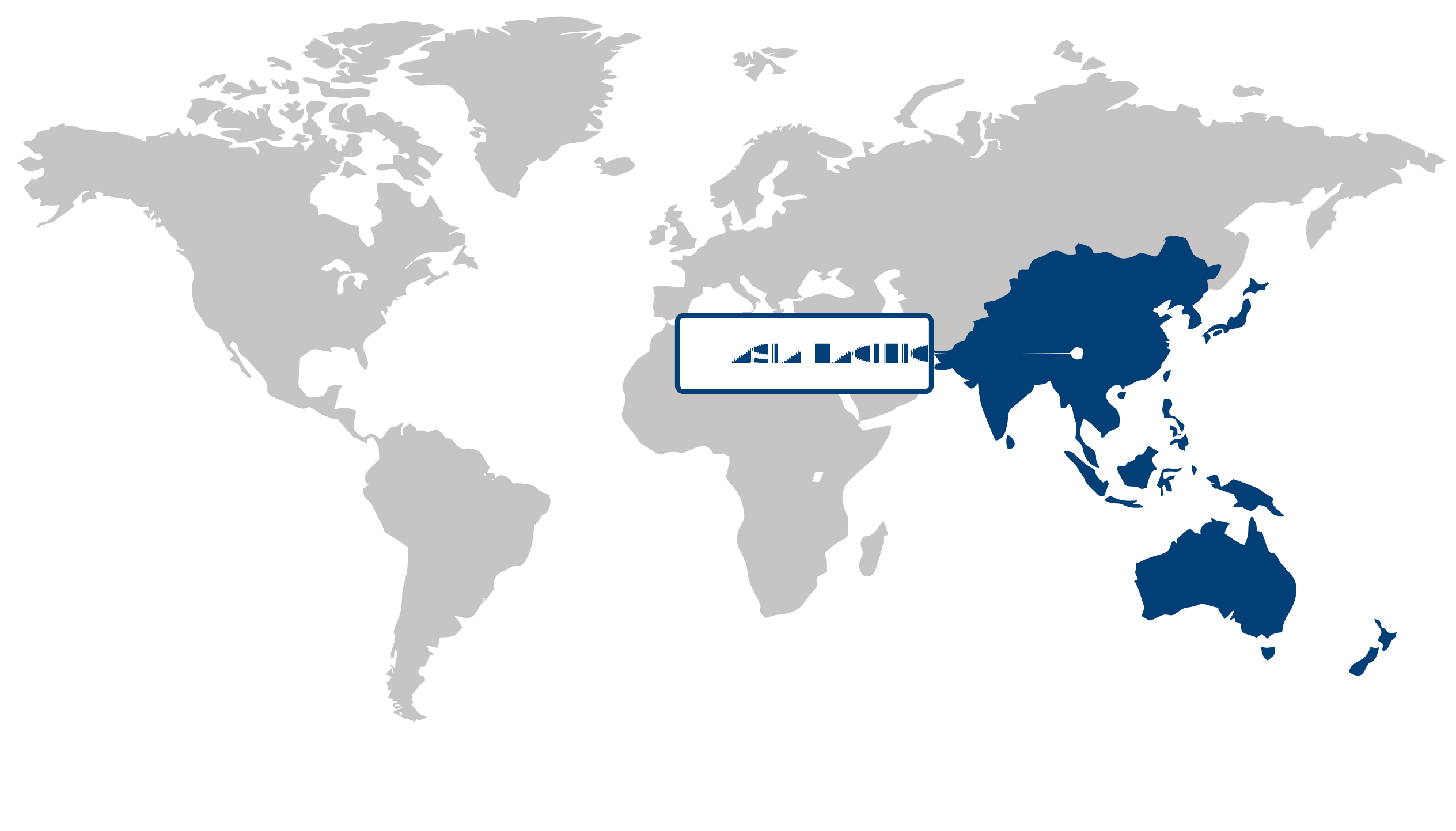
Largest Region
Asia Pacific
66.93% Market Share in 2026
Asia Pacific (Largest & Fastest-Growing Region)
The semiconductor manufacturing equipment market in Asia Pacific held the largest share of 66.93% in 2026 while also representing the fastest-growing region, reflecting the concentration of semiconductor manufacturing capabilities and continued investment in advanced production infrastructure. Strong demand for electronic devices, computing technologies, automotive electronics, and other semiconductor-dependent applications is encouraging expansion of fabrication capacity and modernization of manufacturing facilities. Increasing adoption of advanced process technologies is further driving demand for sophisticated equipment across wafer processing, inspection, packaging, and other stages of semiconductor production, reinforcing the region’s strategic importance in the global semiconductor supply chain.
Key Country Insights
The U.S. semiconductor manufacturing equipment market is supported by expanding domestic fabrication capacity and investment in advanced process technologies. Equipment suppliers focus on automation, precision process control, and production efficiency for next-generation semiconductor manufacturing.
Japan maintains strong demand for semiconductor manufacturing equipment that enhances precision, yield, and production consistency. Equipment developers continue advancing materials processing and manufacturing technologies to support increasingly complex chip fabrication requirements.
South Korea prioritizes semiconductor manufacturing equipment that enhances high-volume memory chip production and advanced fabrication processes. Investment remains focused on improving process efficiency, automation, and equipment performance for increasingly sophisticated manufacturing facilities.
Germany strengthens the semiconductor manufacturing equipment market through precision engineering and advanced production technologies. Demand centers on equipment supporting high-quality wafer processing, inspection, and automation across specialized manufacturing applications.
France supports semiconductor manufacturing equipment adoption through collaboration between research institutions and specialized production facilities. The market emphasizes equipment that enables innovation in advanced semiconductor processes and pilot-scale manufacturing activities.
Italy focuses on semiconductor manufacturing equipment serving specialized electronics production and industrial semiconductor applications. Market participants prioritize flexible equipment platforms that improve manufacturing quality while supporting diverse production requirements.
Segment Leadership and Growth Trends
Process Segment Analysis: Front-end (Largest Segment) vs Back-end (Fastest-Growing Segment)
The front-end process segment dominated the semiconductor manufacturing equipment market with a 70.85% share in 2026, reflecting the extensive equipment requirements associated with wafer preparation, fabrication, and the formation of increasingly sophisticated semiconductor structures. Front-end manufacturing involves highly precise processes that require advanced equipment for maintaining performance, consistency, and process control. The continued push toward more capable semiconductor devices and increasingly complex manufacturing requirements reinforces demand for front-end equipment.
Back-end processing is emerging as the fastest-growing process segment as semiconductor production increasingly emphasizes efficient assembly, packaging, testing, and integration of advanced devices. Growing demand for sophisticated packaging solutions and improved performance at the device level is increasing the importance of back-end manufacturing capabilities. As semiconductor architectures become more complex, investments in advanced packaging and testing technologies are supporting greater adoption of back-end equipment.
Application Segment Analysis: Semiconductor Fabrication Plant/Foundry (Largest Segment) vs Semiconductor Electronics Manufacturing (Fastest-Growing Segment)
Semiconductor fabrication plants and foundries accounted for the largest share of the semiconductor manufacturing equipment market at 49.93% in 2026. These facilities require extensive manufacturing equipment across multiple stages of semiconductor production, from wafer processing through precision fabrication. Increasing semiconductor production complexity, the need for advanced manufacturing capabilities, and continued investment in fabrication capacity support strong equipment demand within this application.
Semiconductor electronics manufacturing is expanding at the fastest pace as electronic products increasingly depend on advanced semiconductor components and increasingly sophisticated manufacturing processes. The proliferation of connected devices, computing technologies, and high-performance electronics is encouraging manufacturers to strengthen their semiconductor production and integration capabilities. Greater emphasis on component performance, manufacturing efficiency, and supply-chain resilience is further supporting equipment adoption in semiconductor electronics manufacturing.
| Report Segmentation | |||
| Segment | Sub-Segment | Largest Segment | Fastest Growing Segment |
|---|---|---|---|
| Process | Front-end, Back-end | Front-end | Back-end |
| Application | Semiconductor Electronics Manufacturing, Semiconductor Fabrication Plant/Foundry, Testing & Inspection | Semiconductor Fabrication Plant/Foundry | Semiconductor Electronics Manufacturing |
| Dimension | 2D, 2.5D, 3D | 2.5D | 3D |
 Read our Research Approach
Competitive Landscape and Market Positioning
Prominent players in the semiconductor manufacturing equipment market:
1. ASML Holding N.V. (Netherlands)
2. Applied Materials Inc. (United States)
3. Lam Research Corporation (United States)
4. Tokyo Electron Limited (Japan)
5. KLA Corporation (United States)
6. Advantest Corporation (Japan)
7. SCREEN Holdings Co. Ltd. (Japan)
8. ASM International N.V. (Netherlands)
9. Hitachi High-Tech Corporation (Japan)
10. Teradyne Inc. (United States)
The semiconductor manufacturing equipment market is being driven by rising investments in next-generation fabrication technologies and advanced chip production capabilities. Equipment providers are focusing on precision engineering, AI-assisted process controls, and automation systems to support increasingly complex semiconductor manufacturing requirements. Growing collaboration across semiconductor supply chains is also strengthening innovation and ecosystem expansion within the semiconductor manufacturing equipment market.
Industry Development/News
| Company Name | Date | Key Development |
|---|---|---|
| Axion Semiconductor | May-26 | Axion Semiconductor acquired Moov Technologies, a leading marketplace for pre-owned semiconductor equipment. The integration of Moov’s digital asset management and transaction platform into Axion’s operating framework strengthens its end-to-end supply chain capabilities, improving equipment sourcing and lifecycle management for global semiconductor manufacturers. |
| Manz Asia and Epson | Mar-26 | Manz Asia and Seiko Epson established a strategic partnership to develop scalable inkjet technology for semiconductor fabrication. By combining specialized semiconductor equipment engineering with high-precision printhead technology, the collaboration aims to provide Lab-to-Fab printing solutions for material deposition in advanced packaging and device architectures. |
| TSMC | Mar-25 | TSMC announced a US$100 billion capital investment in the United States, focused on expanding advanced manufacturing and packaging capacity. This investment strengthens the U.S. semiconductor ecosystem, creating substantial long-term demand for advanced fabrication equipment and supporting the localization of resilient production supply chains. |
| Tokyo Electron | Feb-25 | Tokyo Electron commenced plans to construct a new JPY 104 billion production facility in Miyagi Prefecture, Japan. The project incorporates "Smart Production" automation to scale capacity for plasma etch systems, specifically targeting the projected growth in the global semiconductor equipment market toward 2030. |
| Hitachi High-Tech | Apr-25 | Hitachi High-Tech inaugurated a new semiconductor manufacturing facility aimed at enhancing production output while integrating sustainable operational practices. This expansion increases the company's manufacturing footprint and strengthens its ability to meet increasing demand for advanced process control and inspection equipment. |
| Disco | Jan-24 | Disco announced an investment of over JPY 40 billion in a new Hiroshima Prefecture plant dedicated to the production of essential wafer cutting and grinding materials. This strategic capacity expansion addresses rising global semiconductor demand by scaling the manufacturing of critical precision processing consumables. |
Why Choose Us
Specialized Expertise: Our team comprises industry experts with a deep understanding of your market segment. We bring specialized knowledge and experience that ensures our research and consulting services are tailored to your unique needs.
Customized Solutions: We understand that every client is different. That's why we offer customized research and consulting solutions designed specifically to address your challenges and capitalize on opportunities within your industry.
Proven Results: With a track record of successful projects and satisfied clients, we have demonstrated our ability to deliver tangible results. Our case studies and testimonials speak to our effectiveness in helping clients achieve their goals.
Cutting-Edge Methodologies: We leverage the latest methodologies and technologies to gather insights and drive informed decision-making. Our innovative approach ensures that you stay ahead of the curve and gain a competitive edge in your market.
Client-Centric Approach: Your satisfaction is our top priority. We prioritize open communication, responsiveness, and transparency to ensure that we not only meet but exceed your expectations at every stage of the engagement.
Continuous Innovation: We are committed to continuous improvement and staying at the forefront of our industry. Through ongoing learning, professional development, and investment in new technologies, we ensure that our services are always evolving to meet your evolving needs.
Value for Money: Our competitive pricing and flexible engagement models ensure that you get maximum value for your investment. We are committed to delivering high-quality results that help you achieve a strong return on your investment.
Select Licence Type

