



Small Capacity Electrolyzer Market Size & Growth Forecast 2027–2036, By Segments (Capacity, Product, Application), Regional Demand Trends (North America, Asia Pacific, Europe), Key Country Insights (U.S., Japan, South Korea, Germany, France, Italy), and Competitive Landscape
Market Size and Growth Outlook
Small Capacity Electrolyzer Market size was more than USD 234.31 Million in 2026 and is set to grow at 3.89% CAGR between 2027 and 2036, crossing USD 343.18 Million by 2036. The industry revenue for 2027 is estimated at USD 241.9 Million.
Base Year Value (2026)
USD 234.31 Million
CAGR (2027-2036)
3.89%
Forecast Year Value (2036)
USD 343.18 Million

Historical Data Period
2022-2026

Largest Region
Europe

Forecast Period
2027-2036
Small Capacity Electrolyzer Market Intelligence Snapshot:
-
Regional Market Dynamics:
- Europe leads through strong hydrogen and decarbonization commitments, renewable energy deployment, supportive clean-energy policies, and growing investment in hydrogen projects.
- Asia Pacific is expanding through renewable capacity growth, industrialization, clean-energy investment, and increasing demand for distributed hydrogen production and lower-carbon industrial solutions.
-
Segment Momentum:
- The ≤100 kW segment leads because it supports decentralized hydrogen production, pilot projects, and small commercial installations with lower installation complexity, reduced capital requirements, and flexible renewable energy integration.
- The power generation segment is expanding quickly as renewable energy integration increases demand for hydrogen-based energy storage and grid balancing, creating greater opportunities for small capacity electrolyzer deployment.
-
Market Expansion Drivers:
- Hydrogen production targets driving distributed small-scale electrolyzer deployment
- R&D advancements improving efficiency and scalability of electrolyzer systems
- Industrial decarbonization initiatives increasing on-site hydrogen generation adoption
-
Leading Market Participants:
Prominent players in the small capacity electrolyzer market include ITM Power plc (United Kingdom), Nel ASA (Norway), Sunfire GmbH (Germany), McPhy Energy S.A. (France), Enapter S.r.l. (Italy), Green Hydrogen Systems A/S (Denmark), Plug Power Inc. (United States), Bloom Energy Corporation (United States), Siemens Energy AG (Germany), Linde plc (Ireland)
Global Market Forecast Snapshot:
-
Market Outlook:
- 2026 Market Size: USD 234.31 Million
- 2027 Estimated Market Size: USD 241.9 Million
- Projected Market Size: USD 343.18 Million by 2036
- Growth Forecasts: 3.89% CAGR (2027-2036)
-
Regional and Segment Outlook:
- Leading Regional Market: Europe
- High-Growth Regional Hub: Asia Pacific
- Core Revenue Segment: ≤ 100 kW (Capacity) | PEM (Product) | Transportation (Application)
- Emerging Opportunity Segment: > 100 kW - 300 kW (Capacity) | PEM (Product) | Power Generation (Application)
Market Growth Drivers and Industry Trends
Hydrogen production targets driving distributed small-scale electrolyzer deployment
National and regional hydrogen development strategies are encouraging broader deployment of decentralized production systems, which will drive the small capacity electrolyzer market growth across commercial and industrial applications. Small-scale electrolyzers provide localized hydrogen generation that reduces dependence on centralized supply chains while supporting flexible production close to the point of use. Their modular design also enables gradual capacity expansion, making them suitable for organizations seeking scalable hydrogen infrastructure without extensive initial investments.
R&D advancements improving efficiency and scalability of electrolyzer systems
Continuous innovation in electrolyzer design is enhancing system performance, and the small capacity electrolyzer market is benefiting from improvements that increase operational efficiency and simplify deployment. Research efforts focused on advanced materials, cell configurations, and system integration are helping reduce energy losses while improving durability under varying operating conditions. These technological developments also make compact electrolyzer systems more adaptable for diverse applications where reliable hydrogen production and efficient resource utilization are critical.
Industrial decarbonization initiatives increasing on-site hydrogen generation adoption
The growing emphasis on reducing industrial carbon emissions will boost the small capacity electrolyzer market demand as manufacturers increasingly adopt on-site hydrogen production to support cleaner operations. Producing hydrogen at industrial facilities improves supply flexibility while minimizing transportation requirements and enhancing process reliability. Industries pursuing lower-emission manufacturing practices are integrating compact electrolyzer systems into their operations to supply hydrogen for energy, processing, and other industrial applications where cleaner alternatives are becoming increasingly important.
| Growth Driver Assessment Framework | |||||
| Growth Driver | Impact On CAGR | Regulatory Influence | Geographic Relevance | Adoption Rate | Impact Timeline |
|---|---|---|---|---|---|
| Hydrogen production targets driving distributed small-scale electrolyzer deployment | 2% | High | Europe, Asia Pacific | High | Mid Term |
| R&D advancements improving efficiency and scalability of electrolyzer systems | 1.8% | Moderate | North America, Europe | Medium | Mid Term |
| Industrial decarbonization initiatives increasing on-site hydrogen generation adoption | 1.6% | High | Asia Pacific, Middle East & Africa | Medium | Mid Term |
Unlock insights tailored to your business with our bespoke market research solutions - Click to get your customized report now!
Regional Demand Dynamics
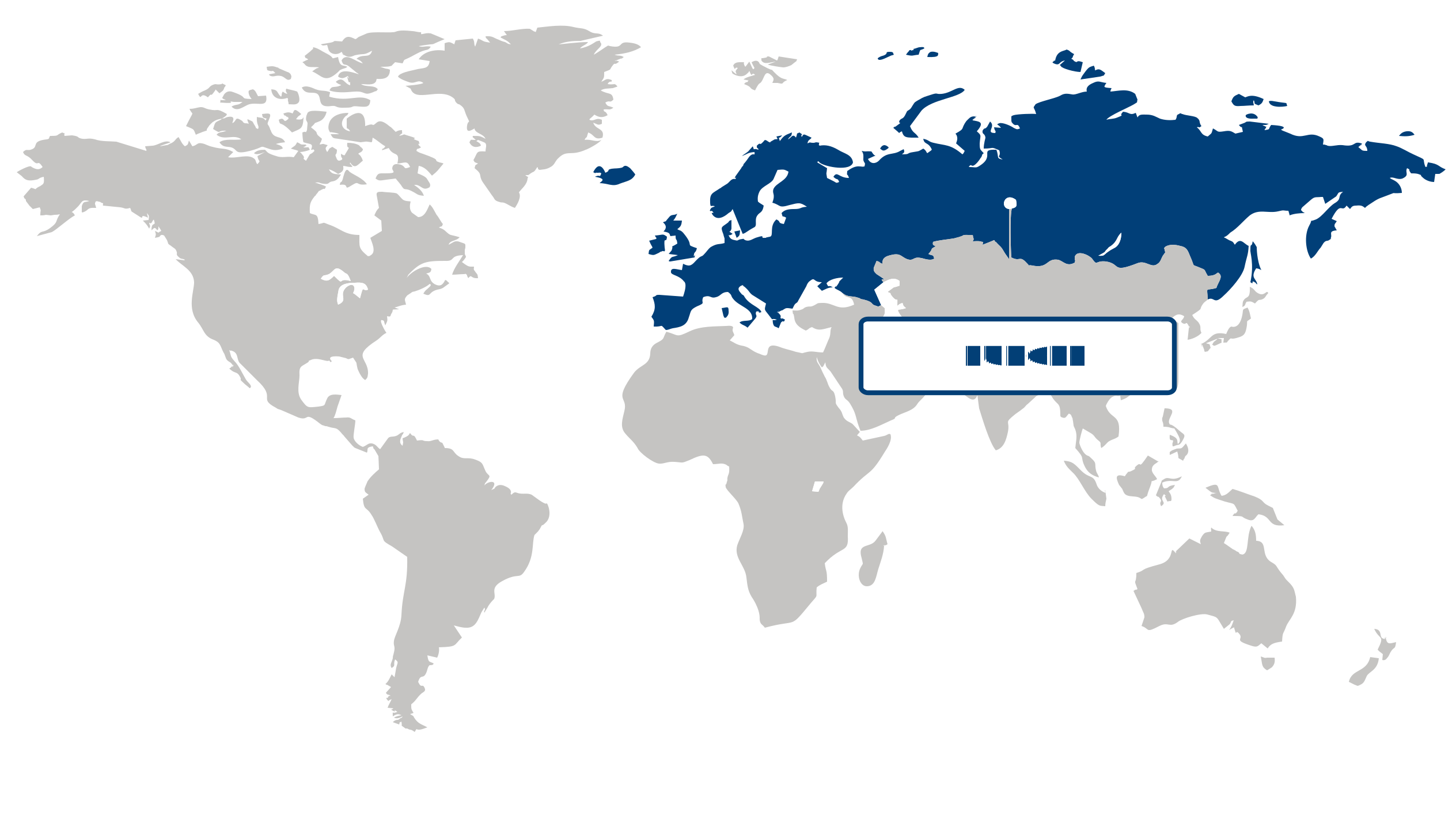
Largest Region
Europe
Largest Market Share in 2026
Europe (Largest Region) vs Asia Pacific (Fastest-Growing Region)
Europe held the largest share of the small capacity electrolyzer market in 2026, supported by strong commitments toward hydrogen development, decarbonization, and the integration of renewable energy into industrial and energy systems. Small capacity electrolyzers are gaining relevance for decentralized hydrogen production, particularly where organizations seek to produce hydrogen close to points of consumption and reduce dependence on centralized supply networks. Supportive clean-energy policies, increasing deployment of renewable power, and efforts to decarbonize hard-to-abate sectors are creating a favorable environment for electrolyzer adoption. The region's established energy infrastructure and growing investment in hydrogen projects are further strengthening demand for compact electrolysis systems.
Asia Pacific is expected to experience the fastest growth, driven by expanding renewable energy capacity, industrialization, and rising interest in hydrogen as a lower-carbon energy carrier. Growing investments in clean-energy infrastructure are creating opportunities for distributed hydrogen production across industrial facilities, transportation applications, and energy systems. The region's strong manufacturing base is also encouraging the development and deployment of electrolyzer technologies, while efforts to reduce industrial emissions are increasing interest in hydrogen-based solutions. Increasing integration of solar and wind power with hydrogen production is expected to further support the adoption of small capacity electrolyzers across the region.
No card data available for this language/report.
Segment Leadership and Growth Trends
Capacity Segment Analysis: ≤ 100 kW (Largest Segment) vs > 100 kW - 300 kW (Fastest-Growing Segment)
The ≤100 kw capacity segment held the largest market share in 2026, supported by its suitability for decentralized hydrogen production, pilot projects, and small-scale commercial installations. Compact electrolyzer systems are widely adopted where localized hydrogen generation and flexible deployment are essential. Their lower installation complexity, reduced capital requirements, and compatibility with distributed renewable energy systems have further strengthened their position across emerging hydrogen applications.
The >100 kW–300 kw capacity segment is projected to witness the fastest growth over the forecast period. As the small capacity electrolyzer market continues to expand, industries are increasingly investing in medium-capacity systems capable of delivering higher hydrogen output while maintaining operational flexibility. Growing demand from commercial facilities, industrial users, and integrated renewable energy projects is expected to accelerate the adoption of this capacity range.
Product Segment Analysis: PEM (Largest & Fastest-Growing Segment)
The PEM product segment held the largest market share in 2026 while also emerging as the fastest-growing segment in the small capacity electrolyzer market. Its strong market position is driven by high operational efficiency, rapid response to fluctuating renewable power generation, and the ability to produce high-purity hydrogen. PEM electrolyzers are increasingly preferred for distributed hydrogen production and clean energy applications because they offer operational flexibility and efficient integration with renewable electricity sources. Continued technological advancements and growing investments in green hydrogen infrastructure are expected to further reinforce the segment’s expansion.
Application Segment Analysis: Transportation (Largest Segment) vs Power Generation (Fastest-Growing Segment)
The transportation application segment held the largest market share in 2026, reflecting increasing adoption of hydrogen as an alternative fuel for low-emission mobility. Rising investments in hydrogen refueling infrastructure and expanding deployment of fuel cell vehicles have strengthened demand for compact electrolyzer systems capable of localized hydrogen production. The segment has also benefited from increasing emphasis on reducing emissions within the transportation sector.
The power generation application segment is expected to record the fastest growth over the forecast period. Growing integration of renewable energy resources with hydrogen production is creating new opportunities for electrolyzers in energy storage and grid balancing applications. Within the small capacity electrolyzer market, increasing focus on improving renewable energy utilization and supporting flexible power systems is expected to drive rapid expansion of this application segment.
| Report Segmentation | |||
| Segment | Sub-Segment | Largest Segment | Fastest Growing Segment |
|---|---|---|---|
| Capacity | ≤ 100 kW, > 100 kW - 300 kW, > 300 kW - 500 kW | ≤ 100 kW | > 100 kW - 300 kW |
| Product | Alkaline, PEM, Solid Oxide, Others | PEM | PEM |
| Application | Power Generation, Transportation, Industry Energy, Industry Feedstock, Others | Transportation | Power Generation |
 Read our Research Approach
Competitive Landscape and Market Positioning
Major players in the small capacity electrolyzer market:
- ITM Power plc (United Kingdom)
- Nel ASA (Norway)
- Sunfire GmbH (Germany)
- McPhy Energy S.A. (France)
- Enapter S.r.l. (Italy)
- Green Hydrogen Systems A/S (Denmark)
- Plug Power, Inc. (United States)
- Bloom Energy Corporation (United States)
- Siemens Energy AG (Germany)
- Linde plc (Ireland)
Competition in the small capacity electrolyzer market is evolving alongside the expansion of decentralized hydrogen production, encouraging suppliers to prioritize modular system design, installation flexibility, and operational efficiency across varied end-use applications. Product development increasingly focuses on simplifying deployment while improving compatibility with renewable energy sources and distributed energy systems, allowing vendors to address a broader range of commercial and industrial requirements. As customer expectations shift toward lower operating complexity and dependable long-term performance, participants are reinforcing their competitive position through integrated control systems, maintenance support, and adaptable solutions capable of serving diverse operating conditions without extensive infrastructure modifications.
Industry Development/News
| Company Name | Date | Key Development |
|---|---|---|
| Bloom Energy | Apr-22 | Bloom Energy installed a 130-kW high-temperature solid oxide electrolyzer in Gumi, South Korea, operating at 46 kWh per kilogram of hydrogen using water and 40.4 kWh per kilogram with steam to support national decarbonization goals and expand its regional market presence. |
| Green Hydrogen Systems | Apr-22 | Swiss Gaznat Innovation Lab ordered Green Hydrogen Systems' HyProvide A90 electrolyzers with a 0.5 MW capacity for renewable hydrogen production, under a three-year agreement that includes on-site maintenance and remote monitoring to expand market share in Switzerland. |
Why Choose Us
Specialized Expertise: Our team comprises industry experts with a deep understanding of your market segment. We bring specialized knowledge and experience that ensures our research and consulting services are tailored to your unique needs.
Customized Solutions: We understand that every client is different. That's why we offer customized research and consulting solutions designed specifically to address your challenges and capitalize on opportunities within your industry.
Proven Results: With a track record of successful projects and satisfied clients, we have demonstrated our ability to deliver tangible results. Our case studies and testimonials speak to our effectiveness in helping clients achieve their goals.
Cutting-Edge Methodologies: We leverage the latest methodologies and technologies to gather insights and drive informed decision-making. Our innovative approach ensures that you stay ahead of the curve and gain a competitive edge in your market.
Client-Centric Approach: Your satisfaction is our top priority. We prioritize open communication, responsiveness, and transparency to ensure that we not only meet but exceed your expectations at every stage of the engagement.
Continuous Innovation: We are committed to continuous improvement and staying at the forefront of our industry. Through ongoing learning, professional development, and investment in new technologies, we ensure that our services are always evolving to meet your evolving needs.
Value for Money: Our competitive pricing and flexible engagement models ensure that you get maximum value for your investment. We are committed to delivering high-quality results that help you achieve a strong return on your investment.
Select Licence Type

