Smart Lighting Market Size & Growth Forecast 2027–2036, By Segments (Connectivity, Application, Component), Regional Demand Trends (North America, Asia Pacific, Europe), Key Country Insights (U.S., Japan, South Korea, Germany, France, Italy), and Competitive Landscape
Market Size and Growth Outlook
Smart Lighting Market size stood at USD 24.4 billion in 2026 and is predicted to grow at a 14.73% CAGR from 2027 to 2036, crossing USD 96.42 billion by 2036. The industry revenue for 2027 is estimated at USD 27.43 billion.
Get more details on this report
Request Free Sample ReportSmart Lighting Market Intelligence Snapshot
Regional Market Dynamics
- Europe leads with 39.22% share supported by widespread adoption of energy-efficient lighting, building automation integration, and large-scale retrofit of connected LED systems across commercial and public infrastructure.
- Asia Pacific is expanding at 23.87% CAGR driven by rapid urban development, large-scale new construction, and integration of connected lighting systems in smart city and commercial infrastructure projects.
Segment Momentum
- Wired connectivity held 62.27% of the market in 2026 because commercial and infrastructure projects prioritize reliability, stable data transmission, centralized management, and dependable integration with building controls.
- Outdoor applications are growing fastest as cities and commercial properties seek remote monitoring, adaptive illumination, and lower maintenance through centralized control of widely distributed lighting assets.
Market Expansion Drivers
- Growing smart home and IoT adoption accelerating deployment of connected lighting systems.
- Government energy-efficiency regulations driving transition from incandescent lamps to LED smart lighting.
- Expanding smart city infrastructure projects increasing adoption of sensor-enabled intelligent street lighting.
Leading Market Participants
- Prominent players in the smart lighting market include Signify N.V. (Netherlands), Acuity Brands Inc. (United States), Schneider Electric SE (France), Honeywell International Inc. (United States), ams OSRAM AG (Austria), Zumtobel Group AG (Austria), GE Lighting (United States), Itron Inc. (United States), Sengled Optoelectronics Co., Ltd. (China), Wipro Lighting (India).
Global Market Forecast Snapshot
Market Outlook
- 2026 Market Size: USD 24.4 billion
- 2027 Estimated Market Size: USD 27.43 billion.
- Projected Market Size: USD 96.42 billion by 2036
- Growth Forecast: 14.73% CAGR (2027-2036)
Regional and Segment Outlook
- Leading Regional Market: Europe
- High-Growth Regional Hub: Asia Pacific
- Core Revenue Segment: Wired (Connectivity) | Indoor (Application) | Hardware (Component)
- Emerging Opportunity Segment: Wired (Connectivity) | Outdoor (Application) | Software (Component)
Market Growth Drivers and Industry Trends
Growing smart home and IoT adoption accelerating deployment of connected lighting systems
The increasing penetration of connected household devices is encouraging consumers to integrate lighting into broader home automation ecosystems. The smart lighting market is benefiting as homeowners adopt wi-fi, bluetooth, and other connected lighting solutions that can be controlled through smartphones, voice assistants, and centralized smart home platforms. Connected lighting enables users to automate schedules, adjust brightness, and coordinate illumination with other household devices, providing greater convenience and energy management. As IoT ecosystems become more accessible, lighting is increasingly being incorporated as an essential component of digitally managed residential environments.
Government energy-efficiency regulations driving transition from incandescent lamps to LED smart lighting
Stricter energy-efficiency requirements are encouraging households, businesses, and public institutions to replace conventional lighting technologies with more efficient alternatives. For the smart lighting market, regulatory measures supporting efficient illumination are creating favorable conditions for LED-based connected systems that combine lower energy consumption with digital control capabilities. Smart LED lighting can enable automated switching, occupancy-based control, dimming, and scheduling, allowing users to manage energy use more effectively. The transition away from inefficient lighting technologies is therefore increasing opportunities for integrated systems that deliver both energy performance and intelligent functionality.
Expanding smart city infrastructure projects increasing adoption of sensor-enabled intelligent street lighting
Municipalities are increasingly deploying connected infrastructure to improve energy management, public safety, and urban service efficiency. The smart lighting market is gaining from smart city programs that incorporate sensor-enabled street lighting capable of responding to traffic, pedestrian activity, environmental conditions, and operational requirements. Intelligent streetlights can provide adaptive illumination while also serving as connected infrastructure for monitoring and communication applications. Their integration with centralized management platforms allows city authorities to remotely monitor lighting performance, identify maintenance requirements, and optimize illumination across different urban areas.
| Growth Driver | Impact on CAGR | Regulatory Influence | Geographic Relevance | Adoption Rate | Impact Timeline |
|---|---|---|---|---|---|
| Growing smart home and IoT adoption accelerating deployment of connected lighting systems | 2.00% | Moderate | Europe, Asia Pacific | High | Near Term |
| Government energy-efficiency regulations driving transition from incandescent lamps to LED smart lighting | 1.90% | High | Europe, North America | High | Mid Term |
| Expanding smart city infrastructure projects increasing adoption of sensor-enabled intelligent street lighting | 1.50% | High | Asia Pacific, Middle East | Emerging | Long Term |
Unlock insights tailored to your business with our bespoke market research solutions.
Click to get your customized report now.
Regional Demand Dynamics
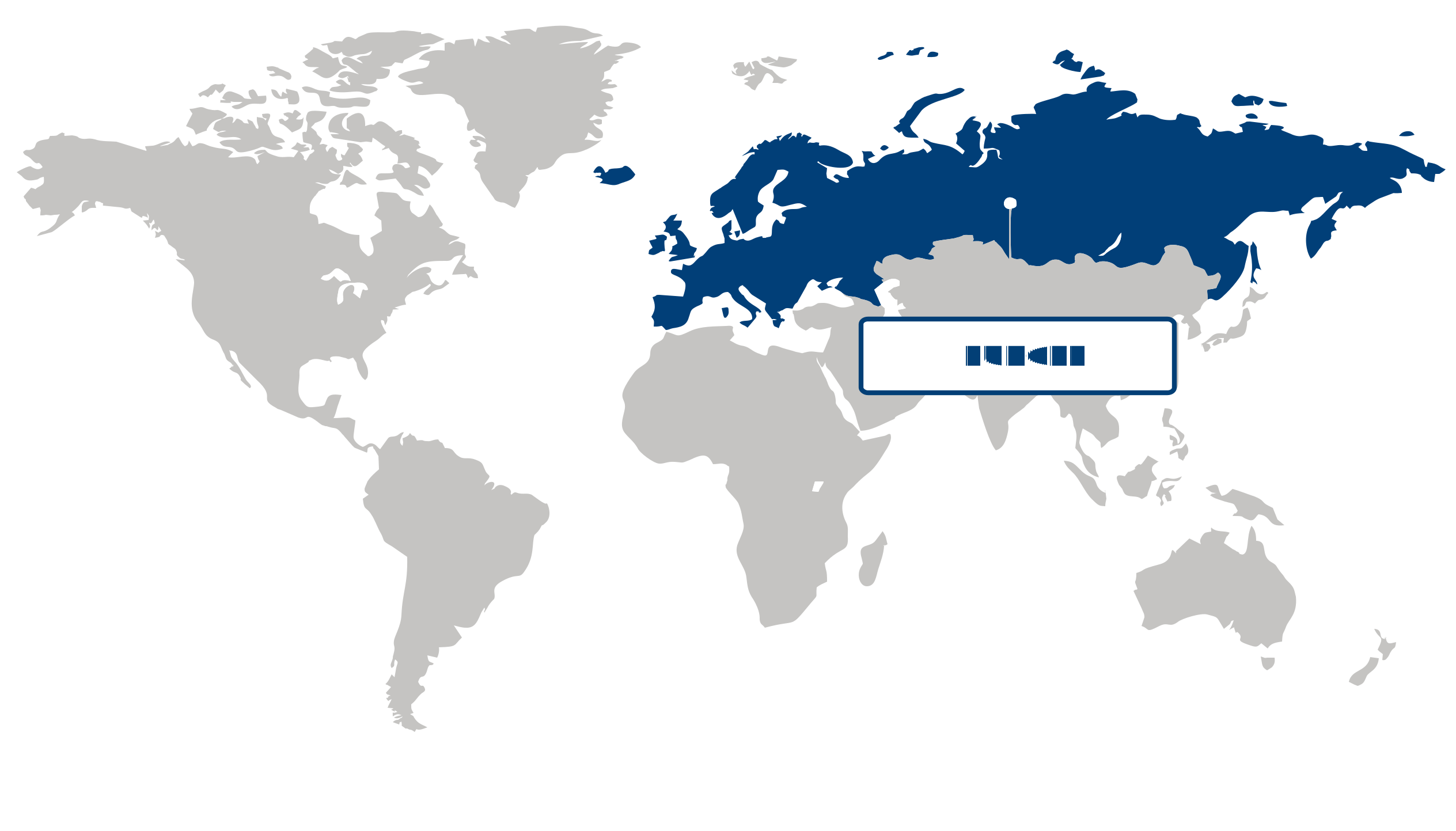
Europe (Largest Region)
Europe held the largest share of the smart lighting market at 39.22% in 2026, supported by strong adoption of energy-efficient lighting solutions across residential, commercial, and public infrastructure. The region benefits from established smart building ecosystems, growing emphasis on energy conservation, and regulatory efforts encouraging efficient electricity consumption. Increasing integration of connected lighting with building automation, sensors, and digital control systems is also strengthening demand as property owners prioritize operational efficiency, convenience, and sustainability.
Asia Pacific (Fastest-Growing Region)
Asia Pacific represents the fastest-growing regional market, driven by rapid urbanization, expanding construction activity, and increasing investment in smart infrastructure. Rising adoption of connected technologies across homes, offices, retail facilities, and industrial environments is creating broader opportunities for intelligent lighting systems. Growing awareness of energy management, the development of digitally enabled buildings, and the expansion of technology-oriented urban projects are further supporting market growth across the region.
| Parameter | North America | Asia Pacific | Europe | Latin America | MEA |
|---|---|---|---|---|---|
| Innovation Hub i Scale Nascent Developing Advanced | |||||
| Cost-Sensitive Region i Scale Low Medium High | |||||
| Regulatory Environment i Scale Restrictive Neutral Supportive | |||||
| Demand Drivers i Scale Weak Moderate Strong | |||||
| Development Stage i Scale Emerging Developing Developed | |||||
| Adoption Rate i Scale Low Medium High | |||||
| New Entrants / Startups i Scale Sparse Moderate Dense | |||||
| Macro Indicators i Scale Weak Stable Strong |
Key Country Insights
Germany 🇩🇪
Industrial Efficiency SolutionsGermany emphasizes smart lighting deployments that support industrial productivity, sustainable building operations, and energy optimization. Businesses across Germany increasingly integrate intelligent lighting controls with broader building automation platforms to enhance operational performance.
France 🇫🇷
Sustainable Building FocusFrance continues integrating smart lighting solutions into commercial buildings and public infrastructure to improve energy performance. Organizations in France prioritize connected lighting technologies that align with sustainability objectives and modern building management practices.
Italy 🇮🇹
Retrofit Modernization StrategyItaly is increasing adoption of smart lighting through retrofit projects across commercial properties, public facilities, and urban infrastructure. Organizations in Italy focus on upgrading conventional lighting with connected technologies that improve operational efficiency and long-term energy management.
Japan 🇯🇵
Intelligent Urban ApplicationsJapan continues adopting smart lighting technologies that complement connected urban infrastructure and energy-efficient building design. Organizations in Japan increasingly deploy sensor-enabled lighting solutions that improve operational efficiency and adaptive environmental management.
South Korea 🇰🇷
Smart City IntegrationSouth Korea is expanding smart lighting deployments alongside smart city initiatives and connected public infrastructure. Municipal authorities and commercial developers in South Korea increasingly implement intelligent lighting systems that support digital infrastructure and energy optimization goals.
United States 🇺🇸
Connected Infrastructure DemandThe U.S. continues advancing smart lighting adoption across commercial buildings, municipalities, and residential developments. Organizations in the U.S. increasingly prioritize connected lighting systems that improve energy management, automation, and operational efficiency through intelligent controls.
Segment Leadership and Growth Trends
Smart Lighting Market Share (%), by Connectivity, 2026
Go beyond the chart, access full insights & data tables
Request Free Sample ReportConnectivity Segment Analysis: Wired (Largest & Fastest-Growing Segment)
Wired connectivity accounted for the largest share of the smart lighting market in 2026 and is also the fastest-growing connectivity segment. Wired systems provide stable communication, reliable power delivery, and consistent performance, making them particularly suitable for commercial buildings, large facilities, and installations where dependable network connectivity is essential. Their integration with building management and automation systems can support centralized control and coordinated lighting operations. Continued investment in connected infrastructure and demand for dependable smart-building solutions are reinforcing the adoption of wired smart lighting.
Application Segment Analysis: Indoor (Largest Segment) vs Outdoor (Fastest-Growing Segment)
Indoor applications dominated the smart lighting market, accounting for 63.54% in 2026. Smart lighting is widely deployed in homes, offices, commercial buildings, hospitality spaces, and institutional facilities to provide automated control, energy management, scheduling, and customized illumination. Increasing adoption of connected building technologies and growing awareness of efficient lighting management are supporting demand for indoor smart lighting. Integration with broader building automation systems and connected-home platforms further strengthens its market position.
Outdoor applications are expected to experience the fastest growth as municipalities, businesses, and property owners increasingly adopt connected lighting for streets, parking areas, campuses, public spaces, and exterior facilities. Smart outdoor systems can support remote monitoring, adaptive illumination, and more efficient operation while improving visibility and safety. Growing investment in connected infrastructure, demand for intelligent public-space management, and increasing focus on energy-efficient outdoor lighting are creating favorable conditions for this segment.
| Segment | Sub-Segment | Largest Segment | Fastest Growing |
|---|---|---|---|
| Connectivity | Wired, Wireless | Wired | Wired |
| Application | Indoor, Outdoor | Indoor | Outdoor |
| Component | Hardware, Software, Services | Hardware | Software |
Competitive Landscape and Market Positioning
Leading companies in the smart lighting market:
1. Signify N.V. (Netherlands)
2. Acuity Brands Inc. (United States)
3. Schneider Electric SE (France)
4. Honeywell International Inc. (United States)
5. ams OSRAM AG (Austria)
6. Zumtobel Group AG (Austria)
7. GE Lighting (United States)
8. Itron Inc. (United States)
9. Sengled Optoelectronics Co. Ltd. (China)
10. Wipro Lighting (India)
The smart lighting market is witnessing rapid advancements in connected lighting systems, IoT integration, and energy-efficient illumination technologies. Manufacturers are introducing intelligent lighting solutions equipped with automation, motion sensing, and remote-control capabilities to support smart residential and commercial infrastructure. Increasing demand for energy conservation and adaptive lighting environments is further accelerating innovation and competitive activity within the smart lighting market.
| Company | Market Share | Company Revenue | Revenue CAGR (%) | Product Portfolio | Geographic Presence | Innovation / R&D Focus | Strategic Developments |
|---|---|---|---|---|---|---|---|
| Signify N.V. (Netherlands) | |||||||
| Acuity Brands Inc. (United States) | |||||||
| Schneider Electric SE (France) | |||||||
| Honeywell International Inc. (United States) | |||||||
| ams OSRAM AG (Austria) | |||||||
| Zumtobel Group AG (Austria) | |||||||
| GE Lighting (United States) | |||||||
| Itron Inc. (United States) | |||||||
| Sengled Optoelectronics Co. Ltd. (China) | |||||||
| Wipro Lighting (India). |
Industry Development/News
| Company Name | Date | Key Development |
|---|---|---|
| Savant | Apr-26 | Savant formed a strategic partnership with Timber Block to integrate smart home technologies directly into premium residential projects. By embedding smart lighting and automation systems into new construction, this partnership enhances Savant’s market reach in the luxury residential sector and establishes a repeatable model for large-scale technology adoption in the housing industry. |
| Ubicquia | Feb-26 | Ubicquia secured $106 million in funding to accelerate the deployment of intelligent streetlight infrastructure. This investment supports the expansion of smart-city lighting, integrated sensor technology, and AI-enabled urban management platforms, marking a significant move toward scaling connected municipal infrastructure and improving operational efficiency in urban environments. |
| Philips Hue | Sep-25 | Philips Hue announced major platform upgrades, including the launch of Bridge Pro and expanded Matter-over-Thread support. These enhancements are designed to improve interoperability and overall system performance across complex smart-home ecosystems, directly addressing technical barriers to widespread smart lighting adoption and strengthening its competitive position in the residential connectivity market. |
| IKEA | Jul-25 | IKEA introduced more than 20 new Matter-compatible smart-home products, reinforcing its commitment to interoperability. This initiative aims to increase the accessibility and affordability of connected technologies, including smart lighting, and positions IKEA to capture a broader share of the mass-market consumer segment through an ecosystem based on universal connectivity standards. |
| Daisy | Mar-25 | Daisy raised $15 million in Series C funding, increasing its total capital to $35 million. The investment is earmarked to accelerate the growth of its smart-home technology installation network. This expansion significantly strengthens the company's distribution and integration capabilities for residential smart lighting and automation solutions across its service footprint. |
| Nobi | Mar-25 | Nobi secured investment from 15th Rock to fuel its international expansion into the Japanese market. This move focuses on the commercialization of its AI-enabled smart lighting solutions, particularly targeting specialized applications, and represents a strategic effort to scale its regional operations and increase its footprint in the global smart lighting ecosystem. |
| Unilumin | Feb-25 | Unilumin partnered with Atlético de Madrid to deploy advanced lighting technologies throughout the club’s Sports City complex. This project involves the implementation of sophisticated lighting systems to create a more immersive and intelligent environment, serving as a significant reference for the company’s capabilities in large-scale commercial and professional venue lighting applications. |
| Miami Dade Smart Lighting Partners | Oct-24 | Miami-Dade County advanced a long-term smart infrastructure initiative via its partnership with Miami Dade Smart Lighting Partners. The project focuses on the large-scale deployment of connected and resilient lighting networks, demonstrating a strategic shift toward data-driven urban management and the integration of smart-city infrastructure on a municipal scale. |
| iGuzzini | Jun-24 | iGuzzini introduced the Filorail and Newfo systems, which provide advanced, low-profile smart-lighting infrastructure tailored for architectural and commercial environments. This product development focuses on the integration of high-performance lighting within structural design, expanding the company's reach into sophisticated, high-end commercial applications that require both functional lighting and aesthetic architectural integration. |
Customize Your Report
Explore examples of how this report can be tailored to different research needs, including custom segments, additional topics or chapters, and related reports. Click a section of the wheel or its numbered marker to explore the available options.
Smart Lighting Market — Custom Segments
| Segment | Sub-Segment |
|---|---|
| End User | Residential, Commercial, Industrial, Public & Infrastructure |
| Sales Channel | Direct Sales, Distributor & Wholesaler, Retail, E-commerce |
| Control Interface | Smartphone & Tablet, Voice Control, Wall-Mounted Controls, Centralized Building Management Systems |
Smart Lighting Market — Custom TOC
| Custom Chapter | Custom Details |
|---|---|
| Smart City and Infrastructure Deployment Pipeline Assessment |
|
| Connected Lighting Ecosystem and Interoperability Benchmarking |
|
| Lighting-as-a-Service Business Model Assessment |
|
Need a different cut of the data?
Request Custom ResearchWhat is the market size of smart lighting?
How is the smart lighting industry projected to perform over the next decade?
How is IoT adoption influencing purchasing behavior in the smart lighting market?
Why are smart city projects becoming a major growth driver for the smart lighting market?
Why is wired connectivity the preferred choice in the smart lighting market?
What is accelerating adoption of outdoor smart lighting applications?
Why does Europe lead the smart lighting market?
What is driving Asia Pacific growth in the smart lighting market?
Which organizations are considered leaders in the smart lighting landscape?
Our Clients
"The team demonstrated a great understanding of our business needs, and the reports were tailored to address our specific concerns and objectives."
Infosys
"The report was up-to-date with the latest industry trends and technological advancements. The detailed competitive landscape analysis was quite helpful."
Zebra Technologies
"The data presented in the report was accurate and well-researched. I also found the market dynamics section particularly useful."
Arlo Technologies
Our Research Team & Methodology
Every Fundamental Business Insights report is built by a dedicated vertical research team, validated through a structured primary-and-secondary methodology, and reviewed for accuracy before it reaches you.
Research Team Overview
Prepared by the Smart Technologies Research Team
Delivery
Published
Demand
Available
Support
Trust & Compliance
Research Domains
10 coverage areasResearch Intelligence
| Source | Reference |
|---|---|
| National Institute of Standards and Technology (NIST) | www.nist.gov |
| International Organization for Standardization (ISO) | www.iso.org |
| Institute of Electrical and Electronics Engineers (IEEE) | www.ieee.org |
| Internet Engineering Task Force (IETF) | www.ietf.org |
| World Wide Web Consortium (W3C) | www.w3.org |
| Cloud Security Alliance (CSA) | cloudsecurityalliance.org |
| Open Source Initiative (OSI) | opensource.org |
| Linux Foundation | www.linuxfoundation.org |
| FinOps Foundation | www.finops.org |
| PCI Security Standards Council | www.pcisecuritystandards.org |
| SWIFT | www.swift.com |
| Financial Stability Board (FSB) | www.fsb.org |
| GSMA | www.gsma.com |
| International Telecommunication Union (ITU) | www.itu.int |
| OWASP Foundation | owasp.org |
| MITRE | www.mitre.org |
| World Economic Forum (WEF) | www.weforum.org |
| OECD Digital Economy | www.oecd.org/digital |
| World Bank Data | data.worldbank.org |
| U.S. Census Bureau | www.census.gov |
Research Workflow & Quality Assurance
Data Collection
Verified information gathered through primary and secondary research.
Data Triangulation
Cross-validation using multiple independent data sources.
Forecast Modelling
Market estimates developed using historical trends and analytical models.
Analyst Validation
Findings reviewed by domain experts for accuracy and consistency.
Editorial & Quality Review
Final editorial, quality, and compliance checks before publication.
Final Publication
Released after successful completion of the internal review process.
Report Coverage
📊 Market Assessment
- Market Size & Forecast
- Market Segmentation
- Regional Analysis
- Growth Drivers & Challenges
- Market Dynamics
🏢 Competitive Intelligence
- Competitive Landscape
- Company Profiles
- Competitive Benchmarking
- Mergers & Acquisitions
- Market Share Analysis or Key Company Strategies
🔍 Strategic Analysis
- Value Chain Analysis
- Porter's Five Forces
- PESTLE Analysis
- Pricing Trends
- Supply-Demand Analysis
🚀 Future Outlook
- Technology Landscape
- Regulatory Landscape
- Investment & Funding Landscape
- Emerging Opportunities
- Future Market Outlook
Have a question about this report or need a custom scope?
Request Customization