Smart Rings Market Size & Growth Forecast 2027–2036, By Segments (Technology, Operating System, Distribution Channel, Consumer Group, Price Range), Regional Demand Trends (North America, Asia Pacific, Europe), Key Country Insights (U.S., Japan, South Korea, Germany, France, Italy), and Competitive Landscape
Market Size and Growth Outlook
Smart Rings Market size was valued at USD 980 Million in 2026 and is anticipated to grow at 25.91% CAGR from 2027 to 2036, surpassing USD 9.81 Billion by 2036. The industry revenue for 2027 is calculated at USD 1.2 Billion.
Get more details on this report
Request Free Sample ReportSmart Rings Market Intelligence Snapshot
Regional Market Dynamics
- Europe accounted for 32.83% in 2026, supported by strong wearable adoption, health and wellness awareness, and demand for connected personal devices.
- North America is gaining momentum through high technology adoption, strong connected-device spending, sensor advancements, and growing consumer interest in discreet personalized health and wellness insights.
Segment Momentum
- Bluetooth captured 60.58% of the market in 2026 by enabling seamless connectivity with smartphones and wearables while supporting health monitoring, notifications, payments, and energy-efficient real-time data synchronization.
- Online channels are the fastest-growing distribution segment as consumers increasingly prefer e-commerce for broader product selection, competitive pricing, convenient purchasing, and access to newly launched smart rings.
Market Expansion Drivers
- Rising consumer adoption of wearable health and fitness tracking devices
- Increasing demand for compact multifunctional connected devices in consumer electronics ecosystem
- Expansion of biometric authentication applications enhancing device utility beyond fitness tracking
Leading Market Participants
- Prominent companies in the smart rings market include Oura Health Ltd. (Finland), Samsung Electronics Co., Ltd. (South Korea), Ultrahuman Healthcare Pvt. Ltd. (India), Movano Health, Inc. (United States), RingConn (China), Sky Labs Co., Ltd. (South Korea), Noise (India), Amazfit (China), Colmi (China), Boat Lifestyle (India)
Global Market Forecast Snapshot
Market Outlook
- 2026 Market Size: USD 980 Million
- 2027 Estimated Market Size: USD 1.2 Billion
- Projected Market Size: USD 9.81 Billion by 2036
- Growth Forecast: 25.91% CAGR (2027-2036)
Regional and Segment Outlook
- Leading Regional Market: Europe
- High-Growth Regional Hub: North America
- Core Revenue Segment: Bluetooth (Technology) | Android (Operating System) | Offline Channels (Distribution Channel) | Women (Consumer Group) | Medium ($50 - $200) (Price Range)
- Emerging Opportunity Segment: Bluetooth (Technology) | Android (Operating System) | Online Channels (Distribution Channel) | Unisex (Consumer Group) | Medium ($50 - $200) (Price Range)
Market Growth Drivers and Industry Trends
Rising consumer adoption of wearable health and fitness tracking devices
Growing consumer interest in continuous wellness monitoring is encouraging wider acceptance of compact wearable technologies that provide health insights throughout the day. The smart rings market is benefiting from this trend as users seek discreet devices capable of tracking sleep quality, physical activity, heart rate, and other physiological indicators without the size or visibility of traditional wearables. Increasing awareness of preventive healthcare and personalized fitness management is also encouraging consumers to integrate wearable monitoring into their daily routines for long-term lifestyle management.
Increasing demand for compact multifunctional connected devices in consumer electronics ecosystem
Consumers increasingly prefer devices that combine multiple digital functions within a compact and comfortable form factor, reducing the need to carry or wear several separate products. This shift will propel the smart rings market as manufacturers integrate health monitoring, notifications, contactless controls, and connectivity features into miniature wearable devices that seamlessly interact with smartphones and other connected electronics. Improvements in low-power components, wireless communication technologies, and miniaturized sensors continue to expand functional capabilities while maintaining user comfort and extended battery performance.
Expansion of biometric authentication applications enhancing device utility beyond fitness tracking
The use of biometric authentication is expanding across digital payments, secure access, identity verification, and connected consumer devices, creating new application opportunities for wearable technologies. Beyond wellness monitoring, the smart rings market is gaining traction as embedded biometric capabilities enable convenient and secure authentication through unique physiological characteristics while reducing dependence on passwords or physical credentials. Integration with smart home systems, enterprise security platforms, and digital ecosystems further broadens the functional value of smart rings across both personal and professional environments.
| Growth Driver | Impact on CAGR | Regulatory Influence | Geographic Relevance | Adoption Rate | Impact Timeline |
|---|---|---|---|---|---|
| Rising consumer adoption of wearable health and fitness tracking devices | 2.3% | Low | North America, Asia Pacific | High | Near Term |
| Increasing demand for compact multifunctional connected devices in consumer electronics ecosystem | 2.1% | Low | Asia Pacific, Europe | High | Mid Term |
| Expansion of biometric authentication applications enhancing device utility beyond fitness tracking | 1.9% | Moderate | North America, Europe | Emerging | Long Term |
Unlock insights tailored to your business with our bespoke market research solutions.
Click to get your customized report now.
Regional Demand Dynamics
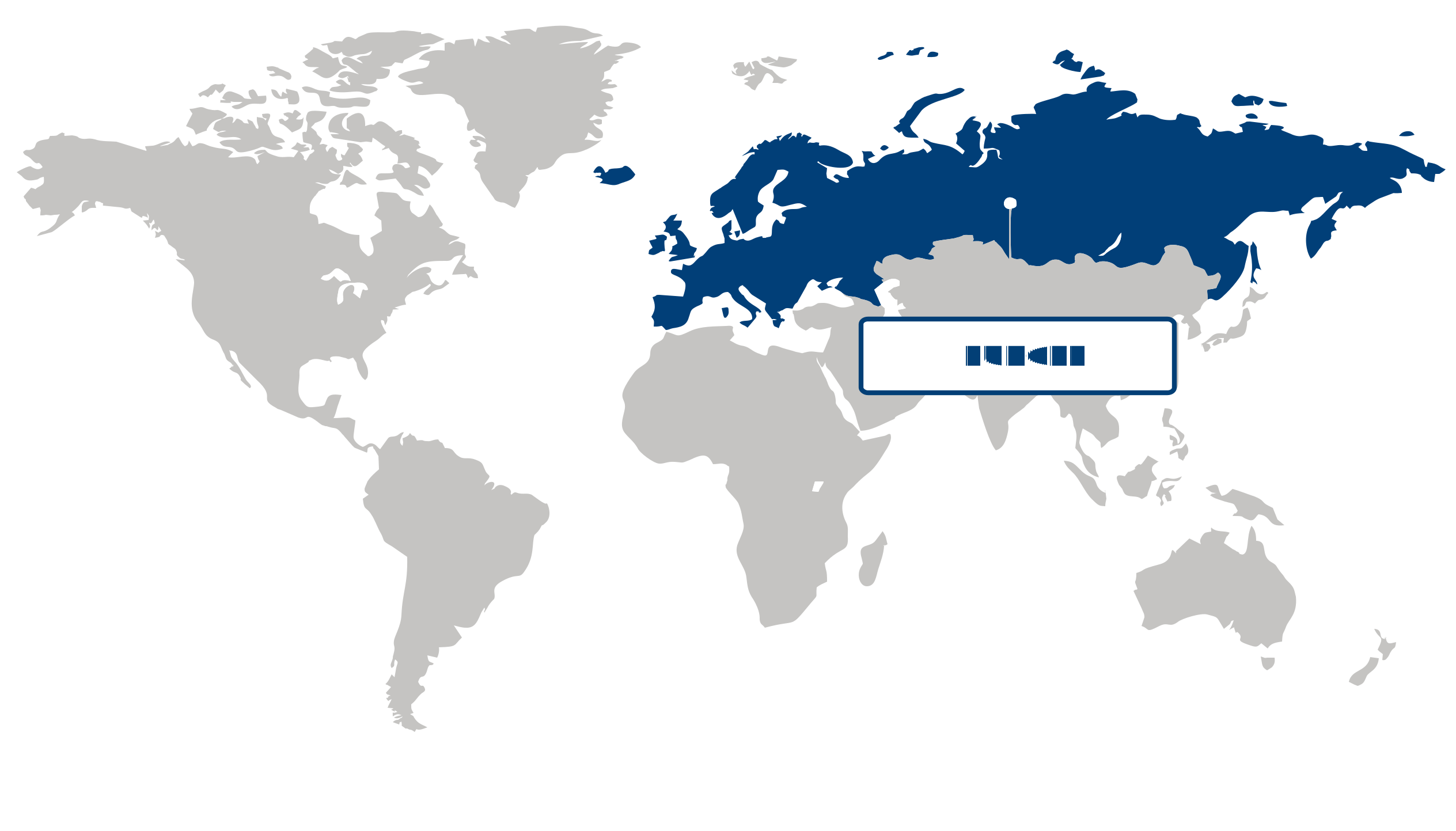
Europe (Largest Region)
Europe accounted for the largest share of the smart rings market at 32.83% in 2026, supported by strong consumer interest in wearable technology, health and wellness monitoring, and connected personal devices. The region benefits from high awareness of digital health solutions and growing demand for compact wearables that combine convenience with fitness and lifestyle functionality. Increasing consumer focus on personal health insights, sleep monitoring, activity tracking, and connected-device ecosystems is encouraging the adoption of smart rings as an alternative form factor within the broader wearable technology landscape.
North America (Fastest-Growing Region)
North America is expected to register the fastest growth, fueled by high technology adoption, strong consumer spending on connected devices, and increasing interest in discreet health and wellness wearables. Consumers are increasingly seeking wearable products that can provide continuous insights while integrating conveniently into daily routines. Advancements in sensor technologies, expanding digital health ecosystems, and growing awareness of personalized wellness are creating favorable conditions for smart ring adoption. The region’s established technology infrastructure and receptiveness to innovative consumer electronics are also supporting market expansion.
| Parameter | North America | Asia Pacific | Europe | Latin America | MEA |
|---|---|---|---|---|---|
| Innovation Hub i Scale Nascent Developing Advanced | |||||
| Cost-Sensitive Region i Scale Low Medium High | |||||
| Regulatory Environment i Scale Restrictive Neutral Supportive | |||||
| Demand Drivers i Scale Weak Moderate Strong | |||||
| Development Stage i Scale Emerging Developing Developed | |||||
| Adoption Rate i Scale Low Medium High | |||||
| New Entrants / Startups i Scale Sparse Moderate Dense | |||||
| Macro Indicators i Scale Weak Stable Strong |
Key Country Insights
United States 🇺🇸
Connected Health AdoptionThe U.S. smart rings market is shaped by strong demand for wearable devices that combine health monitoring, contactless functionality, and everyday convenience. Product development increasingly focuses on sensor accuracy, seamless mobile integration, and subscription-based wellness ecosystems.
Germany 🇩🇪
Privacy-Centric WearablesGermany emphasizes smart rings that deliver health insights while meeting strict expectations for data privacy and device reliability. Manufacturers prioritize premium materials, secure connectivity, and compatibility with established digital health platforms.
Japan 🇯🇵
Compact Lifestyle TechnologyJapan values smart rings that integrate advanced biometric tracking into compact, unobtrusive designs suited to daily use. Market activity centers on energy-efficient hardware, precision sensing, and products that complement broader consumer electronics ecosystems.
South Korea 🇰🇷
Digital Wellness IntegrationSouth Korea is expanding adoption of smart rings through its digitally connected consumer base and interest in personal wellness technologies. Companies emphasize fashionable designs, AI-enabled health features, and interoperability with smartphones and smart home devices.
France 🇫🇷
Premium Lifestyle WearablesFrance supports demand for smart rings that combine wellness tracking with refined aesthetics and everyday usability. Brands increasingly differentiate through premium design, durable materials, and features that appeal to health-conscious consumers.
Italy 🇮🇹
Design-Led InnovationItaly's smart rings market reflects consumer preference for wearable technology that balances style with practical health monitoring capabilities. Manufacturers focus on elegant product design, comfort, and features that integrate naturally into daily routines.
Segment Leadership and Growth Trends
Smart Rings Market Share (%), by Technology, 2026
Go beyond the chart, access full insights & data tables
Request Free Sample ReportTechnology Segment Analysis: Bluetooth (Largest & Fastest-Growing Segment)
The bluetooth technology segment dominated the smart rings market with a 60.58% share in 2026 and also emerged as the fastest-growing segment. Its strong position is driven by seamless connectivity with smartphones, wearables, and other connected devices, enabling users to access health metrics, notifications, payment functions, and device controls through a single interface. The widespread compatibility of bluetooth technology across consumer electronics ecosystems has further strengthened its adoption, making it the preferred communication standard for smart ring manufacturers. The segment’s continued growth is supported by advancements in low-energy bluetooth protocols, which improve battery efficiency while maintaining reliable connectivity. As consumers increasingly prioritize compact wearable devices capable of delivering real-time data synchronization and personalized user experiences, bluetooth-enabled smart rings are expected to remain central to product innovation and market expansion.
Operating System Segment Analysis: Android (Largest & Fastest-Growing Segment)
In the smart rings market, the android operating system segment held the largest position in 2026 and simultaneously represented the fastest-growing segment. The dominance of android is supported by its extensive global user base and compatibility with a broad range of smartphone brands and device configurations. This flexibility allows smart ring manufacturers to reach a wider consumer audience while offering seamless integration with health monitoring, fitness tracking, and notification management applications. Growth in the android segment is further encouraged by continuous enhancements in mobile operating system capabilities, including improved support for connected devices and wearable ecosystems. The increasing availability of smart ring applications on android platforms, combined with growing consumer interest in connected health and lifestyle technologies, continues to reinforce the segment’s leadership within the market.
Distribution Channel Segment Analysis: Offline Channels (Largest Segment) vs Online Channels (Fastest-Growing Segment)
Holding the largest share of the smart rings market, the offline distribution channel segment maintained its leading position in 2026. Physical retail stores, electronics outlets, and specialty wearable technology shops remain important purchasing points for consumers seeking hands-on product evaluation before making a buying decision. The ability to compare designs, assess comfort, and receive in-person guidance contributes significantly to the continued relevance of offline sales channels.
The online distribution channel segment is witnessing the fastest growth as consumers increasingly embrace digital commerce platforms for technology purchases. E-commerce channels offer wider product availability, convenient purchasing experiences, competitive pricing, and direct access to newly launched products. Expanding internet penetration, growing trust in online transactions, and the increasing influence of digital marketing strategies are further accelerating the adoption of online sales channels for smart rings.
| Segment | Sub-Segment | Largest Segment | Fastest Growing |
|---|---|---|---|
| Technology | Bluetooth, NFC | Bluetooth | Bluetooth |
| Operating System | Android, iOS | Android | Android |
| Distribution Channel | Online Channels, Offline Channels | Offline Channels | Online Channels |
| Consumer Group | Men, Women, Unisex | Women | Unisex |
| Price Range | Low (<$50), Medium ($50 - $200), High (>$200) | Medium ($50 - $200) | Medium ($50 - $200) |
Competitive Landscape and Market Positioning
Major players in the smart rings market:
- Oura Health Ltd. (Finland)
- Samsung Electronics Co., Ltd. (South Korea)
- Ultrahuman Healthcare Pvt. Ltd. (India)
- Movano Health, Inc. (United States)
- RingConn (China)
- Sky Labs Co., Ltd. (South Korea)
- Noise (India)
- Amazfit (China)
- Colmi (China)
- Boat Lifestyle (India)
Competitive positioning in the smart rings market is increasingly shaped by the ability to combine advanced sensing capabilities with compact design and seamless user experience. Manufacturers are refining sensor integration, power management, and software ecosystems to improve health monitoring accuracy while maintaining comfort and extended wearability. As wearable technology becomes more interconnected, competition is also expanding beyond hardware innovation toward data reliability, ecosystem compatibility, and privacy-focused digital experiences, making long-term user engagement as important as device functionality.
| Company | Market Share | Company Revenue | Revenue CAGR (%) | Product Portfolio | Geographic Presence | Innovation / R&D Focus | Strategic Developments |
|---|---|---|---|---|---|---|---|
| Oura Health Ltd. (Finland) | |||||||
| Samsung Electronics Co. Ltd. (South Korea) | |||||||
| Ultrahuman Healthcare Pvt. Ltd. (India) | |||||||
| Movano Health Inc. (United States) | |||||||
| RingConn (China) | |||||||
| Sky Labs Co. Ltd. (South Korea) | |||||||
| Noise (India) | |||||||
| Amazfit (China) | |||||||
| Colmi (China) | |||||||
| Boat Lifestyle (India) |
Industry Development/News
| Company Name | Date | Key Development |
|---|---|---|
| Eli Lilly | Jun-26 | Eli Lilly partnered with Ōura via its LillyDirect platform to grant GLP-1 patients access to smart rings. The integration tracks biometric data and medication health metrics to scale digital health support for chronic conditions. |
| Essence Healthcare | Jun-26 | Essence Healthcare expanded its partnership with Ōura to deploy a clinical program utilizing smart ring data to detect sleep apnea risks, validating wearable technology for preventive insurance risk management. |
| Ōura | Mar-26 | Ōura completed the acquisition of an AI-based gesture recognition technology company. The transaction integrates new intellectual property into Ōura's portfolio, laying the framework for future smart rings with advanced gesture controls. |
| Ōura | Oct-25 | Ōura raised $900 million in a Series E funding round, boosting its valuation to $11 billion. The funding capitalizes the company to accelerate new health feature engineering and drive growth in the competitive global smart ring market. |
| Samsung | Jun-25 | Samsung Electronics agreed to acquire Xealth, a digital health platform connected to over 500 hospitals. The transaction establishes technical synergies with Samsung's smart ring ecosystem and strengthens its position in clinical data management. |
| Dexcom | Nov-24 | Dexcom completed a $75 million investment in Ōura alongside a strategic partnership to integrate continuous glucose monitoring data with smart ring biometric metrics. The initiative expands connected digital health capabilities across both wearable ecosystems. |
| Ōura | Oct-24 | Ōura secured a $96 million enterprise contract from the U.S. Department of Defense to deploy smart rings and continuous health monitoring services, marking a significant commercial scale-up for enterprise wearables. |
| Samsung | Jul-24 | Samsung formally entered the smart ring segment via the commercial launch of the AI-powered Galaxy Ring, introducing continuous wellness tracking and advanced algorithmic insights to its broader mobile ecosystem. |
| Ultrahuman | May-24 | Ultrahuman established its UltraFactory domestic manufacturing facility in the United States to produce smart rings locally. The expansion enhances production capacities and supports aggressive market penetration in North America. |
| Ultrahuman | Mar-24 | Ultrahuman secured $35 million in a Series B funding round to accelerate product innovation and scale its operational footprint within the rapidly growing global wearable technology sector. |
Customize Your Report
Explore examples of how this report can be tailored to different research needs, including custom segments, additional topics or chapters, and related reports. Click a section of the wheel or its numbered marker to explore the available options.
Smart Rings Market — Custom Segments
| Segment | Sub-Segment |
|---|---|
| Primary Use Case | Health & Wellness Monitoring, Fitness & Activity Tracking, Sleep Monitoring, Payments & Access Control |
| Health Monitoring Capability | Basic Activity Monitoring, Sleep & Recovery Monitoring, Vital Signs Monitoring, Advanced Health Monitoring |
| Sensor Type | Optical Sensors, Motion Sensors, Temperature Sensors, Bioelectrical Sensors |
Smart Rings Market — Custom TOC
| Custom Chapter | Custom Details |
|---|---|
| Smart Ring Use-Case Evolution |
|
| Wearable Ecosystem Integration |
|
| Premiumization & Product Differentiation |
|
Need a different cut of the data?
Request Custom ResearchWhat is the market valuation of smart rings?
What is the projected value of the smart rings industry by 2036?
How is consumer demand for wellness monitoring influencing the smart rings market?
Why are biometric authentication capabilities expanding the value of smart rings?
Why is Bluetooth the leading technology in the smart rings market?
Which distribution channel is expected to grow the fastest in the smart rings market?
What makes Europe the leading region in the smart rings market?
Why is North America expected to be the fastest-growing smart rings market?
Which companies dominate the smart rings landscape?
Our Clients
"The team demonstrated a great understanding of our business needs, and the reports were tailored to address our specific concerns and objectives."
Infosys
"The report was up-to-date with the latest industry trends and technological advancements. The detailed competitive landscape analysis was quite helpful."
Zebra Technologies
"The data presented in the report was accurate and well-researched. I also found the market dynamics section particularly useful."
Arlo Technologies
Our Research Team & Methodology
Every Fundamental Business Insights report is built by a dedicated vertical research team, validated through a structured primary-and-secondary methodology, and reviewed for accuracy before it reaches you.
Research Team Overview
Prepared by the Smart Technologies Research Team
Delivery
Published
Demand
Available
Support
Trust & Compliance
Research Domains
10 coverage areasResearch Intelligence
| Source | Reference |
|---|---|
| National Institute of Standards and Technology (NIST) | www.nist.gov |
| International Organization for Standardization (ISO) | www.iso.org |
| Institute of Electrical and Electronics Engineers (IEEE) | www.ieee.org |
| Internet Engineering Task Force (IETF) | www.ietf.org |
| World Wide Web Consortium (W3C) | www.w3.org |
| Cloud Security Alliance (CSA) | cloudsecurityalliance.org |
| Open Source Initiative (OSI) | opensource.org |
| Linux Foundation | www.linuxfoundation.org |
| FinOps Foundation | www.finops.org |
| PCI Security Standards Council | www.pcisecuritystandards.org |
| SWIFT | www.swift.com |
| Financial Stability Board (FSB) | www.fsb.org |
| GSMA | www.gsma.com |
| International Telecommunication Union (ITU) | www.itu.int |
| OWASP Foundation | owasp.org |
| MITRE | www.mitre.org |
| World Economic Forum (WEF) | www.weforum.org |
| OECD Digital Economy | www.oecd.org/digital |
| World Bank Data | data.worldbank.org |
| U.S. Census Bureau | www.census.gov |
Research Workflow & Quality Assurance
Data Collection
Verified information gathered through primary and secondary research.
Data Triangulation
Cross-validation using multiple independent data sources.
Forecast Modelling
Market estimates developed using historical trends and analytical models.
Analyst Validation
Findings reviewed by domain experts for accuracy and consistency.
Editorial & Quality Review
Final editorial, quality, and compliance checks before publication.
Final Publication
Released after successful completion of the internal review process.
Report Coverage
📊 Market Assessment
- Market Size & Forecast
- Market Segmentation
- Regional Analysis
- Growth Drivers & Challenges
- Market Dynamics
🏢 Competitive Intelligence
- Competitive Landscape
- Company Profiles
- Competitive Benchmarking
- Mergers & Acquisitions
- Market Share Analysis or Key Company Strategies
🔍 Strategic Analysis
- Value Chain Analysis
- Porter's Five Forces
- PESTLE Analysis
- Pricing Trends
- Supply-Demand Analysis
🚀 Future Outlook
- Technology Landscape
- Regulatory Landscape
- Investment & Funding Landscape
- Emerging Opportunities
- Future Market Outlook
Have a question about this report or need a custom scope?
Request Customization