



Smart Shelves Market Size & Growth Forecast 2027–2036, By Segments (Component, Application, End-use), Regional Demand Trends (North America, Asia Pacific, Europe), Key Country Insights (U.S., Japan, South Korea, Germany, France, Italy), and Competitive Landscape
Market Size and Growth Outlook
Smart Shelves Market size was valued at USD 5.9 billion in 2026 and is anticipated to grow at a 22.52% CAGR from 2027 to 2036, reaching USD 44.97 billion by 2036. The industry revenue for 2027 is calculated at USD 7.02 billion.
Base Year Value (2026)
USD 5.9 billion
CAGR (2027-2036)
22.52%
Forecast Year Value (2036)
USD 44.97 billion

Historical Data Period
2022-2026

Largest Region
Europe

Forecast Period
2027-2036
Smart Shelves Market Intelligence Snapshot:
-
Regional Market Dynamics:
- Europe holds 37.10% share supported by widespread retail automation adoption, strong supermarket and hypermarket networks, and focus on reducing stockouts and improving inventory visibility through smart shelving systems.
- Asia Pacific is projected 25.85% CAGR driven by rapid retail modernization, rising investment in connected store technologies, and demand for efficient inventory and replenishment management in dynamic consumer markets.
-
Segment Momentum:
- Hardware accounted for 49.82% of the market in 2026 because sensors, RFID readers, display units, and other in-store infrastructure form the essential foundation for smart shelf functionality and ongoing retail deployments.
- Pricing Management is growing fastest as retailers seek faster shelf-edge pricing updates, reduced pricing errors, and better alignment with promotions and demand using real-time smart shelf connectivity.
-
Market Expansion Drivers:
- Real-time inventory visibility and automated replenishment reducing stockouts in retail stores.
- IoT sensors and AI analytics enabling predictive merchandising and operational optimization in retail chains.
- Edge computing and 5G-enabled smart retail infrastructure accelerating in-store digital shelf deployment.
-
Leading Market Participants:
Key players in the smart shelves market include Avery Dennison Corporation (United States), Honeywell International Inc. (United States), Samsung Electronics Co., Ltd. (South Korea), Intel Corporation (United States), Huawei Technologies Co., Ltd. (China), Trax Technology Solutions Pte Ltd (Singapore), E Ink Holdings Inc. (Taiwan), Lenovo PCCW Solutions Limited (Hong Kong), Happiest Minds Technologies Limited (India), AWM Smart Shelf Inc. (United States).
Global Market Forecast Snapshot:
-
Market Outlook:
- 2026 Market Size: USD 5.9 billion
- 2027 Estimated Market Size: USD 7.02 billion.
- Projected Market Size: USD 44.97 billion by 2036
- Growth Forecasts: 22.52% CAGR (2027-2036)
-
Regional and Segment Outlook:
- Leading Regional Market: Europe
- High-Growth Regional Hub: Asia Pacific
- Core Revenue Segment: Hardware (Component) | Inventory Management (Application) | Hypermarkets (End-use)
- Emerging Opportunity Segment: Software (Component) | Pricing Management (Application) | Department Stores (End-use)
Market Growth Drivers and Industry Trends
Real-time inventory visibility and automated replenishment reducing stockouts in retail stores
Real-time inventory visibility is strengthening the smart shelves market by enabling retailers to monitor product availability directly at the shelf level and respond quickly to changing demand. Smart shelves equipped with weight sensors, RFID, cameras, and connected monitoring systems can identify low-stock conditions without relying solely on manual checks. Automated replenishment alerts help store personnel prioritize restocking activities, reduce empty shelf occurrences, and maintain product availability during periods of fluctuating consumer demand. This improves inventory accuracy while supporting more efficient store operations and reducing losses associated with missed sales opportunities.
IoT sensors and AI analytics enabling predictive merchandising and operational optimization in retail chains
The smart shelves market is benefiting from the combination of IoT sensing technologies and AI-driven analytics that transform shelf-level data into actionable retail insights. Connected sensors can capture information on product movement, shelf occupancy, and purchasing patterns, while AI systems analyze these signals to identify demand trends and support predictive merchandising decisions. Retail chains can use these capabilities to improve product placement, optimize assortment planning, coordinate replenishment, and allocate staff more efficiently across stores, creating a data-driven approach to managing physical retail environments.
Edge computing and 5G-enabled smart retail infrastructure accelerating in-store digital shelf deployment
The deployment of edge computing and 5G connectivity is creating stronger infrastructure conditions for the smart shelves market by enabling faster processing and transmission of shelf-level data. Edge systems can analyze sensor and camera information closer to the point of collection, reducing dependence on centralized processing and supporting rapid responses to inventory or merchandising events. Meanwhile, 5G connectivity can provide reliable communication across large retail environments with numerous connected devices, facilitating scalable deployment of digital shelves and supporting real-time applications such as electronic pricing, product monitoring, and automated store management.
| Growth Driver Assessment Framework | |||||
| Growth Driver | Impact On CAGR | Regulatory Influence | Geographic Relevance | Adoption Rate | Impact Timeline |
|---|---|---|---|---|---|
| Real-time inventory visibility and automated replenishment reducing stockouts in retail stores | 2.30% | Low | North America, Europe | High | Near Term |
| IoT sensors and AI analytics enabling predictive merchandising and operational optimization in retail chains | 2.00% | Moderate | North America, Europe, Asia Pacific | Medium | Mid Term |
| Edge computing and 5G-enabled smart retail infrastructure accelerating in-store digital shelf deployment | 1.70% | Moderate | Asia Pacific, North America | Emerging | Long Term |
Unlock insights tailored to your business with our bespoke market research solutions - Click to get your customized report now!
Regional Demand Dynamics
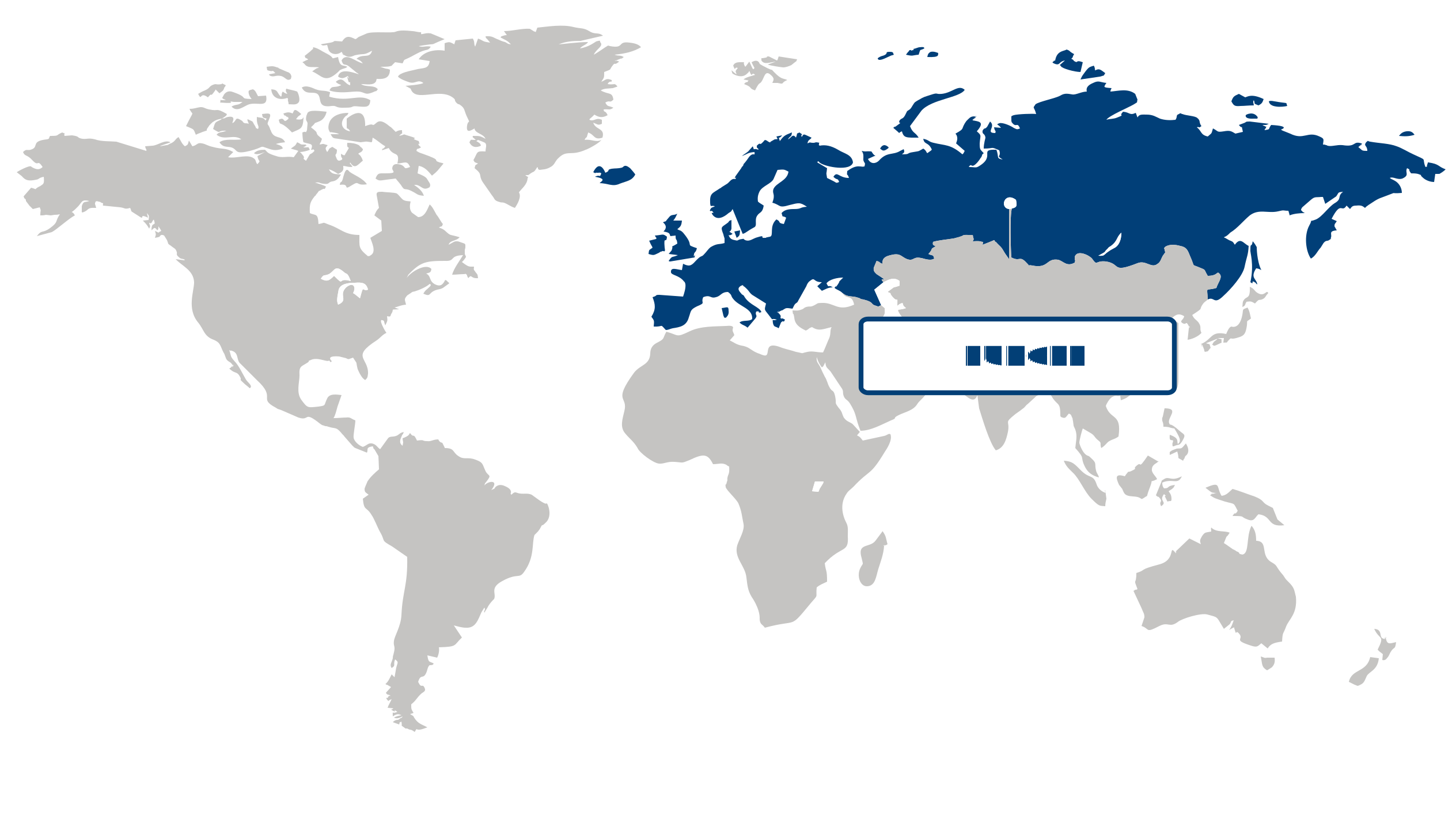
Largest Region
Europe
37.1% Market Share in 2026
Europe (Largest Region) vs Asia Pacific (Fastest-Growing Region)
The smart shelves market in Europe held the largest share of 37.10% in 2026, supported by advanced retail infrastructure, widespread adoption of automated inventory management, and strong emphasis on improving operational efficiency across stores and distribution networks. Retailers are increasingly integrating connected shelving technologies with real-time inventory monitoring, electronic pricing, and data-driven merchandising to reduce stock discrepancies and enhance customer experiences. The region's focus on digital transformation and efficient resource utilization further supports the deployment of smart shelf solutions across modern retail environments.
Asia Pacific is emerging as the fastest-growing region, driven by rapid expansion of organized retail, increasing digitalization, and growing investment in automated store technologies. Retailers are seeking connected solutions that can provide real-time visibility into product availability, support faster replenishment, and improve inventory accuracy as consumer expectations evolve. Expanding e-commerce ecosystems, rising adoption of smart retail infrastructure, and the modernization of physical stores are creating favorable conditions for broader smart shelf deployment.
Key Country Insights
The U.S. smart shelves market is gaining momentum as retailers deploy real-time inventory monitoring and automated replenishment solutions. Businesses in the U.S. increasingly use smart shelves to improve stock visibility, support omnichannel operations, and enhance in-store efficiency.
Japan's extensive convenience store network creates favorable conditions for smart shelf implementation and automated stock management. Retailers in Japan are focusing on technologies that optimize shelf replenishment and support labor efficiency in high-frequency retail environments.
South Korea's smart shelves market is driven by digitally advanced retail formats and growing investment in connected store technologies. Retailers are increasingly integrating smart shelves with analytics platforms and cashier-less concepts to improve customer engagement and operational responsiveness.
Germany is adopting smart shelf technologies to improve inventory precision and operational efficiency in retail and logistics environments. German retailers are integrating sensor-based shelf systems with digital inventory platforms to reduce stock discrepancies and improve product availability.
France is adopting smart shelf solutions to enhance merchandising effectiveness and improve in-store consumer insights. French retailers are increasingly using shelf monitoring technologies to optimize product placement and manage inventory more efficiently across modern retail channels.
Italy's smart shelves market is supported by retailers seeking greater inventory visibility and modernization of store operations. Businesses in Italy are gradually implementing intelligent shelf technologies that help reduce stockouts and improve the efficiency of inventory management processes.
Segment Leadership and Growth Trends
Component Segment Analysis: Hardware (Largest Segment) vs Software (Fastest-Growing Segment)
Hardware segment dominated the smart shelves market, accounting for the largest share of 49.82% in 2026. Smart shelves depend on physical components such as sensors, electronic displays, connectivity modules, and supporting devices to capture and communicate real-time information about products and shelf conditions. These components form the foundational infrastructure required to enable automated inventory visibility, product monitoring, and intelligent retail operations. Increasing adoption of connected retail technologies and the need for accurate shelf-level data are strengthening demand for hardware deployments. Improvements in sensor capabilities and connected devices are also expanding the functionality available through smart shelving systems.
Software is the fastest-growing component segment as retailers increasingly seek intelligent platforms capable of converting data collected from smart shelves into actionable operational insights. Software solutions can support inventory monitoring, analytics, alerts, replenishment decisions, and integration with broader retail management systems. As retail environments become more data-driven, the value of smart shelves increasingly depends on the ability to analyze information and automate decision-making rather than simply collect data. Growing interest in real-time visibility, connected retail ecosystems, and intelligent automation is therefore accelerating software adoption.
Application Segment Analysis: Inventory Management (Largest Segment) vs Pricing Management (Fastest-Growing Segment)
Inventory management represented the largest share of the smart shelves market, accounting for 37.1% in 2026. Smart shelves provide retailers with real-time visibility into product availability, shelf movement, and replenishment requirements, helping address inefficiencies associated with manual inventory monitoring. Automated tracking can improve stock visibility and reduce the likelihood of empty shelves or excess inventory, supporting better store operations and customer satisfaction. As retailers increasingly prioritize accurate inventory data and operational efficiency, inventory management remains a central application for smart shelving technologies.
Pricing management is projected to be the fastest-growing application as retailers increasingly adopt dynamic and digitally enabled approaches to managing product prices. Smart shelves equipped with electronic displays can facilitate rapid price updates, reduce reliance on manual label replacement, and help retailers respond more efficiently to changing market conditions. Integration with pricing and retail analytics systems can further support coordinated promotional strategies and improve pricing accuracy. The growing shift toward automated store operations and data-driven retail management is creating stronger demand for smart shelves in pricing-related applications.
| Report Segmentation | |||
| Segment | Sub-Segment | Largest Segment | Fastest Growing Segment |
|---|---|---|---|
| Component | Hardware, Software, Services | Hardware | Software |
| Application | Planogram Management, Inventory Management, Pricing Management, Content Management, Others | Inventory Management | Pricing Management |
| End-use | Hypermarkets, Supermarkets, Department Stores, Warehouses, Others | Hypermarkets | Department Stores |
 Read our Research Approach
Competitive Landscape and Market Positioning
Top players in the smart shelves market:
1. Avery Dennison Corporation (United States)
2. Honeywell International Inc. (United States)
3. Samsung Electronics Co. Ltd. (South Korea)
4. Intel Corporation (United States)
5. Huawei Technologies Co. Ltd. (China)
6. Trax Technology Solutions Pte Ltd (Singapore)
7. E Ink Holdings Inc. (Taiwan)
8. Lenovo PCCW Solutions Limited (Hong Kong)
9. Happiest Minds Technologies Limited (India)
10. AWM Smart Shelf Inc. (United States)
The smart shelves market is advancing through integration of intelligent sensing and automated inventory tracking capabilities. Innovation efforts are focused on improving retail visibility and operational efficiency. New solution deployments are enhancing real-time decision-making in storage environments. The smart shelves market reflects a shift toward digitally enabled retail infrastructure.
Industry Development/News
| Company Name | Date | Key Development |
|---|---|---|
| Walmart Mexico | Feb-26 | The retail giant introduced its Connected Store Platform across its Walmart Express network, planning an eventual rollout to Supercenter locations to optimize digital inventory management and enhance IoT retail operations. |
| Instacart | Feb-26 | The grocery delivery platform formed a strategic alliance with NVIDIA to embed advanced edge AI technologies into its Caper Cart systems, transforming standard shopping carts into real-time visual and behavioral data pipelines. |
| Smartway | Jan-26 | The anti-waste tech startup integrated its shelf monitoring architecture with VusionGroup's electronic systems at Kavanagh’s supermarket in London, creating an automated tracking solution to detect close-to-expiry items and significantly lower waste. |
| VusionGroup | Jan-26 | The retail technology developer collaborated with Smartway to deploy automated, AI-driven electronic shelf solutions at Kavanagh's supermarket, prioritizing real-time inventory visibility and sustainable product tracking. |
| E Ink Holdings Inc. | Apr-24 | The electronic ink technology provider established a strategic development partnership with Taiwan's AUO Corporation to engineer energy-efficient ePaper displays tailored for next-generation smart retail signage and low-power shelf ecosystems. |
| Huawei Technologies Co. Ltd. | Mar-24 | The multinational technology firm launched an integrated Smart Retail Solution targeting connected store campuses, introducing digital management frameworks for intelligent warehousing, local marketing, and automated energy optimization. |
Why Choose Us
Specialized Expertise: Our team comprises industry experts with a deep understanding of your market segment. We bring specialized knowledge and experience that ensures our research and consulting services are tailored to your unique needs.
Customized Solutions: We understand that every client is different. That's why we offer customized research and consulting solutions designed specifically to address your challenges and capitalize on opportunities within your industry.
Proven Results: With a track record of successful projects and satisfied clients, we have demonstrated our ability to deliver tangible results. Our case studies and testimonials speak to our effectiveness in helping clients achieve their goals.
Cutting-Edge Methodologies: We leverage the latest methodologies and technologies to gather insights and drive informed decision-making. Our innovative approach ensures that you stay ahead of the curve and gain a competitive edge in your market.
Client-Centric Approach: Your satisfaction is our top priority. We prioritize open communication, responsiveness, and transparency to ensure that we not only meet but exceed your expectations at every stage of the engagement.
Continuous Innovation: We are committed to continuous improvement and staying at the forefront of our industry. Through ongoing learning, professional development, and investment in new technologies, we ensure that our services are always evolving to meet your evolving needs.
Value for Money: Our competitive pricing and flexible engagement models ensure that you get maximum value for your investment. We are committed to delivering high-quality results that help you achieve a strong return on your investment.
Select Licence Type

