Smoke Detector Market Size & Growth Forecast 2027–2036, By Segments (Type, Technology, Service, End Use), Regional Demand Trends (North America, Asia Pacific, Europe), Key Country Insights (U.S., Japan, South Korea, Germany, France, Italy), and Competitive Landscape
Jump to content
Market Size and Growth Outlook
Smoke Detector Market size was valued at USD 3.05 Billion in 2026 and is anticipated to grow at 8.48% CAGR from 2027 to 2036, crossing USD 6.88 Billion by 2036. The industry revenue for 2027 is estimated at USD 3.27 Billion.
Get more details on this report
Request Free Sample ReportSmoke Detector Market Intelligence Snapshot
Regional Market Dynamics
- Europe held 34.56% in 2026, supported by stringent fire safety requirements, mature building infrastructure, and widespread adoption of upgraded and connected detection systems.
- Asia Pacific is growing fastest as urbanization and construction expand, increasing demand for reliable fire detection across high-density residential, commercial, and industrial buildings.
Segment Momentum
- Battery-powered smoke detectors accounted for 37.8% of the market in 2026, driven by simple installation, affordability, and independent operation, making them widely preferred for residential buildings, rental properties, and renovation projects.
- Monitoring services are the fastest-growing segment as connected fire safety systems and remote monitoring technologies enable continuous oversight, faster emergency response, and integration with smart building platforms.
Market Expansion Drivers
- Strengthening fire safety regulations driving mandatory smoke detector installations in residential and commercial buildings
- Rising smart home adoption enabling IoT-enabled smoke detection and real-time alert systems
- Increasing insurance-linked safety incentives encouraging residential adoption of advanced fire detection systems
Leading Market Participants
- Leading companies in the smoke detector market include Honeywell International Inc. (United States), Siemens AG (Germany), Johnson Controls International plc (Ireland), Bosch Security Systems GmbH (Germany), ABB Ltd. (Switzerland), Hochiki Corporation (Japan), Gentex Corporation (United States), Apollo Fire Detectors Ltd. (United Kingdom), Carrier Global Corporation (United States), Resideo Technologies, Inc. (United States)
Global Market Forecast Snapshot
Market Outlook
- 2026 Market Size: USD 3.05 Billion
- 2027 Estimated Market Size: USD 3.27 Billion
- Projected Market Size: USD 6.88 Billion by 2036
- Growth Forecast: 8.48% CAGR (2027-2036)
Regional and Segment Outlook
- Leading Regional Market: Europe
- High-Growth Regional Hub: Asia Pacific
- Core Revenue Segment: Battery-powered Smoke Detectors (Type) | Dual Sensor (Technology) | Installation Services (Service) | Manufacturing (End Use)
- Emerging Opportunity Segment: Wi-fi or Z-Wave Smoke Detectors (Type) | Dual Sensor (Technology) | Monitoring Services (Service) | Residential (End Use)
Market Growth Drivers and Industry Trends
Strengthening fire safety regulations driving mandatory smoke detector installations in residential and commercial buildings
Governments and regulatory authorities are implementing stricter fire protection requirements to improve occupant safety and reduce risks associated with delayed fire detection. These regulatory developments will drive the smoke detector market growth as residential complexes, commercial facilities, and public buildings increasingly require compliant detection systems. Mandatory installation standards are encouraging property owners and developers to upgrade fire safety infrastructure while prioritizing reliable early-warning technologies.
Rising smart home adoption enabling IoT-enabled smoke detection and real-time alert systems
The expansion of connected home technologies is changing consumer expectations around safety systems by introducing remote monitoring and intelligent alert capabilities. The smoke detector market is benefiting from smart home adoption as IoT-enabled detectors provide mobile notifications, interconnected alarms, and enhanced visibility into household safety conditions. These digital features improve user responsiveness and allow smoke detection systems to become part of broader connected security ecosystems.
Increasing insurance-linked safety incentives encouraging residential adoption of advanced fire detection systems
Insurance providers are increasingly recognizing the value of proactive safety measures that reduce property risks and improve emergency response capabilities. The smoke detector market will be supported by insurance-related incentives that encourage homeowners to install advanced detection technologies with improved reliability and monitoring features. These initiatives are motivating consumers to move beyond basic alarms toward smarter fire protection solutions that offer additional safety benefits.
| Growth Driver | Impact on CAGR | Regulatory Influence | Geographic Relevance | Adoption Rate | Impact Timeline |
|---|---|---|---|---|---|
| Strengthening fire safety regulations driving mandatory smoke detector installations in residential and commercial buildings | 2.1% | High | North America, Europe | High | Near Term |
| Rising smart home adoption enabling IoT-enabled smoke detection and real-time alert systems | 1.8% | Moderate | North America, Asia Pacific | High | Near Term |
| Increasing insurance-linked safety incentives encouraging residential adoption of advanced fire detection systems | 1.5% | Low | Europe, North America | High | Mid Term |
Unlock insights tailored to your business with our bespoke market research solutions.
Click to get your customized report now.
Regional Demand Dynamics
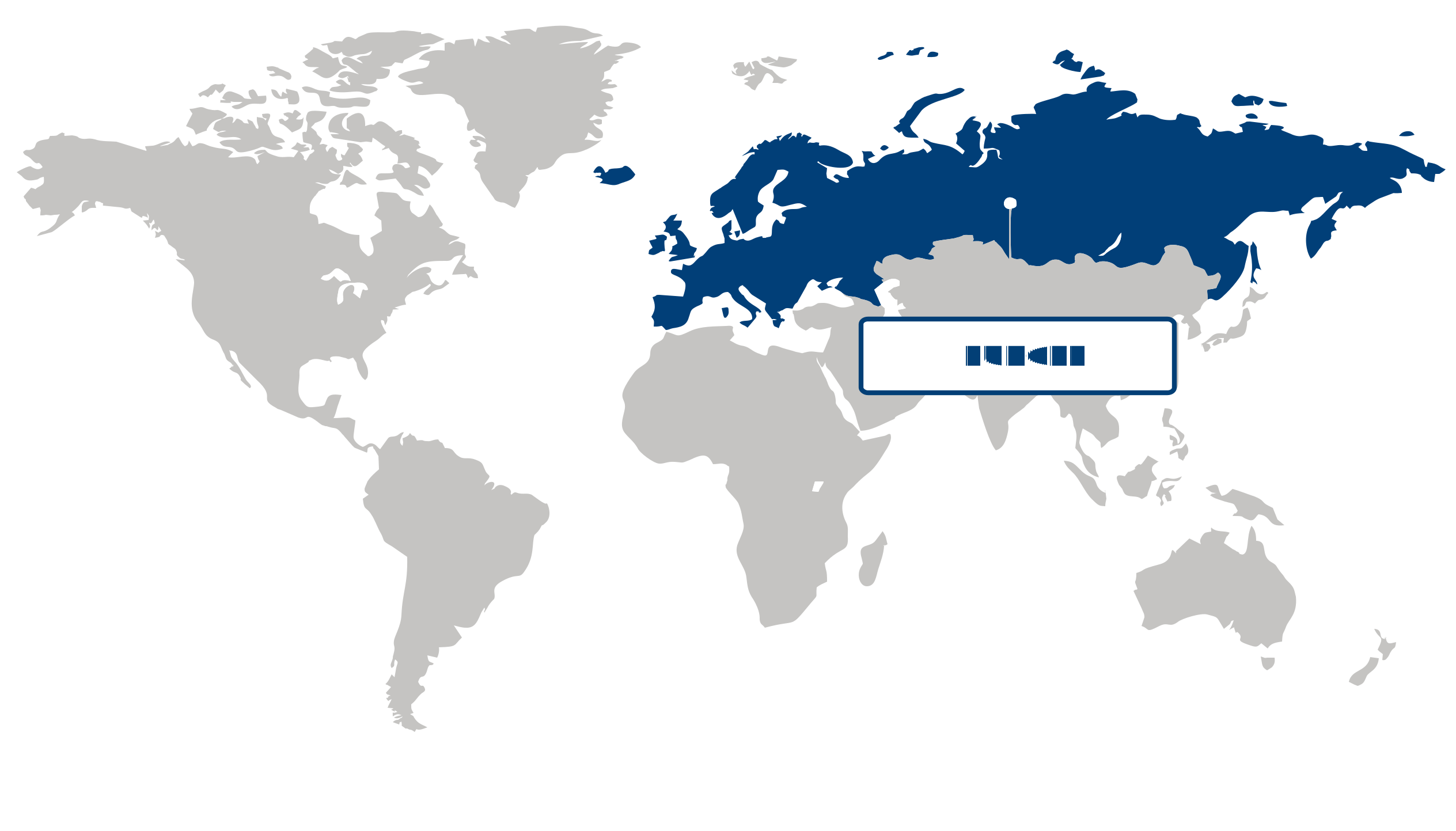
Europe (Largest Region)
Europe held the largest share of the smoke detector market at 34.56% in 2026, supported by stringent fire safety requirements, mature building infrastructure, and strong emphasis on occupant protection across residential, commercial, and industrial properties. The region's established regulatory environment encourages the installation and regular upgrading of fire detection systems, while renovation of older buildings creates additional demand for modern smoke detection technologies. Growing adoption of connected safety devices is also supporting market development as property owners increasingly seek solutions that enable faster alerts, remote monitoring, and integration with broader building management systems. Increasing awareness of fire prevention and emergency preparedness further reinforces demand across the region.
Asia Pacific (Fastest-Growing Region)
Asia Pacific is anticipated to be the fastest-growing regional market, driven by rapid urbanization, expanding construction activity, and the development of commercial, residential, and industrial infrastructure. The growth of high-density buildings and large-scale urban developments is increasing the need for reliable fire detection and safety systems. Governments and building operators are also placing greater emphasis on improving fire safety standards as infrastructure expands, creating favorable conditions for smoke detector adoption. In addition, rising awareness of residential safety, increasing use of smart building technologies, and modernization of existing properties are encouraging demand for connected and technologically advanced detection solutions.
| Parameter | North America | Asia Pacific | Europe | Latin America | MEA |
|---|---|---|---|---|---|
| Innovation HubiScaleNascentDeveloping Advanced | |||||
| Cost-Sensitive RegioniScaleLowMedium High | |||||
| Regulatory EnvironmentiScaleRestrictiveNeutral Supportive | |||||
| Demand DriversiScaleWeakModerate Strong | |||||
| Development StageiScaleEmergingDeveloping Developed | |||||
| Adoption RateiScaleLowMedium High | |||||
| New Entrants / StartupsiScaleSparseModerate Dense | |||||
| Macro IndicatorsiScaleWeakStable Strong |
Key Country Insights
United States 🇺🇸
Code-Driven UpgradesThe U.S. smoke detector market is shaped by building code compliance, replacement demand, and growing adoption of interconnected detection systems. Commercial facilities and residential property owners increasingly prioritize devices with enhanced connectivity and simplified maintenance to improve fire safety management.
Germany 🇩🇪
Integrated Building SafetyGermany emphasizes smoke detectors as part of comprehensive building safety strategies, with demand supported by residential retrofit activity and commercial modernization. German buyers increasingly favor reliable, standards-compliant solutions that integrate smoothly with broader fire protection systems.
Japan 🇯🇵
Compact Safety SolutionsJapan focuses on compact, dependable smoke detection technologies suited to high-density residential and commercial environments. The Japan market increasingly values low-maintenance devices and advanced sensing capabilities that reduce false alarms while supporting strict fire safety requirements.
South Korea 🇰🇷
Smart Detection AdoptionSouth Korea is expanding the use of smart smoke detectors through connected buildings and digital safety initiatives. The South Korea market shows increasing interest in devices with remote monitoring, wireless communication, and integration with broader smart building infrastructure.
France 🇫🇷
Residential Compliance FocusFrance continues to prioritize residential smoke detector adoption through ongoing replacement demand and compliance with fire safety regulations. The France market increasingly favors user-friendly products that combine dependable performance with easy installation across both existing and renovated properties.
Italy 🇮🇹
Retrofit Installation DemandItaly is seeing sustained demand for smoke detectors through renovation projects and upgrades to aging residential and commercial buildings. The Italy market increasingly values practical detection solutions that balance regulatory compliance, installation flexibility, and long-term operational reliability.
Smoke Detector Market Share (%), by Type, 2026
Go beyond the chart, access full insights & data tables
Request Free Sample ReportType Segment Analysis: Battery-powered Smoke Detectors (Largest Segment) vs Wi-fi or Z-Wave Smoke Detectors (Fastest-Growing Segment)
The battery-powered smoke detectors segment accounted for 37.8% in 2026, making it the leading product category in the smoke detector market. Its dominance is supported by simple installation, affordability, and the ability to operate independently without requiring existing electrical wiring. These detectors are widely used in residential buildings, rental properties, and renovation projects where quick deployment and reliable fire detection are essential. Their broad accessibility and ease of maintenance continue to sustain strong market demand.
The wi-fi or Z-wave smoke detectors segment is expected to register the fastest growth during the forecast period. Increasing adoption of smart home technologies and connected safety systems is driving demand for smoke detectors capable of delivering remote notifications, real-time monitoring, and seamless integration with home automation platforms. Growing consumer preference for intelligent safety solutions and enhanced emergency response capabilities is further accelerating adoption.
Technology Segment Analysis: Dual Sensor (Largest & Fastest-Growing Segment)
The smoke detector market was led by the dual sensor technology segment, which held the largest share in 2026, while also emerging as the fastest-growing technology category. Dual sensor smoke detectors combine multiple detection methods to improve responsiveness across a broader range of fire conditions while helping reduce false alarms. Their ability to provide more comprehensive fire detection has encouraged wider adoption across residential, commercial, and industrial environments. Increasing emphasis on occupant safety, regulatory compliance, and advanced fire protection systems continues to reinforce the segment's leadership and sustained growth.
Service Segment Analysis: Installation Services (Largest Segment) vs Monitoring Services (Fastest-Growing Segment)
Holding the largest share of the smoke detector market, the installation services segment maintained its leading position in 2026. Professional installation services play a critical role in ensuring correct device placement, regulatory compliance, and optimal system performance across residential, commercial, and industrial facilities. Growing deployment of fire safety systems and increasing awareness regarding proper installation standards continue to support sustained demand for these services.
The monitoring services segment is anticipated to witness the fastest growth during the forecast period. The growing adoption of connected fire safety systems and remote monitoring technologies is encouraging organizations and homeowners to invest in continuous monitoring solutions that enable rapid emergency response and proactive system oversight. Increasing integration with smart building platforms is further supporting the expansion of this segment.
| Segment | Sub-Segment | Largest Segment | Fastest Growing |
|---|---|---|---|
| Type | Battery-powered Smoke Detectors, Hardwired Smoke Detectors, Wireless Interconnected Smoke Detectors, Wi-fi or Z-Wave Smoke Detectors | Battery-powered Smoke Detectors | Wi-fi or Z-Wave Smoke Detectors |
| Technology | Ionization, Photoelectric, Dual Sensor, Others | Dual Sensor | Dual Sensor |
| Service | Installation Services, Maintenance and Testing Services, Monitoring Services, Repair and Replacement Services, Consulting and Compliance Services | Installation Services | Monitoring Services |
| End Use | Oil, Gas & Mining, Residential, Commercial, Transportation & Logistics, Manufacturing, Telecommunication, Others | Manufacturing | Residential |
Competitive Landscape and Market Positioning
Leading companies in the smoke detector market:
- Honeywell International, Inc. (United States)
- Siemens AG (Germany)
- Johnson Controls International plc (Ireland)
- Bosch Security Systems GmbH (Germany)
- ABB Ltd. (Switzerland)
- Hochiki Corporation (Japan)
- Gentex Corporation (United States)
- Apollo Fire Detectors Ltd. (United Kingdom)
- Carrier Global Corporation (United States)
- Resideo Technologies, Inc. (United States)
Product innovation and regulatory alignment are increasingly defining competitive dynamics in the smoke detector market as end users place greater emphasis on dependable fire detection across residential, commercial, and industrial environments. Manufacturers are differentiating through improved sensing technologies that reduce nuisance alarms while enhancing detection accuracy under varying environmental conditions, shifting competition toward technical performance rather than standard compliance alone. Connectivity is also becoming a stronger source of competitive advantage, with growing demand for devices that integrate with broader building management and smart home ecosystems. As installation requirements and safety standards continue to evolve across regions, suppliers with adaptable product portfolios and the ability to support long-term compliance are strengthening their position in both replacement and new construction markets.
| Company | Market Share | Company Revenue | Revenue CAGR (%) | Product Portfolio | Geographic Presence | Innovation / R&D Focus | Strategic Developments |
|---|---|---|---|---|---|---|---|
| Honeywell International Inc. (United States) | |||||||
| Siemens AG (Germany) | |||||||
| Johnson Controls International plc (Ireland) | |||||||
| Bosch Security Systems GmbH (Germany) | |||||||
| ABB Ltd. (Switzerland) | |||||||
| Hochiki Corporation (Japan) | |||||||
| Gentex Corporation (United States) | |||||||
| Apollo Fire Detectors Ltd. (United Kingdom) | |||||||
| Carrier Global Corporation (United States) | |||||||
| Resideo Technologies Inc. (United States) |
Industry Development / News
| Company Name | Date | Key Development |
|---|---|---|
| Lafayette | Mar-26 | Lafayette acquired a 50% stake in Berlin-based fire safety firm Pyrexx. This strategic investment drives the transformation of Pyrexx from a traditional hardware manufacturer into a digitally integrated fire safety service provider, enhancing its competitive position within the smoke detection ecosystem. |
| FFE Ltd | Aug-25 | FFE Ltd secured UL 268 Seventh Edition and EN certifications for its Fireray Hub Reflective optical beam smoke detector. This regulatory approval establishes global availability for the system, expanding the company's addressable commercial fire detection market. |
| Place | Jun-25 | Place commercialized a multi-functional smart smoke alarm that integrates residential fire detection with indoor air quality monitoring and a security camera. The launch introduces alternative capabilities into the connected home hardware sector, driving feature convergence. |
| Ring | Jan-25 | Ring expanded its connected residential ecosystem by launching a smart smoke detector that natively integrates with the Ring application. The device enhances real-time remote monitoring capabilities, building out the firm's digital home security and safety portfolio. |
| Belimo | Nov-24 | Belimo partnered with Greenheck to introduce the first UL-certified FSKN test module utilizing single-point wiring for combined fire and smoke dampers. The integration streamlines compliance testing protocols and improves the installation efficiency of commercial building safety systems. |
| Honeywell | Sep-24 | Honeywell launched an industrial aspirating smoke detection system specifically optimized for harsh, high-dust food processing environments. The specialized technology targets early-stage smoke identification in dust collection systems to limit facility fire risks and operational downtime. |
| ADT | Jan-24 | ADT introduced integrated fire and life safety upgrades within its core connected home platform at CES 2024. The development supports the technical expansion of the company's residential monitoring service infrastructure and broadens its digital footprint. |
| Honeywell | Jan-22 | Honeywell International introduced Fire-Lite, a dedicated suite of conventional and addressable fire protection systems configured for small to medium-sized commercial infrastructure. The architecture expands the company's product accessibility across both new construction and legacy building retrofits. |
Customize Your Report
Explore examples of how this report can be tailored to different research needs, including custom segments, additional topics or chapters, and related reports. Click a section of the wheel or its numbered marker to explore the available options.
Smoke Detector Market — Custom Segments
| Segment | Sub-Segment |
|---|---|
| Procurement Channel | Direct Sales, Electrical Distributors, Fire & Security System Integrators, Online Channels |
| Detector Replacement Cycle | New Installation, Scheduled Replacement, Replacement Following Failure or Compliance Upgrade |
| Smart Building Integration | Standalone Detectors, Connected Alarm Systems, Building Management System-Integrated Detectors, IoT-Enabled Smart Detectors |
Smoke Detector Market — Custom TOC
| Custom Chapter | Chapter Details |
|---|---|
| Installed-Base Replacement Opportunity |
|
| Smart Home Integration Strategy |
|
| Insurance-Driven Smoke Detector Adoption |
|
Need a different cut of the data?
Request Custom ResearchFrequently Asked Questions
What is the current size of the smoke detector market?
What are the growth projections for the smoke detector industry?
How are fire safety regulations influencing the smoke detector market?
Why is smart home adoption accelerating demand for advanced smoke detectors?
Why are battery-powered smoke detectors the largest product segment?
Which service segment is growing the fastest in the smoke detector market?
Why does Europe lead the smoke detector market?
What is driving faster smoke detector growth in Asia Pacific?
Who are the leading players in the smoke detector landscape?
Our Clients
"The report provided us with a clear direction, and the level of detail was beyond what we expected. I would definitely recommend their services to others."
Haier Appliances
"The collaboration with Fundamental Business Insights has added significant value to our decision-making process, and we look forward to continuing this partnership for our future market research requirements."
Luxottica Group S.p.A.
"The team at FBI delivered an exceptional research report. The insights on industry innovations were particularly impressive and added a lot of value to the overall report."
Nike
Our Research Team & Methodology
Every Fundamental Business Insights report is built by a dedicated vertical research team, validated through a structured primary-and-secondary methodology, and reviewed for accuracy before it reaches you.
Delivery
Published
Available
Support
- Market Size & Forecast
- Market Segmentation
- Regional Analysis
- Growth Drivers & Challenges
- Market Dynamics
- Competitive Landscape
- Company Profiles
- Competitive Benchmarking
- Mergers & Acquisitions
- Market Share Analysis or Key Company Strategies
- Value Chain Analysis
- Porter's Five Forces
- PESTLE Analysis
- Pricing Trends
- Supply-Demand Analysis
- Technology Landscape
- Regulatory Landscape
- Investment & Funding Landscape
- Emerging Opportunities
- Future Market Outlook