



Socks Market Size & Growth Forecast 2027–2036, By Segments (End-user, Raw Material, Product, Distribution Channel), Regional Demand Trends (North America, Asia Pacific, Europe), Key Country Insights (U.S., Japan, South Korea, Germany, France, Italy), and Competitive Landscape
Market Size and Growth Outlook
Socks Market size was worth USD 51.9 billion in 2026 and is expected to grow at a 4.94% CAGR between 2027 and 2036, exceeding USD 84.06 billion by 2036. The industry revenue for 2027 is estimated at USD 54.06 billion.
Base Year Value (2026)
USD 51.9 billion
CAGR (2027-2036)
4.94%
Forecast Year Value (2036)
USD 84.06 billion

Historical Data Period
2022-2026

Largest Region
Europe

Forecast Period
2027-2036
Socks Market Intelligence Snapshot:
-
Regional Market Dynamics:
- Europe leads due to mature retail systems, strong brand presence, and consistent replacement-driven demand across everyday, sports, and seasonal sock categories in established consumer markets.
- Asia Pacific is expanding at 7.8% CAGR, driven by rising apparel consumption, urbanization, expanding digital retail access, and growing demand across casual, school, and athletic wear segments.
-
Segment Momentum:
- Men's socks accounted for 58.77% of the market in 2026 due to steady replacement demand across workwear, casualwear, and sports, supported by routine purchasing patterns and broad product standardization.
- Nylon is the fastest-growing raw material because increasing demand for durability, stretch, and performance-oriented socks is encouraging manufacturers to expand its use in active and high-performance products.
-
Market Expansion Drivers:
- Growing consumer preference for comfort-focused, breathable, and premium fabric socks driving category expansion.
- Rising athleisure and fitness culture increasing demand for performance and compression socks.
- Expansion of e-commerce and D2C apparel brands improving product accessibility and driving global sock sales.
-
Leading Market Participants:
Key companies in the socks market include Nike, Inc. (United States), Adidas AG (Germany), Under Armour, Inc. (United States), Skechers U.S.A., Inc. (United States), ASICS Corporation (Japan), Columbia Sportswear Company (United States), VF Corporation (United States), Lululemon Athletica Inc. (Canada), Li Ning Company Limited (China), Anta Sports Products Limited (China).
Global Market Forecast Snapshot:
-
Market Outlook:
- 2026 Market Size: USD 51.9 billion
- 2027 Estimated Market Size: USD 54.06 billion.
- Projected Market Size: USD 84.06 billion by 2036
- Growth Forecasts: 4.94% CAGR (2027-2036)
-
Regional and Segment Outlook:
- Leading Regional Market: Europe
- High-Growth Regional Hub: Asia Pacific
- Core Revenue Segment: Men (End-user) | Cotton (Raw Material) | Casual (Product) | Online (Distribution Channel)
- Emerging Opportunity Segment: Women (End-user) | Nylon (Raw Material) | Athletic (Product) | Online (Distribution Channel)
Market Growth Drivers and Industry Trends
Growing consumer preference for comfort-focused, breathable, and premium fabric socks driving category expansion
Changing consumer expectations around everyday apparel are supporting the socks market as buyers increasingly prioritize softness, breathability, fit, and fabric quality alongside basic functionality. Premium materials and comfort-oriented construction can improve moisture management, temperature regulation, and overall wearability, making socks an increasingly differentiated apparel category. This preference is encouraging greater product variety across casual, formal, and lifestyle segments, with consumers showing stronger interest in products designed around specific comfort and material characteristics.
Rising athleisure and fitness culture increasing demand for performance and compression socks
The continued adoption of active lifestyles is expanding demand for specialized hosiery, with the socks market gaining from increased use of performance-oriented and compression products during exercise and everyday athleisure wear. Athletic socks can incorporate features such as moisture management, cushioning, ventilation, and supportive construction to address the needs of physically active consumers. Compression designs also appeal to users seeking enhanced support during fitness activities and extended periods of movement, broadening the role of socks beyond conventional apparel.
Expansion of e-commerce and D2C apparel brands improving product accessibility and driving global sock sales
Digital retail channels are making a wider range of sock products accessible to consumers across geographic markets, strengthening the socks market by enabling brands to reach customers without relying exclusively on physical retail networks. E-commerce platforms provide greater product visibility and allow consumers to compare materials, designs, sizes, and functional attributes more easily. At the same time, direct-to-consumer apparel brands can use digital channels to introduce specialized product ranges and engage targeted customer segments, increasing the availability of differentiated sock offerings.
| Growth Driver Assessment Framework | |||||
| Growth Driver | Impact On CAGR | Regulatory Influence | Geographic Relevance | Adoption Rate | Impact Timeline |
|---|---|---|---|---|---|
| Growing consumer preference for comfort-focused, breathable, and premium fabric socks driving category expansion | 2.10% | Low | Asia Pacific, North America | High | Near Term |
| Rising athleisure and fitness culture increasing demand for performance and compression socks | 1.90% | Low | North America, Europe, Asia Pacific | High | Near Term |
| Expansion of e-commerce and D2C apparel brands improving product accessibility and driving global sock sales | 1.60% | Low | Asia Pacific, Latin America | High | Near Term |
Unlock insights tailored to your business with our bespoke market research solutions - Click to get your customized report now!
Regional Demand Dynamics
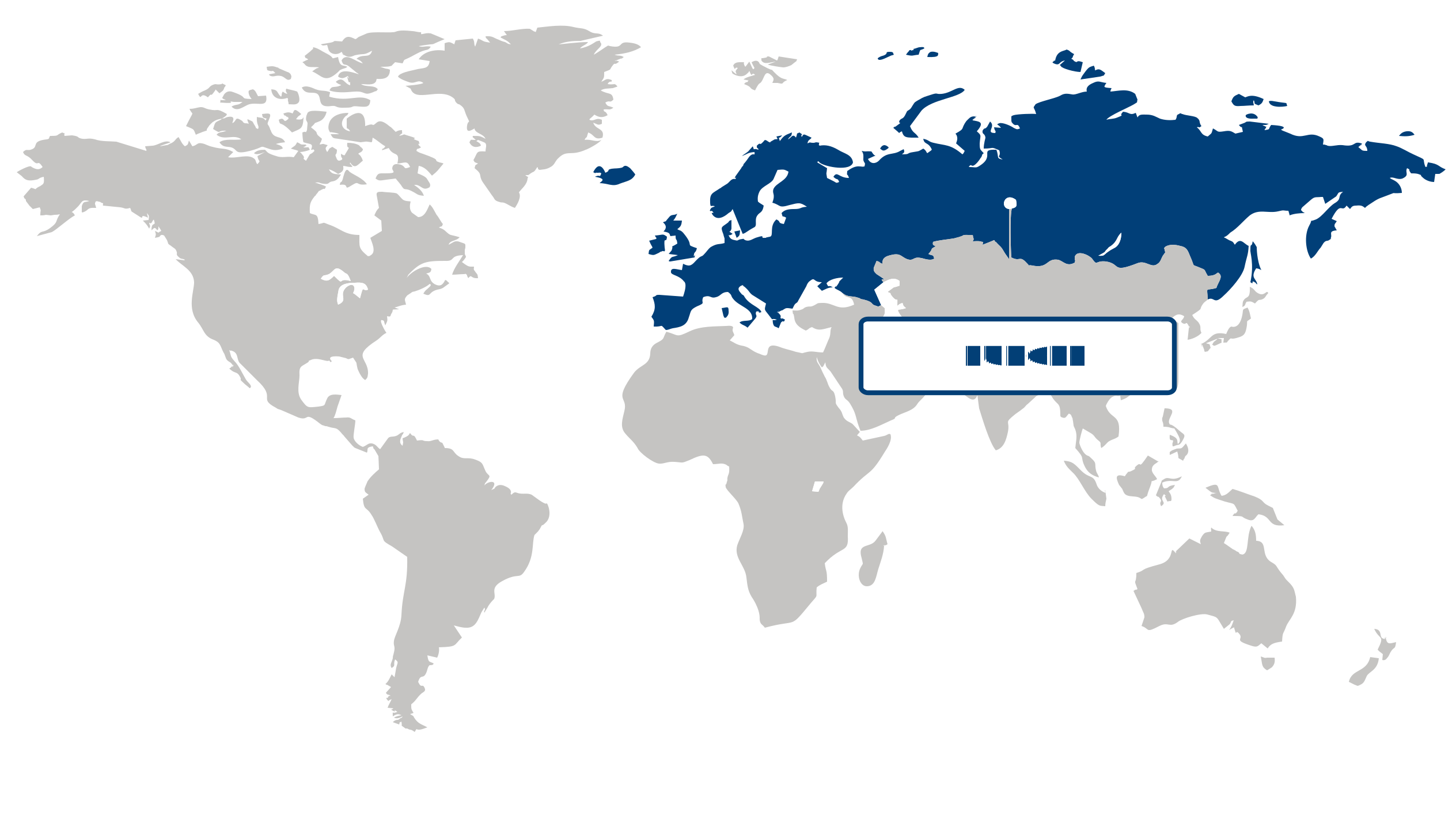
Largest Region
Europe
Largest Market Share in 2026
Europe (Largest Region) vs Asia Pacific (Fastest-Growing Region)
Europe held the largest share of the socks market in 2026, underpinned by established fashion and apparel consumption patterns, strong consumer interest in product quality, and demand for socks designed for diverse lifestyle and seasonal requirements. Consumers across the region increasingly value comfort, durability, material quality, and functional attributes alongside style, supporting demand across everyday, athletic, thermal, and specialized sock categories. The presence of mature retail infrastructure and well-developed e-commerce channels also enables consumers to access a broad range of products and facilitates faster adoption of new designs and material innovations. Sustainability considerations further influence purchasing behavior, encouraging interest in products incorporating responsibly sourced materials, longer-lasting construction, and environmentally conscious manufacturing practices.
Asia Pacific is the fastest-growing regional market, supported by rising disposable incomes, expanding urban populations, and increasing participation in sports, fitness, and outdoor activities. Changing lifestyles are broadening consumer demand beyond basic hosiery toward socks offering enhanced comfort, moisture management, performance characteristics, and fashion appeal. The expansion of organized retail and online commerce is improving product availability across both developed and emerging markets, while growing apparel consumption is creating additional opportunities for premium and specialized sock categories. Increasing domestic production capabilities and evolving consumer preferences are also strengthening the regional market, positioning Asia Pacific as an important growth center for manufacturers seeking to expand their presence in the global socks industry.
Key Country Insights
The U.S. socks market is shaped by strong demand for athletic, comfort, and lifestyle products, encouraging manufacturers to expand technical fabrics and sustainable material options. Retailers in the U.S. continue to balance premium collections with value-oriented offerings across both online and physical channels.
Japan values premium craftsmanship, ergonomic fit, and innovative textile technologies within the socks market. Companies operating in Japan continue introducing lightweight, moisture-managing, and season-specific products that align with consumer demand for comfort and refined product quality.
South Korea combines fashion trends with everyday apparel demand, encouraging frequent product refreshes and creative designs. Brands in South Korea increasingly integrate functional features with style-focused collections while strengthening digital retail engagement.
Germany emphasizes durable, functional socks designed for everyday wear, outdoor activities, and occupational use. Manufacturers serving Germany increasingly prioritize material performance, certified production standards, and environmentally responsible sourcing to meet evolving consumer expectations.
France supports demand for premium socks that combine fashion aesthetics with quality materials and sustainable production practices. Companies targeting France continue expanding designer collaborations and refined product assortments suited to changing consumer preferences.
Italy maintains strong interest in premium hosiery supported by textile expertise and attention to product finishing. Manufacturers in Italy focus on high-quality fibers, comfort-oriented construction, and design differentiation for both domestic and export-oriented product portfolios.
Segment Leadership and Growth Trends
End-user Segment Analysis: Men (Largest Segment) vs Women (Fastest-Growing Segment)
The men segment led the socks market, accounting for a 58.77% share in 2026. Its strong position is supported by the consistent use of socks as an everyday apparel essential, with demand spanning formal, casual, athletic, and work-related clothing. Men's socks are increasingly available in a wide range of materials, lengths, patterns, and performance-oriented designs, allowing consumers to select products based on comfort, occasion, and activity. The expansion of sportswear and athleisure preferences is also encouraging demand for specialized socks featuring moisture management, cushioning, breathability, and enhanced durability. These factors, combined with the routine replacement cycle associated with frequently worn apparel, help maintain strong consumption within the men's segment.
Women represent the fastest-growing end-user segment as preferences increasingly shift toward socks that combine functional performance with fashion and personal styling. The expanding popularity of athleisure, casual footwear, and active lifestyles is creating greater demand for products designed around comfort, breathability, support, and aesthetic appeal. Women's socks are also becoming more differentiated across styles, colors, patterns, lengths, and functional characteristics, broadening their relevance beyond basic apparel. Increasing participation in fitness and recreational activities further supports demand for performance-oriented products, while greater emphasis on coordinated fashion and seasonal styling is encouraging consumers to treat socks as an integral component of everyday wardrobes.
Raw Material Segment Analysis: Cotton (Largest Segment) vs Nylon (Fastest-Growing Segment)
Cotton dominated the socks market by raw material, representing a 52.04% share in 2026. Its leading position is primarily attributed to consumer familiarity with cotton's softness, breathability, and comfort, particularly for products intended for regular daily wear. Cotton socks are suitable across a broad range of casual and formal applications and can provide a comfortable feel during extended use. Growing consumer interest in natural and familiar textile materials also supports the continued relevance of cotton-based products. Manufacturers can further adapt cotton through blending and fabric treatments to improve durability, moisture management, and overall performance, allowing the material to remain competitive as consumer expectations for comfort and functionality evolve.
Nylon is experiencing the fastest growth as demand increases for socks requiring greater durability, elasticity, shape retention, and performance characteristics. The material's strength and resistance to wear make it suitable for athletic, outdoor, and everyday applications where products are exposed to repeated movement and washing. Nylon can also be blended with other fibers to enhance fit and resilience while maintaining a lightweight construction. The increasing popularity of performance-oriented apparel and active lifestyles is encouraging manufacturers to incorporate synthetic fibers into specialized sock designs, supporting the expanding role of nylon within the raw material landscape.
| Report Segmentation | |||
| Segment | Sub-Segment | Largest Segment | Fastest Growing Segment |
|---|---|---|---|
| End-user | Men, Women, Children | Men | Women |
| Raw Material | Cotton, Nylon, Wool, Others | Cotton | Nylon |
| Product | Casual, Formal, Athletic | Casual | Athletic |
| Distribution Channel | Hypermarkets and Supermarket, Convenience Store, Online, Others | Online | Online |
 Read our Research Approach
Competitive Landscape and Market Positioning
Key companies in the socks market:
1. Nike Inc. (United States)
2. Adidas AG (Germany)
3. Under Armour Inc. (United States)
4. Skechers U.S.A. Inc. (United States)
5. ASICS Corporation (Japan)
6. Columbia Sportswear Company (United States)
7. VF Corporation (United States)
8. Lululemon Athletica Inc. (Canada)
9. Li Ning Company Limited (China)
10. Anta Sports Products Limited (China)
The socks industry is experiencing heightened competition driven by evolving consumer preferences and material innovation. In the socks market, participants are focusing on differentiated product lines that combine comfort, performance, and modern design elements. New product introductions featuring advanced fabric technologies and functional enhancements are expanding consumer choices, while shifting lifestyle trends continue to influence purchasing behavior.
Industry Development/News
| Company Name | Date | Key Development |
|---|---|---|
| Gildan | Aug-25 | Gildan acquired Hanesbrands for USD 2.2 billion in an equity and cash transaction. This consolidation integrates major consumer brands, including Gold Toe and Hanes, into Gildan’s portfolio. The move is designed to achieve significant operational scale and manufacturing efficiencies, positioning the combined entity as a dominant force in the global apparel and hosiery market. |
| Marquee Brands | Nov-25 | Marquee Brands acquired Stance, a prominent lifestyle and performance sock brand. This strategic acquisition expands Marquee’s apparel footprint into the premium sock segment, allowing the company to leverage Stance’s established brand equity and product expertise within a multi-brand platform to drive growth in the high-performance and fashion-forward sock market. |
| Nester Hosiery, LLC | Jul-25 | Nester Hosiery, LLC acquired the majority of assets from Fox River Mills, a long-established sock manufacturer. Following the acquisition, the company consolidated its production footprint by closing the Fox River Mills facility in Osage and relocating manufacturing equipment to Nester’s headquarters in North Carolina. This integration aims to centralize operational capabilities and enhance manufacturing throughput in the U.S. domestic market. |
| Owlet | Jan-24 | Owlet secured FDA clearance for its Dream Sock, an infant monitoring device that utilizes wearable technology to track vital health indicators. This development represents a significant shift in sock utility, moving from traditional apparel into the medical-grade wearable devices segment, enabling real-time, sensor-driven health monitoring for infants. |
| Walmart Inc. | Apr-25 | Walmart expanded its private-label sock line under the Joyspun brand, incorporating recycled polyester into its product range. This initiative underscores the retailer's strategic commitment to sustainable apparel sourcing, aimed at integrating circular economy practices into high-volume, everyday consumer goods within its expansive retail ecosystem. |
| TRAK Compression | May-26 | TRAK Compression launched a line of performance-engineered compression socks featuring specialized reinforced structures, targeted cushioning zones, and advanced fabric mapping. The development focuses on technical athletic requirements, highlighting the industry trend toward integrating performance ergonomics into functional hosiery to enhance comfort and support during high-intensity athletic activities. |
| PCNA | May-25 | PCNA entered a partnership with Strideline to introduce full-sublimation unisex sock styles. By integrating Strideline’s manufacturing capabilities into its distribution network, PCNA has enhanced its product customization offerings. This collaboration strengthens the company’s position in the branded merchandise market, providing greater agility in fulfilling complex, high-volume promotional apparel requirements. |
| Smartwool | Oct-24 | Smartwool partnered with Altra to release a technical cold-weather running collection. The collaboration combines Smartwool’s merino wool performance apparel expertise with Altra’s technical footwear focus to deliver a coordinated run kit. This initiative serves to reinforce Smartwool’s market positioning in the technical athletic sector by emphasizing specialized thermal regulation and comfort for endurance athletes. |
| Stand Out Socks | Jan-24 | Stand Out Socks secured new investment following a successful appearance on the television program Dragons’ Den. The funding is designated to accelerate product development and scale distribution infrastructure for its inclusivity-focused sock line. This development highlights growing market demand for differentiated, mission-driven apparel brands that emphasize social representation and accessibility in design. |
Why Choose Us
Specialized Expertise: Our team comprises industry experts with a deep understanding of your market segment. We bring specialized knowledge and experience that ensures our research and consulting services are tailored to your unique needs.
Customized Solutions: We understand that every client is different. That's why we offer customized research and consulting solutions designed specifically to address your challenges and capitalize on opportunities within your industry.
Proven Results: With a track record of successful projects and satisfied clients, we have demonstrated our ability to deliver tangible results. Our case studies and testimonials speak to our effectiveness in helping clients achieve their goals.
Cutting-Edge Methodologies: We leverage the latest methodologies and technologies to gather insights and drive informed decision-making. Our innovative approach ensures that you stay ahead of the curve and gain a competitive edge in your market.
Client-Centric Approach: Your satisfaction is our top priority. We prioritize open communication, responsiveness, and transparency to ensure that we not only meet but exceed your expectations at every stage of the engagement.
Continuous Innovation: We are committed to continuous improvement and staying at the forefront of our industry. Through ongoing learning, professional development, and investment in new technologies, we ensure that our services are always evolving to meet your evolving needs.
Value for Money: Our competitive pricing and flexible engagement models ensure that you get maximum value for your investment. We are committed to delivering high-quality results that help you achieve a strong return on your investment.
Select Licence Type

