



Solar Panel Recycling Market Size & Growth Forecast 2027–2036, By Segments (Technique, Shelf Life, Type), Regional Demand Trends (North America, Asia Pacific, Europe), Key Country Insights (U.S., Japan, South Korea, Germany, France, Italy), and Competitive Landscape
Market Size and Growth Outlook
Solar Panel Recycling Market size was valued at USD 404.6 million in 2026 and is anticipated to grow at a 5.7% CAGR from 2027 to 2036, surpassing USD 704.33 million by 2036. The industry revenue for 2027 is assessed at USD 424.02 million.
Base Year Value (2026)
USD 404.6 million
CAGR (2027-2036)
5.70%
Forecast Year Value (2036)
USD 704.33 million

Historical Data Period
2022-2026

Largest Region
Europe

Forecast Period
2027-2036
Solar Panel Recycling Market Intelligence Snapshot:
-
Regional Market Dynamics:
- Europe leads through its mature renewable energy infrastructure, established collection systems, compliance-driven recycling framework, and growing volumes of end-of-life photovoltaic modules requiring processing.
- Europe is expected to grow at an 8.48% CAGR as aging solar assets, rising replacement activity, and increased recovery of reusable materials drive higher recycling throughput.
-
Segment Momentum:
- Mechanical recycling accounted for 62.58% of the market in 2026 because it supports efficient high-volume processing, reliable material separation, and simpler integration into existing recycling operations.
- Chemical recycling is growing fastest because it improves recovery of higher-value materials with greater purity, addressing rising demand for deeper material recovery from increasingly complex solar panels.
-
Market Expansion Drivers:
- Expanding producer responsibility regulations accelerating photovoltaic module recycling infrastructure investments.
- Automated high-recovery recycling technologies improving material recovery efficiency and commercial scalability.
- Rising utility-scale solar installations increasing long-term end-of-life panel waste management demand.
-
Leading Market Participants:
Top players in the solar panel recycling market include First Solar, Inc. (United States), Aurubis AG (Germany), Reiling GmbH & Co. KG (Germany), Canadian Solar Inc. (Canada), Trina Solar Co., Ltd. (China), Hanwha Solutions Corporation (South Korea), Yingli Green Energy Holding Company Limited (China), SunPower Corporation (United States), Echo Environmental, LLC (United States), Envaris GmbH (Germany).
Global Market Forecast Snapshot:
-
Market Outlook:
- 2026 Market Size: USD 404.6 million
- 2027 Estimated Market Size: USD 424.02 million.
- Projected Market Size: USD 704.33 million by 2036
- Growth Forecasts: 5.7% CAGR (2027-2036)
-
Regional and Segment Outlook:
- Leading Regional Market: Europe
- High-Growth Regional Hub: Europe
- Core Revenue Segment: Mechanical (Technique) | Early Loss (Shelf Life) | Crystalline Silicon (Type)
- Emerging Opportunity Segment: Chemical (Technique) | Normal Loss (Shelf Life) | Thin Film (Type)
Market Growth Drivers and Industry Trends
Expanding producer responsibility regulations accelerating photovoltaic module recycling infrastructure investments
The introduction and expansion of producer responsibility requirements are placing greater emphasis on the collection, treatment, and responsible disposal of end-of-life photovoltaic modules. Such regulatory developments will accelerate solar panel recycling market growth by encouraging manufacturers, project owners, and waste management participants to establish more structured recycling and recovery processes. Clearer obligations around end-of-life handling can also improve investment visibility for recycling facilities, collection networks, and specialized processing capabilities as stakeholders seek compliant approaches for managing retired solar panels and recovering usable materials.
Automated high-recovery recycling technologies improving material recovery efficiency and commercial scalability
Technological advances in automated recycling are improving the ability of recyclers to separate and recover valuable components from photovoltaic modules with greater consistency and processing efficiency. The solar panel recycling market is gaining from systems designed to automate dismantling, sorting, material separation, and recovery processes, helping reduce labor intensity and improve operational throughput. Higher recovery capabilities can strengthen the commercial attractiveness of recycling by enabling greater utilization of materials such as glass, metals, and other recoverable components while supporting more standardized processing across different panel configurations.
Rising utility-scale solar installations increasing long-term end-of-life panel waste management demand
The continued expansion of utility-scale solar projects is creating a growing installed base of photovoltaic modules that will eventually require structured end-of-life management. As large solar assets mature, the solar panel recycling market will benefit from increasing demand for collection, transportation, dismantling, material recovery, and responsible processing services associated with retired modules. Utility-scale projects can also generate concentrated volumes of panels requiring coordinated waste management, creating opportunities for specialized recycling infrastructure and service providers capable of handling large-scale module recovery operations.
| Growth Driver Assessment Framework | |||||
| Growth Driver | Impact On CAGR | Regulatory Influence | Geographic Relevance | Adoption Rate | Impact Timeline |
|---|---|---|---|---|---|
| Expanding producer responsibility regulations accelerating photovoltaic module recycling infrastructure investments | 2.00% | High | North America, Europe | High | Near Term |
| Automated high-recovery recycling technologies improving material recovery efficiency and commercial scalability | 1.80% | Moderate | North America, Asia Pacific | Medium | Mid Term |
| Rising utility-scale solar installations increasing long-term end-of-life panel waste management demand | 1.50% | Moderate | Asia Pacific, Europe | Emerging | Long Term |
Unlock insights tailored to your business with our bespoke market research solutions - Click to get your customized report now!
Regional Demand Dynamics
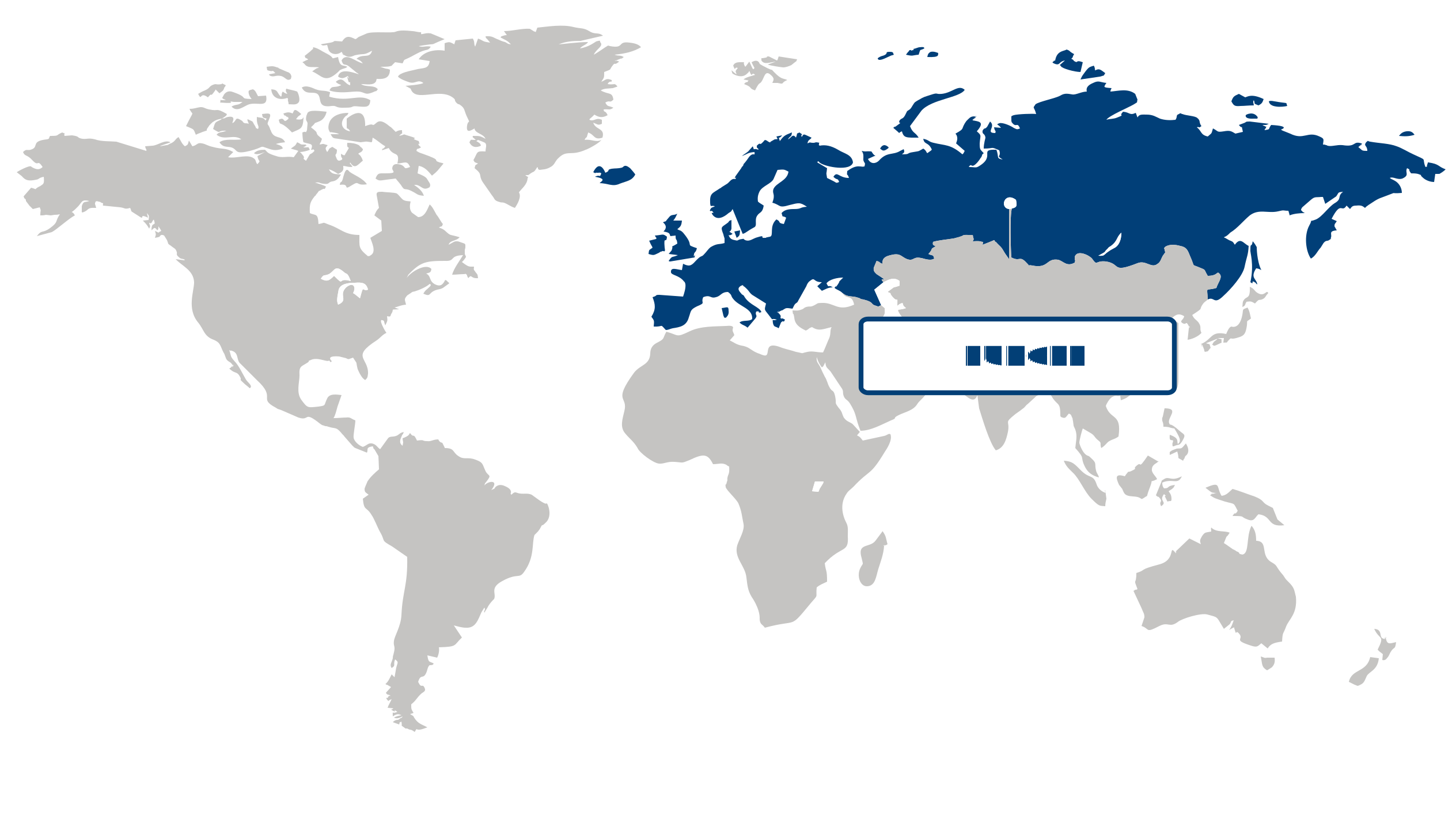
Largest Region
Europe
Largest Market Share in 2026
Europe (Largest & Fastest-Growing Region)
Europe holds the largest position in the solar panel recycling market, supported by strong environmental priorities, established waste-management frameworks, and increasing emphasis on recovering valuable materials from end-of-life photovoltaic equipment. The region's mature renewable energy ecosystem is creating a growing need for structured approaches to panel collection, processing, and material recovery. Regulatory focus on circular economy principles and resource efficiency is encouraging investment in specialized recycling infrastructure and technologies.
Europe is also the fastest-growing region, as sustainability objectives increasingly influence renewable energy asset management and waste treatment practices. Greater attention to responsible handling of retired solar equipment is encouraging improvements in recycling capacity, material separation, and recovery processes. Continued development of circular supply chains and stronger integration of recycling considerations into renewable energy infrastructure are expected to reinforce the region's growth momentum.
Key Country Insights
The U.S. solar panel recycling market is expanding its collection and material recovery capabilities as installed photovoltaic capacity continues to mature. Companies are prioritizing efficient recovery of glass, aluminum, and valuable metals while strengthening partnerships across the renewable energy value chain.
Japan focuses on efficient recycling technologies that maximize resource recovery from aging solar installations while addressing limited landfill capacity. Japanese companies continue refining automated dismantling and material separation processes to improve operational efficiency and resource utilization.
South Korea is strengthening domestic recycling capabilities to recover strategic materials from retired solar panels. Industry participants are investing in processing technologies and integrated recycling networks that support renewable energy sustainability and responsible waste management.
Germany emphasizes high-value material recovery through advanced recycling processes that align with circular economy objectives. German recyclers continue investing in technologies that improve material purity and support sustainable management of decommissioned photovoltaic modules.
France is expanding solar panel recycling through structured collection programs and improved processing infrastructure. French stakeholders are prioritizing material recovery solutions that complement renewable energy deployment while supporting environmental compliance and resource efficiency.
Italy continues enhancing regional collection and recycling systems for end-of-life photovoltaic panels. Italian recyclers are improving logistics, material recovery efficiency, and collaboration with installers to support responsible disposal and greater resource recovery.
Segment Leadership and Growth Trends
Technique Segment Analysis: Mechanical (Largest Segment) vs Chemical (Fastest-Growing Segment)
The mechanical technique segment accounted for 62.58% of the solar panel recycling market in 2026, supported by its established role in recovering valuable materials from end-of-life photovoltaic modules. Mechanical processing can separate major panel components through dismantling, crushing, sorting, and material recovery steps, making it suitable for handling diverse panel structures while supporting efficient downstream recycling. The growing volume of retired solar panels and increasing emphasis on recovering glass, metals, and other reusable materials are reinforcing the importance of mechanical techniques in recycling operations.
Chemical techniques are gaining momentum as recyclers seek more effective approaches for recovering materials that are difficult to separate through conventional mechanical processing alone. Chemical treatment can assist in breaking down or removing selected layers, coatings, and binding materials, potentially improving the recovery of higher-value components. Rising attention to resource recovery, material purity, and more comprehensive treatment of complex photovoltaic waste is encouraging greater interest in chemical recycling approaches.
Shelf Life Segment Analysis: Early Loss (Largest Segment) vs Normal Loss (Fastest-Growing Segment)
Within the solar panel recycling market, the early loss segment held the largest share in 2026, reflecting the need to address photovoltaic modules that reach end-of-use prematurely because of damage, defects, performance degradation, or other operational issues. Early-loss panels can create an unplanned stream of recyclable material, increasing the importance of collection, sorting, and processing systems capable of handling panels outside their expected service cycle. The growing deployment of solar installations also strengthens the need for efficient recovery pathways for prematurely retired modules.
The normal loss segment represents the fastest-growing shelf-life category as an increasing number of photovoltaic panels naturally reach the end of their useful operating period. Planned retirement creates a more predictable feedstock for recycling facilities and supports systematic recovery of materials from aging solar assets. Greater emphasis on circular resource management and responsible disposal is encouraging asset owners and recyclers to establish processes for collecting and recovering panels that have completed their normal service life.
| Report Segmentation | |||
| Segment | Sub-Segment | Largest Segment | Fastest Growing Segment |
|---|---|---|---|
| Technique | Mechanical, Thermal, Chemical | Mechanical | Chemical |
| Shelf Life | Normal Loss, Early Loss | Early Loss | Normal Loss |
| Type | Crystalline Silicon, Thin Film, Others | Crystalline Silicon | Thin Film |
 Read our Research Approach
Competitive Landscape and Market Positioning
Major players in the solar panel recycling market:
1. First Solar Inc. (United States)
2. Aurubis AG (Germany)
3. Reiling GmbH & Co. KG (Germany)
4. Canadian Solar Inc. (Canada)
5. Trina Solar Co. Ltd. (China)
6. Hanwha Solutions Corporation (South Korea)
7. Yingli Green Energy Holding Company Limited (China)
8. SunPower Corporation (United States)
9. Echo Environmental LLC (United States)
10. Envaris GmbH (Germany)
The solar panel recycling market is gaining traction due to increasing focus on circular economy initiatives and stricter environmental regulations surrounding photovoltaic waste. Companies are investing in advanced material recovery technologies and efficient recycling processes to maximize resource utilization and reduce landfill dependency.
Industry Development/News
| Company Name | Date | Key Development |
|---|---|---|
| ROSI | Apr-26 | ROSI secured over €20 million in funding to scale its European photovoltaic module recycling operations. The investment is earmarked for expanding facility capacity dedicated to the recovery of high-purity silicon and silver from end-of-life solar panels, addressing the growing demand for secondary raw material streams within the European renewable energy supply chain. |
| OnePlanet Solar Recycling | Apr-25 | OnePlanet Solar Recycling raised $7 million in seed funding to advance its $90 million industrial-scale solar panel recycling project in River City, Florida. This capital deployment is critical to establishing high-volume processing infrastructure capable of extracting valuable components from end-of-life modules at an industrial scale. |
| SOLARCYCLE | Oct-24 | SOLARCYCLE announced plans to construct a 5 GW solar panel recycling facility in Georgia. This investment significantly bolsters domestic U.S. recycling capacity for end-of-life solar modules, providing a essential industrial foundation for addressing the forecasted surge in decommissioned photovoltaic assets and strengthening the domestic circular supply chain. |
| Comstock Metals | Jul-24 | Comstock Metals secured a dedicated site for a new solar panel recycling facility engineered to process up to 100,000 tons of panels annually. This initiative represents a substantial capacity expansion effort, positioning the company to capture significant volume as the first wave of large-scale solar installations reaches the end of their operational lifecycles. |
| Illuminate USA | Aug-25 | Illuminate USA entered a five-year supply agreement with SOLARCYCLE to procure U.S.-manufactured solar glass derived from recycled panels. This strategic partnership fosters circular supply chain integration, reducing reliance on virgin material imports by creating a verified downstream market for high-quality recycled glass within the domestic solar manufacturing sector. |
| Qcells | Jun-25 | Qcells launched its EcoRecycle facility in Georgia, integrating solar panel recycling capabilities directly into its regional manufacturing ecosystem. The facility enables the systematic recovery of aluminum, glass, silver, and copper from retired modules, facilitating the internal reuse of secondary materials and lowering the carbon intensity of the company's domestic module production. |
| Comstock Metals | Mar-26 | Comstock Metals advanced its commercialization efforts by delivering key processing equipment for its upcoming facility in Silver Springs, Nevada. The move toward commissioning this commercial-scale plant demonstrates the transition from site acquisition to active operational readiness, enhancing the company’s ability to service the growing Western U.S. market for photovoltaic waste management. |
| Envaris GmbH | May-25 | Envaris GmbH introduced a hybrid solar panel recycling technique that integrates thermal and mechanical processes. This technological innovation improves the efficiency of material recovery, specifically increasing yields of silicon wafers while simultaneously reducing operational processing costs, thereby improving the economic viability of recycling end-of-life photovoltaic modules. |
| SPR | Jan-25 | SPR launched an automated bifacial solar panel recycling line designed to achieve glass recovery rates of 99% or higher. This technological upgrade enhances overall processing efficiency for modern, high-complexity photovoltaic modules, setting a new benchmark for material recovery standards in the competitive solar recycling service sector. |
| Reiling GmbH & Co. KG | Apr-24 | Reiling GmbH & Co. KG commissioned its first industrial-scale solar module recycling plant in Germany. The facility features advanced integrated systems for high-quality solar glass recovery and silicon reclamation, strengthening the company's position as a key provider in the European market for sophisticated photovoltaic waste processing services. |
Why Choose Us
Specialized Expertise: Our team comprises industry experts with a deep understanding of your market segment. We bring specialized knowledge and experience that ensures our research and consulting services are tailored to your unique needs.
Customized Solutions: We understand that every client is different. That's why we offer customized research and consulting solutions designed specifically to address your challenges and capitalize on opportunities within your industry.
Proven Results: With a track record of successful projects and satisfied clients, we have demonstrated our ability to deliver tangible results. Our case studies and testimonials speak to our effectiveness in helping clients achieve their goals.
Cutting-Edge Methodologies: We leverage the latest methodologies and technologies to gather insights and drive informed decision-making. Our innovative approach ensures that you stay ahead of the curve and gain a competitive edge in your market.
Client-Centric Approach: Your satisfaction is our top priority. We prioritize open communication, responsiveness, and transparency to ensure that we not only meet but exceed your expectations at every stage of the engagement.
Continuous Innovation: We are committed to continuous improvement and staying at the forefront of our industry. Through ongoing learning, professional development, and investment in new technologies, we ensure that our services are always evolving to meet your evolving needs.
Value for Money: Our competitive pricing and flexible engagement models ensure that you get maximum value for your investment. We are committed to delivering high-quality results that help you achieve a strong return on your investment.
Select Licence Type

