



Space Heating Boilers Market Size & Growth Forecast 2027–2036, By Segments (Application, Type, Operation, Region), Regional Demand Trends (North America, Asia Pacific, Europe), Key Country Insights (U.S., Japan, South Korea, Germany, France, Italy), and Competitive Landscape
Market Size and Growth Outlook
Space Heating Boilers Market size was valued at USD 30.5 billion in 2026 and is projected to grow at a 3.33% CAGR from 2027 to 2036, surpassing USD 42.32 billion by 2036. The industry revenue for 2027 is estimated at USD 31.35 billion.
Base Year Value (2026)
USD 30.5 billion
CAGR (2027-2036)
3.33%
Forecast Year Value (2036)
USD 42.32 billion

Historical Data Period
2022-2026

Largest Region
Europe

Forecast Period
2027-2036
Space Heating Boilers Market Intelligence Snapshot:
-
Regional Market Dynamics:
- Europe held a 62.76% market share in 2026, supported by an extensive installed boiler base, recurring retrofit projects, and continuous replacement demand across residential and commercial buildings.
- Asia Pacific is forecast to grow at a 3.99% CAGR as urbanization, expanding construction activity, and investment in building services infrastructure increase new boiler installations across the region.
-
Segment Momentum:
- Commercial applications accounted for a 57.96% share in 2026, supported by the continuous heating needs of offices, hospitals, educational facilities, and other large non-residential buildings.
- Non-condensing space heating boilers are the fastest-growing type because they offer easier replacement within existing heating infrastructure where minimizing installation complexity is a priority.
-
Market Expansion Drivers:
- Stringent energy efficiency standards and decarbonization mandates accelerating high-efficiency boiler adoption.
- Replacement of aging heating infrastructure driving demand for modern condensing boiler systems.
- Electrification shift and heat pump adoption restraining conventional boiler demand growth trajectory.
-
Leading Market Participants:
Top players in the space heating boilers market include Daikin Industries, Ltd. (Japan), Carrier Global Corporation (United States), Rheem Manufacturing Company (United States), Ariston Holding N.V. (Italy), BDR Thermea Group B.V. (Netherlands), Ideal Heating Ltd. (United Kingdom), Navien, Inc. (South Korea), Lennox International Inc. (United States), Lochinvar, LLC (United States), Viessmann Climate Solutions SE (Germany).
Global Market Forecast Snapshot:
-
Market Outlook:
- 2026 Market Size: USD 30.5 billion
- 2027 Estimated Market Size: USD 31.35 billion.
- Projected Market Size: USD 42.32 billion by 2036
- Growth Forecasts: 3.33% CAGR (2027-2036)
-
Regional and Segment Outlook:
- Leading Regional Market: Europe
- High-Growth Regional Hub: Asia Pacific
- Core Revenue Segment: Commercial (Application) | Condensing Space Heating Boiler (Type) | Gas-fired Space Heating Boilers (Operation) | Asia Pacific (Region)
- Emerging Opportunity Segment: Residential (Application) | Non-condensing Space Heating Boiler (Type) | Electric Space Heating Boilers (Operation) | Asia Pacific (Region)
Market Growth Drivers and Industry Trends
Stringent energy efficiency standards and decarbonization mandates accelerating high-efficiency boiler adoption
Increasingly demanding energy performance requirements are pushing building owners and heating-system operators toward equipment capable of delivering greater thermal efficiency with lower fuel consumption. The space heating boilers market is gaining support from this transition as condensing and other high-efficiency boiler technologies can extract more usable heat from fuel while reducing energy losses during operation. Decarbonization policies are also encouraging upgrades to heating equipment as governments and building operators seek to reduce emissions associated with conventional heating systems. In addition, energy efficiency requirements can make older, inefficient installations less attractive to maintain, prompting investment in modern systems that provide improved combustion control, better heat recovery, and compatibility with evolving building energy-management practices.
Replacement of aging heating infrastructure driving demand for modern condensing boiler systems
A substantial installed base of older heating equipment requires replacement as systems reach the end of their useful operating life, experience declining efficiency, or become increasingly expensive to maintain. This replacement cycle is supporting the space heating boilers market, particularly for modern condensing systems that can provide improved fuel utilization and more efficient heat delivery than legacy boiler technologies. Building owners are also considering reliability, maintenance requirements, available installation space, and operating costs when upgrading heating infrastructure, making replacement projects an important source of equipment demand. Condensing technology can further support modernization efforts where buildings require dependable space heating while operators seek to improve overall energy performance without completely redesigning existing heating distribution infrastructure.
Electrification shift and heat pump adoption restraining conventional boiler demand growth trajectory
The growing shift toward electrified building heating is creating a competitive challenge for conventional boiler technologies as heat pumps gain wider consideration for space-heating applications. In the space heating boilers market, this transition can limit new demand in buildings where owners prioritize electric heating solutions to reduce direct fossil-fuel consumption and align with decarbonization objectives. Heat pumps can also be integrated with increasingly efficient building envelopes and renewable electricity systems, strengthening their appeal in applications where electrification is technically and economically viable. As policy support, energy-system modernization, and consumer awareness encourage alternatives to combustion-based heating, boiler manufacturers and suppliers face pressure to improve efficiency, explore lower-carbon fuel compatibility, and address applications where electric heating may not be suitable.
| Growth Driver Assessment Framework | |||||
| Growth Driver | Impact On CAGR | Regulatory Influence | Geographic Relevance | Adoption Rate | Impact Timeline |
|---|---|---|---|---|---|
| Increasing energy efficiency requirements | 1.20% | Short term (≤ 2 yrs) | Europe, North America | High | Fast |
| Technological innovations in boiler design | 1.00% | Medium term (2–5 yrs) | Europe, Asia Pacific | Low | Moderate |
| Replacement of outdated heating systems in emerging regions | 1.30% | Long term (5+ yrs) | Asia Pacific, Latin America | Low | Slow |
| Stringent energy efficiency standards and decarbonization mandates accelerating high-efficiency boiler adoption | 2.80% | High | Europe, North America | High | Near Term |
| Replacement of aging heating infrastructure driving demand for modern condensing boiler systems | 2.60% | Moderate | Europe, Asia Pacific | High | Near Term |
| Electrification shift and heat pump adoption restraining conventional boiler demand growth trajectory | 2.10% | High | Europe, North America | High | Mid Term |
Unlock insights tailored to your business with our bespoke market research solutions - Click to get your customized report now!
Regional Demand Dynamics
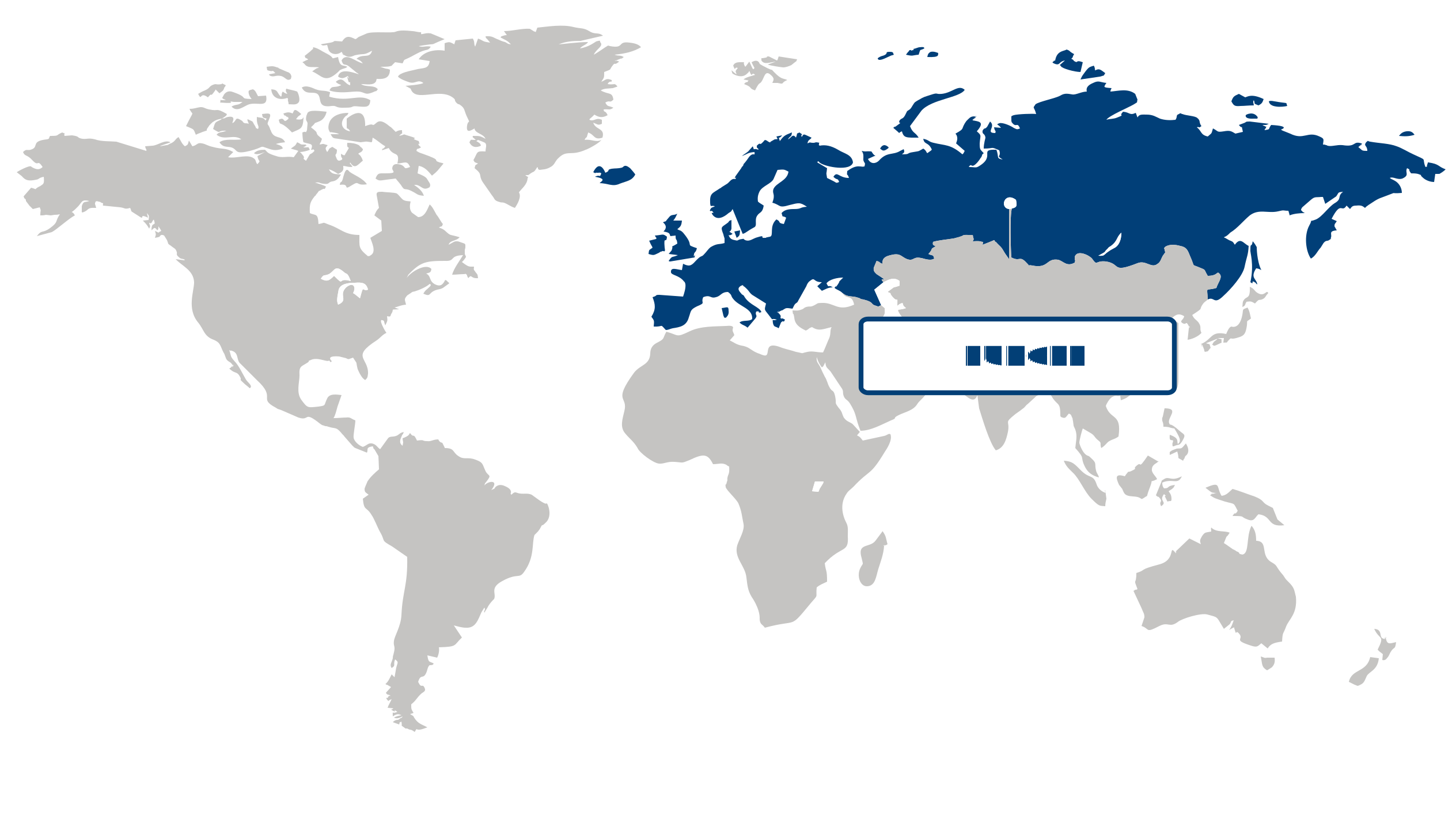
Largest Region
Europe
62.76% Market Share in 2026
Europe (Largest Region) vs Asia Pacific (Fastest-Growing Region)
In the space heating boilers market, Europe held the largest share of 62.76% in 2026, reflecting established heating infrastructure, significant seasonal heating requirements, and continued demand for efficient building heating systems. The region’s focus on energy efficiency and modernization of existing heating installations supports replacement and upgrade activity. Strong awareness of heating performance and efforts to improve building energy management further reinforce the market’s established position.
Asia Pacific is the fastest-growing region, supported by expanding urban development, rising construction activity, and increasing demand for reliable indoor heating in colder markets. Growing investment in residential and commercial infrastructure is creating opportunities for modern space heating solutions, while improving awareness of energy-efficient heating technologies is encouraging system upgrades. The expansion of building infrastructure across the region is expected to strengthen adoption of space heating boilers.
Key Country Insights
The U.S. prioritizes replacement of aging space heating boilers with energy-efficient systems across residential and commercial buildings. Demand increasingly favors smart controls, lower-emission technologies, and equipment that supports evolving building performance standards and renovation projects.
Japan focuses on compact, high-efficiency space heating boilers suited to urban residential developments and commercial facilities. Suppliers continue refining system reliability, space-saving designs, and intelligent energy management features to meet customer expectations.
South Korea is expanding the deployment of space heating boilers compatible with connected building management systems. Buyers increasingly value efficient operation, remote monitoring capabilities, and products that complement modern residential and commercial construction projects.
Germany is advancing the adoption of space heating boilers that align with decarbonization objectives and high energy performance requirements. Manufacturers are emphasizing hybrid-compatible systems, improved efficiency, and integration with modern building heating infrastructure.
France emphasizes space heating boiler replacements within building renovation programs aimed at improving energy performance. The market increasingly favors efficient equipment that supports lower fuel consumption while maintaining reliable heating across residential and institutional properties.
Italy continues upgrading residential heating infrastructure with efficient space heating boilers suited to renovation-driven demand. Italian purchasers prioritize dependable performance, ease of installation, and systems compatible with modern energy-saving building upgrades.
Segment Leadership and Growth Trends
Application Segment Analysis: Commercial (Largest Segment) vs Residential (Fastest-Growing Segment)
Commercial applications dominated the space heating boilers market with a 57.96% share in 2026, reflecting the substantial heating requirements of offices, hospitality facilities, healthcare buildings, educational institutions, and other commercial properties. These facilities require dependable heating systems capable of maintaining comfortable indoor environments across large or continuously occupied spaces. Increasing attention to energy efficiency and building performance is also encouraging commercial property owners to adopt modern boiler technologies that can improve heating efficiency and operational control.
Residential applications are expanding at a faster pace as households increasingly prioritize efficient, reliable, and controllable space heating solutions. Demand is supported by the need for comfortable indoor temperatures, replacement of aging heating equipment, and greater awareness of energy-efficient technologies. The growing focus on household energy management and improved heating performance is creating favorable conditions for wider adoption of modern space heating boilers in residential environments.
Type Segment Analysis: Condensing Space Heating Boiler (Largest Segment) vs Non-condensing Space Heating Boiler (Fastest-Growing Segment)
Condensing space heating boilers accounted for the largest share of the space heating boilers market at 85.88% in 2026, reflecting their strong efficiency advantages and ability to recover heat from flue gases that would otherwise be lost. Their improved fuel utilization can help reduce operating costs while supporting energy-efficiency objectives in heating systems. Increasing attention to efficient building operations and lower energy consumption continues to reinforce the dominant position of condensing boiler technology.
Non-condensing space heating boilers are growing more rapidly as replacement demand remains relevant in buildings where existing heating infrastructure, installation requirements, or system configurations favor conventional boiler technology. Their compatibility with established heating systems can simplify replacement and integration in certain applications. Continued modernization of older heating equipment, combined with the need for practical and adaptable heating solutions, is supporting demand for non-condensing boilers.
| Report Segmentation | |||
| Segment | Sub-Segment | Largest Segment | Fastest Growing Segment |
|---|---|---|---|
| Application | Residential, Commercial | Commercial | Residential |
| Type | Non-condensing Space Heating Boiler, Condensing Space Heating Boiler | Condensing Space Heating Boiler | Non-condensing Space Heating Boiler |
| Operation | Gas-fired Space Heating Boilers, Electric Space Heating Boilers, Oil-fired Space Heating Boilers | Gas-fired Space Heating Boilers | Electric Space Heating Boilers |
| Region | North America, Europe, Asia Pacific, Central & South America, Middle East & Africa | Asia Pacific | Asia Pacific |
 Read our Research Approach
Competitive Landscape and Market Positioning
Major players in the space heating boilers market:
1. Daikin Industries Ltd. (Japan)
2. Carrier Global Corporation (United States)
3. Rheem Manufacturing Company (United States)
4. Ariston Holding N.V. (Italy)
5. BDR Thermea Group B.V. (Netherlands)
6. Ideal Heating Ltd. (United Kingdom)
7. Navien Inc. (South Korea)
8. Lennox International Inc. (United States)
9. Lochinvar LLC (United States)
10. Viessmann Climate Solutions SE (Germany)
Growing focus on energy-efficient heating systems is transforming the space heating boilers market, with manufacturers introducing smart controls, low-emission technologies, and renewable energy-compatible solutions. Continuous innovation is supporting improved performance while reducing environmental impact.
Industry Development/News
| Company Name | Date | Key Development |
|---|---|---|
| Carrier | Jan-24 | Carrier completed the acquisition of Viessmann Climate Solutions, strengthening its portfolio of energy-efficient and renewable heating technologies. The transaction significantly expands Carrier’s presence in the European heating market while enhancing regional operations across Europe, the Middle East, and Africa through the integration of Viessmann’s workforce and capabilities. |
| Babcock Wanson | Feb-24 | Babcock Wanson acquired VKK Group, expanding its industrial boiler manufacturing and engineering capabilities. The acquisition adds production facilities in Köthen and a service location in Duisburg, strengthening the company’s global manufacturing footprint and service capabilities for industrial boiler customers. |
| Hurst Boiler & Welding | Mar-24 | Hurst Boiler & Welding appointed Nationwide Boiler as its exclusive sales representative in California and Houston, Texas. The agreement expands market access for Hurst’s industrial packaged boilers, feedwater equipment, and engineered boiler solutions through an established regional distribution network. |
| Miura | May-24 | Miura introduced a 5 ppm Ultra Low NOx boiler designed to deliver high energy efficiency while complying with stringent emissions standards. The launch strengthens the company’s portfolio with an advanced low-emission solution supporting regulatory compliance without compromising boiler performance. |
| Rheem Manufacturing Company | Jul-25 | Rheem Manufacturing launched the FT Series high-efficiency condensing boilers for residential and light commercial applications. Offering up to 95% AFUE efficiency with multi-zone heating capability and advanced controls, the product expands Rheem’s competitive position in the premium energy-efficient boiler segment. |
| Regional District of Fraser-Fort George | Jan-26 | The Regional District of Fraser-Fort George is evaluating heat pump systems for public facilities including Exploration Place and Beaverly Fire Hall as part of an energy efficiency initiative. The assessment indicates a potential transition away from conventional space heating boilers toward lower-carbon heating technologies aimed at reducing long-term operational energy costs. |
| Rheem Manufacturing Company | Jul-25 | Rheem Manufacturing Company launched its FT Series boiler line featuring high-efficiency condensing technology for residential and light commercial applications. The system delivers up to 95% AFUE efficiency and integrates compact design and smart controls, strengthening Rheem’s competitive position in energy-efficient boiler solutions. |
| Carrier | Jan-24 | Carrier completed the acquisition of Viessmann Climate Solutions, significantly expanding its heating systems portfolio with a leading European provider of energy-efficient and renewable heating technologies. The acquisition strengthens Carrier’s regional footprint across Europe, the Middle East, and Africa and enhances its competitive position in low-carbon heating solutions. |
| Miura | May-24 | Miura introduced a 5 ppm ultra-low NOx boiler designed to significantly reduce emissions while maintaining operational efficiency. The system enables compliance with stringent environmental standards and supports industrial users in achieving lower NOx output without compromising boiler performance. |
| Hurst Boiler & Welding | Mar-24 | Hurst Boiler & Welding appointed Nationwide Boiler as its exclusive sales representative for California and Houston, strengthening its distribution network for industrial boilers and feedwater systems. The agreement enhances regional market access and supports broader commercialization of engineered boiler solutions across key U.S. industrial markets. |
| Babcock Wanson | Feb-24 | Babcock Wanson acquired VKK Group, a designer and manufacturer of industrial boiler systems serving food, energy, and chemical industries. The acquisition expands Babcock Wanson’s engineering and service capabilities and adds production and maintenance infrastructure, strengthening its competitive position in industrial boiler systems. |
| Burnham Commercial Boilers | Aug-23 | Burnham Commercial Boilers acquired CSI Services to strengthen its thermal rental boiler division. The acquisition adds mechanical contracting capabilities and expands service offerings across boiler systems and related ancillary services, enhancing Burnham’s integrated solutions portfolio. |
Why Choose Us
Specialized Expertise: Our team comprises industry experts with a deep understanding of your market segment. We bring specialized knowledge and experience that ensures our research and consulting services are tailored to your unique needs.
Customized Solutions: We understand that every client is different. That's why we offer customized research and consulting solutions designed specifically to address your challenges and capitalize on opportunities within your industry.
Proven Results: With a track record of successful projects and satisfied clients, we have demonstrated our ability to deliver tangible results. Our case studies and testimonials speak to our effectiveness in helping clients achieve their goals.
Cutting-Edge Methodologies: We leverage the latest methodologies and technologies to gather insights and drive informed decision-making. Our innovative approach ensures that you stay ahead of the curve and gain a competitive edge in your market.
Client-Centric Approach: Your satisfaction is our top priority. We prioritize open communication, responsiveness, and transparency to ensure that we not only meet but exceed your expectations at every stage of the engagement.
Continuous Innovation: We are committed to continuous improvement and staying at the forefront of our industry. Through ongoing learning, professional development, and investment in new technologies, we ensure that our services are always evolving to meet your evolving needs.
Value for Money: Our competitive pricing and flexible engagement models ensure that you get maximum value for your investment. We are committed to delivering high-quality results that help you achieve a strong return on your investment.
Select Licence Type

