Standalone Single Phase PV Inverter Market Size & Growth Forecast 2027–2036, By Segments (Application, Product, Nominal Output Power), Regional Demand Trends (North America, Asia Pacific, Europe), Key Country Insights (U.S., Japan, South Korea, Germany, France, Italy), and Competitive Landscape
Market Size and Growth Outlook
Standalone Single Phase PV Inverter Market size was over USD 585.49 Million in 2026 and is likely to grow at 12.48% CAGR between 2027 and 2036, exceeding USD 1.9 Billion by 2036. The industry revenue for 2027 is calculated at USD 648.72 Million.
Get more details on this report
Request Free Sample ReportStandalone Single Phase PV Inverter Market Intelligence Snapshot
Regional Market Dynamics
- Europe led in 2026 due to strong renewable energy adoption, distributed solar installations, energy-transition efforts, and demand for decentralized household power systems.
- Asia Pacific is expanding rapidly as solar electrification, decentralized power demand, renewable investments, and off-grid electricity needs increase across emerging economies.
Segment Momentum
- Residential applications accounted for 69.7% of the market in 2026, supported by growing rooftop solar adoption, demand for energy independence, and investment in decentralized renewable energy systems.
- Micro inverters are the fastest-growing product segment because they improve individual panel performance, enhance energy generation under partial shading, and offer better scalability and monitoring capabilities.
Market Expansion Drivers
- Rising demand for energy independence accelerating residential solar inverter adoption
- Increasing off-grid electrification needs driving standalone PV system deployment
- Advancements in inverter efficiency improving solar power reliability and economics
Leading Market Participants
- Prominent players in the standalone single phase PV inverter market include SMA Solar Technology AG (Germany), Growatt New Energy Technology Co., Ltd. (China), Ginlong Technologies (Solis) (China), INVTSolar (INVT) Co., Ltd. (China), Kirloskar Solar Technologies Pvt. Ltd. (India), Statcon Energiaa Pvt. Ltd. (India), Eastman Auto & Power Ltd. (India), Sunway Solar Co., Ltd. (China), Tanfon Solar Co., Ltd. (China), Guangdong Prostar New Energy Technology Co., Ltd. (China)
Global Market Forecast Snapshot
Market Outlook
- 2026 Market Size: USD 585.49 Million
- 2027 Estimated Market Size: USD 648.72 Million
- Projected Market Size: USD 1.9 Billion by 2036
- Growth Forecast: 12.48% CAGR (2027-2036)
Regional and Segment Outlook
- Leading Regional Market: Europe
- High-Growth Regional Hub: Asia Pacific
- Core Revenue Segment: Residential (Application) | String (Product) | 3 - 33 kW (Nominal Output Power)
- Emerging Opportunity Segment: Residential (Application) | Micro (Product) | 3 - 33 kW (Nominal Output Power)
Market Growth Drivers and Industry Trends
Rising demand for energy independence accelerating residential solar inverter adoption
Growing concerns over electricity reliability, rising utility costs, and the desire for greater control over household energy consumption are encouraging homeowners to invest in independent solar power solutions. The standalone single phase PV inverter market growth is driven by increasing residential adoption of solar energy systems that enable self-generation and reduce dependence on conventional power grids. Homeowners are also seeking inverter technologies capable of delivering stable power conversion, seamless integration with rooftop photovoltaic installations, and efficient operation under varying load conditions, making standalone systems an attractive option for long-term energy management.
Increasing off-grid electrification needs driving standalone PV system deployment
Remote communities, agricultural facilities, and locations with limited grid connectivity continue to require dependable electricity solutions that can operate independently of centralized infrastructure. Expanding off-grid electrification initiatives will propel the standalone single phase PV inverter market growth by increasing demand for photovoltaic systems designed to provide reliable power in underserved regions. These installations support residential, commercial, and community applications where standalone inverters play a critical role in converting solar energy into usable electricity while ensuring consistent system performance in isolated environments.
Advancements in inverter efficiency improving solar power reliability and economics
Continuous improvements in power electronics, energy conversion technologies, and intelligent control capabilities are enhancing the operational performance of modern solar inverters. Within the standalone single phase PV inverter market, higher conversion efficiency and improved system management enable better utilization of available solar energy while reducing operational losses. Advanced inverter designs also contribute to enhanced voltage stability, optimized energy output under changing environmental conditions, and longer equipment service life, supporting dependable operation across a wide range of residential and off-grid applications.
| Growth Driver | Impact on CAGR | Regulatory Influence | Geographic Relevance | Adoption Rate | Impact Timeline |
|---|---|---|---|---|---|
| Rising demand for energy independence accelerating residential solar inverter adoption | 2% | Moderate | North America, Asia Pacific | High | Near Term |
| Increasing off-grid electrification needs driving standalone PV system deployment | 1.8% | Moderate | Asia Pacific, Africa | High | Mid Term |
| Advancements in inverter efficiency improving solar power reliability and economics | 1.4% | Low | Europe, North America | Medium | Mid Term |
Explore Growth Opportunities
Request Free Sample ReportRegional Demand Dynamics
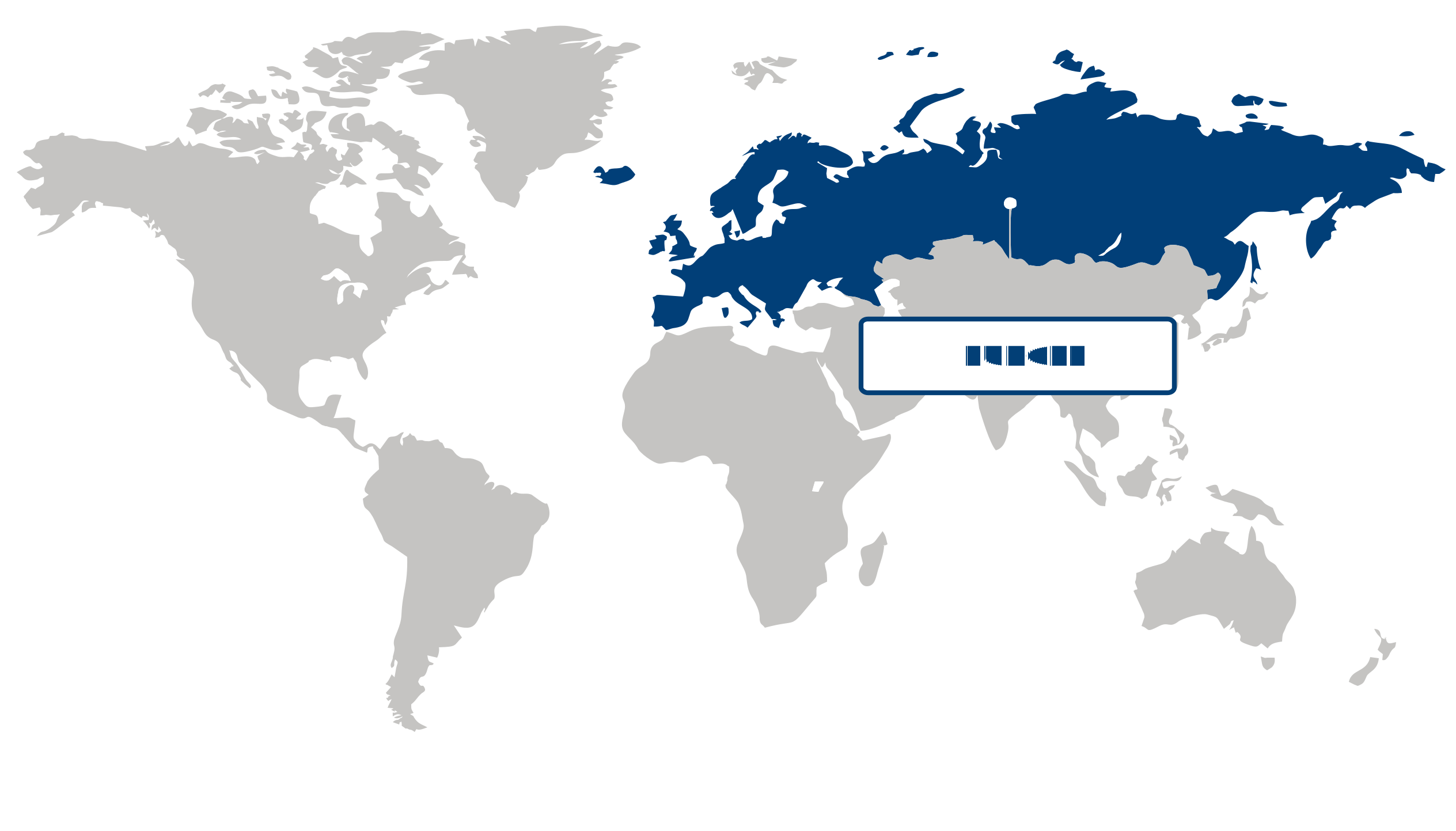
Europe (Largest Region)
Europe accounted for the largest share of the standalone single phase PV inverter market in 2026, supported by strong renewable energy adoption, distributed solar installations, and continued efforts to expand decentralized electricity generation. The region's focus on energy transition, grid resilience, and household-level renewable power systems is encouraging demand for standalone photovoltaic solutions, while supportive regulatory frameworks and growing consumer interest in energy independence are reinforcing inverter deployment.
Asia Pacific (Fastest-Growing Region)
Asia Pacific is projected to experience the fastest growth, supported by expanding solar electrification, rising demand for decentralized power systems, and increasing renewable energy investments across emerging economies. Growing electricity requirements in remote and underserved areas are creating opportunities for standalone photovoltaic systems, while improving solar infrastructure and greater awareness of reliable off-grid power solutions are strengthening demand for single-phase inverters.
| Parameter | North America | Asia Pacific | Europe | Latin America | MEA |
|---|---|---|---|---|---|
| Innovation Hub i Scale Nascent Developing Advanced | |||||
| Cost-Sensitive Region i Scale Low Medium High | |||||
| Regulatory Environment i Scale Restrictive Neutral Supportive | |||||
| Demand Drivers i Scale Weak Moderate Strong | |||||
| Development Stage i Scale Emerging Developing Developed | |||||
| Adoption Rate i Scale Low Medium High | |||||
| New Entrants / Startups i Scale Sparse Moderate Dense | |||||
| Macro Indicators i Scale Weak Stable Strong |
Key Country Insights
United States 🇺🇸
Residential Solar IntegrationThe U.S. emphasizes standalone single phase PV inverters that improve residential solar performance, smart monitoring, and compatibility with home energy storage. Demand is shaped by distributed generation projects and installer preference for flexible, grid-compliant inverter platforms.
Germany 🇩🇪
Grid Compliance FocusGermany prioritizes standalone single phase PV inverters with high conversion efficiency and strict compliance with national grid standards. The country continues to favor advanced inverter features that support rooftop solar optimization and reliable household energy management.
Japan 🇯🇵
Space-Efficient InstallationsJapan focuses on compact standalone single phase PV inverters designed for space-constrained residential installations. Japanese buyers value high reliability, quiet operation, and integration with home energy systems that maximize electricity self-consumption.
South Korea 🇰🇷
Smart Energy ConnectivitySouth Korea promotes standalone single phase PV inverters capable of seamless connectivity with smart home platforms and distributed energy systems. Local demand encourages manufacturers to enhance digital monitoring, remote diagnostics, and operational efficiency.
France 🇫🇷
Rooftop Energy OptimizationFrance supports adoption of standalone single phase PV inverters that improve residential rooftop solar performance while meeting evolving energy efficiency objectives. The French market values products offering simplified installation and dependable long-term operation.
Italy 🇮🇹
Distributed Solar ExpansionItaly encourages standalone single phase PV inverter deployment across residential and small commercial rooftop installations. Italian customers increasingly seek efficient inverter solutions that simplify maintenance while supporting local distributed solar generation initiatives.
Segment Leadership and Growth Trends
Standalone Single Phase PV Inverter Market Share (%), by Application, 2026
Go beyond the chart, access full insights & data tables
Request Free Sample ReportApplication Segment Analysis: Residential (Largest & Fastest-Growing Segment)
The residential segment dominated the standalone single phase PV inverter market, accounting for the largest market share of 69.7% in 2026, while also emerging as the fastest-growing application. Rising adoption of rooftop solar installations, increasing consumer interest in energy independence, and growing awareness of clean energy solutions have significantly strengthened residential demand. Standalone single-phase PV inverters are well suited for household power requirements, offering reliable energy conversion for off-grid and backup applications. Continued investment in residential renewable energy systems and decentralized power generation further supports the segment's leading position.
Product Segment Analysis: String (Largest Segment) vs Micro (Fastest-Growing Segment)
The string inverter segment held the largest share of the market in 2026. String inverters remain widely preferred because they provide a cost-effective and efficient solution for residential and small commercial solar installations. Their straightforward installation, proven reliability, and ability to manage multiple solar modules through a single inverter have contributed to broad market acceptance and sustained leadership.
The standalone single phase PV inverter market is experiencing the fastest growth in the micro inverter segment. Micro inverters are gaining popularity because they optimize the performance of individual solar panels, improving energy generation in installations affected by partial shading or varying panel orientations. Increasing demand for higher system efficiency, easier scalability, and improved monitoring capabilities is driving the rapid adoption of this product category.
Nominal Output Power Segment Analysis: 3 - 33 kW (Largest & Fastest-Growing Segment)
The standalone single phase PV inverter market was led by the 3–33 kw nominal output power segment in 2026, which also represented the fastest-growing category. This power range is ideally suited for residential properties, small commercial establishments, and other distributed energy applications requiring dependable electricity generation without excessive system complexity. Its versatility, compatibility with a broad range of solar installations, and ability to balance performance with installation efficiency have supported widespread adoption. As decentralized solar power systems continue to expand across residential and light commercial sectors, demand for inverters within this output range remains particularly strong.
| Segment | Sub-Segment | Largest Segment | Fastest Growing |
|---|---|---|---|
| Application | Residential, Commercial & Industrial | Residential | Residential |
| Product | String, Micro | String | Micro |
| Nominal Output Power | ≤ 0.5 kW, 0.5 - 3 kW, 3 - 33 kW, 33 - 110 kW | 3 - 33 kW | 3 - 33 kW |
Unlock insights tailored to your business with our bespoke market research solutions.
Click to get your customized report now.
Competitive Landscape and Market Positioning
Major players in the standalone single phase PV inverter market:
- SMA Solar Technology AG (Germany)
- Growatt New Energy Technology Co., Ltd. (China)
- Ginlong Technologies (Solis) (China)
- INVTSolar (INVT) Co., Ltd. (China)
- Kirloskar Solar Technologies Pvt. Ltd. (India)
- Statcon Energiaa Pvt. Ltd. (India)
- Eastman Auto & Power Ltd. (India)
- Sunway Solar Co., Ltd. (China)
- Tanfon Solar Co., Ltd. (China)
- Guangdong Prostar New Energy Technology Co., Ltd. (China)
Product differentiation in the standalone single phase PV inverter market is increasingly influenced by reliability in off-grid environments, encouraging manufacturers to refine power conversion efficiency, battery compatibility, and intelligent energy management capabilities. Competitive momentum is shifting toward solutions that simplify installation while supporting a wider range of renewable energy configurations across residential and remote applications. Suppliers are also placing greater emphasis on durable designs and adaptive control features that enable stable operation under varying load conditions, reducing reliance on purely price-based competition.
| Company | Market Share | Company Revenue | Revenue CAGR (%) | Product Portfolio | Geographic Presence | Innovation / R&D Focus | Strategic Developments |
|---|---|---|---|---|---|---|---|
| SMA Solar Technology AG (Germany) | |||||||
| Growatt New Energy Technology Co. Ltd. (China) | |||||||
| Ginlong Technologies (Solis) (China) | |||||||
| INVTSolar (INVT) Co. Ltd. (China) | |||||||
| Kirloskar Solar Technologies Pvt. Ltd. (India) | |||||||
| Statcon Energiaa Pvt. Ltd. (India) | |||||||
| Eastman Auto & Power Ltd. (India) | |||||||
| Sunway Solar Co. Ltd. (China) | |||||||
| Tanfon Solar Co. Ltd. (China) | |||||||
| Guangdong Prostar New Energy Technology Co. Ltd. (China) |
Industry Development/News
| Company Name | Date | Key Development |
|---|---|---|
| Livguard | Oct-24 | Livguard introduced the Hybrid and Off-Grid series, a new line of high-frequency solar inverters utilizing transformer-less technology. This launch enhances system efficiency, reliability, and form-factor compactness, reinforcing the company's competitive positioning and technology adoption in the solar inverter market. |
| Shenzhen Huangjintai Electronics | Apr-24 | Shenzhen Huangjintai Electronics announced the establishment of a new manufacturing facility dedicated to single-phase hybrid solar inverters. These units integrate solar inverter and charge controller functions to support both grid-connected and off-grid operations, expanding the company's production capacity and technological capabilities within the renewable energy sector. |
Customize Your Report
Explore examples of how this report can be tailored to different research needs, including custom segments, additional topics or chapters, and related reports. Click a section of the wheel or its numbered marker to explore the available options.
Standalone Single Phase PV Inverter Market — Custom Segments
| Segment | Sub-Segment |
|---|---|
| Battery Compatibility | Lead-acid Battery Compatible, Lithium-ion Battery Compatible, Multi-chemistry Compatible |
| Installation Configuration | Rooftop Systems, Ground-mounted Systems, Portable Systems |
| Sales Channel | Direct Sales, Distributor & Wholesaler, Online Retail |
Standalone Single Phase PV Inverter Market — Custom TOC
| Custom Chapter | Chapter Details |
|---|---|
| Residential Solar System Economics |
|
| Inverter Distribution Channel Strategy |
|
| Residential Solar Financing Landscape |
|
Need a different cut of the data?
Request Custom ResearchHow much is the standalone single phase PV inverter market worth?
What is the anticipated CAGR of the standalone single phase PV inverter industry?
How is the demand for energy independence influencing the standalone single phase PV inverter market?
Why are off-grid electrification initiatives accelerating standalone single phase PV inverter deployment?
Why is the residential segment leading the standalone single phase PV inverter market?
Why are micro inverters gaining popularity in the market?
Why does Europe hold the largest share of the standalone single phase PV inverter market?
What is driving the fastest growth of standalone single phase PV inverters in Asia Pacific?
What are the key competitors in the standalone single phase PV inverter landscape?
Our Clients
"The information presented in the report was genuinely insightful. The data was clear and easy to understand, which made it much easier to interpret the findings."
Amara Raja Group
"The responsiveness and professionalism exhibited by the team were exemplary. They were readily available to address queries, provide clarifications, and offer additional insights."
ONGC
"The reports offered a comprehensive analysis of various segments within the market. The detailed insights into market trends, and regulatory landscapes were excellent."
TotalEnergies
Our Research Team & Methodology
Every Fundamental Business Insights report is built by a dedicated vertical research team, validated through a structured primary-and-secondary methodology, and reviewed for accuracy before it reaches you.
Research Team Overview
Prepared by the Energy & Power Research Team
Delivery
Published
Demand
Available
Support
Trust & Compliance
Research Intelligence
| Source | Reference |
|---|---|
| International Energy Agency (IEA) | www.iea.org |
| U.S. Energy Information Administration (EIA) | www.eia.gov |
| International Renewable Energy Agency (IRENA) | www.irena.org |
| International Electrotechnical Commission (IEC) | www.iec.ch |
| International Organization for Standardization (ISO) | www.iso.org |
| IEEE | www.ieee.org |
| CIGRE (International Council on Large Electric Systems) | www.cigre.org |
| World Energy Council (WEC) | www.worldenergy.org |
| U.S. Department of Energy (DOE) | www.energy.gov |
| International Atomic Energy Agency (IAEA) | www.iaea.org |
| American Petroleum Institute (API) | www.api.org |
| Society of Petroleum Engineers (SPE) | www.spe.org |
| Hydrogen Council | hydrogencouncil.com |
| Battery Council International (BCI) | batterycouncil.org |
| Global Wind Energy Council (GWEC) | gwec.net |
| SolarPower Europe | www.solarpowereurope.org |
| World Bioenergy Association (WBA) | worldbioenergy.org |
| International Hydropower Association (IHA) | www.hydropower.org |
| Edison Electric Institute (EEI) | www.eei.org |
| National Renewable Energy Laboratory (NREL) | www.nrel.gov |
Research Workflow & Quality Assurance
Data Collection
Verified information gathered through primary and secondary research.
Data Triangulation
Cross-validation using multiple independent data sources.
Forecast Modelling
Market estimates developed using historical trends and analytical models.
Analyst Validation
Findings reviewed by domain experts for accuracy and consistency.
Editorial & Quality Review
Final editorial, quality, and compliance checks before publication.
Final Publication
Released after successful completion of the internal review process.
Report Coverage
📊 Market Assessment
- Market Size & Forecast
- Market Segmentation
- Regional Analysis
- Growth Drivers & Challenges
- Market Dynamics
🏢 Competitive Intelligence
- Competitive Landscape
- Company Profiles
- Competitive Benchmarking
- Mergers & Acquisitions
- Market Share Analysis or Key Company Strategies
🔍 Strategic Analysis
- Value Chain Analysis
- Porter's Five Forces
- PESTLE Analysis
- Pricing Trends
- Supply-Demand Analysis
🚀 Future Outlook
- Technology Landscape
- Regulatory Landscape
- Investment & Funding Landscape
- Emerging Opportunities
- Future Market Outlook
Have a question about this report or need a custom scope?
Request Customization